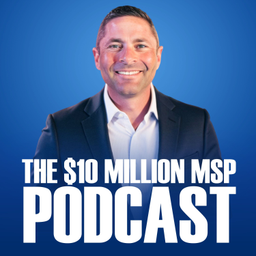
The $10 Million MSP Podcast dives into the real stories of MSP leaders who have gone beyond 10 million. How they built teams, created systems and turned their businesses into valuable wealth-building assets. Join Brian Hoppe, Strategic Coach to MSPs, as he sits down with leaders of $10M+ MSPs to unpack the inflection points that matter – From the personal stories of MSP leaders to key fundamentals like culture, operational maturity and driving profitability. This isn’t another MSP podcast about tools and tech. On The $10 Million MSP Podcast you’ll find behind the scenes conversations with leaders that have built thriving MSPs – their biggest wins, their toughest lessons and practical advice that you can use now. If you’re an MSP owner who knows that growth starts from within, that mindset, leadership and strategy, align to create both wealth and meaning, then this show is for you. New episodes are released every other week!
$7M to $29M: What Changed When He Stopped Doing It All w/ Bruce Nelson
Can your MSP scale without you?
Take the free MSP Maturity Assessment.
brianhoppe.com/assessment
Giving up control is uncomfortable for most MSP owners. For Bruce Nelson, it became one of the biggest drivers of growth.
Bruce, President of Vertilocity, joins Brian Hoppe to explain how the business grew from roughly $7 million in revenue to nearly $29 million, with a $35 million target ahead.
They discuss joining a larger CPA firm, using acquisitions to add new capabilities, and building a leadership team that could run the day-to-day without everything flowing through Bruce.
Bruce also shares why culture remains his responsibility, how Vertilocity evaluates potential acquisitions, and why AI could significantly change the skills, pricing models, and services MSPs need over the next several years.
In this episode:
Why giving up control can accelerate MSP growth
Growing from roughly $7 million to nearly $29 million
What Vertilocity looks for when acquiring another MSP
How joining a larger organization changed Bruce’s role
Building leaders who can solve problems without the owner
Why culture is one responsibility Bruce will not delegate
How AI could reshape the MSP business model
Key Moments
0:00 - Introduction
1:07 - Meet Bruce Nelson
2:01 - Why giving up control matters
4:01 - Building the original MSP
8:15 - Joining HBK and accelerating growth
13:21 - Vertilocity’s acquisition strategy
22:20 - Growing inside a larger organization
30:28 - Building a remote company and leadership team
37:27 - Getting Bruce out of the day-to-day
42:06 - Why culture stays with the leader
50:38 - How AI could reshape MSPs
54:36 - Bruce’s biggest leadership mistake
56:37 - Rapid-fire questions
Connect
Brian Hoppe:
https://brianhoppe.com/
https://www.linkedin.com/in/brianhoppe/
Bruce Nelson:
https://vertilocity.com/
https://www.linkedin.com/in/brucenelsonvs/
https://www.linkedin.com/in/brucenelsonvs/
21 Sept 2026
From $10M to $175M: What Changes When an MSP Really Scales w/ Reed Wilson
Can your MSP scale without you?
Take the free MSP Maturity Assessment.
brianhoppe.com/assessment (http://brianhoppe.com/assessment)
Private equity is often treated like the enemy of MSP owners. Reed Wilson once saw it that way too.
Reed, CEO of Courser, joins Brian Hoppe to explain how the right private equity partnership helped turn a $10 million MSP into a $175 million organization with approximately 650 employees and 25 acquisitions.
They discuss why Courser keeps its local MSP brands, what changes after an acquisition, and why the skills needed to build an MSP are not always the same skills needed to scale one.
Reed also breaks down Courser’s approach to organic growth, board management, leadership hiring, and using machine learning to identify at-risk clients before they churn.
In this episode:
What MSP owners misunderstand about private equity
How recurring revenue helped Reed’s MSP reach $10 million
Why Courser preserves the local brands it acquires
How Courser transforms a new MSP after an acquisition
What it takes to manage an MSP with 650 employees
How machine learning reduced churn among at-risk clients
Why builders are not always the right people to scale a company
For MSP owners considering private equity, acquisitions, or their own role in the next stage of the business, this conversation offers a candid look at what changes when an MSP grows beyond the founder.
Key Moments
0:00 - Introduction
1:07 - Meet Reed Wilson
1:25 - What MSP owners get wrong about private equity
5:20 - Building an MSP from the ground up
8:54 - Moving from project work to recurring revenue
12:29 - Why Reed finally considered private equity
15:33 - Scaling Courser to $175 million
19:40 - Transforming an MSP after an acquisition
27:15 - Learning to work with a board
30:10 - The difference between builders and scalers
37:03 - Building an organic growth engine
40:07 - Using machine learning to reduce client churn
46:24 - Reed’s biggest leadership mistakes
50:05 - Leadership lessons and rapid-fire questions
54:59 - Where to connect with Reed Wilson
Connect
Brian Hoppe:
https://brianhoppe.com/ (https://brianhoppe.com/)
https://www.linkedin.com/in/brianhoppe/ (https://www.linkedin.com/in/brianhoppe/)
Reed Wilson:
https://www.linkedin.com/in/sreedwilson (https://www.linkedin.com/in/sreedwilson)
https://www.gocourser.com/ (https://www.gocourser.com/?utm_source=chatgpt.com)
7 Sept 2026
The $18M MSP Bottleneck Was The CEO w/ Clay Harris
Can your MSP scale without you?
Take the free MSP Maturity Assessment.
brianhoppe.com/assessment (http://brianhoppe.com/assessment)
Hiring a second-in-command does not remove the owner bottleneck if every important decision still runs through the owner.
Brian Hoppe sits down with Clay Harris, former CEO of WorkSmart and Certified EOS Implementer, to discuss the systems, leadership, and personal decisions behind growing an MSP from its earliest days to $22 million in revenue and more than 100 employees.
WorkSmart began in 2001 with a group of recent college graduates selling IT services for $40 an hour. Over the next two decades, the company built recurring revenue, completed eight acquisitions, expanded into new markets, and eventually used EOS to break through a ceiling at roughly $5 million.
Clay explains why founders often hold onto responsibilities long after the business has outgrown their involvement. In his case, he was still personally ordering millions of dollars in hardware while serving as CEO of an $18 million company.
He also shares what it actually takes to empower an integrator, why handing someone a messy business is not delegation, and why a professionally managed MSP must give its leadership team real authority instead of forcing every decision back through the founder.
In this episode:
Why MSP owners create too much chaos or wait too long to act
How WorkSmart grew to $22 million through organic growth and acquisitions
Why a well-run company is already being built to sell
What founders must do before hiring professional management
Why integrators fail when owners refuse to release control
How EOS helped WorkSmart triple its monthly recurring revenue
What MSP owners should consider before selling or stepping away
If your MSP has outgrown the way you currently lead it, this conversation will help you create the clarity, accountability, and leadership structure required for the business to operate without everything depending on you.
Key Moments
0:00 - Introduction
1:07 - Meet Clay Harris
1:59 - What MSP owners get wrong about growth
3:38 - Building WorkSmart from the ground up
7:48 - Growing the MSP to $22 million
10:28 - Organic growth and eight acquisitions
11:46 - Building an MSP to own or sell
14:52 - Preparing the business for professional management
17:19 - Why founders struggle to let go
19:53 - How Clay became his company’s bottleneck
21:22 - Delegating without taking the work back
22:33 - What a true integrator does
25:18 - Finding an identity beyond the MSP
27:48 - Why remaining an owner did not work for Clay
30:19 - Finding purpose after an exit
35:15 - A great life does not require selling the company
37:15 - How EOS changed WorkSmart
39:26 - Growing MRR from $340,000 to $1 million
42:08 - The three things every entrepreneur needs
44:16 - Clay’s biggest leadership mistake
47:47 - Where to connect with Clay Harris
Connect
Brian Hoppe:
https://brianhoppe.com/ (https://brianhoppe.com/)
https://www.linkedin.com/in/brianhoppe/ (https://www.linkedin.com/in/brianhoppe/)
Clay Harris:
https://clayharris.com/ (https://clayharris.com/?utm_source=chatgpt.com)
https://implementer.eosworldwide.com/clay-harris/ (https://implementer.eosworldwide.com/clay-harris/?utm_source=chatgpt.com)
Contact The $10 Million MSP Podcast
Guest appearances
Books guests
Based on episode analysis; this does not confirm that the show is currently accepting guests.
Host of The $10 Million MSP Podcast?
Claim your podcast to manage its listing and keep your show details accurate.
Pod Engine is an independent podcast discovery and analytics service and is not affiliated with or endorsed by this podcast. Artwork and show content belong to their owners. Full legal notice.
Explore this show Podcast research with Pod Engine