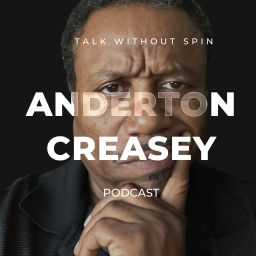
The goal of the Anderton Creasey Show is to be a compelling and thought-provoking podcast that delves deep into the myriad of current affairs impacting the lives of everyday Americans. Hosted by an insightful and engaging presenter, the show provides a unique blend of serious analysis and a humorous take on the often absurd world of politics and community leadership. In each episode, Anderton Creasey dissects the latest news and events, unafraid to question the decisions and motivations of those in power. We bring a fresh perspective to discussions, encouraging listeners to think critically.
Uncover the chilling reality of Jim Crow injustice and the systemic devaluation of Black lives, particularly young Black women, through the tragic story of Hattie McCray.
In this episode, we delve into the case of 14-year-old Hattie, who was killed by a white police officer in segregated New Orleans in 1930 after she refused his repeated sexual advances.
Her death starkly illustrates the pervasive sexualized violence faced by Black women and girls by white men who often acted with impunity.
Hattie's case revealed the systemic failure of the legal system to hold law enforcement accountable for violence against Black individuals; between 1920 and 1945, in Orleans Parish, grand juries refused to indict police officers in an alarming 95 percent of homicide cases involving Black victims.
While her killer, Charles Guerand, was initially convicted in a rare outcome for the era, the sources argue this was more about preserving the image of white authority than valuing Hattie's life.
The conviction was ultimately undermined through legal maneuvers, leading to a reduced sentence and minimal time served, a process characterized as "Justice Mocked".
Explore the societal complicity highlighted by bystander inaction at the time of the crime.
Learn about how some media accounts devalued Hattie's experience and pain, framing the killing as self-defense and denying her full personhood.
We also touch upon the tragic irony that Hattie was truly believed only after her death, as her lifeless body served as undeniable evidence against racist stereotypes.
Despite the systemic failures, Hattie's story spurred community activism in New Orleans, with organizations like the NAACP, the Federation of Civic Leagues, and the Louisiana Weekly newspaper forming a coalition to support legal action and demand justice.
Her case became a symbol of Black womanhood in need of protection and is remembered today as an example of the historical struggle against racial and gendered violence, contributing to contemporary movements like #SayHerName.
This episode bears witness to Hattie's life and legacy, ensuring her story is not forgotten.
25 Apr 2025
East St. Louis Massacre: From 1917 Racial Violence to Today's Systemic Racism & Project 2025
Explore the hidden history of the 1917 East St. Louis Massacre, a bloody riot that resulted in the massacre of dozens of African Americans by white mobs.
This historical event, though often overlooked, serves as a chilling blueprint for systemic oppression that continues to impact Black America today. While the physical scars have faded, the systems it reinforced—economic inequality, segregation, and racial violence—still shape contemporary struggles.
This podcast delves into the causes and immediate impacts of the 1917 massacre, including labor competition and racial animosity. We then trace the direct connections to modern-day challenges, uncovering how historical trauma informs contemporary issues such as the racial wealth gap, ongoing segregation, the school-to-prison pipeline, and police violence.
Crucially, we examine how the legacy of East St. Louis resonates in current policy debates, including the threats posed by Project 2025 to economic justice, education, civil rights rollbacks, and environmental justice in Black communities.
But this is also a story of resilience and resistance. From the powerful Silent Protest Parade of 1917 organized by the NAACP to modern movements fighting voter suppression, environmental racism, and economic inequality, we highlight the enduring fight for justice.
Tune in to understand how a massacre from over a century ago echoes in the lives of Black Americans right now. Learn from the past to inform the present and empower the fight for a more equitable future.
23 Apr 2025
Black Single Mothers: Poverty, Criminalization, and the Path to Empowerment
Explore the critical challenges facing Black single mothers and the alarmingly high rates of poverty within their households.
This podcast delves into the deep-rooted causes, including the historical legacy of slavery and systemic racism, and the devastating impact of the criminalization of Black men through mass incarceration on family structures and maternal mental health.
We examine the vital role of employment stability and educational attainment as pathways to economic security and empowerment for Black single mothers and their children. Understand the influence of political forces and policy proposals like Project 2025 and how they threaten or support Black families.
Through insightful analysis, historical context, and discussions on potential solutions, this podcast aims to raise awareness, foster action, and help break the cycle of poverty in Black single-mother households, building a more equitable future for generations to come.
14 Mar 2025
Elizabeth Eckford and the Little Rock Central High School Integration Crisis
Dive into the powerful story of Elizabeth Eckford and the Little Rock Central High School integration crisis. This podcast episode explores the pivotal moment in the Civil Rights Movement when fifteen-year-old Elizabeth Eckford faced a hostile white mob alone.
Learn about:•
Elizabeth Eckford's incredible bravery and resilience as one of the Little Rock Nine, the first African American students to integrate Little Rock Central High School in 1957. Her composure amidst threats and racial slurs became an iconic symbol.•
The fierce resistance to desegregation in the South following the Brown v. Board of Education ruling. Discover how Arkansas Governor Orval Faubus deployed the National Guard to block the students' entry.•
President Eisenhower's intervention, federalizing the National Guard and sending the 101st Airborne Division to ensure the students could enter the school.•
The double standards and unfair expectations placed upon Elizabeth Eckford as a Black teenager compared to the white protesters.•
The psychological impact of racism and the long-term trauma Eckford endured, including PTSD.•
The significance of the iconic photograph capturing Eckford's solitary confrontation with the mob and how it galvanized the nation.•
The concept of "understanding over absolution" in relation to Eckford's complex relationship with Hazel Bryan Massery, the white student seen shouting at her in the photo.•
The ongoing impact of this history and its relevance to contemporary issues of inequality and discrimination.•
Eckford's lasting legacy as a "living symbol of strength and perseverance" and her receipt of the Congressional Gold Medal in 1999.
This episode delves into the systemic injustice, personal courage, and lasting lessons of the Little Rock integration crisis, offering valuable insights into the fight for civil rights.
#ElizabethEckford, #LittleRockNine, #LittleRockCentral HighSchool, #CivilRightsMovement, #Desegregation, #Integration, #Racism, #SystemicInjustice, #Bravery, #Resilience, #1957, #Arkansas, #OrvalFaubus, #DwightD.Eisenhower, #CongressionalGoldMedal, #AmericanHistory
13 Mar 2025
Black Women: Pausing for Revolutionary Rest
Tired of the myth of the "Strong Black Woman"? This podcast dives deep into the systemic barriers and societal expectations that uniquely impact Black women's well-being. We unpack the harmful archetype demanding emotional restraint, extreme independence, and constant caretaking, and explore how it hinders essential self-care practices.
Discover the historical context of energy exploitation faced by Black women, who have long served as the "moral compass and revolutionary vanguard". We examine how their energy has been "consistently extracted without reciprocity or acknowledgement," leading to a deeply ingrained expectation of constant output and resilience.
We tackle crucial questions like:•
How do financial constraints due to economic inequities and lack of time due to multiple responsibilities act as barriers to self-care?•
What are the impacts of ingrained societal expectations beyond the "Strong Black Woman" myth?•
Why is prioritizing rest considered a "revolutionary act" for Black women?•
What does "reclamation of energy" truly mean for Black women's well-being and collective power?•
How does "intersectional invisibility" compound the challenges Black women face in accessing self-care and achieving overall well-being?
Join us as we challenge these norms, explore the revolutionary potential of rest, and redefine strength on Black women's own terms.
This podcast is a space for understanding, empowerment, and the crucial reclaiming of energy for Black women everywhere.
#Black women, #self-care, #well-being, #StrongBlackWomanmyth, #systemicbarriers, #societalexpectations, #historicalexploitation, #energyreclamation, #restasresistance, #intersectionality, #mentalhealth, #emotionalhealth, #radicalself-care.
11 Mar 2025
Celebrating Women's History Month
This podcast episode will illuminate how March 8th, as International Women's Day, served as a foundational event around which the broader recognition of women's history in the United States was organized, ultimately paving the way for the establishment of Women's History Month. Understand the key moments and dedicated individuals who championed the recognition of women's vital roles in shaping our nation. Tune in to learn:
The grassroots beginnings of Women's History Week in Santa Rosa, California.
The pivotal role of Molly Murphy McGregor and the Sonoma County Commission on the Status of Women.•
The strategic connection between Women's History Week and International Women's Day (IWD) on March 8th.•
How President Jimmy Carter's proclamation elevated the observance to a national level.•
The first congressional action that formalized Women's History Week.•
The foundational influence of IWD on the development of women's history recognition in the US.
Don't miss this engaging exploration of the history behind Women's History Month and the enduring significance of March 8th!
Subscribe now to delve into more fascinating historical journeys.
10 Mar 2025
Black Land Loss in America: The Reels Family’s Fight for Justice in Silver Dollar Road
The issue of Black land loss in the United States is a critical yet often overlooked consequence of systemic racism, legal loopholes, and economic exclusion. Silver Dollar Road, a powerful documentary by Raoul Peck, sheds light on this crisis through the story of the Reels family and their relentless battle to retain their ancestral land.
A key driver of Black land dispossession is heirs' property laws—policies that come into play when landowners pass away without a will, resulting in fragmented ownership. These laws create vulnerabilities that allow developers and outside interests to seize land from Black families, perpetuating generational wealth loss.
Compounded by historical discrimination, exclusion from financial and legal systems, and the commodification of land, these challenges have continuously undermined Black Americans' pursuit of economic stability and the so-called "American Dream."
The Reels family's story is one of resilience, resistance, and the unyielding fight to preserve their heritage. Their struggle against systemic oppression represents a larger narrative of Black land ownership in America—one deeply tied to culture, identity, and historical justice. Through the lens of colonialism and capitalism, Silver Dollar Road underscores the urgent need to protect Black landownership and recognize its significance in the broader fight for racial and economic justice.
7 Mar 2025
The Power of Boycotts: Civil Rights Strategy and Lasting Impact
This episode delves into the strategic use of boycotts by the Civil Rights Movement as a powerful tool against racial inequality. By targeting economic structures, these boycotts pressured white-owned businesses, driving social and legislative change.
Key historical boycotts—including Montgomery, Baton Rouge, Claiborne, and Chicago—are examined to reveal the tactics used, their economic impact, and their role in shaping future policies. These grassroots efforts not only disrupted unjust systems but also laid the groundwork for legal validation, influencing subsequent civil rights legislation.
Additionally, the episode explores the Leadership Council for Metropolitan Open Communities and its role in advancing fair housing policies. Through advocacy and mobility programs, the council fought to dismantle housing discrimination, further expanding the movement’s reach.
The lessons from these boycotts continue to inspire modern social justice movements, showcasing the enduring power of economic resistance in the fight for equality.
4 Mar 2025
The Complexities of DEI initiatives
This episode explores the complexities of Diversity, Equity, and Inclusion (DEI) initiatives. It examines the reasons for DEI's implementation, highlighting historical inequalities and the need for fair opportunities in workplaces and society. Statistics reveal ongoing disparities in discrimination, leadership representation, and economic consequences. We analyze how the majority community sometimes circumvents DEI efforts in contracting. Ultimately, the sources investigate why some groups seek to dismantle DEI and civil rights infrastructure, linking it to power dynamics related to economic, political, and cultural dominance, while also suggesting alternatives focused on economic empowerment and stronger civil rights protections.
13 Feb 2025
Kendrick Lamar's Super Bowl Halftime Show
Welcome to the Anderton Creasey Show!
Ready to dissect the strategy, power, and impact behind the headlines?
This episode isn't just about entertainment; it's a masterclass in branding, strategic marketing, and business positioning, all inspired by Kendrick Lamar's Super Bowl halftime show. Some saw art, others controversy, but we see a blueprint for entrepreneurs, career professionals, and business owners. Learn how to leverage visibility, own your message, and turn cultural moments into business opportunities. Discover the power of cultural marketing, how to turn controversy into currency, and why building a legacy brand is more critical than chasing fleeting trends. From the Super Bowl stage to your personal brand, understand how to command attention, disrupt the status quo, and create lasting impact. Tune in to transform your approach to marketing, branding, and business growth. This is your guide to takingyour Super Bowl moment seriously.
Join Alex & Andy as they extract real-life lessons to grow ourselves and our businesses.
6 Jan 2025
Rapist Get to Choose the Mother of Their Child
Why do women have to suffer more than a rapist?
6 Jan 2025
Women in the Bible
What happens to equality for women?
6 Jan 2025
What the Cuss??!
2 Jul 2024
Rapist get to choose their baby mama.
Rapist get to choose the baby momma.
9 Jun 2024
The Anderton Creasey Show
Why we do this show.
Reach and audience
Public platform figures. Ratings count people who left a rating, not total listeners.
Spotify
5.0 / 5
2 ratings
Contact The Anderton Creasey Show
Guest appearances
Does not typically book guests
Based on episode analysis; this does not confirm that the show is currently accepting guests.
Host of The Anderton Creasey Show?
Claim your podcast to manage its listing and keep your show details accurate.
Pod Engine is an independent podcast discovery and analytics service and is not affiliated with or endorsed by this podcast. Artwork and show content belong to their owners. Full legal notice.
Explore this show Podcast research with Pod Engine