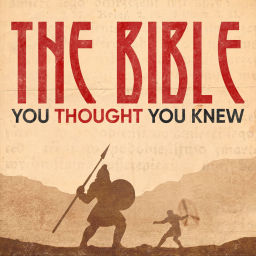
My name is Frank Spina and during my 46 years as a professor of Old Testament and Biblical Theology, I noticed that most people only know interpretations of the Bible, rather than the scripture itself.
In this podcast, I will be your teacher and guide through the Bible that not many people are familiar with.
As we unpack quintessential Biblical stories, you will gain an unparalleled understanding of the scripture and discover a new way to think about the bible you thought you knew.
Be sure to subscribe and tune in each week!
Publisher
CTR Network
Category
education · religion & spirituality · society & culture
In this podcast I deal with the first part of verse 1 of 1 Samuel 4 (the so-called verse 1b). Translators and commentators place this verse as the final verse of 1 Samuel 3. This is because we are told that the word of Samuel came to all Israel, but Samuel says not a word. Plus, he does not even appear in the next story. I argue that is a rhetorical device to have us read the story of the capture of the Ark of the Covenant (1 Samuel 4—6) as a “prophet’s pregnant pause” hovers over the narrative. That strategy intensifies the fact that God had raised up a prophet for Israel, but Israel neglected prophetic ministry for twenty years. Twenty years later (according to 1 Samuel 7) the prophet Samuel finally spoke!
26 Dec 2024
Saul According to 1 Chronicles 10
In this story the totality of Saul’s reign is recorded. It is significantly shorter than Saul’s story as narrated in 1 Samuel 9—31. Plus, the story in 1 Chronicles 10 is uniformly negative. It tells about Israel’s losing a battle to the Philistines, about the death of Saul’s three sons, and his being wounded by Philistine archers. Trying to avoid humiliation, Saul orders his armor-bearer to kill him, something that the man is unable to do. So, Saul kills himself (immediately afterwards, the armor-bearer kills himself). The Philistines find the corpses of Saul and his sons; they desecrate Saul’s corpse by decapitation. Eventually, Saul’s and his sons’ bodies are rescued and buried properly in Israelite territory. 1 Chronicles 11 begins the story of King David’s reign.
26 Dec 2024
Psalm 80
In this psalm, which is technically a communal lament, the psalmist asks God several times to save the people (i.e., Israel). At first, it is unclear from what the people are to be saved. Eventually, it is either from a severe military defeat or the Exile. Several times in this psalm, God is implored to make His face shine, positively on Israel and negatively on Israel’s enemies. Toward the end of the Psalm, the psalmist points out that should salvation appear in the form of victory, God will be invoked.
Reach and audience
Public platform figures. Ratings count people who left a rating, not total listeners.
Apple Podcasts (US)
4.9 / 5
94 ratings
Spotify
5.0 / 5
5 ratings
Podcast Authority Score: 56 / 100
A composite of feed quality, social presence, YouTube performance and engagement. Read the methodology.
Quality
79
Social presence
0
YouTube
0
Engagement
85
Contact The Bible You Thought You Knew
Guest appearances
Books guests
Based on episode analysis; this does not confirm that the show is currently accepting guests.
Host of The Bible You Thought You Knew?
Claim your podcast to manage its listing and keep your show details accurate.
Pod Engine is an independent podcast discovery and analytics service and is not affiliated with or endorsed by this podcast. Artwork and show content belong to their owners. Full legal notice.
Explore this show Podcast research with Pod Engine