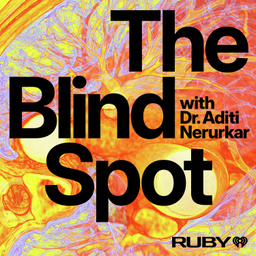
Every misdiagnosis–or missed diagnosis–has a story. The Blind Spot goes looking for it. Each episode goes back to the beginning, as physicians revisit the cases that kept them up at night and patients recount the persistence it took to finally break through a diagnostic wall. The clues were often there. The question is why no one connected them.
From systemic biases where a woman's chronic pain is dismissed as "emotional," to conditions that present differently across diverse patient populations, to the incredible administrative pressures facing providers doing their best.
The Blind Spot reveals what it takes to see what medicine almost missed — and what it costs when we aren’t seeing each other clearly across the exam room.
The Cost of Waiting: Dr. Brad Rovin on IgA Nephropathy and the Clinical Consequences of Missed Signals
For years, IgA nephropathy patients with proteinuria between approximately half a gram and a gram a day were considered low risk. Then the UK's RADAR study found that this group still faced about a thirty percent risk of kidney failure within ten years. Dr. Aditi Nerurkar calls it a blind spot created by good news: the science leapt forward, and the exam room has to catch up.
Dr. Brad Rovin, director of the Division of Nephrology at The Ohio State University and co-chair of the KDIGO work group behind the IgA nephropathy guideline, helped write the new guidance. He explains why he now reads risk from trends, not the number of the day. He also explains why "stable" deserves a second look: a patient can lose approximately half their kidney function before their creatinine begins to rise.
Then comes the practical part: how to reopen the conversation with patients who've been managed one way for years. His answer is to tell the truth, then follow it right away with "we have options to treat this." This is the first of two episodes on IgA nephropathy.
See omnystudio.com/listener (https://omnystudio.com/listener) for privacy information.
8 Oct 2026
Doc, What Would You Do?: Dr. Akshay Pendyal on Managing Risk and Making Difficult Calls with Patients
Nothing in medicine is risk-free. Even aspirin, a cornerstone of cardiology, carries a risk. Clinicians are running a risk-benefit calculation constantly. Patients are too. The challenge is making a decision, even though there’s risk, together. Cardiologist Dr. Akshay Pendyal returns to talk with Dr. Aditi Nerurkar about the gap between population risk and the individual patient, why even “sure, let’s run the test just to see” isn’t risk free, and how handing patients the numbers and stepping back isn't gonna cut it. They discuss how, even as doctors, they struggle sometimes with managing risk, data inundation, and what to do next. But ultimately a comfort with uncertainty and the ability to guide a patient in making a plan are just as essential to practicing medicine as anything else.
See omnystudio.com/listener (https://omnystudio.com/listener) for privacy information.
5 Oct 2026
The Blind Spot is BACK for Season 2!
Nobody teaches a class on uncertainty. Nobody hands you a manual for breaking bad news, or for what to say when a patient asks a question you can't answer. Most of the hardest parts of medicine, doctors learn on the job.
The Blind Spot is the podcast for doctors who wish they had more time to talk shop with other doctors. In each episode, Harvard physician Dr. Aditi Nerurkar sits down with a fellow clinician to find one blind spot: a place where a doctor and a patient both mean well and still miss each other. Then they look for a way through it, together.
Delivering hard news. Keeping up with science that moves faster than the guidelines. The admin that eats the day. And a few laughs along the way. Consider it your audible doctor's lounge.
See omnystudio.com/listener (https://omnystudio.com/listener) for privacy information.
8 Sept 2026
Where AI Fits in Medicine with Dr. Robert Wachter
Dr. Robert Wachter has spent his career watching medicine absorb newtechnology, from the paper chart to the electronic record to the current moment with AI. Theprofessor and chair of the Department of Medicine at UCSF sits down with Dr. Aditi Nerurkar towork out where these powerful new tools may be best situated to actually improve care. Forinstance, models flagging elevated breast cancer risk in scans that read as normal. Systemsmatching patients to trials. Possibilities and possible pitfalls abound, but this is an exciting leapindeed. And, for anyone predicting the end of human doctors in the exam room, take note. Dr.Wachter closes on the doorman fallacy, a lesson from 1950s hotels... turns out there are somevery human things no robot can replace.
See omnystudio.com/listener (https://omnystudio.com/listener) for privacy information.
21 Aug 2026
Naming the Fear in the Room with Dr. Lucy McBride
It can be scary to go to the doctor. Patients may be afraid of bad news, of seeming difficult, of taking up too much time. Doctors might feel uncomfortable delivering bad news, or bringing up the cost of care. This very human layer of healthcare is our blind spot.Dr. Lucy McBride, a primary care physician of more than twenty years and author of Beyond the Prescription, argues that fear is inevitable, but not irreducible. Dr. McBride argues for humility, mutual candor, and even a bit of humor as she lays out practical tips and fresh ideas about how to navigate this very ancient divide.Because by pressing beyond fear, doctors can connect cancer patients with resources they didn’t even know were needed; accurately evaluate risk tolerance; and above all form a human connection and achieve better outcomes as true partners.
See omnystudio.com/listener (https://omnystudio.com/listener) for privacy information.
6 Aug 2026
"Second Trope and Go": Dr. Jeremy Faust on the Language of the Handoff
Host Dr. Aditi Nerurkar sits down with Dr. Jeremy Faust, emergency medicine physician at Brigham and Women's Hospital, Harvard Medical School, and editor in chief of MedPage Today, to trace what actually moves (and doesn't) when one clinician hands a patient to the next. They start with the shorthand. A phrase like "second trope and go" compresses an entire risk stratification into four words, and the person receiving that patient has to trust it completely or start the workup over. From there the conversation widens. What does a patient experience on the other side of that same handoff, and what can care providers do make sure patients stay in partnership with their health teams, even across specialties or departments.
See omnystudio.com/listener (https://omnystudio.com/listener) for privacy information.
23 Jul 2026
"The Child Is Your Patient": Andrea Dunlop on the Medical Abuse Hiding in Plain Sight
Most physicians were trained to believe Munchausen by proxy is vanishingly rare. Andrea Dunlop has spent years talking to the clinicians, survivors, and researchers who know otherwise. In this conversation with Dr. Aditi Nerurkar, she makes the case that the condition is far more common than the medical community recognizes, and that the structural reasons physicians miss it are themselves a form of institutional blind spot.
Dunlop, creator of the award-winning podcast "Nobody Should Believe Me" and founder of the nation's only nonprofit dedicated to survivors of this abuse, walks through how the pattern actually appears in a chart, why clinicians are uniquely vulnerable to manipulation by perpetrators, and why a child aging out of pediatric care does not mean they are out of danger. The conversation keeps returning to a single orienting principle: the child is the patient, not the parent. When that distinction gets blurred, the consequences can be fatal.
See omnystudio.com/listener (https://omnystudio.com/listener) for privacy information.
9 Jul 2026
Diagnosis or Identity? Dr. Judith Joseph on Social Media, Self-Diagnosis, and Loneliness
Fifty-two percent of the top-performing TikTok videos about ADHD contain misinformation. That is where this conversation starts. But Dr. Judith Joseph, board-certified psychiatrist, principal investigator, and author of High Functioning, quickly moves it somewhere more complicated: what happens when a diagnosis is not a medical conclusion but a way of belonging?
Patients are arriving in the exam room already labeled because an online community offered an identity at a moment when they needed one. Dr. Judith walks through the Tourette's uptick she observed in post-pandemic adolescents, the adult women grieving years of missed ADHD diagnoses, and the stimulant shortage she sees as a downstream consequence of over-prescription driven by online self-diagnosis.
See omnystudio.com/listener (https://omnystudio.com/listener) for privacy information.
25 Jun 2026
Be the Medicine: Dr. Akshay Pendyal on Placebo, Nocebo, and Trust
Seventy-one percent of Americans trusted doctors and hospitals in January 2020. By January 2024, that number had fallen to forty percent. But the same data shows that eighty-five percent of patients still trust their own physician. Cardiologist Dr. Akshay Pendyal calls medicine the most complex social role in human history, and in this conversation with Dr. Aditi Nerurkar, he makes the case for why. Drawing on the placebo effect, the nocebo effect, the ORBITA trial, and decades of clinical practice, they examine the alchemy of the therapeutic encounter: what patients bring into the exam room, what doctors carry with them, and what the science says happens when those two forces meet.
See omnystudio.com/listener (https://omnystudio.com/listener) for privacy information.
11 Jun 2026
"They Come In Curious": Dr. Thomas VanderMeer on Curiosity, Humility, and the Patient Who's Done the Reading
Host Dr. Aditi Nerurkar sits down with Dr. Thomas VanderMeer, surgical oncologist and interim director of the Upstate Cancer Center at SUNY Upstate Medical University, to trade notes on the real work of caring for the data-informed patient.
They start with a case. A woman with rising ctDNA, no imaging correlate, walking into Tom's office. He thought the conversation would be about the limits of detection. It wasn't. Her question, once he listened for it, was about her children, and whether the same molecular tests could tell her something about their risk. Tom uses the case to make a larger point. The question on the surface is rarely the question the patient actually came in with.
From there, the two doctors get into the practice. The teach-back method as a check on real understanding. The discipline of not looking at your watch, even when the schedule says you should. And the throughline Aditi names back to him by the end of the conversation: open-mindedness and humility, held steady against the rigor of the science.
Pfizer is a non-editorial sponsor of this content.
See omnystudio.com/listener (https://omnystudio.com/listener) for privacy information.
28 May 2026
The Convergence of Technology and Biology: Dr. Nadine Jackson on Keeping Up and Taking Care
Welcome to The Blind Spot. Every misdiagnosis, every missed diagnosis, has a story. This show goes looking for it.
In the premiere episode, host Dr. Aditi Nerurkar sits down with Dr. Nadine Jackson, gastrointestinal medical oncologist at Dana-Farber and associate professor at Harvard Medical School. Their conversation starts with a simple question. What does it actually feel like to practice oncology right now, when the science is moving faster than the guidelines can capture it?
Dr. Jackson is honest about it. Some days exhilarating. Other days exhausting. Most days both. From there, the two doctors move through the systems Dr. Jackson has built to keep up. The three questions she asks before every patient encounter. The mentor who told her "know what we know, start there." The argument running underneath it all: staying current isn't a luxury. It's part of the job. And the system has to make room for that work.
Pfizer is a non-editorial sponsor of this content.
See omnystudio.com/listener (https://omnystudio.com/listener) for privacy information.
21 May 2026
Introducing: The Blind Spot with Dr. Aditi Nerurkar
Every misdiagnosis–or missed diagnosis–has a story. The Blind Spot goes looking for it. Each episode goes back to the beginning, as physicians revisit the cases that kept them up at night and patients recount the persistence it took to finally break through a diagnostic wall. The clues were often there. The question is why no one connected them. From systemic biases where a woman's chronic pain is dismissed as "emotional," to conditions that present differently across diverse patient populations, to the incredible administrative pressures facing providers doing their best. The Blind Spot reveals what it takes to see what medicine almost missed — and what it costs when we aren’t seeing each other clearly across the exam room.
See omnystudio.com/listener (https://omnystudio.com/listener) for privacy information.
Reach and audience
Public platform figures. Ratings count people who left a rating, not total listeners.
Pod Engine is an independent podcast discovery and analytics service and is not affiliated with or endorsed by this podcast. Artwork and show content belong to their owners. Full legal notice.
Explore this show Podcast research with Pod Engine