- 26
- Episodes
- Monthly
- Cadence
- 2026
- First episode
About The Boardroom Coach
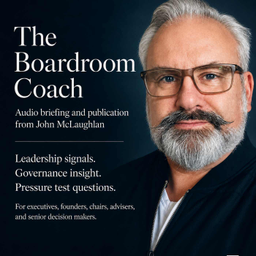
The Boardroom Coach: The audio briefing from John McLaughlan, Non Executive Director, Executive Coach and Board Advisor. Each episode takes one live signal from business, leadership, or organisational life and examines what it really reveals beneath the surface. Not just what happened, but what it means for judgement, accountability, behaviour, and consequence. theboardroomcoach.substack.com (https://theboardroomcoach.substack.com?utm_medium=podcast)
- Publisher
- The Boardroom Coach
- Category
- business · society & culture
- Language
- en
- Explicit
- No
- First episode
- 21 Apr 2026
- Latest episode
- 2 Oct 2026
Latest episodes
26 episodes in the feed.
2 Oct 2026
When AI Starts Acting, Who Is Still Doing the Thinking?
AI is moving from answering questions to taking action. At the same time, organisations may need to pay much closer attention to what happens to human judgement when more of the thinking is delegated to machines. Several developments this week point towards the same emerging tension. AI systems are acquiring greater agency. Research into cognitive offloading is raising questions about what happens when people increasingly delegate parts of their reasoning to AI. And, perhaps tellingly, senior executive development appears to be moving in the opposite direction, towards philosophy, ethics, intellectual challenge and deeper thinking. Taken separately, these look like different stories. Together, they raise a much bigger leadership question. As artificial intelligence becomes more capable of acting, how do organisations ensure that human judgement does not quietly become the thing they automate away? “Intelligence is not Judgement” What’s Happening Reuters reports that OpenAI has introduced autonomous agents (https://www.reuters.com/business/openai-takes-meta-with-always-on-dots-agent-enterprise-ai-push-2026-09-29/) designed to pursue objectives across applications rather than simply respond to individual prompts. The significance is not simply improved automation. It represents another movement from AI as a source of information towards AI as an actor within organisational systems. That creates a different governance problem. An AI that drafts an answer can be checked before anything happens. An AI capable of initiating actions, changing information or progressing work requires organisations to think much more carefully about permissions, visibility, intervention and accountability. A second development provides an interesting comparison. OpenAI and Synopsys have announced work on specialised AI for semiconductor design (https://www.reuters.com/business/synopsys-openai-strike-deal-develop-ai-model-chip-design-work-2026-09-30/). The AI may produce increasingly sophisticated engineering outputs, but those designs will still proceed through established sign-off verification before being accepted as physically valid. There is a valuable distinction here: Generation is not validation. Validation is not authorisation. Authorisation is not accountability. The system may generate the work. Another mechanism establishes whether that work is valid. Someone then determines whether it should be accepted or acted upon. Accountability ultimately remains somewhere within the human organisation. As AI becomes capable of doing more than making recommendations, knowing exactly where those boundaries sit becomes increasingly important. “Recent workplace reporting has also examined whether growing reliance on AI may affect managerial thinking and cognitive independence.” What’s Being Said Much of the current AI governance conversation understandably concentrates on safety, data, permissions and control. But another strand of research is examining what happens to the human side of the relationship. Cognitive offloading is not new. People have always used tools to reduce mental effort. Diaries remember appointments. Calculators perform arithmetic. Search engines retrieve information. Generative AI changes the nature of that relationship because it can increasingly perform elements of analysis, interpretation and reasoning itself. A recent study published in Frontiers in Psychology (https://www.frontiersin.org/journals/psychology/articles/10.3389/fpsyg.2026.1878629/full) examined different forms of AI-assisted cognitive offloading among 589 participants. It found different relationships depending upon whether people retained cognitive agency while using AI or became more dependent upon it. The authors rightly caution against claiming straightforward causation, but the distinction is important. Using AI and delegating judgement to AI are not necessarily the same behaviour. That matters because workplace use is becoming routine. Recent workplace reporting has also examined whether growing reliance on AI may affect managerial thinking and cognitive independence (https://www.hcamag.com/us/news/general/is-ai-making-your-managers-stupid/591775). Managers can now ask AI to interpret information, generate alternatives, construct an argument, challenge a proposal, draft the communication and recommend what to do next. Each individual step can look entirely reasonable. Taken together, however, they raise a difficult question about where the human contribution begins and ends. “A human can remain formally within a decision process while contributing remarkably little independent judgement.” What I’ve Noticed We frequently talk about keeping a human in the loop. That may no longer be sufficient. A human can remain formally within a decision process while contributing remarkably little independent judgement. Imagine an executive receives an AI-generated analysis. The system identifies the problem, interprets the available evidence, generates the alternatives, assesses the risks and recommends a course of action. The executive reads it. It appears persuasive. They approve it. There was a human in the loop. But was there independent human judgement in the loop? The distinction becomes more important as AI becomes more capable. If people repeatedly delegate the uncomfortable cognitive work involved in forming a judgement, something may gradually change. The immediate outputs may actually improve. Decisions may become faster. Analysis may become broader. Communications may become clearer. Nothing necessarily fails. That is precisely why the issue deserves attention. Capabilities generally develop through use. Judgement is unlikely to be an exception. An executive who repeatedly encounters ambiguity, weighs competing evidence, tests assumptions and makes consequential decisions develops something different from an executive who primarily evaluates recommendations that have already been assembled for them. The important question therefore becomes: Does AI challenge human judgement, or gradually replace the need to exercise it? Those are profoundly different uses of the same technology. “Capabilities are develop through use. Judgement is no exception.” What This Means Another development this week makes the timing particularly interesting. The Financial Times has reported growing demand among senior executives for development experiences drawing on philosophy, ethics, history, neuroscience and wider intellectual challenge rather than relying solely on conventional management competencies. There is even experimentation with AI used as a Socratic coach, where its purpose is not to supply the answer but to make the human think more deeply about the question. That shift makes sense. For much of management history, information and expertise were relatively scarce. Leadership development therefore concentrated heavily on transferring knowledge, frameworks and techniques. AI changes that equation. Executives already have access to extraordinary amounts of information. Increasingly they also have access to systems capable of synthesising it, analysing it and recommending what they should do. The scarce commodity may therefore move elsewhere. * Towards the ability to examine those recommendations independently. * To recognise assumptions. * To tolerate contradiction. * To seek disconfirming evidence. * To distinguish confidence from evidence. * To hear dissent without immediately defending an existing position. * And ultimately to decide while retaining responsibility for having made the decision. That creates an interesting paradox. As artificial intelligence becomes more capable, human judgement may become more valuable precisely because intelligence itself becomes abundant. Executive development may consequently move away from simply providing leaders with more answers. Its greater value may lie in creating structured intellectual friction. * Someone introduces another interpretation. * Someone questions the assumption that has quietly become fact. * Someone asks what evidence would cause the executive to change their mind. * Someone prevents an uncomfortable contradiction from being rushed past simply because a plausible answer is already available. That is also where independent executive challenge becomes increasingly important. AI can supply intelligence at a scale no executive coach could realistically attempt to match so there is little value in competing with it there. The more valuable role may be creating the conditions in which executives continue to exercise their own judgement around that intelligence. “Value lies in creating the conditions in which executives continue to exercise their own judgement around available intelligence.” Pressure Test Take one consequential decision in your organisation where AI now contributes to the analysis or recommendation. Before seeing what the AI suggests, could the accountable executive state what they currently believe, why they believe it and how confident they are? Then introduce the AI analysis. If their position changes, could they identify the evidence or argument that caused the change? Could they challenge the recommendation? Could they explain what would make them stop the system acting? And if the AI were wrong, is it completely clear who would remain accountable? Hesitation around those questions does not necessarily indicate poor AI governance. It may reveal something more useful: the organisation has not yet separated intelligence, judgement, authorisation and accountability clearly enough. The next phase of AI will make that distinction increasingly difficult to avoid. The question is no longer simply whether AI can see more, know more or do more. It is whether the people accountable for its actions can still independently judge them. Can you see it? Can you judge it? Can you stop it? And increasingly: Who remains accountable when you don’t? AI can supply intelligence at a scale no executive coach ever could. That makes intelligence a poor place for an executive coach to compete. The more valuable role may be creating the independent friction that prevents intelligence becoming a substitute for judgement. That is how I increasingly think about The Boardroom Coach: independent space for consequential judgement. If your organisation is beginning to wrestle with where human judgement belongs as AI assumes more of the work, our supporting Pathways are designed for those exact conversations. This is a public episode. If you would like to discuss this with other subscribers or get access to bonus episodes, visit theboardroomcoach.substack.com (https://theboardroomcoach.substack.com?utm_medium=podcast&utm_campaign=CTA_1)
24 Sept 2026
Executive Decision-Making When Reality Is Distorted
Senior executives can make entirely rational decisions that still fail when the reality reaching them no longer reflects the organisation they are leading. What happens when good judgement is exercised in a false environment? What’s Happening Some poor executive decisions make complete sense when you understand the environment in which they were made. The information supported the decision, the assumptions appeared reasonable, the executive team discussed the risks and the board asked appropriate questions. Nobody ignored an obvious warning and the governance process worked much as it was designed to work. Yet the decision was still wrong. We tend to examine situations like these by looking for a failure in judgement. Perhaps the executive was overconfident, challenge was weak, the organisation moved too slowly or somebody failed to recognise something that, with hindsight, appears obvious. There is another possibility that deserves more attention. The judgement may have been entirely reasonable, but the environment in which it was exercised was not an accurate reflection of the organisation. That does not require anybody to falsify information or deliberately conceal a problem. The distortion can be much quieter. Information is summarised as it travels, operational complexity is compressed, uncertainty is converted into actions and difficult realities acquire language that makes them manageable. By the time an issue reaches the most senior decision-makers, the individual facts may all be correct while the overall picture they create is incomplete. I explored how that environment can form in Boardrooms: The Eye of the Storm. The central observation was that senior leadership can occupy a strangely calm position while considerable turbulence exists elsewhere in the organisation. Pressure from customers, markets, regulation and delivery converges towards the centre, but what eventually arrives has usually been translated. Dashboards replace stories, percentages replace consequences and operational difficulty arrives accompanied by commentary, ownership and reassurance. Boardrooms: The Eye of the Storm (https://agilemindsetmastery.com/blog/boardrooms-the-eye-of-the-storm?utm_source=chatgpt.com) That translation is necessary. Senior teams could not function if every piece of operational noise arrived untouched. The difficulty begins when compression starts to change meaning. At that point, the eye of the storm becomes more than a metaphor for executive distance. It becomes a decision environment, and consequential decisions begin to be made from within it. “There is established research behind the concern that seniority changes the information available to a leader.” What’s Being Said There is established research behind the concern that seniority changes the information available to a leader. Hal Gregersen, writing in Harvard Business Review, describes the problem as the “CEO bubble”. His argument contains a difficult contradiction: the position that gives a chief executive the authority to change direction can also insulate that person from information capable of challenging the assumptions on which the existing direction depends. (Harvard Business Review (https://hbr.org/2017/03/bursting-the-ceo-bubble?utm_source=chatgpt.com)) Gregersen makes a particularly useful distinction between information actively travelling towards senior executives and information sitting elsewhere in the organisation or market. Reports, briefings and management conversations have already been selected and prepared by somebody. The uncomfortable signal that might materially alter an executive’s interpretation of events may be found in the information that is not naturally travelling towards them at all. (Harvard Business Review (https://hbr.org/podcast/2017/03/break-out-of-your-managerial-bubble?utm_source=chatgpt.com)) Russell Reynolds reaches a similar conclusion in its work with CEOs. It describes an invisible bubble around the role in which leaders become further removed from what people genuinely think and experience. The organisation may still provide considerable amounts of information, but the leader can receive a more polished version of events and experience less direct challenge. Its work explicitly connects that isolation with blind spots affecting decision-making. (russellreynolds.com (https://www.russellreynolds.com/en/insights/books/the-new-ceo/workbook/chapter4-burst-the-ceo-bubble?utm_source=chatgpt.com)) The problem becomes more significant under pressure. Research from Russell Reynolds on complex CEO decisions argues that high-stakes decisions increasingly have to be made with incomplete information, competing stakeholder expectations and no obvious answer. Its analysis suggests that curiosity and the willingness to examine a situation from different vantage points become particularly important because pressure can narrow that openness and make familiar answers more attractive. (russellreynolds.com (https://www.russellreynolds.com/en/insights/articles/how-ceos-make-complex-decisions?utm_source=chatgpt.com)) That pressure has not reduced. In September 2026, Russell Reynolds described C-suite decision-making as involving more decisions, greater speed, incomplete information and less space to think. That combination matters because the executive may be receiving a highly processed version of organisational reality at precisely the point when the demands of the role make it harder to stop and interrogate that reality. (russellreynolds.com (https://www.russellreynolds.com/en/insights/your-leadership-journey/sustaining-performance-by-design/why-decision-making-is-becoming-harder-for-c-suite-leaders?utm_source=chatgpt.com)) More information does not necessarily resolve this. A senior team can have excellent dashboards while sharing the same assumptions about what those dashboards mean. A board can challenge management rigorously while both are working from the same incomplete representation of events. The governance process can therefore appear disciplined and effective while the reality feeding that process has already been filtered. “Every statement presented to the senior team can remain factually correct while the combined picture is wrong” What I’ve Noticed The more dangerous version of this problem is not the organisation where somebody is lying. It is the organisation where almost everything being reported is individually true. Consider a senior team reviewing deteriorating customer service. The dashboard says service remains within agreed tolerances. Complaints have increased, but not dramatically. The operations director reports that additional controls are working, absence is slightly higher and a recovery programme remains amber. The executive team challenges the position and concludes that further intervention would be disproportionate. Management should continue with the recovery plan and report again next month. Nothing about that decision is obviously weak. Now change the vantage point. Experienced employees may be manually correcting failures before customers encounter them. Managers may be carrying vacancies because admitting that the service cannot operate within its existing resources creates another problem. People may be working additional hours that never appear in the operating model. Some customers may have stopped complaining because previous complaints achieved little. The programme may remain amber because turning it red creates escalation, scrutiny and consequences. Every statement presented to the senior team can remain factually correct while the combined picture is wrong. That is considerably harder to detect than dishonesty. A lie creates the possibility of discovery. A collectively constructed reality can feel completely credible because everybody contributing to it is reporting something they reasonably believe to be true. The executive then makes a rational decision from within that environment. This is where the Eye of the Storm argument becomes more consequential. The calm at the centre does not simply affect what leaders know. It affects the decisions they make with what they know. Experience complicates this further. Senior leaders become good at filtering noise because they have to. They have seen supposedly critical problems disappear after competent intervention, watched alarming forecasts recover and learned that escalating every concern creates its own organisational dysfunction. Pattern recognition becomes part of executive judgement, and rightly so. The difficulty is that familiarity can look remarkably similar to perspective. Something can stop alarming an executive because they understand it, but it can also stop alarming them because they have lived with it for too long. A missed target gains context, a recurring customer problem has an explanation, an operational workaround becomes how the organisation gets things done, and a delayed decision can wait another month because it has already waited six. The abnormal gradually loses its ability to attract attention. That is how capable leaders can drift into weak patterns without experiencing themselves as drifting. The mechanisms are often the same ones that have helped them succeed. Experience creates pattern recognition, confidence and resilience, along with an ability to make difficult decisions without perfect information. Those are essential executive qualities, but they can also make an incomplete picture feel sufficiently complete. “Decision quality begins earlier than the decision” What This Means Decision quality begins earlier than the decision. By the time options appear in an executive meeting, much of the intellectual architecture surrounding them already exists. The problem has been defined, evidence has been selected, certain explanations have become accepted, some information has travelled upwards and other information has not. Previous experience has influenced what feels significant and what appears familiar. Only then does the formal decision-making process begin. That means asking whether a decision has been properly challenged may not go far enough. The environment supporting the decision also needs to withstand challenge. A senior team may need to understand what would have to be true for its preferred decision to be right, how confidently it knows those conditions actually exist, what people elsewhere are compensating for and what has become normal simply because the organisation has lived with it for too long. These are not necessarily requests for another dashboard. They test whether the reality represented by the dashboard is sufficiently complete. There is a personal executive dimension here that organisational process cannot entirely solve. The higher someone rises, the more complicated genuinely independent challenge becomes. Team members have responsibilities and reporting relationships. Boards have governance obligations. Advisers have briefs. Colleagues carry organisational history. Even candid conversations happen within a network of relationships and consequences. The effect is visible in recent research. Russell Reynolds wrote in March 2026 that senior executives have access to more dashboards, analytics and information while becoming further removed from unfiltered truth. It also argued that the number of people able to challenge a leader without consequence diminishes with seniority. Its conclusion was made in the context of executive mentoring, but the underlying observation applies equally to the value of genuinely independent executive challenge. (russellreynolds.com (https://www.russellreynolds.com/en/insights/articles/a-beacon-in-the-storm-c-suite-mentoring-as-a-leadership-imperative?utm_source=chatgpt.com)) This is where executive coaching becomes relevant in a more serious way than the familiar language of development and performance improvement suggests. An experienced executive does not necessarily need somebody outside the organisation telling them what decision to make. The more valuable contribution can be a confidential place in which to test the environment surrounding their judgement before testing the judgement itself. That changes the nature of the conversation. An executive can examine why a particular interpretation feels so convincing, what evidence would cause them to change their mind and whether an assumption has survived because it remains valid or simply because it has been repeated often enough. Uncertainty can remain unresolved for long enough to be examined properly, without the immediate organisational requirement to turn it into a decision, recommendation or reassurance. Independent challenge also matters because the executive is not simply an observer of the environment surrounding them. Their behaviour helps create it. People notice what attracts curiosity and what creates irritation. They learn how much evidence is required before raising an uncomfortable concern. They remember what happened when somebody challenged a strongly held position. An executive can sincerely invite candour while authority itself continues to influence what people are prepared to say. This is why a question such as “Would I reach the same conclusion if I were experiencing this organisation from somewhere other than where I currently sit?” can be more valuable than another discussion about the options. It changes the vantage point before reinforcing the answer. None of this removes accountability from the executive. It improves the conditions in which that accountability is exercised. Governance cannot compensate for a reality that never enters the governance process. Challenge cannot expose an assumption nobody recognises as an assumption. Excellent judgement cannot reliably overcome an environment that has quietly become more convincing than the organisation itself. A good leader can therefore make a bad decision. A capable leadership team can collectively support it and a diligent board can approve it, with everyone involved behaving reasonably. Sometimes the failure begins before anybody makes the decision. It begins when the reality available to them is no longer sufficiently real. “The Pressure Test” Pressure Test Take one consequential decision currently sitting with the senior team and, before asking again whether the decision itself is right, ask a different question: How confident are we that the environment in which we are making this decision accurately reflects the environment in which its consequences will be felt? Hesitation or disagreement does not mean the proposed decision is wrong. It may reveal something more useful: the operating reality beneath the decision is not sufficiently shared. If that is the case, another round of debate about the options risks creating greater confidence in an unreliable picture. The first response may therefore be to reconstruct the reality around the decision. That can mean making hidden operational compensation visible, surfacing conflicting interpretations, reconnecting customer consequences with operating constraints and identifying what has become so familiar that it no longer attracts challenge. A good decision made in a false environment can still be the wrong decision. Find out more about how The Boardroom Coach can support you and your organisation. This is a public episode. If you would like to discuss this with other subscribers or get access to bonus episodes, visit theboardroomcoach.substack.com (https://theboardroomcoach.substack.com?utm_medium=podcast&utm_campaign=CTA_1)
17 Aug 2026
AI and Critical Thinking: Protecting Leadership Judgement
Psychology and workplace research is beginning to raise a more difficult question about AI: whether visible performance can improve faster than the judgement supporting it. That distinction matters because AI can make work look better very quickly. The harder question is whether the person producing it is still exercising enough independent judgement to challenge, reconstruct and defend the conclusion. What’s Happening Research is beginning to distinguish between AI that assists thinking and AI that progressively removes the need to think through the task. A 2025 Microsoft Research study surveyed 319 knowledge workers and collected 936 first-hand examples of people using generative AI in their work. Higher confidence in GenAI was associated with less reported critical thinking, while greater confidence in people’s own ability to perform the task was associated with more critical engagement. The researchers also found that critical thinking changed shape around AI, shifting towards information verification, response integration and maintaining oversight of the task. The study is observational, so the findings show associations rather than causation. (Lee et al., 2025 (https://www.microsoft.com/en-us/research/publication/the-impact-of-generative-ai-on-critical-thinking-self-reported-reductions-in-cognitive-effort-and-confidence-effects-from-a-survey-of-knowledge-workers/)) Experimental evidence raises a related question about skill formation. Anthropic ran a randomised controlled study involving 52 mostly junior software engineers who were learning to use an unfamiliar Python library. Participants using AI assistance scored an average of 50% on a subsequent knowledge assessment, compared with 67% for those who worked without AI. The AI-assisted group completed the original task around two minutes faster on average, but the productivity difference was not statistically significant. (Shen and Tamkin, 2026 (https://www.anthropic.com/research/AI-assistance-coding-skills)) The pattern within the Anthropic study is particularly relevant. Participants who largely delegated coding or debugging to AI tended to perform poorly on the subsequent assessment. Those who used AI to ask conceptual questions, request explanations or test their understanding tended to perform better. The researchers are careful not to claim that these interaction styles caused the differences in learning, but the pattern points towards a distinction between using AI to complete work and using it while remaining cognitively engaged. (Shen and Tamkin, 2026 (https://www.anthropic.com/research/AI-assistance-coding-skills)) A 2026 paper in Trends in Cognitive Sciences places this in the wider history of cognitive offloading. The authors conclude that handing cognitive activity to AI can impede skill acquisition and contribute to skill decay, while emphasising that the risk depends considerably on what is being offloaded and how the technology is used. (Cash et al., 2026 (https://doi.org/10.1016/j.tics.2026.06.004)) The American Psychological Association’s July 2026 review reaches a similarly measured conclusion. It notes evidence that heavy reliance on generative AI can reduce critical-thinking activity and job-specific skill development, while structured use can preserve more human engagement. It also stresses that many questions about longer-term cognitive consequences remain unresolved. (Abrams, 2026 (https://www.apa.org/monitor/2026/07-08/ai-job-skills-thinking)) The evidence does not establish that challenging AI preserves leadership judgement. It supports a narrower and more useful proposition. The cognitive consequences of AI appear to depend partly on how much verification, evaluation, independent problem-solving and human oversight remain in the work. “Psychology and workplace research is beginning to raise a more difficult question about AI: whether visible performance can improve faster than the judgement supporting it.That distinction matters because AI can make work look better very quickly. The harder question is whether the person producing it is still exercising enough independent judgement to challenge, reconstruct and defend the conclusion.” What’s Being Said Most organisational discussion about AI still concentrates on adoption and productivity. How quickly are people using it? How much time is being saved? Which workflows can be automated? How good are the prompts becoming? How much more output can people produce? Those questions are commercially understandable. They are also easier to measure than what may be happening underneath the output. A document can improve while the person producing it practises less of the reasoning required to create one independently. A junior employee can produce work that looks considerably more experienced than the judgement behind it. An executive can review a sophisticated recommendation without ever having developed an independent position against which to test it. That creates a difficult possibility. Visible capability may improve faster than underlying judgement. The exposure may therefore remain hidden until the situation no longer fits the pattern the technology has already seen. “Visible capability may improve faster than underlying judgement.” What I’ve Noticed Perhaps the safest way to use AI isn’t to teach people how to get better answers from it. It may be to teach them how to disagree with it intelligently. Much of the training around generative AI understandably focuses on extraction. Write a better prompt. Give the system more context. Specify the format. Refine the answer. Automate the routine work. All useful. Professional judgement develops rather differently. It develops when something refuses to fit. You form a view before everyone else has one. Evidence conflicts with experience. A forecast looks technically defensible but commercially unlikely. A recommendation sounds persuasive, yet one assumption keeps bothering you. You stay with the discomfort long enough to understand why. Those moments are inefficient. They are also where judgement accumulates. AI is exceptionally good at removing cognitive friction. That is part of its value. The more demanding question is which friction wastes time and which friction develops capability. That distinction may matter more than adoption rates. “Perhaps the safest way to use AI isn’t to teach people how to get better answers from it.It may be to teach them how to disagree with it intelligently.” What This Means The organisational exposure may initially resemble progress. Papers arrive faster. Analysis becomes cleaner. Meetings are better prepared. People process greater volumes of information. Junior employees appear capable of operating further beyond their experience. Executives can move between issues with analytical support that would previously have required considerably more time. None of those outcomes should cause concern on their own. The tension appears when capability with the system develops faster than capability to evaluate the system. People become experienced partly by encountering consequences. They make imperfect judgements. They discover where assumptions fail. They learn which questions should have been asked earlier. They recognise patterns because they have previously watched those patterns unfold badly. Much of that development occurs through doing difficult work. If AI progressively completes the cognitively difficult parts of the task, organisations may eventually find that the quality of visible output has developed faster than the judgement supporting it. That becomes particularly important in succession and promotion. A future senior leader may arrive with years of excellent AI-assisted output, increasingly sophisticated analysis and apparent exposure to complex decisions. The question will be how much of the underlying judgement was actually exercised. For experienced executives, there is a different pressure. Years of accumulated judgement make AI enormously useful because there is something substantial against which to test its output. Pressure can change how consistently that judgement is exercised. A late paper arrives. The diary is full. The recommendation is coherent. The assumptions appear reasonable. AI has already synthesised the evidence. Review can quietly become acceptance without anyone consciously deciding that it should. The twenty minutes saved may have contained the doubt that would otherwise have changed the decision. The developmental challenge around AI may therefore be less about protecting people from technology and more about protecting the moments in which judgement is still required. “Pressure Test” Discover where your organisatin is leaking critical thinking Pressure-test this: If AI disappeared tomorrow from one important decision process in your organisation, would the people responsible for that decision still possess enough independent understanding to reconstruct the reasoning, challenge its assumptions and defend the conclusion? If that produces hesitation or disagreement, responsibility and understanding may have begun moving apart. The first senior move is unlikely to involve reducing AI adoption. It is to identify the moments of judgement that are commercially too important to remove from the human part of the process. The productivity case for AI is becoming easier to see. The judgement question will take longer to surface because the early signs may look like improved performance. The organisations worth watching will be those that learn which cognitive friction can safely disappear and which must remain because capability, challenge and accountability still depend on it. This is a public episode. If you would like to discuss this with other subscribers or get access to bonus episodes, visit theboardroomcoach.substack.com (https://theboardroomcoach.substack.com?utm_medium=podcast&utm_campaign=CTA_1)
Contact The Boardroom Coach
- Guest appearances
- Does not typically book guests
Based on episode analysis; this does not confirm that the show is currently accepting guests.
Host of The Boardroom Coach?
Claim your podcast to manage its listing and keep your show details accurate.
Pod Engine is an independent podcast discovery and analytics service and is not affiliated with or endorsed by this podcast. Artwork and show content belong to their owners. Full legal notice.
Explore this show
Podcast research with Pod Engine