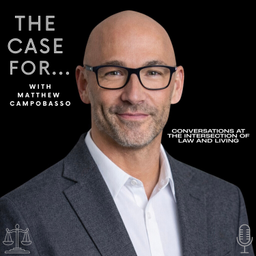
Courtroom trained. Purpose driven. Deeply Human. After 20 years practicing law, Matthew Campobasso turns courtroom skills — evidence, cross-examination, closing arguments — on the questions that actually keep us up at night: connection, identity, stress, relationships, mental health, and what it truly means to be well. Each week, Matt (and his guests) make the case for something, building the argument exhibit by exhibit. Nothing performative — legal reasoning meets real self-improvement. New episodes weekly. Subscribe to The Case For — a podcast about personal growth, honesty, and living well.
The Case For Getting Back Up: How to Learn From Failure Without Letting It Define You
Failure doesn’t teach. Looking at it does.
We tell each other to “learn from your mistakes,” but mistakes hurt, so we look away. In this episode, I share the story of a jury trial I lost early in my career as a prosecutor, why it was entirely my fault, and what I did afterward that kept me from losing a case that way again.
I make the case that you can only learn from a failure if you can stand to look at it, and you can only stand to look at it if it doesn’t get to define you.
You’ll leave with:
A way to describe any failure in one sentence, without judging yourself
A question that makes it easier to look at your failures
A rule you can act on within two days
Four exhibits:
Exhibit A: Looking Away
Exhibit B: Owning It Without Becoming It
Exhibit C: The Case for Kindness
Exhibit D: From Lesson to Rule
I also take on two objections: whether being kind to yourself lets you off the hook, and what to do when you do everything right and still lose.
New episodes every Tuesday.
If this one landed with you, subscribe, leave a rating, and share it with someone who might need it.
What’s a failure you’ve been explaining away? I’d love to hear from you.
15 Oct 2026
The Case For Trusting Yourself: How To Make a Hard Decision When You're Not Sure
"I'm just not sure yet" may be one of the most expensive sentences we say. After twenty years of practicing law and watching people make high-stakes calls with incomplete information, Matt Campobasso has come to believe that feeling sure and making the right decision are two completely different things. The first, you can buy with more research. The second, you can't.
In this episode, Matt makes the case that the certainty you're waiting for may never arrive, and that waiting turns out to be a decision too. He builds the case from four vantage points: what more information really buys us, what waiting costs, why chasing the best option can leave us worse off, and what commitment does to how we feel about a choice. Along the way he draws on research from Paul Slovic, Daniel Kahneman and his co-authors, Sheena Iyengar and Barry Schwartz, Daniel Gilbert and Jane Ebert, and Steven Levitt, plus Jeff Bezos's seventy percent rule. He takes on the strongest objections to his own argument, then closes with The Verdict: three ways to make a hard decision when you're not sure.
If you've ever researched a decision for weeks and felt no closer to an answer, this one is for you. A companion essay is live on Substack. Subscribe to The Case For so every new episode reaches you the moment it drops. New episodes every Thursday.
#TheCaseFor #DecisionMaking #HardDecisions #TrustYourself #Overthinking #PersonalGrowth #Mindset #Podcast
8 Oct 2026
The Case for Settling: Why Winning the Argument Often Costs You the Thing You Wanted
When someone says "I'm not going to settle," they usually mean they refuse to be the one who loses. But after twenty years inside other people's disputes, Matt Campobasso has come to believe we have gotten settling wrong. It isn't what you do when you can't win. It's what happens when both sides stop fighting for the fantasy of total victory and decide what they're really willing to live with.
In this episode, Matt makes the case that winning the argument and getting the thing you wanted are two different things, and that the first one often costs you the second. He builds the case from four vantage points: the courtroom, the relationship, the mirror, and the parent's seat. Along the way he draws on research from Randall Kiser, Linda Babcock and George Loewenstein, and John and Julie Gottman, takes on the two strongest objections to his own argument, and closes with The Verdict: three ways to put it into practice this week.
If you have ever been right about the facts, won the battle, and still felt like you lost the war, this one is for you. A companion essay is live on Substack. Subscribe to The Case For so every new episode comes straight to you the moment it drops.
Reach and audience
Public platform figures. Ratings count people who left a rating, not total listeners.
Apple Podcasts (US)
5.0 / 5
1 ratings
Spotify
5.0 / 5
10 ratings
Contact The Case For... (with Matthew Campobasso)
Guest appearances
Books guests
Based on episode analysis; this does not confirm that the show is currently accepting guests.
Host of The Case For... (with Matthew Campobasso)?
Claim your podcast to manage its listing and keep your show details accurate.
Pod Engine is an independent podcast discovery and analytics service and is not affiliated with or endorsed by this podcast. Artwork and show content belong to their owners. Full legal notice.
Explore this show Podcast research with Pod Engine