- 17
- Episodes
- 1
- Ratings
- Weekly
- Cadence
- 2026
- First episode
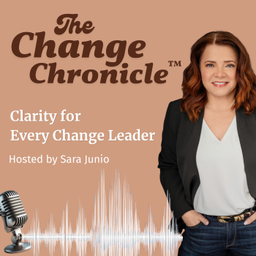
About The Change Chronicle
The Change Chronicle is for the leader watching a transformation unravel and wondering why. Each episode teaches you how strategic leadership shapes the decisions, the culture, and the momentum that turn stalled initiatives into results — because successful transformations are architected, not accidental. Practical. Honest. No jargon.
- Publisher
- Sara Junio
- Category
- business
- Language
- en
- Explicit
- No
- First episode
- 21 Jul 2026
- Latest episode
- 3 Nov 2026
Latest episodes
17 episodes in the feed.
3 Nov 2026
Chronicle 14 - Your Team Just Grew in Size - Now What?
In this episode of The Change Chronicle, Sara Junio discusses the challenges and opportunities presented by the Great Flattening in organizations, where managers are faced with increased spans of control and the need to transition from functional to strategic leadership. She emphasizes the importance of clarity, delegation, and capacity conversations to navigate this change effectively and avoid burnout. Takeaways Transition to strategic leadership Importance of clarity and delegation Chapters 00:00 Introduction to the Great Flattening 03:06 Understanding the Shift in Management 05:48 The Functional Leadership Trap 09:03 Shifting from Functional to Strategic Leadership 12:02 Three Key Shifts for Strategic Leaders 15:01 The Courage to Name Capacity 17:48 The Career Opportunity in Change 21:04 Addressing Common Objections 23:56 Advice for Senior Leaders 27:10 Action Steps for Managers
27 Oct 2026
Chronicle 13 - Are You Struggling To Lead Your Team Through Change?
In this episode, Sara Junio discusses the challenges of leading teams through organizational changes, particularly during mergers. She introduces the 'Three C's' model—Calm, Candor, and Control—as essential strategies for managers to effectively guide their teams through uncertainty. Takeaways Embrace the Three C's Communicate openly and honestly Chapters 00:00 Navigating Mergers and Change 02:57 The Three C's of Leadership 12:06 Understanding Job Insecurity 20:05 Empowering Teams During Uncertainty 25:05 Lessons for Senior Leaders
23 Oct 2026
Chronicle 12 - How To Manage Your Team's Change Fatigue
The conversation focuses on the concept of change fatigue as a portfolio problem, emphasizing the need for leaders to manage multiple initiatives effectively to avoid overwhelming employees. It introduces a practical framework for assessing change load through four key questions, aiming to improve organizational capacity and decision-making. Takeaways Change fatigue is a portfolio issue Effective management requires visibility Chapters 00:00 Understanding Change Fatigue 09:50 The Impact of Change on Employees 20:05 Assessing Change Load Effectively 30:04 Making Strategic Decisions for Change
6 Oct 2026
Chronicle 11 - Nothing Changes Unless You Change
In this episode of The Change Chronicle, Sara Junio discusses the critical role of leadership behavior in driving successful organizational transformations. She emphasizes that true change occurs when leaders align their actions with the changes they advocate, thereby fostering a culture of accountability and clarity among their teams. Learn about the 4M-Test. Takeaways Leadership behavior drives change Align actions with transformation goals Chapters 00:00 The Leadership Accountability Gap 02:47 The Four-Part Leadership Test 05:58 Modeling Change: The Importance of Behavior 09:02 Making Room for Change 12:13 Matching Systems to Messages 15:09 Maintaining the Message Under Pressure 17:56 The Challenge of Leadership Accountability
29 Sept 2026
Chronicle 10 - Why Are You Waiting For The Title?
The Change Chronicle podcast host, Sara Junio, shares insights on building influence, taking action, and leading change without a formal title. She emphasizes the power of trust, expertise, and recognizing unclaimed opportunities for leadership. Sara encourages listeners to take the first step and empower others to lead. Takeaways Building influence is not dependent on a formal title Recognize unclaimed opportunities for leadership Empower others to lead and take action Chapters 00:00 Building Influence Without a Title 02:24 The Power of Trust and Expertise 04:13 The Fear of Acting Without a Title 05:37 The Influence of Structure and Title 06:31 Recognizing Available Influence 08:38 Utilizing Resources and Standing 11:03 The Durability of Influence 11:55 Overstepping vs. Picking Up Unclaimed Responsibility 13:19 Identifying Hesitation and Taking Action 14:57 Taking the First Real Step 17:22 Empowering Others to Lead
22 Sept 2026
Chronicle 9 - The Tuesday Nobody's Watching
Sara Junio shares her journey from an unplanned start to strategic leadership, emphasizing the importance of unwatched Tuesdays and the power of consistency in building a track record. She highlights the visibility dilemma, the need to make contributions visible, and the discomfort associated with self-promotion. Sara provides actionable steps for closing the visibility gap and emphasizes the impact of invisible work on transformation initiatives. Takeaways Consistency builds a track record over time Making contributions visible is essential for recognition and advancement Chapters 00:00 The Unplanned Journey 03:05 The Unwatched Tuesday 05:40 The Power of Consistency 09:02 The Visibility Dilemma 11:14 Making Contributions Visible 14:02 Overcoming Discomfort 16:35 Taking Action 18:01 The Invisible Work
15 Sept 2026
Chronicle 8 - Stop Performing, Start Leading
The Change Chronicle podcast explores the difference between performing and leading in the context of organizational transformation. It emphasizes the importance of honesty, consistency, and purpose-driven ambition in leadership. Takeaways Honesty and consistency are key attributes of effective leadership. Purpose-driven ambition is essential for sustainable leadership success. Chapters 00:00 The VP's Dilemma 02:32 Stop Performing, Start Leading 05:04 The Impact of Performing vs. Leading 07:20 Ambition and Purpose in Leadership 10:06 The Three Key Attributes of Trusted Leaders 11:32 Consistency in Leadership 13:53 Tact vs. Performing 17:29 The Cost of Performing in Change Leadership 19:48 Earning Trust Through Leadership Actions
8 Sept 2026
The Hidden Bottle: Why Resistance to Change Feels So Personal
The Hidden Bottle: Why Resistance to Change Feels So Personal Sara Junio uses a personal story about perfume to explain why resistance to change is often really resistance to losing identity, confidence, and routine. This solo episode connects a small everyday ritual to the bigger patterns leaders see during system rollouts, reorganizations, and transformation efforts. It’s a practical reminder that change management works better when people feel acknowledged, not just informed. Key topics In this episode, Sara Junio frames resistance to change as a deeply human response to losing something that made people feel valuable and secure. She opens with the habit of wearing perfume as a final step before leaving the house, using it as a metaphor for routines people cling to without realizing why. She notes that roughly 47% of people report some sensitivity to fragrance, which makes a personal comfort ritual a genuine issue for many others. Sara shares that her fiancée is allergic to synthetic floral compounds, which forced her to stop wearing perfume and exposed how attached she was to the ritual itself. She explains that she cannot smell, so her attachment was never about scent, but about what perfume represented: confidence, personal branding, and feeling put together. She connects that experience to the workplace, where employees often keep old reports, spreadsheets, or manual processes “just in case” a new system fails. The episode reframes that behavior as identity protection rather than defiance, stubbornness, or a lack of understanding. Sara argues that resistance rooted in identity does not respond to more communication alone. It responds to acknowledgement. She gives three practical leadership moves: name what is being lost, create a short transition or grace period, and watch for quiet resistance rather than only loud objections. She closes by challenging listeners to identify their own “bottle of perfume” - the role, title, or working style they are not fully ready to release. Timestamps (0:00) - The perfume question that reveals something deeper than habit (0:58) - Why this episode is really about resistance to change (1:55) - How a simple ritual becomes part of identity (3:21) - What happens when a routine gets removed (4:18) - Why the ritual matters to you but bothers others (5:14) - The personal reason Sara had to stop wearing perfume (6:05) - Hidden backups at work and resistance disguised as prudence (6:31) - Not being able to smell, but still feeling attached to perfume (7:44) - A report, a process, and the workplace version of the perfume bottle (9:28) - Resistance as a human need for value and comfort (10:27) - What leaders should ask before pushing a change (11:23) - Three ways to handle resistance with more empathy (13:28) - Finding your own version of the perfume bottle (14:53) - The main takeaway: resistance is human, not a flaw (15:44) - Closing reflection and invitation to continue the conversation Action Items Ask what a task or tool represents to the person who is using it before removing it. Name the loss out loud before focusing on the future state. Build a limited grace period instead of forcing an immediate cutover. Look for quiet resistance, like backup files or manual workarounds, not just open pushback. Reflect on your own attachment to old roles, titles, or ways of working.
4 Sept 2026
Chronicle Special Edition with Guest, Dr. Oliver Degnan
The conversation explores the relationship between change resistance and burnout, the impact of change on executives, and the role of systems in transformation. It also delves into the importance of understanding the underlying problem and the human condition in change management. The conversation delves into the impact of burnout on individuals and organizations, highlighting the signs, causes, and solutions for burnout. It emphasizes the importance of negotiating space, having a hobby, and steering through change without panic. Takeaways Change resistance and burnout are interconnected Executives are experiencing burnout due to the volatile business environment Understanding the underlying problem is crucial in change management Negotiating space is crucial to avoid burnout. Having a hobby is essential for maintaining a healthy work-life balance. Chapters 00:00 Change Resistance and Burnout 03:11 Impact of Change on Executives 13:23 The Role of Systems in Transformation 24:41 Understanding the Human Condition in Change Management 28:26 The Impact of Burnout 29:26 The Signs and Causes of Burnout 30:16 Strategies to Overcome Burnout 42:35 The Role of Negotiating Space 50:26 The Importance of Having a Hobby
2 Sept 2026
Chronicle 7 - Purpose Is Not a Retreat Activity
The episode discusses the strategic use of purpose in leadership and transformation, emphasizing the importance of personal purpose and its impact on decision-making. It introduces the Purpose Factor framework and provides actionable steps for leaders to align their purpose with their work. Takeaways Purpose as a strategic leadership instrument Identifying and leveraging natural advantage in leadership and transformation https://www.thepurposefactor.com/home-tpf62394344 (https://www.thepurposefactor.com/home-tpf62394344) Chapters 00:00 The Misuse of Purpose in Organizations 01:27 The Impact of Personal Purpose on Transformation 04:10 Purpose as a Strategic Instrument 06:58 The Difference Between Purpose and Mission 09:12 The Purpose Factor Framework 09:55 Identifying Natural Advantage in Leadership 15:24 Capacity and Direction in Leadership 19:16 Purpose as a Clarity Tool
25 Aug 2026
Chronicle 6 - Five Patterns of Resistance
The conversation explores the concept of resistance in organizational change, highlighting the difference between compliance and belief. It delves into the five patterns of resistance, the brain's response to threat, and the leadership implications of understanding and addressing resistance effectively. Takeaways Resistance is a natural response to change and is often rooted in self-protection. Understanding the brain's response to threat and addressing the underlying causes of resistance is crucial for effective leadership. Chapters 00:00 The Illusion of Compliance 03:34 Resistance as Self-Protection 08:24 Patterns of Resistance: Rigidity 15:21 Patterns of Resistance: Emotional Disengagement and Cynicism 18:41 Patterns of Resistance: Information Seeking and Rumor Spreading 18:41 Patterns of Resistance: Decreased Productivity and Presenteeism 22:21 Patterns of Resistance: Passive Resistance 26:33 The Brain's Response to Threat 36:33 Leadership Implications
18 Aug 2026
Chronicle 5 - Who Makes The Decisions?
The conversation explores the challenges of misaligned transformations and the critical role of strategic leadership in driving successful change. It emphasizes the importance of decision authority, change narrative, and accountability structure in transformation architecture. Takeaways Misalignment leads to hesitation, not resistance Leadership alignment is crucial for successful transformations Chapters 00:00 The Misaligned Transformation 03:21 The Importance of Strategic Leadership 08:59 Decision Authority and Alignment 18:48 The Change Narrative 24:39 Accountability Structure
11 Aug 2026
Chronicle 4 - The New Leadership Capability
The conversation explores the journey of building a high-performing team, the importance of change management, misconceptions about change management, the impact of change management, learning change management through experience, developing change management skills, the role of executives in change management, closing the gap in the leadership pipeline, the significance of change capability, building change capability in managers, the influence of change capability, and the shift in organizational approach. Takeaways Change management is a critical leadership capability Understanding the human side of change is essential for success Chapters 00:00 Building a High-Performing Team 04:28 The Importance of Change Management 06:22 Misconceptions About Change Management 08:06 The Impact of Change Management 10:30 Learning Change Management Through Experience 13:17 Developing Change Management Skills 18:21 The Role of Executives in Change Management 19:11 Closing the Gap in the Leadership Pipeline 24:31 The Significance of Change Capability 26:12 Building Change Capability in Managers 29:19 The Influence of Change Capability 31:00 The Shift in Organizational Approach
4 Aug 2026
Chronicle 3 - It's Not About the System
The Change Chronicle explores the challenges of leading transformation initiatives, highlighting the importance of addressing the people side of change. It emphasizes the need to earn belief, build stories alongside strategy, and understand the impact on individuals and downstream teams. Takeaways Addressing the people side of transformation is crucial for successful adoption. Belief is earned through consistent experience, not just understanding. The 80% of transformation is the hardest and most strategic work, determining the success of the 20% system implementation. Chapters 00:00 The Challenge of Change 01:20 The Three Fears 02:10 The Problem with Adoption 03:20 Telling a Story 06:00 The Belief Gap 07:12 The People Side of Transformation 11:13 The Impact on Downstream Teams 16:42 The 80-20 Truth 18:08 The Leadership Problem 19:26 Earning Belief 21:51 Building Story Alongside Strategy 25:12 The Importance of Listening 27:30 The Role of Belief
30 Jul 2026
Chronicle Special Edition - Harnessing Neuroscience for Change Leadership
Harnessing Neuroscience for Change Leadership: How Your Brain Shapes Transformation Success Understanding and leading change goes beyond project plans and strategies; it requires mastering the emotional and neurological responses that underpin human behavior. In this episode, Sara Junio interviews neurochange expert Julia LeFevre to explore how neuroscience illuminates the internal dynamics of change management, especially for middle managers navigating complex transformations. Main Topics Covered: The internal experience of resistance during organizational change and why it’s rooted in the nervous system, not attitude problems The critical distinction between capability (skills) and capacity (emotional and relational resources) in leading change How the brain’s three core regions—the prefrontal cortex, limbic system, and brain stem—dictate our emotional responses and influence behavior under stress Practical strategies for leaders to regulate their own emotions, create relational safety, and build capacity for sustained change The importance of meeting fundamental human needs—belonging, safety, and value—to foster trust and reduce conflict Tips for managing stress and uncertainty inherent in ongoing transformations and marathon change efforts Timestamps: 00:00 - The missing internal perspective in change frameworks 00:26 - Why resistance is a biological response, not attitude 00:51 - Leading your own emotions before leading others 01:14 - Introducing Julia LeFevre and her approach 02:03 - The common story of middle managers in transformation 02:41 - How plans overlook organizational realities 03:08 - Managing emotions amid resistance 03:58 - Why understanding the brain is essential in change leadership 04:35 - The neuroscience of the brain’s three primary regions 05:25 - The bottom-up operation of the brain during stress 06:44 - The fight or flight response to relational threats 07:37 - Capability versus capacity in leadership 08:34 - Building capacity to stay regulated amidst tension 09:23 - How physical and relational needs fuel the brain 10:39 - The impact of relational safety on stress responses 11:07 - Maintaining presence and emotional regulation in difficult rooms 11:15 - The cycle of reactive behaviors and how to break it 12:25 - Addressing micromanagement at the neurological level 13:33 - Why fixing symptoms isn’t enough—addressing underlying needs 15:14 - Leading your own emotions as a foundation for change 15:56 - How internal states influence room dynamics 17:17 - The role of belonging and connection in leadership 18:47 - Filling your relational tank for better influence 20:39 - The universal need for acceptance at all organizational levels 22:08 - The power of mutuality and collaborative capacity 23:24 - Leading oneself first—beyond skill-building 24:29 - Navigating prolonged stress and open-ended change 25:54 - Fueling the brain with consistent, intentional care 28:40 - Managing physical, emotional, and social needs 33:24 - Practical tips for relational presence and connection 34:47 - Connecting with Julia and resources for further learning
28 Jul 2026
Chronicle 2 - False Summit
Are your organization’s milestones just false peaks? Join Sara Junio as she explores how organizations often celebrate prematurely, mistaking activity for true change, and learn how to recognize and avoid these costly false summits. Main Topics: How organizations often declare success too early in transformation efforts The concept of the 'False Summit' and its dangerous implications Key indicators to identify whether a transformation has truly succeeded The role of incentives and behavior in perpetuating false milestones Actionable markers: decision behavior, manager language, hallway conversations In this episode: Sara shares a story of a seemingly successful company transformation that was actually a façade Discussion on how milestones are often celebrated prematurely, creating a false sense of progress The importance of outcomes over outputs in measuring real transformation The concept of the 'False Summit' rooted in mountaineering, applied to organizational change How incentive structures can manufacture false success markers Three behavioral markers to assess real organizational change: decision speed, manager language, hallway talk Timestamps: 00:00 - Introduction to the concept of false summits in transformation 00:45 - Story of a confident company transformation that felt off 01:10 - Recognizing exhausted silence versus engaged attention in meetings 02:07 - The impact of outside help signaling failure locally 03:03 - Why status reports often hide the real story 04:17 - The danger of false milestones and their cost in trust and momentum 05:37 - How organizational incentives lead to premature celebrations 06:54 - The long-term damage of false summits on credibility and energy 07:47 - Why shifting focus from outputs to outcomes is crucial 09:05 - Reflecting on your last organizational success: activity vs. actual change 10:06 - Mountaineering roots: what is a false summit? 11:24 - Why outcomes matter more than milestones and how to tell the difference 12:48 - The incentive structures that produce false summits and how to own your measurement of real progress 15:22 - Three markers to assess true transformation: decision behavior, manager language, hallway talk 16:58 - How to interpret informal conversations and behavioral signals 18:25 - The importance of psychological safety in honest dialogue 18:54 - Practical steps to identify and move beyond false milestones 19:50 - Recap of markers for true transformation success 20:11 - Sara’s experience of uncovering truths through real conversations 20:55 - Final call: Have one real conversation this week and listen deeply
21 Jul 2026
Chronicle 1 - Three Truths for Org Readiness
Most organizational transformations fail before they even begin because leaders ignore three crucial truths that sabotage success from the start. If you’ve ever launched a change initiative that stalls, feels stuck in ambiguity, or quietly succumbs to cynicism, this episode reveals what you must address first to break the cycle. Sara Junio, a seasoned change leadership strategist, exposes the unseen pitfalls that derail high-stakes transformations, showing how unspoken history, unclear leadership vision, and accumulated change debt can quietly undermine even the best plans and how confronting them early creates the clarity and momentum needed for real change.
Reach and audience
Public platform figures. Ratings count people who left a rating, not total listeners.
- Apple Podcasts (US)
- 5.0 / 5
- 1 ratings
Host of The Change Chronicle?
Claim your podcast to manage its listing and keep your show details accurate.
Pod Engine is an independent podcast discovery and analytics service and is not affiliated with or endorsed by this podcast. Artwork and show content belong to their owners. Full legal notice.
Explore this show
Podcast research with Pod Engine