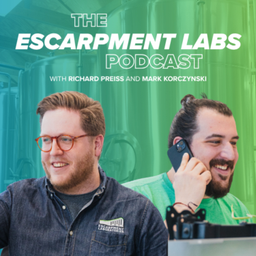
Welcome to The Escarpment Labs Podcast— a weekly podcast that brings you deeper into the science and strategy behind exceptional fermentation. Hosted by Sales Coordinator Mark Korczynski and CEO Richard Preiss, each episode explores popular topics from Escarpment’s blog and Knowledge Base with fresh insight, research updates, and brewer-focused tips.
Whether you're a homebrewer looking to level up or a professional chasing consistency and flavour precision, this show has something for every fermentation nerd. New episodes every Tuesday!
What’s in Your Yeast Nutrient? What 16 Breweries Taught Us About Wort Nutrition
Are your yeast nutrients giving your fermentation precision support, or are they overloading your kettle with heavy metals and unpredictable mineral shifts?
Many commercial worts are naturally deficient in zinc (<0.15 ppm), leading to sluggish fermentations and yeast stress. However, many off-the-shelf nutrients were originally formulated for wine or distilling rather than beer—sometimes adding massive doses of calcium or unwanted pro-oxidant metals like iron and copper.
In this episode, Mark and Richard open up the laboratory vault to share findings from a multi-brewery study evaluating 47 samples across 16 commercial craft breweries.
We break down:
Precision Zinc Delivery: How Yeast Lightning reliably lifts zinc deficient worts (+0.125 ppm avg. increase) straight into the ideal 0.2-0.3 ppm sweet spot.
Heavy Metals & Shelf Life: How excess iron (>0.15 ppm) in competing nutrients triggers Fenton reactions, driving premature lipid oxidation and cardboard off-flavours in packaged beer.
Electrolyte & FAN Balance: Delivering vital cofactors like potassium and magnesium without triggering drastic, unwanted water chemistry shifts or lowering free amino nitrogen.
The Future of Precision Nutrition: Where yeast nutrition research is heading next—from amino acid profiling to custom wort management.
Featured in this Episode:
Check out our newest blog, "What's In Your Nutrient? What 16 Breweries Taught Us About Wort Nutrition" (https://escarpmentlabs.com/blogs/resources/yeast-lightning-under-the-microscope-what-16-breweries-taught-us-about-wort-nutrition).
⚡ Need bulk nutrition in the brewhouse? We’re excited to introduce the new 20kg bulk size for Yeast Lightning (escarpmentlabs.com/products/yeast-lightning-nutrient)! It’s the perfect option for larger production facilities or breweries looking to unlock a major bulk discount on their essential yeast nutrition.
22 Sept 2026
Yeast Capacitance: Real-Time Viable Cell Measurement with Aber Instruments & Equals Brewing
Why do yeast pitch rates vary so drastically between brewing shifts, even when everyone is using the same hemocytometer?
Manual microscopic cell counts are standard practice, but they take time, carry operator bias, and can fall short when slurry densities change across strains. If you've ever faced stalled fermentations or batch-to-batch flavour shifts, inconsistent pitching volume might be the hidden culprit.
In this episode, Mark and Richard are joined by Nick Brown (Brewing Sales Specialist at Aber Instruments (https://aberinstruments.com/brewing/)) and Matt Cummings (Brewmaster at Equals Brewing (https://www.equalsbrewing.com/)) to explore capacitance technology — a real-time method for measuring viable yeast biomass directly in the line or tank.
We cover:
The Limits of the Scope: Where manual cell counts, slurry weight, and optical density fall short in a fast-paced production cellar.
The Science of Cell Capacitance: How live yeast cells with intact membranes act like tiny rechargeable batteries under a radio-frequency field, and why trub, dead cells, and hop debris are completely ignored.
Real-World Production at Equals Brewing: How switching from manual sampling to automated, real-time dosing saved labour and tightened fermentation timelines.
SOPs for Success: Best practices for multi-strain handling, sensor calibration, and proactive yeast health monitoring.
Featured in this Episode:
Aber Instruments (https://aberinstruments.com/brewing/) — Including products for cell counting, pitching, and cropping.
For a more manual approach, check out our FREE Cell Counting Guide (https://escarpmentlabs.com/blogs/resources/download-guide-to-accurate-yeast-cell-counting-in-the-brewery).
To download our comprehensive Yeast Management & Repitching Guide, click here (https://escarpmentlabs.com/blogs/resources/new-download-repitching-guide).
15 Sept 2026
Mastering Diacetyl: Yeast Nutrition, ALDC, and the Forced Diacetyl Test
Why does a beer taste squeaky clean at final gravity, only to turn into a slick, buttery mess three weeks after it hits the can?
Diacetyl and its sneaky, odourless precursor (alpha-acetolactate) remain every brewer’s absolute worst quality control nightmare—especially during peak production season when cellar turns are tight. While dropping ALDC enzyme into the fermenter has become standard practice, relying on it as a silver bullet without fixing underlying yeast nutrition can leave your beer vulnerable to hop creep and post-packaging spikes.
In this episode, Mark and Richard break down the complete cellular biochemistry of diacetyl prevention, ALDC limitations, and cellar-tested QC checks.
We explore:
The Precursor Trap: How alpha-acetolactate hides in clean-tasting beer and oxidizes into buttery diacetyl after packaging.
Yeast Nutrition as Defence: Why Free Amino Nitrogen (FAN), zinc, and magnesium suppress precursor formation at the source.
The Limits of ALDC: How hop creep, bacterial spoilers, and low pH can overwhelm your enzyme insurance policy.
The Forced Diacetyl Test: A step-by-step walkthrough for executing a foolproof heat-forced sensory test—and why boiling your sample creates dangerous false negatives!
Featured in this Episode:
Learn more about ALDC from Escarpment Labs here (https://escarpmentlabs.com/products/abv-aldc-1kg).
For more information about Diacetyl, you can check out our blog posts "The Forced Diacetyl Test (https://escarpmentlabs.com/blogs/resources/the-forced-diacetyl-test)" & "5 Off Flavours Caused by Beer Yeast (And How to Prevent Them) (https://escarpmentlabs.com/blogs/resources/5-off-flavours-beer-yeast)", and our Knowledge Base "Troubleshooting Diacetyl in Beer (https://knowledge.escarpmentlabs.com/article/21-diacetyl)".
Reach and audience
Public platform figures. Ratings count people who left a rating, not total listeners.
Spotify
5.0 / 5
18 ratings
Contact The Escarpment Labs Podcast
Guest appearances
Does not typically book guests
Based on episode analysis; this does not confirm that the show is currently accepting guests.
Pod Engine is an independent podcast discovery and analytics service and is not affiliated with or endorsed by this podcast. Artwork and show content belong to their owners. Full legal notice.
Explore this show Podcast research with Pod Engine