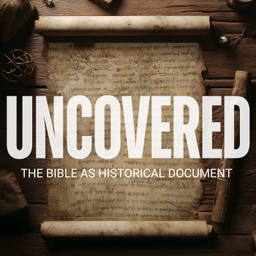
Podcast thumbnail for Uncovered: The Bible as Historical Document

Uncovered: The Bible as Historical Document

Claim This Podcast

by Carl Creasman

4.0(3 reviews)
10 episodes
Updated Daily
Accepts GuestsHas SponsorsLocation 🇺🇸

Podcast Overview

You've probably heard of the Bible, maybe even own one or read one. Its typically thought of as a religious book, but at its core it is a collection of ancient primary manuscripts. In this podcast, we will examine the Bible from the perspective of a Historian, to examine its historicity and manuscript strength, to see if we can uncover why the founders of the United States thought this book held value for the construction of our civic system. This podcast is a follow-up series to "Unmoored: America Adrift in Historical Forgetfulness and Finding Our Way Back." That podcast was an examination of what has happened to the USA in the early 21st century. In that examination, it became clear that the US civic system, as originally designed, was based on a moral virtue foundation held in common. For the citizens at that time, the location for that foundation was the Bible. That makes sense when we realize the country was peopled mostly with Christians. The USA is not peopled mostly with Christians today in the early 21st century, so is the Christian faith even worth examining? Perhaps not, at least not at the civic level, but before we decide to jettison or reject what the Founders believed to be necessary, we should examine it. So, we will seek to uncover what is going on in the Bible and whether we can trust it as a historical document. Is what we read accurate as a historian considers primary source documents? Is it possible that the story it tells of a Savior God coming to rescue the humans remotely accurate?

Language

🇺🇲

Publishing Since

8/11/2025

3 verified contact emails on file for Uncovered: The Bible as Historical Document

Pitch yourself as a guest, propose sponsorships, or reach out directly to the host.

Recent Episodes

Episode thumbnail for Conclusion Means the Search Starts Now

November 11, 2025

Conclusion Means the Search Starts Now

<p>We arrive at the end of our journey of investigating the Bible as a Historical document, as a Historian would any other set of evidence.  In our concluding episode, we take a look back at our episodes, offering insights that each of us gleaned. We also answer a couple of listener comments, hopefully satisfactorily. We even talk about zombies!!</p> <p>If you enjoy the King Arthur story (legend?, history?, myth?), we spend time considering its historical strength. In particular I use this historical personage as a way to consider the strength or weakness of evidence for biographies, for the people we know of from history. There are many movies and plays centered on the Arthurian legend, and during the episode, I mentioned a movie that stars Clive Owen and Kiera Knightley, along with the wonderful Mads Mikkelsen.  I called it "Arthur" but its actually <a href= "https://www.imdb.com/title/tt0349683/" target="_blank" rel= "noopener">"King Arthur."</a></p> <p>I told about these two songs and love for you to hear them:</p> <p><a href="https://youtu.be/rt0TTa9R09k?si=K4D0V48itT-uzsV9" target="_blank" rel="noopener">U2 "40"</a></p> <p><a href="https://youtu.be/JOnokwbFH4s?si=cjMgMkqDA1LNE96v" target="_blank" rel="noopener">DCTalk's "What If I Stumble"</a> song starts with the quote Matthew read from Brennan Manning where he says "The greatest single cause of atheism in the world today is Christians who acknowledge Jesus with their lips and walk out the door and deny Him by their lifestyle. That is what an unbelieving world simply finds unbelievable."  We read this quote to help us seque into our last section, where we close out the entire series.  </p> <p>In a sense, that last section was me desperately calling out to any Christian listening to realize that often the reason why some do not believe Christianity or will not follow Jesus because of what they see lived out in front of them.  </p> <p>I do believe, and I think we have demonstrated, that the historical evidence is overwhelming in support of the historicity of the Bible.  And that historical evidence proves, to me beyond a doubt, that there is this Maker, this Creator Being who wants a relationship with us humans that He created. Episode 8 showed the depth of evidence to prove the resurrection. So for my non-Christian listeners, I desperately want you to see the beauty and life available.</p> <p>And yet, to my Christian listeners, there is a desperate need for each believer of Jesus to live out what Psalm 1 says is a delight in walking in God's ways, in following what is written in this Bible.</p>

Episode thumbnail for Historical Investigation of the Resurrection

November 4, 2025

Historical Investigation of the Resurrection

<p>The Resurrection of Jesus, the man from Nazereth, stands at the center of the Christian faith.  It is the core historical event, either in support of the claim or in denial of the claim.  From the earliest evidence, we see all of the supporters of Jesus and the story around the resurrection, place that Resurrection at the center of their claim that this person Jesus was also the "Son of God."</p> <p>Through this podcast series, we have examined the Bible historically and discovered that the New Testament in particular is the most historically secure set of documents from antiquity. That then leads us to this moment to investigate this central claim. It should be obvious, but if Jesus or His followers never claimed that He was the Son of God, and that He had come back to life after his death, no one would quibble about the historicity of these documents.</p> <p class="MsoNormal"><!-- [if !supportLists]-->We know His death by crucifixion is one of the most highly attested events from antiquity. Some scholars will attempt to question "the how" but the vast majority understand there was this person Jesus, and he was killed by crucifixion. But then we then are confronted with the fact that there was an empty tomb. The followers of Jesus made the audacious claim that he was back, that he was alive.</p> <p class="MsoNormal">Why we must examine it in light of history is that the world was transformed by the followers of Jesus. We are "stuck with" examining Christianity whether we like it or not. By 150 AD, citizens from across the Empire, including many non-Jews, had adopted "the Way," this Christian faith that centers on a story that this man Jesus rose from the grave, and is now alive. By 300 AD, the faith was throughout the Empire, with some estimates suggesting as many as 25%, maybe 30% citizens had converted.</p> <p class="MsoNormal">During the episode, we include research by Sean McDowell in his second edition work The Fate of the Apostles. You can <a href="https://a.co/d/397hkRW" target= "_blank" rel="noopener">find it available on Amazon</a> or elsewhere books may be ordered.</p>

Episode thumbnail for Variants and Contradictions in the Evidence

October 28, 2025

Variants and Contradictions in the Evidence

<p>A fair question to ask about writings from antiquity is about the many variants within all the various copies of the one document in question, or to notice that the evidence that we have about an event can seem to present contradictions to said historical event or narrative.  So this episode will examine both issues, starting with the work of textual scholars.</p> <p>Those scholars spend their lives becoming deeply comfortable with the original languages, materials used for writing, and other contextual information useful to determining how to deal with the variants. We will consider some of the rules used by textual experts.</p> <p>As an example of the work of textual scholarship, we again reference new scholarship about Josephus. For the new research about Josephus, that book is called Josephus and Jesus: New Evidence for the One Called Christ. At least at the time of the writing of these show notes, you <a href= "https://josephusandjesus.com" target="_blank" rel="noopener">can download a free PDF</a> here.  We mention the specific text in question and <a href= "https://www.perseus.tufts.edu/hopper/text?doc=Perseus%3Atext%3A1999.01.0146%3Abook%3D18%3Awhiston+chapter%3D3%3Awhiston+section%3D3" target="_blank" rel="noopener">you can read it here.</a></p> <p>For the issue of contradictions, we bring back the story of the assassination of Julius Caesar and then spend time examining an historical event from the Second Punic Wars, when the Carthagian General Hannibal took an army from modern-day Spain to the Italian peninsula. To do that, his army had to cross both the Pyrenees mountains and the Alps.  With war elephants!! We know both of these things happened, but within the evidence apparent contradictions occur. The Bible has those moments as well.</p> <p>One core answer for those comes in the reality of how ancient biographies were consistently focused on telling something of value or import of the historical figure. They were not as focused on the precise detail of how the story is presented. In the end, what we try to present is that the overarching narrative is secure. We may have some details for which we may not be able to discern which set of details is correct, but no historian doubts the veracity of the narrative.</p>

10 total episodes available

Deep-dive analytics for Uncovered: The Bible as Historical Document

Frequently asked questions

Have a different question and can't find the answer you're looking for? Reach out to our support team by sending us an email and we'll get back to you as soon as we can.

What is Uncovered: The Bible as Historical Document?

You've probably heard of the Bible, maybe even own one or read one. Its typically thought of as a religious book, but at its core it is a collection of ancient primary manuscripts. In this podcast, we will examine the Bible from the perspective of a Historian, to examine its historicity and manuscript strength, to see if we can uncover why the founders of the United States thought this book held value for the construction of our civic system.

This podcast is a follow-up series to "Unmoored: America Adrift in Historical Forgetfulness and Finding Our Way Back." That podcast was an examination of what has happened to the USA in the early 21st century. In that examination, it became clear that the US civic system, as originally designed, was based on a moral virtue foundation held in common. For the citizens at that time, the location for that foundation was the Bible. That makes sense when we realize the country was peopled mostly with Christians.

The USA is not peopled mostly with Christians today in the early 21st century, so is the Christian faith even worth examining? Perhaps not, at least not at the civic level, but before we decide to jettison or reject what the Founders believed to be necessary, we should examine it. So, we will seek to uncover what is going on in the Bible and whether we can trust it as a historical document. Is what we read accurate as a historian considers primary source documents? Is it possible that the story it tells of a Savior God coming to rescue the humans remotely accurate?

How often does this podcast release new episodes?

This podcast updates daily.

Where can I listen to this podcast?

This podcast is available on 4 platforms including Apple Podcasts, Spotify, and more. You can also use the RSS feed directly.

Does this podcast accept guests?

No, this podcast does not typically feature guests.

Legal Disclaimer

Pod Engine is not affiliated with, endorsed by, or officially connected with any of the podcasts displayed on this platform. We operate independently as a podcast discovery and analytics service.

All podcast artwork, thumbnails, and content displayed on this page are the property of their respective owners and are protected by applicable copyright laws. This includes, but is not limited to, podcast cover art, episode artwork, show descriptions, episode titles, transcripts, audio snippets, and any other content originating from the podcast creators or their licensors.

We display this content under fair use principles and/or implied license for the purpose of podcast discovery, information, and commentary. We make no claim of ownership over any podcast content, artwork, or related materials shown on this platform. All trademarks, service marks, and trade names are the property of their respective owners.

While we strive to ensure all content usage is properly authorized, if you are a rights holder and believe your content is being used inappropriately or without proper authorization, please contact us immediately at hey@podengine.ai for prompt review and appropriate action, which may include content removal or proper attribution.

By accessing and using this platform, you acknowledge and agree to respect all applicable copyright laws and intellectual property rights of content owners. Any unauthorized reproduction, distribution, or commercial use of the content displayed on this platform is strictly prohibited.