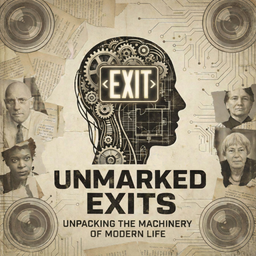
The ideas that shape how you think, work, and consume weren't accidents.
They were designed.
Each episode unpacks one essential text from critical theory, philosophy, fiction, and media studies that reveals how power really operates. No jargon. No academic gatekeeping. Just genuine inquiry into the forces shaping modern life.
We're exploring thinkers like Guy Debord, Michel Foucault, Naomi Klein, and Mark Fisher alongside fiction from Ursula K. Le Guin, Kurt Vonnegut, and Octavia Butler. Some of these works are decades old. All of them feel uncomfortably relevant.
This isn't about telling you what to think. It's about examining the machinery behind what you already believe, and finding the exits nobody marked for you.
New episodes weekly.
S03 E42: We: The One State, Glass Walls, and the Elimination of the Soul
Before Nineteen Eighty-Four, before Brave New World, there was We: the grandfather of dystopian fiction, written in 1920s Soviet Russia and immediately banned.
In this episode, we explore Zamyatin’s novel of the One State, where citizens are numbers, buildings are made of glass, and the only privacy is during scheduled sex. The protagonist, D-503, writes in praise of the system until he develops that most dangerous condition: a soul.
Zamyatin was a Bolshevik who became disillusioned. He saw where the logic of total planning and total transparency would lead. Not to utopia but to the elimination of everything that makes life human.
He wrote it as a warning. It reads as prophecy.
Source: “We” by Yevgeny Zamyatin (1924)
12 Oct 2026
S03 E41: The Sane Society: When Pathology Becomes the Norm
We assume that if most people behave a certain way, that behaviour is normal, healthy, sane. But what if an entire society is sick? What if alienation, anxiety, and destructiveness are rational responses to an insane situation?
In this episode, we explore Fromm’s argument that capitalism produces not just inequality but psychological damage. We’ve built societies that meet material needs while starving the human need for meaning, connection, and productive work.
Fromm isn’t satisfied with diagnosis. He outlines what a sane society would look like: one oriented toward being rather than having.
The book asks: is there something wrong with you, or is there something wrong with everything?
Source: “The Sane Society” by Erich Fromm (1955)
5 Oct 2026
S03 E40: One Flew Over the Cuckoo’s Nest: The Institution as Instrument of Normalization
McMurphy isn’t crazy. He faked it to get out of prison work detail and into what he assumed would be the easier environment of a psychiatric hospital. He discovers that the ward is its own prison, controlled not by locks but by routine, medication, and a nurse who knows exactly how to manipulate shame.
In this episode, we explore Ken Kesey’s novel, told from the perspective of a patient everyone believes is deaf and mute. The hospital is America. The treatment is conformity. Sanity is defined by submission to the rules.
Kesey wrote it after working in a mental hospital and volunteering for government LSD experiments. He saw how institutions define normal by punishing everything else.
Source: “One Flew Over the Cuckoo’s Nest” by Ken Kesey (1962)
Reach and audience
Public platform figures. Ratings count people who left a rating, not total listeners.
Apple Podcasts (US)
1.0 / 5
1 ratings
Spotify
3.7 / 5
3 ratings
Host of Unmarked Exits?
Claim your podcast to manage its listing and keep your show details accurate.
Pod Engine is an independent podcast discovery and analytics service and is not affiliated with or endorsed by this podcast. Artwork and show content belong to their owners. Full legal notice.
Explore this show Podcast research with Pod Engine