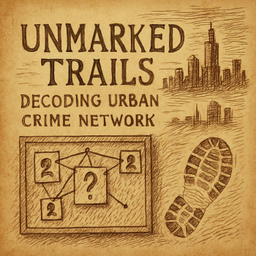
Unmarked Trails Decoding Urban Crime Network
Neonnights Network
- 16
- Episodes
- Monthly
- Cadence
- 2026
- First episode
About Unmarked Trails Decoding Urban Crime Network
This AI-generated podcast explores the transformative power of extraordinary acts. Venture into the shadowed architecture of metropolitan criminal enterprises through rigorous investigation and firsthand testimony. This series reconstructs how organized networks operate across cities, examining the economic systems, territorial boundaries, and human actors that sustain them. Drawing on criminological research, archival records, and accounts from law enforcement, former participants, and affected communities, we map the invisible infrastructure that shapes urban underworlds.
- Publisher
- Neonnights Network
- Category
- history · society & culture · true crime
- Language
- en
- Explicit
- No
- First episode
- 11 Jan 2026
- Latest episode
- 4 Oct 2026
Latest episodes
16 episodes in the feed.
4 Oct 2026
Future Networks Adapting to Enforcement and Technology
This AI-generated podcast explores the transformative power of extraordinary acts. As law enforcement capabilities advance and technological change accelerates, criminal networks continuously adapt their structures, communication methods, and operational models. This concluding investigation examines emerging trends in network evolution: increasing use of artificial intelligence for operational optimization, migration toward decentralized autonomous organizations operating through smart contracts, and adoption of quantum-resistant encryption. We analyze how networks learn from enforcement successes against competitors, implementing lessons into their own operational security. The episode explores predictions from criminologists and law enforcement about future network structures, examining whether networks will continue toward greater decentralization or consolidate around technological platforms. Through interviews with researchers studying emerging criminal technologies and law enforcement officials preparing for future threats, we understand the trajectory of network evolution. The investigation addresses the controversial reality that criminal networks often adopt new technologies before legitimate institutions do, sometimes creating law enforcement gaps where networks operate with technological advantages. We examine how communities might adapt to evolving network threats through economic development, violence prevention, and institutional reform that addresses conditions enabling network recruitment. The episode concludes by situating criminal networks within broader contexts of economic inequality, institutional failure, and social fragmentation that enable their persistence. Understanding network futures reveals that addressing organized crime requires not only law enforcement but fundamental social and economic transformation.
20 Sept 2026
Legitimate Businesses Transformed Into Network Operations
This AI-generated podcast explores the transformative power of extraordinary acts. Some of the most sophisticated criminal networks operate by converting legitimate businesses into criminal enterprises while maintaining legal appearances. This investigation examines how networks acquire or establish businesses—restaurants, nightclubs, construction companies, import-export firms—that generate legitimate revenue while facilitating illegal operations. We reconstruct specific cases where networks used legitimate business infrastructure for money laundering, product distribution, and operational coordination. The episode explores how networks select business types based on operational needs: cash-intensive businesses for money laundering, businesses requiring frequent transportation for drug distribution, businesses with legitimate reasons for international travel for trafficking coordination. Through interviews with financial crime investigators and former network members involved in business operations, we understand the mechanics of converting legitimate enterprises into criminal infrastructure. The investigation addresses how businesses simultaneously serve legitimate and criminal functions, with some customers unaware they're patronizing network-controlled establishments. We examine the challenge this presents for law enforcement: distinguishing legitimate business activity from criminal activity when they're operationally intertwined. The episode explores how networks maintain business operations despite criminal investigation, sometimes keeping legitimate operations profitable to maintain appearances. Understanding business-based networks reveals that criminal enterprises are not always visibly criminal but often operate in plain sight through legitimate commercial activity.
6 Sept 2026
Emergence of Decentralized Networks Without Traditional Hierarchy
This AI-generated podcast explores the transformative power of extraordinary acts. Contemporary criminal networks increasingly operate without centralized leadership or formal hierarchies, adopting distributed organizational models that complicate law enforcement response. This investigation examines how networks evolved from traditional command-and-control structures toward fluid, project-based organizations where members coordinate specific operations without permanent reporting relationships. We analyze how technological communication enables this decentralization, allowing networks to function without physical headquarters or regular in-person meetings. The episode explores specific examples: cryptocurrency-based networks with no identifiable leadership, encrypted communication groups that form for specific operations then dissolve, and franchise-like models where independent operators use established brand names and protocols. Through interviews with law enforcement adapting to these new structures and criminologists studying organizational evolution, we understand why networks are moving toward decentralization. The investigation addresses how decentralized networks prove simultaneously more resilient to law enforcement disruption and more vulnerable to internal conflict without formal dispute resolution mechanisms. We examine how these networks maintain operational standards and prevent infiltration without traditional vetting procedures. This examination reveals that criminal networks continue evolving organizationally, potentially creating enforcement challenges that traditional prosecution strategies cannot address. Understanding contemporary network structures is essential for grasping how organized crime operates in the 21st century.
23 Aug 2026
When Networks Collapse From External Pressure
This AI-generated podcast explores the transformative power of extraordinary acts. Criminal networks are not permanent fixtures but organizations vulnerable to law enforcement intervention, market disruption, and internal fracture. This investigation examines specific cases where networks were systematically dismantled through coordinated federal prosecution, examining the strategies that proved most effective. We reconstruct major cases: RICO prosecutions that targeted entire leadership structures, wiretap investigations that revealed internal communications, and coordinated enforcement across multiple agencies. The episode explores how law enforcement developed organizational theory to understand network structure, identifying key nodes whose removal destabilized entire organizations. Through interviews with federal prosecutors and DEA investigators, we understand the investigative techniques that proved most effective: long-term undercover operations, informant development, financial analysis, and digital forensics. The investigation addresses the controversial reality that network collapse sometimes creates greater chaos and violence than network stability did, as competing factions fight for control of abandoned territory and markets. We examine how networks attempt to maintain continuity despite leadership removal, through succession planning and distributed authority structures. The episode also explores how network collapse affects communities—sometimes reducing violence and enabling legitimate economic development, sometimes creating power vacuums filled by more violent competitors. Understanding network collapse reveals both the fragility and resilience of these organizations, demonstrating that law enforcement can be effective but must account for consequences of disruption.
26 Jul 2026
Women Navigating Roles Inside Criminal Networks
This AI-generated podcast explores the transformative power of extraordinary acts. Criminal networks are not exclusively male enterprises, yet women's roles remain poorly documented and often misunderstood. This investigation examines the diverse positions women occupy within networks—from money handlers and communication coordinators to mid-level dealers and leadership positions. We reconstruct narratives from women who participated in networks, exploring their entry points, the advantages and disadvantages they experienced, and how gender shaped their operational roles. The episode explores how networks assign women to positions based on gendered assumptions about police scrutiny, reliability, and capability—sometimes resulting in women having greater operational responsibility than men at equivalent ranks. Through interviews with female former network members and criminologists studying gender in organized crime, we understand how women navigate networks where male dominance is assumed but operational necessity sometimes demands female leadership. The investigation addresses the controversial reality that women in networks often face dual criminalization: prosecution for network crimes and social judgment for violating gender expectations. We examine how women's networks operate with different structures and communication patterns than male-dominated organizations, sometimes achieving greater stability through relationship-based trust rather than hierarchical authority. Understanding women's roles reveals that networks are more complex and diverse than male-centered narratives suggest, with women's participation shaping organizational dynamics in significant ways.
12 Jul 2026
Communities Caught Between Networks and Law Enforcement
This AI-generated podcast explores the transformative power of extraordinary acts. Residents of neighborhoods dominated by criminal networks experience a paradoxical reality: networks provide certain services and stability while simultaneously generating violence, fear, and economic devastation. This investigation centers community voices often absent from crime narratives, examining how residents navigate daily life under network control. We explore how networks function as informal governance—settling disputes, providing emergency assistance, enforcing informal rules—while simultaneously extracting economic tribute through taxation of street-level dealers and legitimate businesses. The episode reconstructs specific community experiences: the relief when networks reduce street violence through internal discipline, the terror when violence erupts despite network control, the economic dependency that develops when networks are primary employers. Through interviews with community organizers, social workers, and long-term residents, we understand the complex relationship communities develop with networks—neither simple opposition nor acceptance but pragmatic coexistence. The investigation addresses how law enforcement tactics—aggressive policing, mass incarceration, surveillance—sometimes destabilize communities more than networks do, creating resentment that undermines cooperation with authorities. We examine community-led initiatives attempting to reduce network influence through economic development, youth programs, and violence interruption. Understanding community perspectives reveals that network presence cannot be reduced to simple criminality but must be understood within contexts of systemic disinvestment and limited legitimate opportunity.
28 Jun 2026
Rival Networks Negotiate Boundaries and Coexistence
This AI-generated podcast explores the transformative power of extraordinary acts. Rather than constant warfare, criminal networks often establish negotiated arrangements with rivals, creating implicit treaties governing territory, market access, and conflict resolution. This investigation examines how networks manage coexistence, examining cases where competing organizations divided cities into spheres of influence rather than fighting for total control. We reconstruct specific negotiations and agreements—some formalized through sit-downs between leadership, others maintained through understood protocols and historical precedent. The episode explores how networks establish and enforce these agreements without formal legal mechanisms, relying instead on reputation, credible threats, and mutual benefit. Through interviews with law enforcement observers and former network members, we understand the conditions under which networks prefer negotiated coexistence over conflict and when agreements break down into violence. The investigation addresses the controversial reality that these arrangements sometimes produce more stable, predictable criminal markets than either constant warfare or monopolistic control. We examine how networks adapt agreements when external pressure from law enforcement threatens mutual interests, sometimes creating temporary alliances against common enemies. Understanding negotiation and coexistence reveals that criminal networks operate according to rational economic logic similar to legitimate businesses managing competitive markets. This perspective challenges narratives that portray networks as inherently chaotic or violence-driven.
31 May 2026
Corruption Networks Embed Inside Government Systems
This AI-generated podcast explores the transformative power of extraordinary acts. The most dangerous criminal networks aren't those operating in opposition to government but those that penetrate and corrupt government institutions themselves. This investigation examines how networks cultivate relationships with police officers, judges, prosecutors, and city officials, essentially purchasing institutional protection. We reconstruct specific cases where systematic corruption enabled networks to operate with near-impunity: police tipping off dealers before raids, judges dismissing cases on technicalities, prosecutors declining prosecution in exchange for payments. The episode explores the mechanics of corruption—identifying vulnerable officials, establishing financial relationships, and creating mutual obligation structures that bind officials to network interests. Through interviews with anti-corruption investigators and reformed officials, we understand how corruption operates as rational economic exchange rather than individual moral failure. The investigation addresses the controversial reality that some networks have achieved greater stability through corruption than through violence, essentially buying immunity from enforcement. We examine how corruption extends beyond law enforcement to include city inspectors, licensing officials, and utility workers who provide operational support. Understanding institutional corruption reveals why certain networks persist despite intense law enforcement attention while others collapse quickly. This examination demonstrates that networks' greatest power lies not in their criminal capability but in their ability to compromise legitimate authority.
17 May 2026
Technology Transforms How Networks Communicate
This AI-generated podcast explores the transformative power of extraordinary acts. The digital revolution fundamentally altered how criminal networks operate, creating new vulnerabilities while providing unprecedented communication capabilities. This investigation examines how networks adapted to technological change—from pagers and cell phones in the 1990s through encrypted messaging platforms today. We analyze the strategic advantages networks gained from technology: ability to coordinate across multiple neighborhoods simultaneously, rapid response to police enforcement, real-time market information, and reduced need for face-to-face meetings that increase arrest risk. The episode explores specific technologies networks embraced: encrypted phones, cryptocurrency transactions, dark web marketplaces, and sophisticated counter-surveillance tools. Crucially, we examine how law enforcement adapted to technological barriers, developing digital forensics capabilities and leveraging metadata analysis when content encryption proved impenetrable. Through interviews with cybercrime investigators and former network members discussing operational security, we understand the cat-and-mouse dynamic between criminal innovation and law enforcement response. The investigation addresses the controversial reality that technological advancement has sometimes benefited networks more than enforcement agencies, enabling smaller, more distributed operations that are harder to infiltrate. Understanding technological evolution is essential for grasping how contemporary networks operate fundamentally differently from their predecessors.
3 May 2026
When Insiders Become Informants Against Networks
This AI-generated podcast explores the transformative power of extraordinary acts. The most significant threat to criminal networks comes from within: members who cooperate with law enforcement. This examination explores the psychology, incentives, and consequences of informant cooperation, drawing on court records, FBI files, and interviews with former informants and handlers. We analyze why certain individuals choose to cooperate—facing lengthy sentences, protecting family members, seeking revenge against network leadership, or simply deciding the lifestyle is unsustainable. The episode reconstructs specific cases where informant testimony dismantled major networks, examining how networks attempt to identify and neutralize informants through internal security protocols. We explore the controversial reality that law enforcement relies on criminal informants to build cases, creating moral and practical complications. The investigation addresses how networks have adapted to increased informant risk through compartmentalization, encrypted communication, and extreme vetting procedures. Through interviews with federal prosecutors and former informants discussing their experiences, we understand how cooperation works operationally and what price cooperators pay after networks discover their betrayal. This examination reveals informant networks as the primary mechanism through which law enforcement penetrates criminal organizations.
5 Apr 2026
Recruitment Building Networks From Street Level
This AI-generated podcast explores the transformative power of extraordinary acts. Networks cannot sustain themselves without continuous recruitment of new members, yet the actual mechanisms of how this happens remain poorly documented. This investigation examines how criminal organizations identify, recruit, and integrate new participants, from street-level dealers to mid-level coordinators. We explore the appeal of network participation for young people in economically devastated neighborhoods—the income opportunity, social status, protection, and sense of belonging that legitimate institutions fail to provide. The episode reconstructs recruitment narratives through interviews with former members, examining how networks present themselves as opportunity structures rather than criminal enterprises. We analyze the role of family connections, neighborhood proximity, and demonstrated reliability in determining who gets recruited and at what level. The investigation also addresses the controversial reality that many recruits understand the risks but rationally calculate that network income exceeds available legitimate alternatives. Through longitudinal research data, we track how recruitment patterns shift based on law enforcement pressure, market conditions, and network expansion. Understanding recruitment mechanics reveals how networks perpetuate themselves across generations.
22 Mar 2026
Violence as Currency and Communication Method
This AI-generated podcast explores the transformative power of extraordinary acts. Criminal networks employ violence not randomly but strategically, as both enforcement mechanism and information system. This examination distinguishes between violence used to control members, violence used to defend territory, violence used to punish debtors, and violence used to send messages to rival networks. We analyze specific incidents where disproportionate violence served calculated purposes: public executions that discouraged informants, targeted attacks on rival dealers that signaled territorial claims, and strategic restraint that indicated negotiation willingness. The episode explores how networks develop internal codes governing when violence is acceptable, against whom, and with what intensity. Through interviews with criminologists studying violence patterns and former gang members discussing internal discipline, we see how violence maintains network cohesion and deters defection. Crucially, we examine the controversial reality that networks often police themselves more effectively than external law enforcement, using violence to maintain order and predictability. Understanding violence as rational network behavior rather than pathological criminality provides essential context for grasping how these organizations persist.
8 Mar 2026
Supply Chains Built on Powder and Pills
This AI-generated podcast explores the transformative power of extraordinary acts. Drug distribution networks operate as sophisticated logistics enterprises, yet we often discuss them in vague terms. This investigation maps the actual supply chain mechanics of narcotics distribution, from wholesale acquisition through street-level retail. We examine how networks segment operations into specialized roles—sourcing, transportation, wholesale distribution, mid-level dealing, and street sales—each insulated from others to minimize exposure if one segment is compromised. The episode reconstructs the 1980s crack epidemic as a case study, examining how networks adapted distribution models to maximize speed and profit while managing police interdiction. We explore the mathematics of drug dealing: how many grams move through a neighborhood weekly, how pricing adjusts based on supply pressure, and how networks calculate acceptable loss rates from arrest and theft. Through interviews with former distributors and DEA investigators, we understand why certain neighborhoods became major hubs while others remained peripheral. This operational understanding reveals how networks function as rational economic actors rather than chaotic criminal enterprises.
8 Feb 2026
The Money Never Stops Moving Through Cities
This AI-generated podcast explores the transformative power of extraordinary acts. Cash flow is the circulatory system of any criminal network, yet it remains one of the least understood aspects of organized crime. This examination traces how illicit revenue—from drug sales, protection rackets, gambling, and theft—gets integrated back into legitimate economies through layering, placement, and integration mechanisms collectively known as money laundering. We analyze specific case studies where networks purchased real estate, restaurants, and nightclubs to cycle profits while simultaneously establishing legitimate business fronts. The episode explores why traditional banking oversight fails to catch sophisticated laundering operations and how networks exploit the gap between cash-based businesses and regulatory scrutiny. Through interviews with financial crime investigators and forensic accountants, we reconstruct the actual mechanics of how a street-level drug sale in one neighborhood eventually becomes a property investment in another. This foundation is critical for understanding how networks sustain themselves and expand beyond their original criminal enterprises.
25 Jan 2026
When Neighborhoods Became Contested Territory
This AI-generated podcast explores the transformative power of extraordinary acts. The transformation of American cities in the mid-20th century created the conditions for territorial crime networks to flourish. This investigation examines how post-war urban decay, white flight, and disinvestment left specific neighborhoods vulnerable to criminal consolidation. We reconstruct the 1960s-1980s period when organized crime families literally divided cities into zones of control, establishing what researchers call 'spatial monopolies.' Through archival documents and interviews with residents who lived through this period, we see how networks claimed territory not just through violence but through establishing themselves as de facto governance structures—controlling which businesses operated, which residents could move in, and how disputes were resolved. The episode reveals how geography itself became currency in criminal economies, with corner blocks and building blocks valued as commercial real estate. Understanding this territorial foundation is essential for grasping how modern networks still operate within inherited geographic boundaries.
11 Jan 2026
Mapping the Invisible City Beneath Streets
This AI-generated podcast explores the transformative power of extraordinary acts. Before we can understand crime networks, we must first grasp how they're structured fundamentally differently from conventional organizations. This opening examination establishes the core architecture of urban criminal enterprises—how they operate as parallel economies with their own supply chains, hierarchies, and communication protocols. We explore the distinction between street-level operations and the sophisticated backend systems that move money, coordinate territory, and maintain secrecy. Through interviews with criminologists and former law enforcement analysts, listeners will learn why traditional organizational charts fail to capture how these networks actually function. The episode sets foundational vocabulary and conceptual frameworks that subsequent investigations will build upon, ensuring we're all working from the same understanding of what constitutes a 'network' versus isolated criminal activity.
Contact Unmarked Trails Decoding Urban Crime Network
- Guest appearances
- Books guests
Based on episode analysis; this does not confirm that the show is currently accepting guests.
Host of Unmarked Trails Decoding Urban Crime Network?
Claim your podcast to manage its listing and keep your show details accurate.
Pod Engine is an independent podcast discovery and analytics service and is not affiliated with or endorsed by this podcast. Artwork and show content belong to their owners. Full legal notice.
Explore this show
Podcast research with Pod Engine