
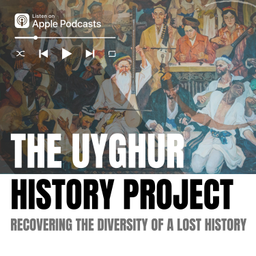
Uyghur History Project
Claim This Podcastby Uyghur History Project
Podcast Overview
<p>In the last century, China’s northwestern Xinjiang Uyghur Autonomous Region has been a theatre of international and regional conflicts, sectarian strife and social upheaval. Today, an estimated 1.5 million of Xinjiang’s native Uyghur population have been incarcerated and subjected to various forms of persecution. Understanding how history has transpired into the current reality is important, because it gives us a direction for taking meaningful action. Join our scholarly discussion on Xinjiang’s past and present, the Uyghur people and their place in the world in the 21st century.</p>
Language
🇺🇲
Publishing Since
10/15/2022
1 verified contact email on file for Uyghur History Project
Pitch yourself as a guest, propose sponsorships, or reach out directly to the host.
Recent Episodes
April 22, 2023
Episode 6: Book Review: Eurasian Crossroads by James Millward
<p>Xinjiang, the vast northwestern region comprising one sixth of the PRC today, borders on India, Pakistan, Afghanistan, Tajikistan, Kyrgyzstan, Kazakstan, Russia and Mongolia. Since antiquity it has stood at the crossroads between China, India, the Mediterranean and Russia. In recent decades its historic silk road linkages have grown increasingly global, with issues of energy, development, separatism and terrorism bringing the region into the news. James Millward draws on primary sources and scholarly research in several European and Asian languages to provide the first general account in English of the history of Xinjiang and its peoples from earliest times to the present. We highly recommend this book as a must-read for all students of Xinjiang, Chinese frontier and Inner Asian history.</p>
April 6, 2023
Episode 5: An Interview with Eric Schluessel: Chinese Economic and Legal Engagement with Xinjiang in the Twentieth Century
<p>The late Qing and early Republic of China era, spanning from 1877 to 1933, is widely recognized as a time of significant transformation in the region of Xinjiang or East Turkestan in Chinese Central Asia. During this period, there was a notable emergence of modern Uyghur national identity, leading to ethnonational conflicts. However, focusing solely on ethnic identity overlooks other factors that contribute to conflict, such as tensions that arose during periods of rapid economic change. Our discussion with Eric Schluessel highlights that much of the violence in Xinjiang was driven by competing local and regional interests. Despite this, the provincial government's information-gathering systems and the way they presented events to the outside world propagated the belief that the violence was due to differences in ethnicity and religion - a clash of Chinese and Muslim cultures. The people in power promoted portrayals of their society that served their political agendas and, in turn, benefited modern Chinese politics.</p>
April 6, 2023
Episode 4: Book Review: Land of Strangers: The Civilizing Project in Qing Central Asia
<p>At the close of the nineteenth century, Confucian revivalists from central China gained control of the Muslim-majority region of Xinjiang, or East Turkestan. There they undertook a program to transform Turkic-speaking Muslims into Chinese-speaking Confucians, seeking to bind this population and their homeland to the Chinese cultural and political realm. Instead of assimilation, divisions between communities only deepened, resulting in a profound estrangement that continues to this day. In Land of Strangers, Eric Schluessel explores this encounter between Chinese power and a Muslim society through the struggles of ordinary people in the oasis of Turpan. He follows the stories of families divided by war, women desperate to survive, children unsure where they belong, and many others to reveal the human consequences of a bloody conflict and the more insidious violence of reconstruction. We highly recommend this book as a must-read for all students of Xinjiang, Chinese frontier and Inner Asian history.</p>
6 total episodes available
Deep-dive analytics for Uyghur History Project
Frequently asked questions
Have a different question and can't find the answer you're looking for? Reach out to our support team by sending us an email and we'll get back to you as soon as we can.
- What is Uyghur History Project?
<p>In the last century, China’s northwestern Xinjiang Uyghur Autonomous Region has been a theatre of international and regional conflicts, sectarian strife and social upheaval. Today, an estimated 1.5 million of Xinjiang’s native Uyghur population have been incarcerated and subjected to various forms of persecution. Understanding how history has transpired into the current reality is important, because it gives us a direction for taking meaningful action. Join our scholarly discussion on Xinjiang’s past and present, the Uyghur people and their place in the world in the 21st century.</p> - How often does this podcast release new episodes?
This podcast updates daily.
- Where can I listen to this podcast?
This podcast is available on 4 platforms including Apple Podcasts, Spotify, and more. You can also use the RSS feed directly.
- Does this podcast accept guests?
Yes, this podcast regularly features guests.
Legal Disclaimer
Pod Engine is not affiliated with, endorsed by, or officially connected with any of the podcasts displayed on this platform. We operate independently as a podcast discovery and analytics service.
All podcast artwork, thumbnails, and content displayed on this page are the property of their respective owners and are protected by applicable copyright laws. This includes, but is not limited to, podcast cover art, episode artwork, show descriptions, episode titles, transcripts, audio snippets, and any other content originating from the podcast creators or their licensors.
We display this content under fair use principles and/or implied license for the purpose of podcast discovery, information, and commentary. We make no claim of ownership over any podcast content, artwork, or related materials shown on this platform. All trademarks, service marks, and trade names are the property of their respective owners.
While we strive to ensure all content usage is properly authorized, if you are a rights holder and believe your content is being used inappropriately or without proper authorization, please contact us immediately at hey@podengine.ai for prompt review and appropriate action, which may include content removal or proper attribution.
By accessing and using this platform, you acknowledge and agree to respect all applicable copyright laws and intellectual property rights of content owners. Any unauthorized reproduction, distribution, or commercial use of the content displayed on this platform is strictly prohibited.