- 7
- Episodes
- 1
- Ratings
- Weekly
- Cadence
- 2026
- First episode
About Vital Pieces
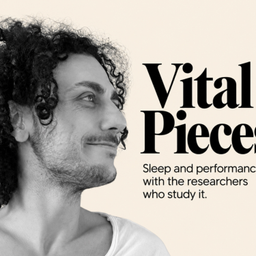
Vital Pieces is a weekly conversation about sleep and what it does to how you perform. I interview the researchers who study it: professors, clinicians and scientists working on sleep, light, memory, recovery and nutrition. Thirty minutes, one guest, the questions you'd ask if you had them in the room. I host it because I spent thirteen years rebuilding my own health after a Crohn's diagnosis and got plenty of the science wrong along the way. Now I ask the people who do the work. New episode every week. I speak to company teams about sleep as a performance tool
- Publisher
- Nima Koucheki
- Category
- health & fitness
- Language
- en
- Explicit
- No
- First episode
- 23 Sept 2026
- Latest episode
- 28 Oct 2026
Latest episodes
7 episodes in the feed.
28 Oct 2026
What eating late does to your body clock
Professor Andries Kalsbeek is Professor of Experimental Neuroendocrinology at Amsterdam UMC and the University of Amsterdam, and leads the Hypothalamic Integration Mechanisms group at the Netherlands Institute for Neuroscience. His research asks how the brain's clock controls your hormones and your metabolism, and what happens when that timing breaks down.The clock in your brain runs on light. But your liver, your gut and your other organs keep their own time, and they set it by when you eat. Eat at the wrong hour and those clocks drift apart, with your brain telling your body one time and your organs working to another.We talk about what that does to how you handle sugar, why people working night shifts carry a higher risk of type 2 diabetes, why jet lag fades in about a week while shift work keeps you out of step, and where morning people and evening people come from in the first place.CHAPTERS 00:00 Why one light at night costs you an hour 00:45 What the biological clock actually does 03:15 Your clock runs longer than 24 hours 06:44 Why your alarm catches your body unprepared 10:37 Melatonin is a darkness signal, not a sleeping pill 15:29 Sleep pressure, and why no pill recreates real sleep 21:17 Every organ has its own clock 23:08 What eating at night does to your insulin 25:41 Jet lag fades. Shift work doesn't. 28:54 Sleeping in two shifts, and the campfire 33:02 Blue light, and how LEDs changed everything 38:01 OutroMORE FROM ANDRIES KALSBEEK Hypothalamic Integration Mechanisms, Netherlands Institute for Neuroscience: https://herseninstituut.nl/author/kalsbeekherseninstituut-knaw-nl/
21 Oct 2026
Daylight saving is propaganda
Professor Till Roenneberg is a chronobiologist at Ludwig Maximilian University in Munich. He built the Munich ChronoType Questionnaire, he coined the term social jet lag, and he has spent twenty years arguing that daylight saving time is a mistake. He opens by explaining why he never takes an intellectual call before four in the afternoon, and the answer turns out to be the whole subject. Your internal clock is genetically set and spread across a population like height is. In a modern city the earliest larks and the latest owls can be twelve hours apart. Then daylight saving. His position is blunt: it's an agreement that everyone goes to work an hour earlier, and we change the clocks so nobody can object. You haven't flown anywhere, so your body clock can't adapt the way it does to travel. He explains what that does inside a cell, why over eighty percent of workers reaching for an alarm clock is the clearest sign of the problem, and why living against your clock doesn't give you a disease so much as bring forward the one you were going to get anyway. We also cover why you can't bank sleep, what your brain does with the faces of strangers on the bus, why weekend lie-ins are biologically necessary rather than lazy, and what he'd change if he ran a company or wrote the law. CHAPTERS 00:00 Why he never takes a call before 4pm 02:55 Getting older makes you earlier 04:09 Can a genetic test tell you your chronotype? 06:45 Twin farmers and office workers: 100,000 lux versus 400 08:03 Why office light pushes your clock later 09:14 Larks, doves and owls, twelve hours apart 10:39 Does living by your chronotype actually matter? 11:55 The Munich ChronoType Questionnaire 12:55 Daylight saving as propaganda 14:26 Working in the wrong time zone without moving 15:48 Amsterdam should be on Greenwich Mean Time 17:06 Spain, late dinners, and why they aren't late 18:12 Social jet lag versus travel jet lag 20:43 Every cell in your body has a clock 23:10 When the orchestra becomes a cacophony 24:33 It doesn't cause the illness. It brings yours forward. 26:01 The alarm clock test 27:09 The washing machine analogy 29:39 "What a waste, a third of my life" 30:59 Why late types can't just go to bed earlier 32:12 Your clock gets later until twenty, then turns around 33:29 What lockdown showed about commuting 34:30 Don't feel guilty about weekend lie-ins 35:46 Bragging about five hours of sleep 36:58 Why you can't bank sleep 39:33 The faces on the bus 43:28 What he'd do as a CEO 44:40 Five hundred safety boots, all the same size 46:13 How to go camping indoors 50:15 The steel industry experiment 53:03 What he'd do as a lawmaker 57:35 Why summer evenings make it worse 58:48 Russia tried this. America is trying again. 01:01:59 The Harvard experiment on short sleepers 01:03:00 The refrigerator you stop hearing MORE FROM TILL ROENNEBERG Chronsulting: https://www.chronsulting.org/ For a chronotype assessment, write to info.chronsulting@gmail.com and Till will send you the procedure.
14 Oct 2026
How to fix insomnia without sleeping pills
Dr. Philip Cheng is Associate Professor of Medicine at Henry Ford Health and Michigan State University Health Sciences, and directs the Center for Behavioral Circadian Medicine. He's President of the Sleep Research Society Foundation. His research covers insomnia, circadian rhythms and shift work, with a focus on getting treatment to people who can't easily access it. Clinical insomnia has a definition most people have never heard: trouble falling or staying asleep around three nights a week, for three months. It doesn't have to happen every night, and he describes the pattern most people actually live with, a run of bad nights followed by a crash where the body catches up. We talk about cognitive behavioural therapy for insomnia, the treatment clinical guidelines put ahead of medication. It runs four to six sessions and it's mostly behavioural. He explains sleep restriction, which consolidates sleep rather than cutting it, and why the hard part isn't the method but sticking to it. We cover the rules that sound small and aren't, one wake time every day and getting out of bed when sleep won't come, and what he does when the behavioural work stalls because of pain or distress. CHAPTERS 00:00 Can insomnia actually be fixed? 00:00 Who I am and why I ask researchers 00:00 What insomnia actually is, clinically 00:00 The crash cycle, and why it isn't every night 00:00 Why CBT-I comes before medication 00:00 Sleep pressure and the body clock 00:00 Sleep restriction, and why it consolidates rather than cuts 00:00 Why sticking to it is the hard part 00:00 When behaviour isn't enough 00:00 One wake time, every day 00:00 Cool, dark, quiet, and what else matters 00:00 Meals and exercise before bed 00:00 A routine that cues the brain to wind down 00:00 Getting out of bed when sleep won't come 00:00 Breathing and visualisation for a racing mind 00:00 Naps, and when they cost you 00:00 Outro MORE FROM PHILIP CHENG Center for Behavioral Circadian Medicine: https://www.henryford.com/hcp/research/sleep/center-for-behavioral-circadian-medicine Sleep research team: https://www.henryford.com/hcp/research/sleep/team Google Scholar: https://scholar.google.com/citations?user=da6WAXYAAAAJ
7 Oct 2026
A Lesson for Life
Professor Mike Tipton studies what happens to the body in extreme environments at the University of Portsmouth. His work helped shape the RNLI's Float to Live message. We talk about the first moments in cold water: the gasp, the loss of breathing control, and the sudden demand on the heart. Mike explains why floating can help when you get into trouble, and what a bystander can do to help. We also discuss saunas, hot yoga, exercise in the heat, and combining cold plunges with breath holding. He explains autonomic conflict, when cold shock and the diving response send competing signals to the heart, and why individual health matters. The conversation ends with a question that gets lost in the cold plunge debate: how strong is the evidence for the benefits, and what should researchers compare cold swimming with? Vital Pieces with Nima Koucheki. Episode 04. CHAPTERS 00:00 A lesson for life 00:14 Welcome to Vital Pieces 00:41 Meet Professor Mike Tipton 01:32 Why cold shock can happen before hypothermia 04:31 The gasp, breathing and strain on the heart 06:30 What to do if you fall into cold water 08:00 Float to Live and finding your float 09:32 When a public health message saves lives 11:19 Helping someone in trouble: phone, float, throw 12:23 A lesson for life 14:11 Inside the Extreme Environments Laboratory 15:15 Hot weather, cold water and drowning 18:12 Heat, football and the World Cup 18:35 Why humidity and sunlight matter 22:08 Hot yoga and sauna: different demands on the body 24:19 Heat exhaustion and heat stroke 24:50 Combining sauna and cold plunges 26:25 Cold shock and the diving response 27:19 Autonomic conflict and heart rhythm 28:54 Why he warns against long breath holds 29:42 Face immersion, the vagus nerve and individual risk 31:05 How strong is the evidence for cold water benefits? 33:22 What to consider before taking up cold swimming 34:43 Sauna, blood pressure and knowing your limits 36:02 Who gets included in cold plunge studies? 36:49 Choose something you enjoy and do it safely 38:34 Outro FURTHER READING RNLI Float to Live: https://rnli.org/water-safety/float Professor Mike Tipton, University of Portsmouth: https://www.port.ac.uk/about-us/structure-and-governance/our-people/our-staff/mike-tipton Shattock and Tipton's paper on autonomic conflict: https://doi.org/10.1113/jphysiol.2012.229864 This conversation is for general information. Your medical history can change the risks of cold water immersion and heat exposure. Follow Vital Pieces for more conversations with researchers.
30 Sept 2026
What changes in perimenopause, the full list
Dr. Funke Afolabi-Brown is a physician board-certified in pediatrics, pediatric pulmonology, and sleep medicine. She founded The Restful Sleep Place, where she helps patients understand what’s keeping them from sleeping.We talk about sleep during perimenopause and menopause, from night sweats and racing thoughts to other sleep disorders that can appear around the same time. She explains when hormone therapy may help, why blood tests don’t tell the whole story, and what she looks at before recommending treatment.Her practical advice starts with a consistent wake-up time, a cool bedroom, and sleep boundaries. For women caring for children and aging parents, that last part can be the hardest.We also discuss children’s bedtime routines, night feeds, and dropping naps. Funke explains why feeding advice needs to account for each baby’s growth and health, with guidance from their pediatrician.00:00 Putting yourself last00:20 Who I am and why I ask researchers00:47 Meet Dr. Funke Afolabi-Brown01:05 What triple board certification means01:43 Who comes to a sleep clinic?02:53 Sleep studies at home03:55 What a sleep assessment looks at05:29 Bedroom temperature, bedding, and sleep05:50 Air quality, allergies, and humidity06:38 Subscribe to Vital Pieces06:50 Sleep during perimenopause and menopause07:28 Night sweats, racing thoughts, and sleep disorders08:22 When hormone therapy may help with sleep09:11 Practical sleep advice for women in midlife10:09 A cooler bedroom and breathable bedding10:24 Setting boundaries around your sleep11:31 What hormone tests can and can’t tell you13:21 Circadian rhythm and consistency14:21 Sleep advice for exhausted parents15:13 Building bedtime habits early16:26 Night feeds and your baby’s individual needs17:22 When children stop needing naps17:44 Where to find Funke and her book Beyond Tired18:53 OutroFind Funke on Instagram, Facebook, and TikTok: @restfulsleepmdBook: Beyond TiredBest pieces10:24 | Setting boundaries around sleep. Funke describes women caring for children and aging parents while leaving themselves last. It’s the strongest personal moment and the section used for the opening hook.08:22 | When hormones explain only part of the problemShe explains why sleep problems that begin during menopause can have several causes. Hormonal symptoms are one part of the assessment.11:31 | The limits of hormone tests. Funke discusses fluctuating hormone levels and why she pays close attention to symptoms. A useful passage for viewers trying to understand what their test results mean.
23 Sept 2026
EP 02 — Dr. Amy Bender
Dr. Amy Bender is a sleep scientist and Adjunct Assistant Professor of Kinesiology at the University of Calgary. She started out scoring sleep studies by hand, ran sleep deprivation research for her PhD, and has worked with around 200 Canadian Olympic team athletes. We talk about banking sleep, the idea that you can build a reserve in the week before something that matters, and the 1990s study that showed it works. She explains how she prepared the Canadian women's sevens rugby team for Paris, where they took silver. And we get into sleep trackers, the Oura lawsuit, and why two trained technicians looking at the same night disagree about a fifth of the time. Chapters below. 00:00 Can you actually bank sleep? 00:30 Who I am and why I ask researchers 00:58 From sleep technologist to sleep EEG 02:15 Keeping people awake for 62 hours 02:46 Working with the Canadian national team 03:41 200 Olympic athletes and margins of a fraction of a second 04:19 Preparing the rugby sevens team for Paris 05:43 Shifting a whole team's clock before they fly 06:55 Why 5pm is peak for Olympic swimmers 07:55 A UFC fighter who couldn't sleep before fights 09:34 Sleeping pills, and why she won't prescribe 09:55 Bank sleep in the week before it matters 11:06 The 1990s study that proves it works 12:18 Can you really hack sleep cycles? 13:23 The boring advice that works 14:51 Polyphasic sleep and the 1800s 16:11 Why night sleep beats daytime sleep 16:39 Naps, yoga nidra, and the 25 minute line 18:00 Ten hour sleepers and what that means 18:24 Dolly Parton and the true short sleepers 20:40 The genetics behind needing four hours 21:29 The Oura lawsuit and orthosomnia 23:14 Even the gold standard disagrees 20% of the time 25:07 What Amy actually rates the Oura ring 26:27 Why I stopped wearing my tracker 27:28 The study where they changed the clocks 30:05 The athlete sleep questionnaire 31:20 Regularity can beat duration 32:28 Outro Athlete Sleep Screening Questionnaire, Centre for Sleep and Human Performance: https://assq.centreforsleep.com/athlete-sleep-screening-questionnaire/athlete.html The validation paper Amy co-authored on that questionnaire: https://pubmed.ncbi.nlm.nih.gov/29869021/ Amy on Instagram: @sleep4sport
23 Sept 2026
EP 01 — Dr. Mariana Figueiro
Dr. Mariana Figueiro studies light and health at Mount Sinai. Her work covers what light does to the human body clock, from hospital lighting to the lamps in your living room. We talk about why melatonin works as a nighttime signal rather than a sedative, and why that changes how you should think about taking it. She explains why morning light matters more than most people realize, since the human clock runs slightly longer than 24 hours and needs resetting every day. And she gives the practical version: buy brighter bulbs, keep the warm color you like, and dim everything a couple of hours before bed. 00:00 Melatonin tells your body it's night 00:20 Who I am and why I ask researchers 00:47 Why morning light matters first thing 01:45 Crossing time zones and shifting your clock 02:14 Your body clock runs longer than 24 hours 03:27 Daily resetting versus jet lag 04:20 Using morning light and evening melatonin together 05:15 What morning light does beyond sleep 06:19 Cortisol in the morning, melatonin at night 07:16 Melatonin is a signal, not a sleeping pill 07:37 Why it won't help if your schedule is regular 08:30 Animals with no measurable melatonin still sleep 09:36 Why sleep exists even though it leaves us vulnerable 11:23 Dreams, REM, and what happens without them 12:12 Sleep deprivation records and micro sleeps 12:54 How to build the perfect morning 14:00 Living somewhere the sun doesn't come up 15:12 Make your lamps four times brighter 16:04 Light boxes versus diffuse lamps 16:53 How to set up your evening 17:47 Screens, and why the answer is it depends 18:22 Blue light blockers, and when they help 19:21 Bedtime lighting with a seven year old 20:31 The myth about light from above 21:22 Don't turn sleep into another thing to worry about 21:50 Bright days, dim evenings, dark nights
Reach and audience
Public platform figures. Ratings count people who left a rating, not total listeners.
- Spotify
- 5.0 / 5
- 1 ratings
Contact Vital Pieces
- Guest appearances
- Books guests
Based on episode analysis; this does not confirm that the show is currently accepting guests.
Host of Vital Pieces?
Claim your podcast to manage its listing and keep your show details accurate.
Pod Engine is an independent podcast discovery and analytics service and is not affiliated with or endorsed by this podcast. Artwork and show content belong to their owners. Full legal notice.
Explore this show
Podcast research with Pod Engine