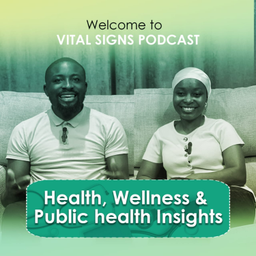
Podcast thumbnail for Vital Signs Podcast

Vital Signs Podcast

Claim This Podcast

by Vital Signs Podcast

5.0(2 reviews)
27 episodes
Updated Daily
Accepts GuestsHas SponsorsLocation 🇳🇬

Podcast Overview

Welcome to the Vital Signs Podcast - your go-to audio guide for public health, wellness, and the pulse of healthcare systems around the world. Hosted by healthcare professionals passionate about making health information accessible, we dive deep into the signs that matter most — from the latest medical research and real-life patient stories to mental health, preventative care, and the social issues shaping our wellbeing. Whether you're a curious listener, a health worker, or someone navigating their own care journey, this podcast is here to inform, empower, and spark meaningful conversations.

Language

🇺🇲

Publishing Since

8/14/2025

1 verified contact email on file for Vital Signs Podcast

Pitch yourself as a guest, propose sponsorships, or reach out directly to the host.

Recent Episodes

Episode thumbnail for What Now? Can Nigerian Healthcare Actually Be Fixed? (Series Finale)

July 14, 2026

What Now? Can Nigerian Healthcare Actually Be Fixed? (Series Finale)

<p>For ten weeks, Vital Signs Unfiltered has walked through Nigeria&#39;s healthcare system — the failures, the deaths, the missing money, the people who left, and the ones who stayed. In this season finale, we ask the only question that remains: what now? Can it actually be fixed?</p><p><br></p><p>A broken system is not the same as an irreversible one. Other countries have rebuilt collapsed health systems before. Rwanda — after the genocide of 1994 — restructured its healthcare almost from scratch, and now ranks among the best-performing in Africa. Reform is possible. But only if the will exists.</p><p><br></p><p>So what would change in Nigeria require? Three things. First, funding: meeting the Abuja Declaration target of 15% of the national budget would more than double current health spending. Second, workforce retention: better salaries, safer hospitals, and clear pathways for newly qualified doctors and nurses. Third, primary care: strong, well-equipped community clinics that catch problems before they reach hospitals.</p><p><br></p><p>And the case for reform is not just moral — it is mathematical. According to global health research, every dollar invested in primary healthcare in low-resource settings returns multiple dollars in economic productivity, life expectancy, and reduced emergency cost.</p><p><br></p><p>But policy alone is not enough. Trust has to be rebuilt. Patients must feel respected. Healthcare workers must feel protected. And accountability must mean something — when a hospital fails, when a budget disappears, when a life is lost. That is the harder reform, and it cannot be done by government alone. Citizens knowing their rights. Nurses speaking up. Doctors staying when they can. Journalists asking questions. Diaspora professionals coming home, even temporarily, to teach, train, and treat. Reform happens when many small forces push in the same direction at once.</p><p><br></p><p>Nigeria&#39;s healthcare system is broken. But broken is a description — not a destiny. The deaths we have spoken about across this series were preventable. Which means future ones can be too.</p><p><br></p><p>Because sometimes the end of a question is the beginning of a demand.</p><p><br></p><p>🎙️ Follow Vital Signs Podcast on Spotify for more.</p><p><br></p><p>⭐ If this series moved you, please rate the show — it helps more Nigerians find it.</p><p><br></p><p>Sources: World Health Organization, Abuja Declaration 2001 Archive, Rwanda Ministry of Health, global primary care investment research.</p>

Episode thumbnail for The Ones Who Stayed: The People Holding Nigerian Healthcare Together

July 5, 2026

The Ones Who Stayed: The People Holding Nigerian Healthcare Together

<p>Last week, we talked about the ones who left. Today, we talk about the ones who stayed.</p><p><br></p><p>While the loudest story in Nigerian healthcare is about the doctors and nurses who emigrated, this episode of Vital Signs Unfiltered is about the invisible workforce that keeps the system alive when everything else fails — the nurses, midwives, junior doctors, lab scientists, cleaners, porters, pharmacists, traditional birth attendants, and the families who become caregivers when no one else can.</p><p><br></p><p>The Nursing and Midwifery Council of Nigeria records over 200,000 registered nurses and midwives in the country. But for a population of 220 million, the WHO recommends nearly three times that number. Each Nigerian nurse is doing the job of three. Each junior doctor is covering for two consultants who left. Each pharmacist is rationing supplies that should have been replenished months ago.</p><p><br></p><p>And the cost is invisible. Burnout. Compassion fatigue. Trauma without therapy. Healthcare workers report being shouted at by patients, under-protected by management, and sometimes physically assaulted on the wards. And still, they keep coming back.</p><p><br></p><p>It&#39;s not just hospital staff. It&#39;s traditional birth attendants catching babies in homes with no electricity. It&#39;s community health workers travelling hours to reach a single patient. It&#39;s families becoming nurses to their own sick relatives because no one else can. This is the workforce statistics don&#39;t always capture.</p><p><br></p><p>Without these people, Nigerian healthcare would have collapsed long ago. They are the reason the system functions at all — and the reason no one notices how broken it really is, because they keep absorbing the failure on its behalf.</p><p><br></p><p>This episode is for them.</p><p><br></p><p>🎙️ Follow Vital Signs Podcast on Spotify for the rest of the Unfiltered series.</p><p><br></p><p>⭐ If this episode moved you, please rate the show — it helps more Nigerians find it.</p><p><br></p><p>Sources: Nursing and Midwifery Council of Nigeria, World Health Organization, Federal Ministry of Health Nigeria.</p>

Episode thumbnail for Faith, Herbs, and Hope: When Hospitals Fail, Where Do Nigerians Turn?

June 22, 2026

Faith, Herbs, and Hope: When Hospitals Fail, Where Do Nigerians Turn?

<p>When the hospital is too far, too expensive, or too cold, Nigerians turn to something else. A pastor. A herbalist. A neighbour with strong opinions and a bag of leaves.</p><p><br></p><p>In this episode of Vital Signs Unfiltered, we step into the space between modern medicine and traditional belief — and what it costs.</p><p><br></p><p>Traditional and faith-based healing has deep roots in Nigerian culture. Long before colonial hospitals, communities had healers, midwives, and prayer warriors who knew their people. That history is real, and it deserves respect. But when it replaces evidence-based care entirely, the consequences can be devastating.</p><p><br></p><p>The World Health Organization estimates that up to 80% of people in many African countries use traditional medicine for some part of their healthcare. Nigeria is no exception — studies suggest that a significant proportion of Nigerian patients seek traditional or spiritual treatment before reaching a hospital, sometimes for years. And by the time they arrive, the cancer has often spread, the diabetes has caused organ damage, the pregnancy complication has become an emergency.</p><p><br></p><p>But the reasons people turn to alternatives are not irrational. Hospitals are expensive. Doctors don&#39;t always explain. The waiting is long, the rooms are crowded, and the staff are often exhausted. A pastor listens. A herbalist gives time. A neighbour shares stories of others who got better. That is care — even when the medicine is wrong.</p><p><br></p><p>The truth isn&#39;t that Nigerians choose ignorance. The truth is that the system has failed to give them anything better. And until it does, faith will keep filling the gap.</p><p><br></p><p>🎙️ Follow Vital Signs Podcast on Spotify for the rest of the Unfiltered series.</p><p><br></p><p>⭐ If this episode moved you, please rate the show — it helps more Nigerians find it.</p><p><br></p><p>Sources: World Health Organization, Nigerian medical journals, Federal Ministry of Health Nigeria.</p>

27 total episodes available

Deep-dive analytics for Vital Signs Podcast

Frequently asked questions

Have a different question and can't find the answer you're looking for? Reach out to our support team by sending us an email and we'll get back to you as soon as we can.

What is Vital Signs Podcast?

Welcome to the Vital Signs Podcast - your go-to audio guide for public health, wellness, and the pulse of healthcare systems around the world. Hosted by healthcare professionals passionate about making health information accessible, we dive deep into the signs that matter most — from the latest medical research and real-life patient stories to mental health, preventative care, and the social issues shaping our wellbeing.

Whether you're a curious listener, a health worker, or someone navigating their own care journey, this podcast is here to inform, empower, and spark meaningful conversations.

How often does this podcast release new episodes?

This podcast updates daily.

Where can I listen to this podcast?

This podcast is available on 4 platforms including Apple Podcasts, Spotify, and more. You can also use the RSS feed directly.

Does this podcast accept guests?

Information about guest appearances is not available.

Legal Disclaimer

Pod Engine is not affiliated with, endorsed by, or officially connected with any of the podcasts displayed on this platform. We operate independently as a podcast discovery and analytics service.

All podcast artwork, thumbnails, and content displayed on this page are the property of their respective owners and are protected by applicable copyright laws. This includes, but is not limited to, podcast cover art, episode artwork, show descriptions, episode titles, transcripts, audio snippets, and any other content originating from the podcast creators or their licensors.

We display this content under fair use principles and/or implied license for the purpose of podcast discovery, information, and commentary. We make no claim of ownership over any podcast content, artwork, or related materials shown on this platform. All trademarks, service marks, and trade names are the property of their respective owners.

While we strive to ensure all content usage is properly authorized, if you are a rights holder and believe your content is being used inappropriately or without proper authorization, please contact us immediately at hey@podengine.ai for prompt review and appropriate action, which may include content removal or proper attribution.

By accessing and using this platform, you acknowledge and agree to respect all applicable copyright laws and intellectual property rights of content owners. Any unauthorized reproduction, distribution, or commercial use of the content displayed on this platform is strictly prohibited.