- 18
- Episodes
- Weekly
- Cadence
- 2026
- First episode
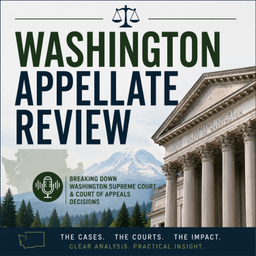
About Washington Appellate Review
Washington Appellate Review examines significant decisions from the Washington Supreme Court and Washington Court of Appeals. Each episode uses the IRAC method—Issue, Rule, Analysis, and Conclusion—to break down recent appellate opinions, explain the court's reasoning, and discuss the practical impact on Washington law. Companion episodes feature full readings of published opinions, allowing listeners to hear the court's words directly. Designed for attorneys, judges, law students, journalists, public officials, and anyone interested in Washington law. This podcast is for educational and infor
- Publisher
- Washington Appellate Review
- Category
- government
- Language
- en
- Explicit
- No
- First episode
- 5 Jun 2026
- Latest episode
- 19 Sept 2026
Latest episodes
18 episodes in the feed.
19 Sept 2026
Initiative 2066 Struck Down: The Single-Subject Rule & Climate Solutions v. State
Washington voters approved Initiative 2066. So how did the Washington Supreme Court end up striking down the entire initiative? In Climate Solutions v. State of Washington, the court held that I-2066 violated Washington Constitution article II, section 19—the single-subject rule. The majority concluded that the initiative combined four constitutionally distinct subjects without the required rational unity and that the offending provisions could not be severed. In this episode of Washington Appellate Review, we break down the court’s distinction between horizontal and vertical rational unity, why natural-gas access, air-quality regulation, building and energy codes, and the repeal of a severability clause became central to the analysis, and why the majority rejected arguments that I-2066 could survive as an omnibus measure. We also examine Justice Mungia’s dissent, which would have severed specific provisions and preserved most of the voter-approved initiative, and the deeper disagreement between the opinions over judicial review, Washington’s initiative power, and how demanding the constitutional rational-unity requirement should be. We’ll also explain an important limitation on the decision: the Supreme Court majority did not decide the separate subject-in-title or article II, section 37 silent-amendment challenges. 🎙️ Follow Washington Appellate Review on Spotify for new Washington appellate decisions, and subscribe on YouTube for video case breakdowns, Shorts, and Washington Supreme Court coverage. Washington Appellate Review is for educational and informational purposes only. It is not legal advice and does not create an attorney-client relationship. Always read the full opinion and conduct independent legal research.
10 Sept 2026
Liberty on the Line: Expert Vouching, Joel’s Law & the Limits of Judicial Authority
Two Washington Court of Appeals decisions filed on the same day ask a similar question from very different directions: what legal safeguards must be respected when government action affects a person’s liberty? In State v. Rowan, Division III held that the evidence was legally sufficient to support two convictions for first-degree rape of a child—but reversed the convictions because the State’s examining doctor gave an improper opinion that effectively vouched for the child witness’s credibility. The court explains the distinction between sufficiency of the evidence and reversible trial error, why credibility determinations belong to the jury, and when an unpreserved claim of expert vouching may be reviewed as manifest constitutional error under RAP 2.5(a)(3). Then, in In re Detention of R.P., Division II examines Joel’s Law, RCW 71.05.201. The court reversed R.P.’s initial 120-hour involuntary-detention order because the petition was filed by his sister-in-law, who was not among the family members authorized by statute to initiate the proceeding. The court also explains why the collateral bar rule did not prevent R.P. from directly appealing the order. The later 14-day commitment, however, was separately affirmed. Together, the cases illustrate a recurring appellate principle: serious factual concerns do not eliminate statutory and constitutional protections. Courts still must ask whether the right person invoked the process, whether the right decision-maker resolved the issue, and whether the evidence was presented in a legally permissible way. This episode covers expert testimony, witness credibility, constitutional harmless-error review, Joel’s Law, civil commitment, strict statutory construction, the collateral bar rule, and the procedural safeguards that matter when liberty is at stake. Washington Appellate Review is for educational and informational purposes only. It is not legal advice, does not create an attorney-client relationship, and is not a substitute for reading the full opinions, reviewing the governing statutes and rules, checking subsequent history, and conducting independent legal research.
8 Sept 2026
Where Criminal Liability Crosses the Line: State v. Kueck & State v. Le
Where does criminal conduct cross the statutory line? In this episode of Washington Appellate Review, we examine two published Washington Court of Appeals decisions that confront that question in dramatically different circumstances. In State v. Kueck, Division III interprets what it means to kill an animal while “manifesting an extreme indifference to life” under RCW 16.52.205(1)(c). The court explains why intentional and unjustified killing alone cannot satisfy the phrase—and what additional circumstances can establish the aggravated culpability required for first-degree animal cruelty. Then, in State v. Le, Division I examines the boundary between preparation and criminal attempt. After communicating with an undercover officer posing as a mother offering her minor daughters for sex, Le negotiated a price, arranged a meeting, traveled to the location, and arrived carrying condoms and the agreed-upon cash. The court considers whether those actions constituted a “substantial step” under RCW 9A.28.020 and explains how Washington's modern attempt standard differs from the older “overt act” formulation. Together, Kueck and Le illustrate an important principle of statutory interpretation: every element matters. Courts cannot simply collapse “extreme indifference” into intentional killing or “substantial step” into criminal intent. The State must prove that the defendant crossed the particular threshold the legislature established. We break down the facts, holdings, statutory language, appellate reasoning, and practical implications of both decisions—and what they teach Washington practitioners about sufficiency of the evidence, statutory construction, and the boundaries of criminal liability. Washington Appellate Review is for educational and informational purposes only. It is not legal advice and does not create an attorney-client relationship. Read the full published opinions and conduct independent legal research before relying on any case discussed on the show.
3 Sept 2026
When Two Theories Can Coexist: Earl v. Campbell, Negligent Retention & Vicarious Liability
Can an employer face both vicarious liability for an employee’s conduct and a separate negligent-retention claim for keeping that employee on the job? In Earl v. Campbell, No. 104495-0, the Washington Supreme Court unanimously says yes. The case arises from the 2016 fatal shooting of Jacqueline Salyers during an encounter with Tacoma police officers. Her estate sought to pursue both a vicarious-liability theory against the City of Tacoma and a direct negligent-retention claim based on allegations concerning Officer Aaron Joseph. The City argued that because the officers were acting within the scope of employment, negligent retention could not proceed separately. The Supreme Court rejected that rule. In this episode of Washington Appellate Review, we break down why the Court treated the two theories as analytically distinct: Vicarious liability concerns an employer’s responsibility for an employee’s tort. Negligent retention concerns the employer’s own alleged negligence in retaining an employee it knew, or reasonably should have known, was unfit. We also examine CR 8’s alternative-pleading rules, the Court’s treatment of Beltran-Serrano, Niece, and Anderson, its rejection of prior Court of Appeals authority tying negligent retention to scope of employment, and the practical implications for comparative fault, evidentiary issues, and double recovery. Just as important, this is a pleading-stage decision. The Supreme Court did not find that Tacoma was negligent, that Officer Joseph was unfit, that the underlying allegations were true or admissible, or that negligent retention caused Salyers’s death. The Court held only that the claim may proceed. Washington Appellate Review is for educational and informational purposes only. It is not legal advice, does not create an attorney-client relationship, and is not a substitute for reading the full opinion, reviewing the governing law, checking subsequent history, and conducting independent legal research.
3 Sept 2026
Washington at Work: DoorDash, WISHA, and the Reach of L&I
Two Washington Court of Appeals decisions filed the same day examine worker protection from two very different angles: who counts as a covered worker under the Industrial Insurance Act, and what safety rules require once a worker is exposed to a regulated hazard. In DoorDash, Inc. v. Department of Labor & Industries, Division II reviews roughly $14.5 million in industrial-insurance premiums and penalties and asks whether Dashers qualify as covered workers under RCW 51.08.180. The court explains why the independent-contractor label does not end the analysis, why using an ordinary personal vehicle does not necessarily make equipment rather than labor the essence of the contract, and why an earlier Board decision involving phone-book delivery did not collaterally estop L&I. Then, in Northwest Cascade, Inc. v. Department of Labor & Industries, the court considers a traffic flagger standing 7 feet 8 inches from a 17-foot-deep trench. The opinion explains WISHA’s definition of an excavation’s “affected area,” why a traffic flagger was not considered directly involved in the excavation process, and why Northwest Cascade failed to establish that fall protection was infeasible. Together, the cases show how Washington worker-protection law focuses on function over labels, regulatory text over intuition, and the actual administrative record over broad assumptions. Key topics include: industrial-insurance coverage, the personal-labor test, independent contractors, collateral estoppel, WISHA, excavation and trench safety, fall-protection requirements, regulatory exceptions, infeasibility defenses, and judicial review of L&I decisions. Washington Appellate Review is for educational and informational purposes only. It is not legal advice, does not create an attorney-client relationship, and is not a substitute for reading the actual opinions, reviewing the governing statutes and regulations, and conducting independent legal research.
1 Sept 2026
Charged, Not Convicted: Bailey-Cobb, Drug-Monitoring Patches & Washington Privacy Rights
Can a court require someone who has been charged with DUI—but not convicted—to continuously wear a drug-monitoring patch as a condition of pretrial release? In this episode of Washington Appellate Review, we examine Division One's published decision in Simone A. Bailey-Cobb v. Snohomish County District Court, consolidated with Andrew P. Toombs v. Snohomish County District Court, and an important question under article I, section 7 of the Washington Constitution. Bailey-Cobb and Toombs were each awaiting trial when the district court required them to wear transdermal drug-monitoring patches. The devices attach directly to the skin, continuously collect sweat, and can detect evidence of drug use over an extended period. The State argued that the monitoring furthered the compelling governmental interest of protecting the public from impaired driving and was authorized by Washington's pretrial-release statutes and court rules. Division One disagreed. The court emphasized a critical constitutional distinction: a person awaiting trial is not a probationer. Bailey-Cobb and Toombs had been charged with crimes, but they had not been convicted. Division One held that they therefore did not possess the diminished privacy interests applicable to convicted offenders. The government's legitimate interest in public safety did not, by itself, supply the "authority of law" required by article I, section 7. The episode examines RCW 10.21.045 and CrRLJ 3.2, the State's balancing-test and special-needs arguments, and why statutory authority to impose pretrial conditions does not automatically make a particular search constitutional. We also look closely at the technology itself. The patches continuously collect biological information, can identify drugs beyond those prohibited by the release order, require information to be shared with a third-party monitoring company, and do not actually test for alcohol. Those characteristics became important to Division One's conclusion that the monitoring was not sufficiently tailored to justify the intrusion. The significance of Bailey-Cobb reaches beyond DUI cases and drug patches. As courts gain access to increasingly sophisticated forms of continuous biometric, chemical, and electronic monitoring, this decision raises a much larger question: Does the fact that technology makes continuous government monitoring possible make that monitoring constitutionally permissible? Division One's answer reinforces an important principle of Washington constitutional law: technological capability and constitutional authority are not the same thing. For criminal defense attorneys, prosecutors, judges, and lawyers litigating pretrial-release conditions, the decision is also an important reminder that being accused of a crime does not itself eliminate the privacy protections guaranteed by article I, section 7. Cases: Simone A. Bailey-Cobb v. Snohomish County District Court and Andrew P. Toombs v. Snohomish County District Court, Washington Court of Appeals, Division One, Nos. 87585-0-I and 87738-1-I. Washington Appellate Review breaks down significant decisions from Washington's appellate courts, explaining what the courts held, why they reached those decisions, and what those rulings mean for Washington law. This podcast is for educational and informational purposes only. It is not legal advice, does not create an attorney-client relationship, and is not a substitute for reading the complete published opinion and conducting independent legal research. Why This Case Matters
27 Aug 2026
Who Decides a Recall? The Port of Benton Case and Washington’s Recall Process
When Washington voters seek to recall an elected official, who decides whether the accusations are actually true—the courts or the voters? In this episode of Washington Appellate Review, we examine the Washington Supreme Court's unanimous decision in In re Recall of William O'Neil, Scott Keller, and Lori Stevens, No. 105253-7, filed August 20, 2026, involving all three commissioners of the Port of Benton. The recall effort originally contained 13 charges. Most were dismissed. The Supreme Court considered three surviving charges: two involving alleged retaliation against Port employees and a third involving Commissioner Scott Keller's financial disclosure filings and his ownership interest in The Axe LLC. But the most important point about the decision is what the Supreme Court did not decide. The Court did not determine that any commissioner committed the alleged misconduct. Instead, it considered whether the allegations were sufficiently supported and legally adequate to be placed before the voters. Factual vs. Legal Sufficiency We break down the two separate thresholds a recall charge must satisfy under Washington law and explain why a recall proceeding is not a trial on the truth of the allegations. The Constitutional Right of Recall We examine article I, sections 33 and 34 of the Washington Constitution, RCW 29A.56.110, and the unusual division of responsibility Washington law creates between judges and voters. Charges 12 and 13: Alleged Retaliation The episode examines allegations surrounding the suspension of Executive Director Diahann Howard and termination of Finance Director Alicia Myers, including why timing, motive, and the limits on discretionary governmental authority became important to the Court's analysis. Charge 7: Financial Disclosure We analyze the charge against Commissioner Keller involving financial disclosure forms and The Axe LLC, including the distinction between an innocent reporting mistake and an allegation of intentional concealment. Discretion Isn't Unlimited Public officials routinely make discretionary personnel decisions. We discuss why those decisions generally cannot support recall—and when an alleged manifest abuse of discretion may cross the line into legally sufficient recall charges. This case provides a practical roadmap for understanding Washington recall law. The Supreme Court's role is essentially that of a constitutional gatekeeper. Courts determine whether allegations satisfy the legal requirements necessary to proceed. They do not decide whether those allegations are ultimately true. That responsibility belongs to the voters. For elected officials, government and municipal attorneys, employment lawyers, election-law practitioners, and attorneys drafting or challenging recall petitions, the opinion provides important guidance about the boundary between political disagreement, discretionary decision-making, and legally sufficient allegations of official misconduct. Courts act as gatekeepers. Voters decide the facts and ultimately determine whether an elected official should remain in office. Case discussed: In re Recall of William O'Neil, Scott Keller & Lori Stevens, Washington Supreme Court No. 105253-7 (Aug. 20, 2026). Washington Appellate Review breaks down significant decisions from the Washington Supreme Court and Washington Court of Appeals—explaining what the courts held, why they reached those decisions, and what Washington lawyers need to know. This podcast is for educational and informational purposes only. It is not legal advice, does not create an attorney-client relationship, and is not a substitute for reading the actual opinion and conducting independent legal research. In this episode:Why This Opinion MattersFinal Takeaway
27 Aug 2026
State v. Sliger: Chewing Tobacco, Breath Tests & a Divided Washington Supreme Court
Can tiny strands of chewing tobacco left between a driver's teeth make a breath-alcohol test inadmissible? In this episode of Washington Appellate Review, we examine State v. Sliger, a closely divided Washington Supreme Court decision addressing the statutory requirements for admitting breath-test evidence in a vehicular homicide prosecution. The case arose after law enforcement arrested Sliger following a fatal collision. Before administering a Draeger breath test, the officer conducted the required observation period. Sliger removed a lump of chewing tobacco from his mouth, but the officer later observed small strands of tobacco remaining between his teeth. That seemingly minor fact produced a major disagreement at the Washington Supreme Court. The Breath-Test Foundation We examine former RCW 46.61.506(4)(a)(iii), WAC 448-16-040, and Washington's statutory requirements for establishing a prima facie foundation for admission of breath-test results. What Does "Any Foreign Substance" Mean? The lead opinion concluded that the statute should be interpreted in light of the reliability of the breath test. The Court considered expert testimony that the residual tobacco strands could not have affected the test results. Admissibility vs. Weight We explore an important distinction for trial lawyers: when does a problem with a breath test prevent the evidence from reaching the jury, and when does it instead become an issue affecting the weight the jury should give that evidence? A Fractured Court The decision requires particular attention because the justices did not speak with one voice. Four justices joined Justice Madsen's lead opinion. Justice González concurred in the result but disagreed with important aspects of the lead opinion's reasoning, supplying the fifth vote to affirm. The Dissent's Bright-Line Rule Justice Mungia, joined by three other justices, argued that the statute means what it says: once an officer observes a foreign substance in the subject's mouth, the statutory and Washington State Patrol procedures must be followed. Under that interpretation, the remaining tobacco should have prevented admission of the breath-test results. Sliger is about much more than chewing tobacco. The disagreement exposes a fundamental question about evidentiary rules: Should courts demand strict compliance with a legislatively created procedural safeguard, or should admissibility ultimately turn on whether the deviation could actually affect the scientific reliability of the evidence? For DUI and vehicular-homicide practitioners, the decision also provides an important lesson about preserving challenges to breath-test evidence, developing the scientific record, and distinguishing questions of admissibility from arguments about evidentiary weight. Today's Final Takeaway: When reading a fractured appellate decision, don't stop at the result. Count the votes and determine precisely which reasoning actually commanded a majority. Case: State v. Sliger, Washington Supreme Court No. 103563-2 (Aug. 13, 2026). Washington Appellate Review breaks down significant decisions from the Washington Supreme Court and Washington Court of Appeals, explaining what the courts held, why they ruled the way they did, and what those decisions mean for Washington law. This podcast is provided for educational and informational purposes only. It is not legal advice, does not create an attorney-client relationship, and is not a substitute for reading the actual opinion or conducting independent legal research. In this episode:Why This Case Matters
24 Jul 2026
When Statutes Matter: Construction Liens, Public Corruption & Two Important Division III Decisions | Washington Appellate Review
How much can a court decide in an expedited proceeding? And how much turns on the precise words chosen by the Legislature? In this episode of Washington Appellate Review, we examine two published decisions from Division III of the Washington Court of Appeals that demonstrate how procedural posture and statutory language can determine the outcome of a case. Using our IRAC format—Issue, Rule, Application, and Conclusion—we analyze: Feekes v. Triple M Construction, LLC – A construction lien dispute addressing the limited scope of Washington's expedited lien release procedure, when a contractor must provide the statutory Notice to Customer, and why disputed factual issues generally cannot be resolved through a summary show-cause hearing. State v. Tarver – A significant statutory interpretation case examining Washington's unlawful compensation statute, where the Court considered whether "compensation" includes sexual contact and whether a dependency proceeding and visitation arrangements qualify as a "transaction" under RCW 9A.68.030. Why construction lien challenges under RCW 60.04.081 are intentionally limited. How the scope of a contractor's agreement affects statutory notice requirements. Why prevailing at trial does not automatically entitle a party to attorney fees on appeal. How Washington courts interpret undefined statutory terms using ordinary meaning and legislative context. Why preserving the procedural posture of a case is often just as important as the underlying legal issue. We conclude by connecting these opinions through a common theme: successful appellate advocacy begins with the statutory text, respects the procedural posture of the case, and recognizes that appellate courts resolve legal questions—not disputed facts. Whether you're a practicing attorney, judge, law student, or simply interested in Washington law, this episode provides practical insight into how the Court of Appeals approaches both civil and criminal cases. Cases Discussed: Feekes v. Triple M Construction, LLC (Division III) State v. Tarver (Division III) ⚖️ Washington Appellate Review brings you clear, practical analysis of the latest published decisions from the Washington Supreme Court and Washington Court of Appeals—helping legal professionals stay informed, one opinion at a time. This podcast is provided for educational and informational purposes only. It is not legal advice and does not create an attorney-client relationship. Because every case depends on its unique facts and the law continues to evolve, listeners are encouraged to read the full published opinions and conduct their own legal research before relying on any legal principle discussed in this episode. In this episode you'll learn:
19 Jun 2026
State v. Meta Platforms: Political Advertising, Free Speech, and the Limits of Transparency
In this episode of Washington Appellate Review, we examine one of the most significant election-law and First Amendment cases to reach the Washington Supreme Court in recent years: State of Washington v. Meta Platforms, Inc. At the center of the dispute is Washington's Fair Campaign Practices Act and the state's effort to require greater transparency in political advertising. The case arose after Meta, the parent company of Facebook and Instagram, refused to comply with Washington's public-disclosure requirements for political advertisements, leading to a major enforcement action and substantial civil penalties. Using the IRAC method, we break down the legal questions presented to the Court, including whether Washington's disclosure requirements violate the First Amendment, whether Meta committed hundreds of separate violations of state campaign-finance laws, and whether the resulting penalties were constitutionally excessive. The episode follows the case from the trial court through the Court of Appeals and ultimately to the Washington Supreme Court, where the justices considered the balance between political transparency and constitutional protections for speech and association. The Court ultimately affirmed Meta's liability and allowed the multi-million-dollar penalty judgment to stand. Can a state require social-media companies to disclose political advertising information? Are campaign-finance disclosure laws different from restrictions on speech? How does the First Amendment apply to modern digital platforms? When does a civil penalty become an excessive fine? What authority do states have to regulate online political advertising? For voters, the decision highlights the role transparency plays in modern elections. For technology companies, it signals that states may continue to impose disclosure obligations on digital advertising platforms. For political campaigns and election lawyers, the ruling provides important guidance on campaign-finance compliance and public-record requirements. For legislators and policymakers, the case offers a roadmap for future efforts to regulate political advertising in the digital age. Join us as we examine a landmark Washington Supreme Court decision at the intersection of elections, technology, free speech, and government transparency. Washington Appellate Review is provided for educational and informational purposes only and does not constitute legal advice. Questions Discussed in This EpisodeWhy This Case Matters
17 Jun 2026
Appellate Roundup: Probate Deadlines, Contractor Claims, and the Meaning of Live Performance
In this episode of Washington Appellate Review, we examine two Washington Court of Appeals decisions that demonstrate how statutory language can determine the outcome of a case. Although the cases arise in very different areas of law—probate administration and criminal prosecution—both turn on the courts' interpretation of key statutory terms and the practical consequences that follow. The first case, Right Now Heating, Cooling & Plumbing, LLC v. Estate of Gerald D. Hall, addresses the strict deadlines governing creditor claims against a decedent's estate. The central question was whether a contractor qualified as a "reasonably ascertainable creditor" under Washington probate law. The Court of Appeals concluded that the estate's personal representative exercised reasonable diligence when reviewing the decedent's records and that the contractor was not reasonably ascertainable. Because the contractor failed to file its claim within the shorter statutory deadline, its claim against the estate was barred. The second case, State v. Moss, examines the meaning of "live performance" under Washington's sexual exploitation of a minor statute. The Court of Appeals was asked to decide whether a minor exposing herself at an adult's direction while the adult watched constituted a live performance under the statute. Applying traditional principles of statutory interpretation, the court concluded that the conduct qualified as an "other exhibition" and therefore satisfied the statutory definition of a live performance. Using the IRAC method, we break down both opinions and explain how Washington courts interpret statutes by examining legislative purpose, statutory context, and the specific facts presented in each case. Questions discussed in this episode: • What makes a creditor "reasonably ascertainable" under Washington probate law? • How much investigation must a personal representative perform before creditor deadlines begin to run? • Why was the contractor's claim against the estate dismissed as untimely? • What does the term "live performance" mean under Washington's sexual exploitation statute? • How did the Court of Appeals apply the doctrine of ejusdem generis to interpret the statute? • Why can a private, noncommercial exhibition satisfy the statutory definition of a performance? Why These Cases Matter For probate attorneys and personal representatives, the Hall Estate decision highlights the importance of documenting creditor reviews and preserving the statutory presumption of reasonable diligence. For contractors and creditors, the opinion serves as a reminder that informal collection efforts may not be sufficient to preserve claims against an estate. Formal notice procedures, mechanic's liens, and documented communications remain critical tools. For criminal practitioners, State v. Moss provides important guidance on the scope of Washington's sexual exploitation statutes and the meaning of statutory language that may not be expressly defined. For appellate lawyers, both opinions demonstrate how seemingly small statutory terms can become outcome-determinative issues on appeal. Although one case involves probate deadlines and the other criminal liability, both reinforce the same lesson: careful attention to statutory language and factual context often determines who wins and who loses in Washington's appellate courts. Washington Appellate Review is provided for educational and informational purposes only and does not constitute legal advice.
16 Jun 2026
Verduzco v. King County: Retaliation, Workplace Bias, and a Critical Jury Instruction
In this episode of Washington Appellate Review, we examine the Washington Supreme Court's decision in Verduzco v. King County, a significant employment-law case involving workplace retaliation, discrimination complaints, and the rules that govern how juries decide these disputes. Reynaldo Verduzco, a longtime King County employee, alleged that the county retaliated against him after he repeatedly raised concerns about racial bias and discrimination within his department, particularly regarding hiring practices. Following those complaints, Verduzco experienced a series of employment actions, including letters of expectations, a performance review, administrative leave, a suspension without pay, and a reassignment. The case ultimately reached the Washington Supreme Court, where the central question was not whether retaliation occurred, but whether the jury was properly instructed on what constitutes an "adverse employment action" under Washington's Law Against Discrimination. Using the IRAC method, we break down the competing legal standards and explain why the Court found the trial court's instruction potentially misleading. The discussion explores the difference between the standard used in discrimination claims—whether an action materially affects the terms and conditions of employment—and the broader standard used in retaliation claims, which asks whether an employer's action would discourage a reasonable employee from reporting discrimination. The Washington Supreme Court concluded that combining the two standards into a single jury instruction created the potential for confusion. However, the Court also held that King County failed to prove the error actually affected the outcome of the trial. As a result, the Court declined to reverse the verdict and remanded the case to the Court of Appeals for consideration of remaining issues. Questions discussed in this episode: • What qualifies as an adverse employment action in a retaliation case? • Why are retaliation claims evaluated differently from discrimination claims? • When does an incorrect jury instruction become reversible error? • Why did King County lose even though the Supreme Court found problems with the instruction? • What lessons can lawyers and employers learn from this decision? Why This Case Matters For employees, the decision reinforces strong protections against retaliation when reporting discrimination or workplace bias. For employers, the case highlights the importance of thorough investigations, careful documentation, and consistent responses to employee complaints. For trial lawyers, the opinion demonstrates how critical jury instructions can be and how small differences in wording may shape the outcome of a case. For appellate lawyers, the decision serves as an important reminder that identifying legal error is only part of the battle; the challenging party must also prove that the error caused actual prejudice. Join us as we explore a case that sits at the intersection of employment law, civil rights protections, and appellate procedure, and examine what it means for workplaces across Washington State. Washington Appellate Review is provided for educational and informational purposes only and does not constitute legal advice.
16 Jun 2026
McLellan & Holloway v. Brown: Can Washington Disarm Repeat DUI Offenders?
In this episode of Washington Appellate Review, we examine a significant Washington Supreme Court decision addressing the intersection of gun rights, public safety, and constitutional law. The case, McLellan & Holloway v. Brown, challenged a Washington statute that temporarily prohibits firearm possession by individuals who have been convicted of two or more DUI offenses within a seven-year period. The central question before the Court was whether the State may constitutionally restrict firearm rights for repeat DUI offenders who have never committed a violent firearm-related crime. Using the IRAC method, we break down the legal issues, the governing constitutional framework, and the Court's reasoning. The discussion explores the United States Supreme Court's decisions in New York State Rifle & Pistol Association v. Bruen and United States v. Rahimi, which require modern firearm regulations to be consistent with the nation's historical tradition of firearm regulation. The Washington Supreme Court ultimately concluded that the law is constitutional, finding sufficient historical support for temporarily disarming categories of individuals who present heightened risks to public safety. The majority rejected the argument that courts must conduct individualized dangerousness hearings before firearm rights may be restricted. The episode also examines Justice Whitener's dissent, which argued that the State failed to identify sufficiently similar historical firearm restrictions and warned that the majority's reasoning extends Second Amendment limitations beyond their historical foundations. Questions discussed in this episode: • Can the government restrict firearm rights based on repeated DUI convictions? • Does the Second Amendment require an individualized finding that a person is dangerous? • How do courts apply the historical-tradition test established by Bruen? • Why did the majority and dissent disagree about the historical evidence? • What does this decision mean for future firearm regulations in Washington and beyond? Why This Case Matters For gun owners, the decision demonstrates how non-firearm-related criminal convictions may affect constitutional firearm rights. For criminal defense attorneys, the case highlights the significant collateral consequences that can follow repeat DUI convictions. For constitutional lawyers, the opinion represents one of Washington's most important applications of the United States Supreme Court's modern Second Amendment jurisprudence. For legislators, the ruling confirms that firearm regulations may be based on categories of dangerous conduct rather than individualized findings in every case. Join us as we explore one of the most consequential Washington firearm-rights decisions in recent years and examine what it means for the future of Second Amendment litigation. Washington Appellate Review is provided for educational and informational purposes only and does not constitute legal advice.
16 Jun 2026
Disbarred: The Washington Supreme Court's Decision in In re Feyissa
In this episode of Washington Appellate Review, we examine the Washington Supreme Court's unanimous decision to disbar attorney Shakespear N. Feyissa in one of the state's most significant recent attorney-discipline cases. What began as an investigation into fee disputes, settlement accounting practices, and client matters evolved into something far more serious. The Court ultimately concluded that Feyissa created false declarations and falsified fee agreements that were later submitted during an Office of Disciplinary Counsel investigation. The justices determined that this conduct struck at the heart of the attorney-discipline system and warranted the profession's most severe sanction: disbarment. Using the IRAC method, we break down the key issues before the Court, including the hearing officer's findings of misconduct, Feyissa's claims that racial bias affected the disciplinary process, and the Court's analysis of aggravating and mitigating factors. We also explore why the Court concluded that evidence of depression did not excuse the intentional creation of false evidence and why misconduct committed during a disciplinary investigation can be even more serious than the underlying allegations being investigated. Join us as we discuss what this case means for lawyers, clients, judges, and the public—and why honesty remains one of the most fundamental obligations of the legal profession. Questions discussed in this episode: What specific evidence did the Court find Feyissa falsified? How did the Washington Supreme Court evaluate and reject the racial bias claims? Why wasn't the mitigation evidence sufficient to avoid disbarment? Why is dishonesty during a disciplinary investigation treated so seriously? What lessons should practicing attorneys take from this decision? Washington Appellate Review is provided for educational and informational purposes only and does not constitute legal advice.
9 Jun 2026
Appellate Roundup: 911 Liability, Homeless Housing, Jury Selection, and Mental Health Commitments
Title: Appellate Roundup: 911 Liability, Homeless Housing, Jury Selection, and Mental Health Commitments Summary: In this edition of Washington Appellate Review, we take a tour through four important decisions from the Washington Court of Appeals that highlight the wide-ranging impact of appellate law on government accountability, land-use planning, jury selection, and mental health proceedings. First, we examine Bartlett v. Valley Communications Center, a case addressing whether a 911 dispatch center can be held liable when delays in emergency response contribute to a person's death. The court analyzed the Public Duty Doctrine and the Special Relationship exception, ultimately allowing the negligence claim to move forward. Next, we discuss Spanaway Concerned Citizens v. Pierce County, where local residents challenged county approvals for a proposed homeless housing village. The Court of Appeals upheld the county's decision, finding compliance with applicable land-use and planning regulations. We then turn to State v. Thompson, a significant jury-selection case involving General Rule 37 and allegations of discriminatory juror strikes. The court explored how Washington's "objective observer" standard is applied when evaluating whether bias may have influenced the removal of prospective jurors. Finally, we review In re Detention of A.R., a procedural decision clarifying who bears responsibility for representing petitioners in certain involuntary treatment proceedings. The court interpreted Washington's mental-health commitment statutes to resolve a dispute between county prosecutors and the Attorney General's Office. Join us as we break down what these cases mean for lawyers, judges, public officials, and Washington residents, and explain why appellate decisions continue to shape daily life across the state. Washington Appellate Review is an educational podcast discussing recent decisions from the Washington Supreme Court and Washington Court of Appeals. This podcast is for informational and educational purposes only and does not constitute legal advice.
7 Jun 2026
State v. Korsakas: Guilty Pleas, Silent Counsel, and the Right to an Attorney
In this episode of Washington Appellate Review, we break down the Washington Supreme Court’s decision in State v. Korsakas, a case asking whether a defendant is completely denied counsel when their attorney refuses to argue a motion to withdraw a guilty plea. Korsakas pleaded guilty during trial, but later moved to withdraw his plea at sentencing, claiming ineffective assistance of counsel. His attorney declined to argue the motion, incorrectly describing it as a collateral attack, and the trial court allowed Korsakas to present the motion himself. The motion was denied. The Washington Supreme Court held that this was not a complete denial of counsel requiring automatic reversal. The majority emphasized that counsel remained appointed, was physically present, did not formally withdraw, and the motion did not proceed to an evidentiary hearing. The Court distinguished structural error from ordinary ineffective assistance claims, which require a showing of prejudice. We also discuss the Court’s important procedural clarification that a motion to withdraw a guilty plea before judgment may be made orally and does not need to be filed in writing. Finally, we examine Justice Whitener’s dissent, which argued that Korsakas was effectively forced into self-representation without a valid waiver of counsel. This episode explains the issue, rule, analysis, conclusion, and why this decision matters for defense attorneys, trial judges, appellate lawyers, and anyone following Washington criminal procedure. Washington Appellate Review is for educational and informational purposes only and does not provide legal advice.
7 Jun 2026
State v. Hogan: Jury Selection, Racial Bias, and Washington's GR 37 Rule
Title: State v. Hogan: Jury Selection, Racial Bias, and Washington's GR 37 Rule Episode Summary: In this episode of Washington Appellate Review, we examine the Washington Supreme Court's June 4, 2026 decision in State v. Hogan, a significant case involving jury selection, racial bias, and the application of General Rule 37. The case arose during the trial of Nigel Hogan, where the prosecution used a peremptory challenge to remove a juror who acknowledged the existence of systemic racial bias in policing and the criminal justice system. The defense objected under GR 37, Washington's rule designed to eliminate both explicit and implicit bias in jury selection. We discuss several important holdings from the Court, including its conclusion that simply invoking "GR 37" is sufficient to preserve an objection for appellate review, its rejection of demeanor-based explanations such as a juror appearing hesitant or uncomfortable, and its reaffirmation that distrust of law enforcement or concerns about racial profiling are presumptively invalid reasons for striking a juror. Despite those findings, the Court ultimately ruled in favor of the State, concluding that the prosecution successfully rebutted the presumption of improper bias when the entire jury-selection process was considered. The Court emphasized that other jurors expressing similar views were not removed, supporting the conclusion that race was not the motivating factor behind the challenge. Join us as we break down the Court's reasoning, the dissenting and policy implications of the decision, and what trial lawyers, judges, and the public should take away from this important development in Washington jury-selection law. Washington Appellate Review is an educational podcast discussing recent decisions from the Washington Supreme Court and Washington Court of Appeals. This podcast is for informational purposes only and does not constitute legal advice.
5 Jun 2026
Episode 0: Why Washington Appellate Decisions Matter
Welcome to the inaugural episode of Washington Appellate Review. Every year, the Washington Supreme Court and Washington Court of Appeals issue hundreds of decisions that shape the laws governing criminal justice, constitutional rights, public records, environmental regulation, business disputes, family law, and countless other areas that affect daily life. Yet many of these opinions receive little public attention despite their significant impact. In this introductory episode, we explain the mission of Washington Appellate Review and why appellate courts play such a critical role in the development of Washington law. We discuss how appellate decisions influence government agencies, law enforcement practices, businesses, attorneys, and ordinary citizens throughout the state. You'll also learn what to expect from future episodes, including our Supreme Court Spotlight, where we take a deep dive into important Washington Supreme Court decisions, and our Appellate Roundup, which highlights notable cases from the Washington Court of Appeals. Whether you're an attorney, law student, journalist, public official, or simply interested in how the law evolves, Washington Appellate Review is designed to make complex appellate opinions accessible, understandable, and relevant. Join us as we begin exploring the decisions that shape Washington law—one opinion at a time. Disclaimer: This podcast is provided for educational and informational purposes only and does not constitute legal advice. Listening to this podcast does not create an attorney-client relationship.
Contact Washington Appellate Review
- Guest appearances
- Does not typically book guests
Based on episode analysis; this does not confirm that the show is currently accepting guests.
Host of Washington Appellate Review?
Claim your podcast to manage its listing and keep your show details accurate.
Pod Engine is an independent podcast discovery and analytics service and is not affiliated with or endorsed by this podcast. Artwork and show content belong to their owners. Full legal notice.
Explore this show
Podcast research with Pod Engine