
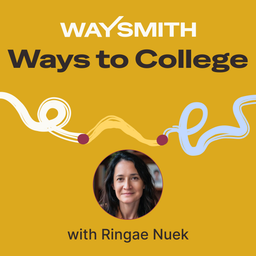
Ways to College
Claim This Podcastby Ringae Nuek
Podcast Overview
<p>After 20 years in product design and strategy, I've seen what happens when people make expensive decisions without understanding themselves or the landscape first. Families make that mistake with college all the time.</p><p>On this show, you'll hear from higher ed leaders doing different things—rethinking curriculum, student support, career integration. You'll come away understanding what actually matters, asking smarter questions during the college search, and making a decision that's genuinely yours.</p><p>Hosted by Ringae Nuek, a college admissions consultant and founder of Waysmith.</p>
Language
🇺🇲
Publishing Since
4/8/2026
Reach the team behind Ways to College
Verified contact details for this show aren't on file yet — sign up to get notified when they land.
Recent Episodes
June 25, 2026
Designed Around the Student: Inside the Connected College
<p>Four in ten students who start college don't finish — and it's usually not about grades. Elliot Felix explains what separates the colleges that set students up to thrive from the ones that don't, and how families can tell the difference before they ever enroll.</p><p>Elliot Felix trained as a designer at UVA and MIT and has spent 20 years helping more than 100 colleges — from MIT and Cornell to NYU and UVA — redesign the spaces, services, and systems students rely on. He's the author of two books: How to Get the Most Out of College and, most recently, The Connected College: Leadership Strategies for Student Success.</p><p><strong>This episode will be the season finale. See you again in the fall.</strong></p><p><strong>What we cover:</strong></p><p>Elliot starts with why students leave — about half for financial reasons, and a lot of the rest because they never feel they belong. From there, the experiences that reliably predict success: learning communities, working with faculty, internships, mentoring, and semester-long projects — and why it matters whether a school requires those things or leaves them to chance. We get into "connected" versus "siloed" colleges (duplicate tutoring centers, turf wars, the bright line between academic and student affairs), the difference between good friction that helps you grow and bad friction that just gets in the way, and where AI fits — useful for cutting bureaucracy and tier-one advising, but no substitute for the relationships that keep students in school. He closes with how to read a college like an open book: the College Scorecard, IPEDS, a school's own institutional research dashboards, and whether they actually report progress against their strategic plan.</p><p><strong>What Parents Should Ask:</strong></p><ul><li>Are high-impact experiences like internships, capstones, learning communities required, or just available?</li><li>How do the career center and academic departments actually work together?</li><li>Is there a one-stop for student services, or does my kid get the runaround across offices?</li><li>Does the school report progress against its strategic plan — or did the plan get written and shelved?</li><li>Do they describe what they offer in plain English, or in insider jargon you have to decode?</li></ul><p><strong>Find Elliot:</strong></p><p>LinkedIn — <a target="_blank" rel="noopener noreferrer nofollow" href="https://www.linkedin.com/in/elliotfelix/">https://www.linkedin.com/in/elliotfelix/</a></p><p>Website — <a target="_blank" rel="noopener noreferrer nofollow" href="https://www.elliotfelix.com/">https://www.elliotfelix.com/</a></p><p><strong>Find Ringae:</strong></p><p>Website —<a target="_blank" rel="noopener noreferrer nofollow" href="https://waysmith.io/"> https://waysmith.io/</a></p><p>Book a discovery call —<a target="_blank" rel="noopener noreferrer nofollow" href="https://cal.com/waysmith/discovery-call"> https://cal.com/waysmith/discovery-call</a></p><p>Sign up for my newsletter —<a target="_blank" rel="noopener noreferrer nofollow" href="https://waysmith.io/#newsletter"> https://waysmith.io/#newsletter</a></p>
June 4, 2026
The Most Important Agent Is You
<p>Everyone obsesses over getting in. Harlan Cohen talk focuses on what comes after, because the secret ingredient was never the school. It's the student.</p><p>Harlan Cohen has spent 25+ years helping families navigate the transition into and through college. He's the author of The Naked Roommate, the bestselling book on college life, and Win or Learn, and he runs the Best First Year coaching program.</p><p><strong>What we cover:</strong></p><p>Harlan starts with his own rocky first year — losing his roommate, his fraternity bids, and his girlfriend in a matter of weeks — and how it taught him that rejection creates reflection. We get into "wantrophy": what happens when high-achieving kids get so good at being wanted that they lose track of what they actually want. From there, his framework for the search — the six transitions every student faces (social, emotional, physical, financial, academic, professional) and his "people, places, patience" method for finding real fit. He reframes freshman year as the "getting-comfortable year," makes the case for parents as low-stakes coaches, and argues that in an AI-shaped world, curiosity is currency — so don't wait for a job, create one.</p><p><strong>What Parents Should Ask:</strong></p><ul><li>Which of the six transitions matter most for my student, and which schools support those?</li><li>On a visit, who are the specific people and places tied to what my kid wants to do?</li><li>How accessible are the clubs, research, and internships my student wants?</li><li>Does advising here encourage curiosity, or just box-checking toward a degree?</li></ul><p><strong>Find Harlan:</strong></p><p>Website - <a target="_blank" rel="noopener noreferrer nofollow" href="https://harlancohen.com/">https://harlancohen.com/</a></p><p>Coaching Program - <a target="_blank" rel="noopener noreferrer nofollow" href="https://bestfirstyear.com/">https://bestfirstyear.com/</a></p><p><strong>Find Ringae: </strong></p><p>Website -<strong> </strong><a target="_blank" rel="noopener noreferrer nofollow" href="https://waysmith.io/">https://waysmith.io/</a></p><p>Book a discovery call - <a target="_blank" rel="noopener noreferrer nofollow" href="https://cal.com/waysmith/discovery-call">https://cal.com/waysmith/discovery-call</a></p><p>Sign up for my newsletter - <a target="_blank" rel="noopener noreferrer nofollow" href="https://waysmith.io/#newsletter">https://waysmith.io/#newsletter</a></p>
May 20, 2026
The Student Is the Only One Who Sees the Whole Journey
<p>Brian LeDuc is a design strategist who's spent 15+ years working at the intersection of higher ed, corporate learning, and service design. He runs a consulting practice, Learning Designed, where he works with universities to redesign how campuses support the student experience.</p><p>His thesis: higher ed was not designed around students. It can be — but most campuses are still set up like a mall, where each "store" (academic advising, residence life, the career center, faculty office hours) operates independently and has no awareness that the student walking through the door has just been to four other stores that day.</p><p><strong>What we cover:</strong></p><p>Why the discovery years matter, and why "what's your major?" is the wrong question. Brian argues that 50–80% of employers say the major doesn't matter, and that early general education classes are actually slots for exploration. A better framing he offers: pick a problem you want to solve, then let that shape your major, your classes, and the experiences you build.</p><p>What to look for in advising. Big professional advising centers, cross-disciplinary advising for undeclared students, advisor time per student, and whether the same kind of support extends past freshman year. Most campuses front-load support and then leave students to figure it out.</p><p>Whether the campus listens to students. Brian distinguishes between superficial signals (student advisory councils stacked with engaged campus residents who don't represent the actual student body) and real listening structures including innovation labs, ongoing feedback engines, and leaders whose strategic plans reflect what students are saying. </p><p>The role of AI on campus, and where to be wary. Useful for transactional, self-serve answers. A red flag when it replaces human interactions in advising, career counseling, and other places where the relationship is the point.</p><p>Work-integrated learning and on-campus jobs as a launchpad — especially for first-gen students. Ask what students are actually doing in their campus jobs, not just whether they have one.</p><p>And to close: Brian's advice for what parents and students should do on a campus visit — walk off the tour route, stop students at random, and ask two questions.</p><p><strong>What Parents Should Ask:</strong></p><ul><li>Walk off the tour route. Ask 5–10 students: what's one word you'd use to describe this university, and why? Then: what's something you wish you'd known about this school before you got here?</li><li>Ask your tour guide: who are the two people on campus who've helped you be successful, and how? The second name tells you where the real support culture lives.</li><li>How does advising work past freshman year? Is there sophomore- and junior-year support, or are students on their own once they declare?</li><li>Is there a structure on campus for ongoing student listening — beyond a student advisory council?</li><li>When does career conversation start? Freshman year, or senior year?</li></ul><p><strong>Find Brian:</strong> </p><p>LinkedIn —<a target="_blank" rel="noopener noreferrer nofollow" href="https://www.linkedin.com/in/brianfleduc/"> https://www.linkedin.com/in/brianfleduc/</a> </p><p>Substack —<a target="_blank" rel="noopener noreferrer nofollow" href="https://brianfleduc.substack.com/"> https://brianfleduc.substack.com/</a></p><p><strong>Find Ringae:</strong> </p><p>Website —<a target="_blank" rel="noopener noreferrer nofollow" href="https://waysmith.io/"> https://waysmith.io/</a> </p><p>Book a discovery call —<a target="_blank" rel="noopener noreferrer nofollow" href="https://cal.com/waysmith/discovery-call"> https://cal.com/waysmith/discovery-call</a> </p><p>Sign up for my newsletter —<a target="_blank" rel="noopener noreferrer nofollow" href="https://waysmith.io/#newsletter"> https://waysmith.io/#newsletter</a></p>
6 total episodes available
Deep-dive analytics for Ways to College
Frequently asked questions
Have a different question and can't find the answer you're looking for? Reach out to our support team by sending us an email and we'll get back to you as soon as we can.
- What is Ways to College?
<p>After 20 years in product design and strategy, I've seen what happens when people make expensive decisions without understanding themselves or the landscape first. Families make that mistake with college all the time.</p><p>On this show, you'll hear from higher ed leaders doing different things—rethinking curriculum, student support, career integration. You'll come away understanding what actually matters, asking smarter questions during the college search, and making a decision that's genuinely yours.</p><p>Hosted by Ringae Nuek, a college admissions consultant and founder of Waysmith.</p> - How often does this podcast release new episodes?
This podcast updates daily.
- Where can I listen to this podcast?
This podcast is available on 4 platforms including Apple Podcasts, Spotify, and more. You can also use the RSS feed directly.
- Does this podcast accept guests?
Yes, this podcast regularly features guests.
Legal Disclaimer
Pod Engine is not affiliated with, endorsed by, or officially connected with any of the podcasts displayed on this platform. We operate independently as a podcast discovery and analytics service.
All podcast artwork, thumbnails, and content displayed on this page are the property of their respective owners and are protected by applicable copyright laws. This includes, but is not limited to, podcast cover art, episode artwork, show descriptions, episode titles, transcripts, audio snippets, and any other content originating from the podcast creators or their licensors.
We display this content under fair use principles and/or implied license for the purpose of podcast discovery, information, and commentary. We make no claim of ownership over any podcast content, artwork, or related materials shown on this platform. All trademarks, service marks, and trade names are the property of their respective owners.
While we strive to ensure all content usage is properly authorized, if you are a rights holder and believe your content is being used inappropriately or without proper authorization, please contact us immediately at hey@podengine.ai for prompt review and appropriate action, which may include content removal or proper attribution.
By accessing and using this platform, you acknowledge and agree to respect all applicable copyright laws and intellectual property rights of content owners. Any unauthorized reproduction, distribution, or commercial use of the content displayed on this platform is strictly prohibited.