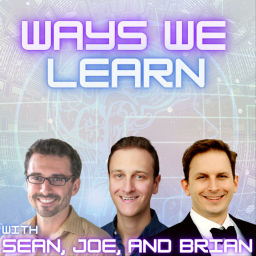
Podcast thumbnail for Ways We Learn

Ways We Learn

Claim This Podcast

by Sean, Joe, and Brian investigate the ways people learn

5.0(12 reviews)
39 episodes
Updated Weekly
Accepts GuestsHas SponsorsLocation 🇺🇸

Podcast Overview

Your hosts Sean Dagony-Clark, Joe Burgess, and Brian Tobal are investigating the ways people learn across all modalities and ages. We'll investigate learning through storytelling, experience, and games. We'll look at learning in schools, businesses, and personal life. We’ll look at everything from learning techniques to educational technology, AI- and computer-assisted learning, effective classroom practices, and traditional and non-traditional learning approaches. Basically: all the ways we learn!

Language

🇺🇲

Publishing Since

12/26/2022

1 verified contact email on file for Ways We Learn

Pitch yourself as a guest, propose sponsorships, or reach out directly to the host.

Recent Episodes

Episode thumbnail for Learning About Copyright Law with Ariel Diaz

November 26, 2024

Learning About Copyright Law with Ariel Diaz

Ariel Diaz, serial entrepreneur and CEO of Boundless Learning, shares his side of the story behind the company's copyright lawsuit and its impact on the textbook market.

Episode thumbnail for AI as Learning Facilitator with Steve Midgley & Whitney Whealdon

November 19, 2024

AI as Learning Facilitator with Steve Midgley & Whitney Whealdon

<p>I've spent years in the field of ed tech. Along the way, I became disappointed by a lot of what I saw.</p> <p>There has been way too much “shiny new object syndrome,” and way too little of the actual learning transformation that it promised. Starting with blackboards, then whiteboards, then radio, then film strips, then TV, then calculators, then computers, then many other EdTech things – they all promise transformative learning, but they don't always deliver.</p> <p>So my question: is AI going to be different?</p> <p>Thankfully, Steve Midgley and Whitney Whealdon have some answers!</p> <p>Steve is the Founder and Managing Director of Learning Tapestry, and Whitney is the Director of Learning Innovation. Steve served as the Deputy Director of Educational Technology for Arne Duncan at the U. S. Department of Education and the Director of Education at the FCC. Whitney has worked in education for over 20 years, including 10 years at the Louisiana Department of Education, and led the creation of the ELA Guidebooks, which is an English language arts curriculum used in over 80 percent of Louisiana districts and other states nationwide.</p> <p>Both of these folks really know education, and they’re perfect guests for my big question today: how do the affordances of AI lead to truly transformative learning?</p> <p>Contents:</p> <ul> <li><strong>01:00</strong> The Evolution and Challenges of EdTech</li> <li><strong>02:23</strong> Learning Tapestry’s Purpose</li> <li><strong>03:43</strong> Steve's Background and Vision</li> <li><strong>04:47</strong> Whitney's Perspective on EdTech</li> <li><strong>10:46</strong> AI's Potential in Education</li> <li><strong>21:08</strong> AI in the Classroom</li> <li><strong>39:23</strong> Academic Integrity</li> <li><strong>41:05</strong> Practical AI for Teachers</li> <li><strong>43:52</strong> AI as a Collaborative Partner</li> <li><strong>53:40</strong> Quality Assurance in AI-Driven Learning</li> <li><strong>59:43</strong> Ethical Considerations</li> </ul> <p>Links and further reading:</p> <ul> <li><p>Learning Tapestry: <a href="https://www.learningtapestry.com" target="_blank" rel="ugc noopener noreferrer">https://www.learningtapestry.com</a></p> </li> <li><p>Steve’s bio: <a href="https://www.learningtapestry.com/steve-midgley.html" target="_blank" rel="ugc noopener noreferrer">https://www.learningtapestry.com/steve-midgley.html</a></p> </li> <li><p>Whitney’s LinkedIn: <a href="https://www.linkedin.com/in/whealdon/" target="_blank" rel="ugc noopener noreferrer">https://www.linkedin.com/in/whealdon/</a></p> </li> <li><p>And here’s the knowledge-building app they described! (Remember the frog &gt; lily lad &gt; chlorophyll example?) Wonderwood is an infinite digital encyclopedia and interactive learning app for children ages 3-8 to build their knowledge of the world: <a href="https://wonderwood.me/" target="_blank" rel="ugc noopener noreferrer">⁠https://wonderwood.me/⁠</a></p> </li> <li><p>And here's the quote Steve referenced, with his intro:</p> <p>Here's a quote that is old but, for me at least, informs where our expectations need to shift to in the age of AI. The movement from computational to concept-based math is parallel to a movement from expressive to concept-based ELA - and the skills below reflect what I think are valuable to students regardless of how much support they get from AI in their schooling.</p> <p>"At school you are engaged not so much in acquiring knowledge as in making mental efforts under criticism... You go to a great school not so much for knowledge as for arts and habits; for the habit of attention, for the art of expression, for the art of assuming at a moment's notice a new intellectual position, for the art of entering quickly into another person's thoughts, for the habit of submitting to censure and refutation, for the art of indicating assent or dissent in graduated terms, for the habit of regarding minute points of accuracy, for the art of working out what is possible in a given time, for taste, for discrimination, for mental courage, and for mental soberness."</p> <p>- William Johnson Cory, 19th Century Headmaster at Eton</p> </li> </ul>

Episode thumbnail for Gamification That Doesn't Suck with Seth Trudeau

November 12, 2024

Gamification That Doesn't Suck with Seth Trudeau

<p>Think about your experience with education. What was that experience like? For many of us, organized learning was sort of like a factory. A bunch of students along for the ride, not necessarily wanting to be there, but ingesting a lot of information that was handed down by a teacher, and waiting for a big scary test at the end.</p> <p><br></p> <p>Now think about a time you&#39;ve played a game. You may have found the game more enjoyable than some of your learning experiences. You’re more active in a game. You get quick feedback in a game. A game is really meant to be fun, even in that big scary test at the end.</p> <p><br></p> <p>Seth Trudeau is someone who thinks education can and should be more like games. He is the founder and managing director of Routine Chaos, where he works with companies to build transformative products through deep product discovery and rigorous product development. He&#39;s built games, simulations, and applications for learners from primary school up through postgraduate studies.</p> <p><br></p> <p>We sat down to discuss the potential benefits of gamification in education from classics like “Oregon Trail” to modern games like “Minecraft,” and the importance of creating engaging, skill-building environments in games. We talked about Pokemon tournaments and how such community-driven, game-based learning can be applied to educational contexts. And we looked at project-based and self-directed learning, and how teachers can foster meaningful motivation and interest in students.</p> <p><br></p> <p>Contents:</p> <ul> <li>00:58 Games vs. Traditional Learning</li> <li>02:45 The Evolution of Gamification</li> <li>09:09 Challenges in Educational Gaming</li> <li>11:27 Effective Educational Games Today</li> <li>13:48 The Value of Games in Learning</li> <li>20:18 Gamification in Professional Training</li> <li>24:17 Leveraging LLMs for Scenario-Based Learning</li> <li>27:42 The Pokemon Company and Education</li> <li>36:36 Mixed-Age Communities and No Age-Based Hierarchies</li> <li>37:07 The Pokemon Tournament Experience</li> <li>40:36 Rethinking Traditional Education Hierarchies</li> <li>42:43 The Role of Critical Thinking in Education</li> <li>53:45 Conceptual Exposure in Math Education</li> <li>58:11 Project-Based and Interest-Driven Learning</li> <li>01:04:26 Advice for Traditional Classrooms</li> </ul> <p><br></p> <p>Links and Further Reading:</p> <ul> <li>Seth’s writing on gamification: <a href="https://routinechaos.substack.com/p/what-if-the-pokemon-company-took">https://routinechaos.substack.com/p/what-if-the-pokemon-company-took</a></li> <li>More of Seth’s thoughts: <a href="https://routinechaos.substack.com/p/a-bit-more-on-gamification">https://routinechaos.substack.com/p/a-bit-more-on-gamification</a></li> <li>Marc LeBlanc&#39;s 8 kinds of fun: <a href="http://algorithmancy.8kindsoffun.com">http://algorithmancy.8kindsoffun.com</a></li> <li>Jesse Schell&#39;s Art of Game Design: <a href="https://schellgames.com/art-of-game-design">https://schellgames.com/art-of-game-design</a></li> <li>The Importance of Play: <a href="https://www.routine-chaos.com/introducing-pursuit-of-play/" target="_blank" rel="noopener noreferer">https://www.routine-chaos.com/introducing-pursuit-of-play/</a></li> </ul>

39 total episodes available

Deep-dive analytics for Ways We Learn

Frequently asked questions

Have a different question and can't find the answer you're looking for? Reach out to our support team by sending us an email and we'll get back to you as soon as we can.

What is Ways We Learn?

Your hosts Sean Dagony-Clark, Joe Burgess, and Brian Tobal are investigating the ways people learn across all modalities and ages. We'll investigate learning through storytelling, experience, and games. We'll look at learning in schools, businesses, and personal life. We’ll look at everything from learning techniques to educational technology, AI- and computer-assisted learning, effective classroom practices, and traditional and non-traditional learning approaches. Basically: all the ways we learn!

How often does this podcast release new episodes?

This podcast updates weekly.

Where can I listen to this podcast?

This podcast is available on 9 platforms including Apple Podcasts, Spotify, and more. You can also use the RSS feed directly.

Does this podcast accept guests?

Yes, this podcast regularly features guests.

Legal Disclaimer

Pod Engine is not affiliated with, endorsed by, or officially connected with any of the podcasts displayed on this platform. We operate independently as a podcast discovery and analytics service.

All podcast artwork, thumbnails, and content displayed on this page are the property of their respective owners and are protected by applicable copyright laws. This includes, but is not limited to, podcast cover art, episode artwork, show descriptions, episode titles, transcripts, audio snippets, and any other content originating from the podcast creators or their licensors.

We display this content under fair use principles and/or implied license for the purpose of podcast discovery, information, and commentary. We make no claim of ownership over any podcast content, artwork, or related materials shown on this platform. All trademarks, service marks, and trade names are the property of their respective owners.

While we strive to ensure all content usage is properly authorized, if you are a rights holder and believe your content is being used inappropriately or without proper authorization, please contact us immediately at hey@podengine.ai for prompt review and appropriate action, which may include content removal or proper attribution.

By accessing and using this platform, you acknowledge and agree to respect all applicable copyright laws and intellectual property rights of content owners. Any unauthorized reproduction, distribution, or commercial use of the content displayed on this platform is strictly prohibited.