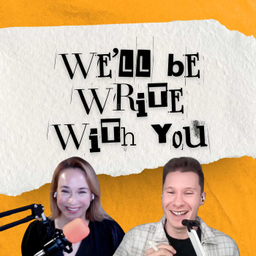
We'll Be Write With You Podcast
Dr. Shelly Lorts & Liam Marshall
5.0from 1 ratings
- 6
- Episodes
- 1
- Ratings
- Weekly
- Cadence
- 2026
- First episode
About We'll Be Write With You Podcast
A call-in show for writers and anyone who wants to fall back in love with writing. Hosted by Dr. Shelly Lorts & Liam Marshall. wewillbewritewithyou.substack.com (https://wewillbewritewithyou.substack.com?utm_medium=podcast)
- Publisher
- Dr. Shelly Lorts & Liam Marshall
- Category
- arts · education
- Language
- en
- Explicit
- No
- First episode
- 1 Sept 2026
- Latest episode
- 13 Oct 2026
Latest episodes
6 episodes in the feed.
13 Oct 2026
Episode 4: On Perspective, Tension, and Upping the Stakes
We started this one tired and ended it on a sugar high we can’t explain. Somewhere in the middle there’s a proper, craft-focused episode, which answers three of your questions. First up, Carmel wants to know how to write multiple perspectives without it feeling clunky. We talk about choosing between first and third person on purpose, how close the reader sits to each character, narrators who shift their tone depending on who they’re following, and why every narrator, even an all-seeing one, comes with judgement. Along the way we look at unreliable narrators in Gone Girl and The Girl on the Train, and Shelly shares a village feud that turned out to be a lesson in point of view. Kevin, who’s writing horror in the Write It™ cohort, asks how to build tension in a scene where nothing physically happens. We get into tension as a gap the writer holds open, the difference between tension and surprise, Hitchcock’s bomb under the table, subtext (“bless your heart”), and what The Fall, Killing Eve, police procedurals, and Argo can teach you about making a reader wait. Finally, Nicole asks what to do when the pressure to be good straight away stops her writing at all. We talk about creativity as a muscle, low-stakes ways back in, when to put some skin in the game, perfectionism, pseudonyms, and why the edit is where the story really takes shape (with some help from Below Deck and RuPaul’s Drag Race). Got a question you’d like us to ramble about? (We can’t guarantee that we won’t got a bit mad.) Send us a voicemail via liamandshelly.com, email hello@liamandshelly.com (mailto:hello@liamandshelly.com), or find us on socials at @liammarshallcreative and @doctorofstory. We’ll Be Write With You again in two weeks. This is a public episode. If you would like to discuss this with other subscribers or get access to bonus episodes, visit wewillbewritewithyou.substack.com (https://wewillbewritewithyou.substack.com?utm_medium=podcast&utm_campaign=CTA_1)
29 Sept 2026
Episode 3: On AI, Writing Routines, and Em Dashes
We’re back with three listener questions and absolutely no self-control about staying on topic. First, Alexandra asks whether AI can be used as an ideas generator. It’s a question with more nuance than either of them expected, and it takes them from sycophantic chatbots and unreliable narrators all the way to why there’s no such thing as an original idea. Along the way, Shelly finally delivers her long-promised rant in defence of the em dash, and Liam defends the rule of three. If you’ve ever been told your writing “looks like AI” because you used punctuation correctly, this one is for you. Then, Jenni asks, at what point in a book draft should you let someone read it, and who should that someone be? Alpha readers, beta readers, why family and friends are the worst possible choice, what Stephen King does with a finished first draft, and a cautionary tale about querying agents five chapters in. Finally, Nicole in Wisconsin asks the question every writer has asked themselves at 11pm on a Tuesday: how do you actually build a writing schedule and stick to it? Treating writing like a job, showing up whether or not the muse does, why 500 words a day gets you a manuscript in six months, and why regularity is not the same thing as regiment. We close out by turning the question on ourselves, with two very honest do-as-I-say-not-as-I-do confessions. In this episode: * (02:15) Can AI be an ideas generator? * (14:00) In defence of the em dash * (17:45) The rule of three, and why patterns are human * (21:10) When to let someone read your draft * (28:00) Alpha readers, beta readers, and too many cooks * (33:00) A cautionary tale about querying too early * (37:55) How to build a writing schedule and actually stick to it * (47:00) Regularity is not regiment * (53:20) Liam and Shelly’s own writing routines New episodes every two weeks. Got a question? Leave us a voicemail at liamandshelly.com (https://liamandshelly.com/), and we might answer it on the show. Press one button, talk, done. You can also email hello@liamandshelly.com (mailto:hello@liamandshelly.com) or drop it in the comments. Find Shelly on Instagram @doctorofstory (https://instagram.com/doctorofstory) and Liam @liammarshallcreative (https://instagram.com/liammarshallcreative). This is a public episode. If you would like to discuss this with other subscribers or get access to bonus episodes, visit wewillbewritewithyou.substack.com (https://wewillbewritewithyou.substack.com?utm_medium=podcast&utm_campaign=CTA_1)
22 Sept 2026
Article: On Seeing Things Through
If you’re anything like me, you’re a serial starter. An ideas factory. A self-professed shiny object chaser. I love the thrill of a new idea and starting a new project, but my pursuit of the next idea keeps me from seeing a lot of things through. There’s nothing like writing those opening lines and feeling the rush of a new beginning. The problem is, if we’re constantly chasing the new things, that means we’re often neglecting the old. Quick aside before I go on: I actually created a draft for a different article before writing this one. I titled it “On ‘The Big Idea’” and gave it the subheading “But… What does it mean?”, and I truly wish I could remember what I’d intended to write. Unfortunately, the big idea eludes me at present because a different idea drifted past the corner of my mind’s eye and, before you know it, I’d started something new. And that’s the point of this article in a nutshell. Part of what makes new ideas so hard to resist is their electricity. There’s a dopamine hit in the starting: the rush of possibility, the blank page, the sense that this one could be The One. But that feeling has a shelf life. It fades as the work gets harder and the ending feels further away. Before long, another idea drifts past, and the whole cycle begins again. When we keep chasing that high, we only ever experience the beginning of things, and while the beginning is wonderful, it’s not the whole story. The harder stretches when it comes to writing — the long middle, the earned ending — are where our real development as writers happens. But when we keep skipping them, we start to convince ourselves that we can’t do them at all (and spoiler, we absolutely can). I’ve admitted this before, so I’ve no qualms about saying it again here. As a writer, my weakness is endings. I know that. And there are a couple of reasons why… Firstly — I don’t really like goodbyes. Not to my creative work, anyway. I like to draw the process out because there’s something comforting about knowing a piece is there to be visited when I need it. If I finish it, I’ve lost that comfort blanket. The second reason I’m not great at endings is that I’m not very well practised at writing them. I don’t get to them often, so when I do, I’m like a deer in headlights. My confidence when it comes to wrapping things up in a satisfying bundle leaves a lot to be desired. So I shy away and start lots of things rather than ever finishing them. The problem with starting lots of things and not seeing them through is that if we don’t complete them, they never see the light of day, and if they never see the light of day, they never get to be enjoyed in the way they were intended to. In episode 2 (https://wewillbewritewithyou.substack.com/p/on-getting-your-writing-out-there), we talk a lot about assigning meaning to our writing, and this is precisely why that lack of finishing matters. If our work has meaning, it also has purpose. But if we never finish something, how can it fulfil its purpose? How can we? As writers, as creatives. And I know it’s hard to resist the call of a new idea. When it comes to you and flirts with you, and propositions you — it’s compelling, but we have to learn to say no when the timing isn’t right. That doesn’t mean you can’t revisit it later. If you’re listening along to the podcast, you’ll have heard Shelly mentioning something called a commonplace book a few times. This is a small notebook you carry with you, in your pocket, in your bag, so you can capture those ideas you can’t act on right now. It’s a great way to commit to ideas, just not… immediately. Think of it as a promise book. Your way of saying, I like you, I see you, I want to make this work, but I’m not ready just yet. The only way to break the cycle of being a serial starter is to go ahead and finish something. If you think you’ll be missing out on that rush of starting something new, reframe it this way — every ending you write gets to be rewarded with starting something new. It becomes a win/win. If you’re like me and can’t resist the call of the next idea, jot it down and then ask yourself, is this something I have to do now, or can it wait until I’m over the line on the piece I’m working on? There’s nothing wrong with having a queue of ideas. Some will leave the line as their patience wears thin, but the ones who stick around are going to be so much more fulfilling. Every ending you write is proof that you can write another. How about we make a promise, you and I, that we’ll see things through a little more often? What’s one project that’s been ongoing for a while that you’re willing to commit to and get it over the line? Set aside some time for it, create a routine, commit to showing up for it, and push through that ending (remember, we can always improve it in the next draft). Then you can reward yourself with the rush of something new. Speak soon,Liam Find Liam on Instagram @liammarshallcreative (https://instagram.com/liammarshallcreative) and Shelly @doctorofstory (https://instagram.com/doctorofstory) Thanks for reading We'll Be Write With You! Subscribe for free to receive new posts and support my work. This is a public episode. If you would like to discuss this with other subscribers or get access to bonus episodes, visit wewillbewritewithyou.substack.com (https://wewillbewritewithyou.substack.com?utm_medium=podcast&utm_campaign=CTA_1)
15 Sept 2026
Episode 2: On Getting Your Writing Out There
Welcome to episode 2 of We’ll Be Write With You, the fortnightly call-in show where we answer real questions from real writers. Liam Marshall of Liam Marshall Creative (https://www.liammarshall.co.uk/) and Dr. Shelly Lorts of Scholar & Story (https://scholarandstory.com/) and Academy of Story (https://campus.academyofstory.com/join-the-academy) take three questions from the voicemail and end up somewhere between a mark on the kettle, a nuclear waste site and a tent full of people who very much wanted smut. In this episode: Alexandra says her life is mundane and she doesn’t know how to find inspiration in the same old. We get into the power of the ordinary, why routine puts you on autopilot and your brain filters out everything you’re not actively looking for, and how to turn that off again. Which becomes a much bigger conversation about meaning: asking why like a toddler until you hit the layer where the story actually is, why humans invented mythology in the first place, and the true story of the academics who worked out that the best way to keep people away from a radioactive site for 100,000 years was to build a religion around it. Plus the earwig that turns you into a chicken, according to Shelly’s big sister. Sophie asks how to build offers and a business around your writing when you’re carrying the belief that you’re not a real writer because you have no qualifications. Liam’s answer is that if you started a business you are already a creative, full stop. Shelly’s is the Dunning-Kruger effect: the people who think they’re incredible usually aren’t, and the fact that you’re nervous is a decent sign you’re good. Then it gets practical. The economics of advances and royalties and why self-publishing is worth a serious look, treating writing like a business rather than a cottage fantasy, building a tangential business around the part of writing you happen to be best at, and Elizabeth Gilbert lighting a candle and promising her writing she would always support it. Also five failed versions of Shelly’s business, Liam writing a stage play behind a hotel reception desk at 10pm, and a brief defence of low stakes jobs. An anonymous listener is self-conscious about putting the naughty bits in their manuscript, even though it’s boy slop. So: how much of yourself do you put on the page when you know people will read it? Liam tells the story of the Xanadu tent at the Big Retreat Festival, the hand that shot up at the back, and the drunk priest story that got better the moment its author put the smut back in. Shelly makes the case that adults have sex, readers want the taboo stuff, and nobody has to read your draft but you. We cover writing sex that does actual character work (with a nod to how Outlander handles it), why Hallmark Christmas movies are the enemy, and the power of suggestion if you’d rather point at it and let the reader do the rest. New episodes every two weeks. Got a question? Leave us a voicemail at liamandshelly.com (https://liamandshelly.com), and we might answer it on the show. Press one button, talk, done. You can also email hello@liamandshelly.com (mailto:hello@liamandshelly.com) or drop it in the comments. Find Shelly on Instagram @doctorofstory (https://instagram.com/doctorofstory) and Liam @liammarshallcreative (https://instagram.com/liammarshallcreative). This is a public episode. If you would like to discuss this with other subscribers or get access to bonus episodes, visit wewillbewritewithyou.substack.com (https://wewillbewritewithyou.substack.com?utm_medium=podcast&utm_campaign=CTA_1)
8 Sept 2026
Article: On Moving Your Readers
Have you ever read a book or watched something and found yourself getting teary? I have—and that’s a sign of good writing. Here’s an example of a book I cried at - Adam Silvera’s They Both Die At The End (https://uk.bookshop.org/a/18005/9781471166204). The title lands the biggest spoiler of the whole thing, yet the journey I went on with the characters was so rich and emotional that part of me longed for a last-minute twist that let them both live. But that didn’t happen. As promised from the get-go, both of the protagonists died at the end, and I was devastated. Why? Because over the course of reading this book, I became emotionally invested in this young, queer love story, and I wanted them to win. Two characters, who started as total strangers both to each other and to me, had become close friends. As writers, we often talk about the hero’s journey and character and story arcs, but it’s not so often that we discuss the reader’s journey and what that means. Every time someone reads your work, they go on an adventure. They embark on a journey with an expectation to be moved, and since our words can’t do that physically, it has to be done emotionally. In the case of They Both Die At The End, I spent 300+ pages experiencing Mateo and Rufus’s last day on earth with them and seeing how they brought out the best in each other. I went through all of the emotions, and even though I was left heartbroken at the end, I still felt satisfied because I’d ended in a different place than I’d started. I’m not saying that every story has to bring tears to the eye, or have you wheezing with laughter, but it should effect change in some way. It might be a small change - a new awareness of something, a newfound sense of empathy, or a question that plays on the mind—but readers have to step away from the world you’ve created, having moved a little in their own. Every line, every page, every chapter that you write should take them a little closer to that new position. As a writer, you can’t be afraid to be vulnerable in your work. Vulnerability is the thread between you and your reader. Your work should make you feel how you want them to feel. It should be a shared experience between you putting the words on the page and someone else lifting them back up. The only thing that separates the two events is time. There’s an important act of encoding and decoding that needs to take place in the writing process—a transference of thoughts and feelings. If you laugh, they will laugh; if you cry, they will cry. I can’t tell you how many times I’ve found myself welling up reading back a piece of writing, or felt my blood boiling as my characters have launched into an impassioned rage. Your words are your connection to the world, and if you don’t feel and experience them yourself, how can you hope for someone else to on the other end? Our characters often take on a life of their own. In Episode 1 of (https://wewillbewritewithyou.substack.com/p/episode-1-on-inspiration-and-motivation)We’ll Be Write With You (https://wewillbewritewithyou.substack.com/p/episode-1-on-inspiration-and-motivation), Shelly shared an exercise about dropping your characters into unfamiliar settings and scenarios to see how they react. As we write, we might find ourselves surprised by what they do, what they say, how they react and the choices they make. Many authors have described finding a point in their writing where they feel guided by the characters, rather than them deciding what the characters do. It’s not a sign that you’ve lost control of your writing, but a sign that you’ve connected with it. Truly connected with it. That experience is the writing doing its job, and we’re just strapped in for the ride. As much as we’re encouraged to read as writers, we should also be encouraged to write like readers. Along for the journey, open to surprise, ready to embrace and feel something new. That’s what that feeling of the characters taking charge is. That’s how we know that our readers will be transported, because we are too. And now for the practical tips—firstly, to write like a reader, you also have to be a reader. It’s something we also discussed in Episode 1, but the more you read, the more you absorb, and the more you’ll understand how it feels to be moved while immersed in someone else’s writing. That understanding is invaluable for sharing your own experience with your readers. Secondly, a simple way to get into the head of your readers is to distance yourself from the work. I know, it sounds impossible. Your writing is deeply personal, and it’s your baby. But between drafts, I’d encourage you to step away for a little while. Put it in a drawer, or file it away on your computer, and go work on something else. Give yourself the time and space to sever the bond (or at least soften it a little) so that when you read it back next, you’ll experience it through the eyes of your audience. Notice the phrases that make you feel something—anticipation, excitement, joy, anger —and, more importantly, pay attention to those that don’t. Ask yourself, “Is this story taking me on a journey?” and take note of the answers to help you with your next draft. Your readers will thank you for thinking of them while you write. Speak soon,Liam This is a public episode. If you would like to discuss this with other subscribers or get access to bonus episodes, visit wewillbewritewithyou.substack.com (https://wewillbewritewithyou.substack.com?utm_medium=podcast&utm_campaign=CTA_1)
1 Sept 2026
Episode 1: On Inspiration and Motivation
Welcome to the very first episode of We’ll Be Write With You, the fortnightly call-in show where we answer real questions from real writers. Liam Marshall of Liam Marshall Creative and Dr. Shelly Lorts of Scholar & Story and Academy of Story take four questions from the voicemail and end up somewhere between Hamlet, a blocked drainpipe and a very clean bathroom. In this episode: Kevin reads constantly but only ever comes away with the story, never the craft. We get into active reading and marginalia (which Kevin hated, loudly), why writing in the margins used to be completely normal, and what changes when you know which beats you’re hunting for. Which turns into a much bigger conversation about originality, why The Lion King is Hamlet, why Timon and Pumbaa are Rosencrantz and Guildenstern, and why almost nothing you love is as original as you think it is. Penn wants to know how to get past reading your own work back and finding it a crime against literature. Liam’s answer is that the feeling never leaves, so you may as well get used to it. Shelly’s is that you have to put ugly wet clay on the wheel before you can throw a pot. Somewhere in there we cover turning on the tap, why you shouldn’t look back until you’ve finished, and building the exposure muscle by letting people read the thing. Antoine has plenty of ideas but goes blank the moment he sits down. This one gets practical: artist’s dates, commonplace books, walking without earbuds, writing by hand, dream journals, and why your best ideas turn up while you’re scrubbing a toilet or reorganising a wardrobe. Plus Elizabeth Gilbert’s theory that ideas are sentient beings looking for a collaborator, and what happens when you keep one waiting. Hannah asks how to get back into a story she abandoned months ago, and then accidentally answers her own question in a workshop about ice cream. We talk prompts, dropping your character into a random situation to see what they do, how Outlander began as practice, and how to tell when an idea has quietly moved on to another writer. New episodes every two weeks. Got a question? Leave us a voicemail at liamandshelly.com (https://liamandshelly.com) and we might answer it on the show. Press one button, talk, done. Find Shelly on Instagram @doctorofstory (https://instagram.com/doctorofstory) and Liam @liammarshallcreative (https://instagram.com/liammarshallcreative). This is a public episode. If you would like to discuss this with other subscribers or get access to bonus episodes, visit wewillbewritewithyou.substack.com (https://wewillbewritewithyou.substack.com?utm_medium=podcast&utm_campaign=CTA_1)
Reach and audience
Public platform figures. Ratings count people who left a rating, not total listeners.
- Apple Podcasts (US)
- 5.0 / 5
- 1 ratings
Host of We'll Be Write With You Podcast?
Claim your podcast to manage its listing and keep your show details accurate.
Pod Engine is an independent podcast discovery and analytics service and is not affiliated with or endorsed by this podcast. Artwork and show content belong to their owners. Full legal notice.
Explore this show
Podcast research with Pod Engine