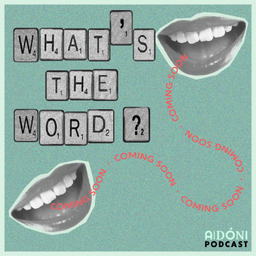
Podcast thumbnail for What's The Word?

What's The Word?

Claim This Podcast

by Aidóni

5.0(2 reviews)
12 episodes
Updated Inactive
Accepts GuestsHas Sponsors

Podcast Overview

This is a podcast about all things language and media. This first season of our podcast explored how media reports about certain countries or regions around the world, and how words and terminology used to talk about those regions impact the larger understanding of the regions, and very often perpetuate misinformed stereotypes. In the second season, we turn our attention to the language of conflict, and ask what really happens when the words we use to report on conflict start shaping how it’s remembered, and even how it’s justified.

Language

🇺🇲

Publishing Since

10/17/2023

2 verified contact emails on file for What's The Word?

Pitch yourself as a guest, propose sponsorships, or reach out directly to the host.

Recent Episodes

Episode thumbnail for S02E06: Unpacking 'Terrorism' - Who gets called a 'terrorist' and why Ft. Meenakshi Ravi

May 20, 2026

S02E06: Unpacking 'Terrorism' - Who gets called a 'terrorist' and why Ft. Meenakshi Ravi

<p>In the sixth and final episode of <strong>What’s the Word? Season 2, </strong>we take a look at a set of words: Terrorism. Terrorist. Militant. Insurgent.</p><p>Who gets called what? Who escapes these labels? And what happens when these words are used to delegitimise struggles or flatten complex histories into good versus evil?</p><p>To unpack this, host <strong>Shriya Roy</strong> is joined by <strong>Meenakshi Ravi. </strong>Meenakshi is a senior journalist and executive producer at Al Jazeera English, where she works on The Listening Post—a programme deeply invested in media critique and narrative analysis. In addition, she works on All Hail - a series dedicated to explaining the social, economic, and political forces that hold power in our everyday lives. She has been a journalist for close to 20 years. </p><p><br></p><p><strong>Important links: </strong></p><p><br><br></p><p>Producer: Shriya Roy</p><p>Host: Shriya Roy</p><p>Concept: Shriya Roy</p>

Episode thumbnail for S02E05: Unpacking the politics behind a ‘Ceasefire’ Ft. Hager Hesham Mustafa

May 6, 2026

S02E05: Unpacking the politics behind a ‘Ceasefire’ Ft. Hager Hesham Mustafa

<p>In the fifth episode of <strong>What’s the Word? Season 2, </strong>we’re unpacking a word that often sounds neutral - <strong>Ceasefire</strong>. </p><p>Words like ceasefire, truce, humanitarian pause, and de-escalation sound neutral, even hopeful. They suggest restraint. Relief. A step toward peace.</p><p>But in many conflicts, these words don’t actually mean safety. They don’t mean justice. They don’t even always mean that violence has stopped.</p><p>Instead, they often signal something narrower — a temporary slowing of visible violence, while structural violence continues: siege, displacement, occupation, starvation, surveillance, restricted movement.</p><p>So today we’re asking:</p><p>Who benefits when violence is described as “paused”?</p><p>What realities disappear when diplomacy sets the vocabulary?</p><p>And how does language lower — or raise — the bar for accountability?</p><p>To unpack this, host <strong>Shriya Roy</strong> speaks with <strong>Hager Hesham Mustafa. </strong>Hager is an award-winning data journalist based in Cairo. She is the founder of Anmat, an independent research and journalism initiative working at the intersection of artificial intelligence, media accountability, and social justice in the MENA region.</p><p>With her expertise spanning investigative reporting, data analysis, and applied AI, Hager specializes in uncovering hidden narratives, bias, and power dynamics within social and economic systems. Her work at Amat combines explainable AI methods with community-centered approaches to build open, reusable data infrastructures that support journalists, researchers, and civil society organizations.</p><p><br></p><p><strong>Important links: </strong></p><p>Anmat media website: https://www.anmat.media/</p><p>Framing Gaza project: https://www.anmat.media/framing-gaza</p><p><br></p><p>Producer: Shriya Roy</p><p>Host: Shriya Roy</p><p>Concept: Shriya Roy</p>

Episode thumbnail for S02E04: Unpacking 'Unrest' - the language that shapes dissent Ft. Muda Tariq

April 23, 2026

S02E04: Unpacking 'Unrest' - the language that shapes dissent Ft. Muda Tariq

<p>In the fourth episode of <strong>What’s the Word? Season 2</strong>, we’re unpacking a word that we hear so often that it barely registers anymore: <strong>Unrest.</strong></p><p>It appears in headlines, government statements, and international reports. It sounds factual, even restrained. But restraint in language often hides a great deal.</p><p>The word unrest has a way of flattening political struggle. It removes cause, blurs responsibility, and makes resistance seem like a spontaneous disruption rather than a response to something deeper. </p><p>To unpack this, host <strong>Shriya Roy</strong> speaks with <strong>Muda Tariq. </strong>Muda covers South Asia for the Asian Forum for Human Rights and Development (FORUM-ASIA), where her mandate covers civic space. As a researcher, she is also interested in the intersection of language, narratives, and civic space, particularly how governments weaponise terminology to criminalise dissent; how journalism, international bodies, and big tech often reinforce or reproduce these narratives; and how this shapes international response, advocacy, and documentation.<br></p><p>Producer: Shriya Roy</p><p>Host: Shriya Roy</p><p>Concept: Shriya Roy</p>

12 total episodes available

Deep-dive analytics for What's The Word?

Frequently asked questions

Have a different question and can't find the answer you're looking for? Reach out to our support team by sending us an email and we'll get back to you as soon as we can.

What is What's The Word??

This is a podcast about all things language and media. This first season of our podcast explored how media reports about certain countries or regions around the world, and how words and terminology used to talk about those regions impact the larger understanding of the regions, and very often perpetuate misinformed stereotypes.

In the second season, we turn our attention to the language of conflict, and ask what really happens when the words we use to report on conflict start shaping how it’s remembered, and even how it’s justified.

How often does this podcast release new episodes?

This podcast updates inactive.

Where can I listen to this podcast?

This podcast is available on 4 platforms including Apple Podcasts, Spotify, and more. You can also use the RSS feed directly.

Does this podcast accept guests?

Information about guest appearances is not available.

Legal Disclaimer

Pod Engine is not affiliated with, endorsed by, or officially connected with any of the podcasts displayed on this platform. We operate independently as a podcast discovery and analytics service.

All podcast artwork, thumbnails, and content displayed on this page are the property of their respective owners and are protected by applicable copyright laws. This includes, but is not limited to, podcast cover art, episode artwork, show descriptions, episode titles, transcripts, audio snippets, and any other content originating from the podcast creators or their licensors.

We display this content under fair use principles and/or implied license for the purpose of podcast discovery, information, and commentary. We make no claim of ownership over any podcast content, artwork, or related materials shown on this platform. All trademarks, service marks, and trade names are the property of their respective owners.

While we strive to ensure all content usage is properly authorized, if you are a rights holder and believe your content is being used inappropriately or without proper authorization, please contact us immediately at hey@podengine.ai for prompt review and appropriate action, which may include content removal or proper attribution.

By accessing and using this platform, you acknowledge and agree to respect all applicable copyright laws and intellectual property rights of content owners. Any unauthorized reproduction, distribution, or commercial use of the content displayed on this platform is strictly prohibited.