
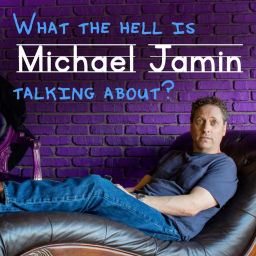
What The Hell Is Michael Jamin Talking About?
Claim This Podcastby Michael Jamin
Podcast Overview
<p>Michael Jamin has been a television writer/showrunner since 1996. He interviews professional writers, artists, and performers about living their creative lives, inspiring others to do the same.</p>
Language
🇺🇲
Publishing Since
11/17/2021
1 verified contact email on file for What The Hell Is Michael Jamin Talking About?
Pitch yourself as a guest, propose sponsorships, or reach out directly to the host.
Recent Episodes
April 3, 2024
Ep 127 - Artist Manager Dave Rose
<p>On this week's episode, we have music manager Dave Rose (Lit, Marcy Playground, Stryper and many many more) and we discuss his journey starting out as a bassist and what it’s like managing today vs. the pre-digital age. Tune in for so much more.</p><h2>Show Notes</h2><p><strong>Dave Rose Agency:</strong> <a href="https://www.deepsouthentertainment.com/" rel="nofollow">https://www.deepsouthentertainment.com/</a></p><p><strong>Dave Rose on TikTok:</strong> <a href="https://www.tiktok.com/@daverosedeepsouth" rel="nofollow">https://www.tiktok.com/@daverosedeepsouth</a></p><p><strong>Dave Rose on Instagram:</strong> <a href="https://www.instagram.com/daverosedeepsouth/" rel="nofollow">https://www.instagram.com/daverosedeepsouth/</a> </p><p><strong>A Paper Orchestra on Website</strong>: <a href="https://michaeljamin.com/book" rel="nofollow">https://michaeljamin.com/book</a></p><p><strong>A Paper Orchestra on Audible:</strong> <a href="https://www.audible.com/ep/creator?irclickid=wsY0cWRTYxyPWQ32v63t0WpwUkHzByXJyROHz00&irgwc=1&source_code=PDTGBPD060314004R" rel="nofollow">https://www.audible.com/ep/creator?source_code=PDTGBPD060314004R&irclickid=wsY0cWRTYxyPWQ32v63t0WpwUkHzByXJyROHz00&irgwc=1</a></p><p><strong>A Paper Orchestra on Amazon:</strong> <a href="https://www.amazon.com/Audible-A-Paper-Orchestra/dp/B0CS5129X1/ref=sr_1_4?crid=19R6SSAJRS6TU&keywords=a+paper+orchestra&qid=1707342963&sprefix=a+paper+orchestra%2Caps%2C149&sr=8-4" rel="nofollow">https://www.amazon.com/Audible-A-Paper-Orchestra/dp/B0CS5129X1/ref=sr_1_4?crid=19R6SSAJRS6TU&keywords=a+paper+orchestra&qid=1707342963&sprefix=a+paper+orchestra%2Caps%2C149&sr=8-4</a></p><p><strong>A Paper Orchestra on Goodreads:</strong> <a href="https://www.goodreads.com/book/show/203928260-a-paper-orchestra" rel="nofollow">https://www.goodreads.com/book/show/203928260-a-paper-orchestra</a></p><p><strong>Free Writing Webinar</strong> - <a href="https://michaeljamin.com/op/webinar-registration/" rel="nofollow">https://michaeljamin.com/op/webinar-registration/</a></p><p><strong>Michael's Online Screenwriting Course</strong> - <a href="https://michaeljamin.com/course" rel="nofollow">https://michaeljamin.com/course</a></p><p><strong>Free Screenwriting Lesson </strong>- <a href="https://michaeljamin.com/free" rel="nofollow">https://michaeljamin.com/free</a></p><p><strong>Join My Newsletter</strong> - <a href="https://michaeljamin.com/newsletter" rel="nofollow">https://michaeljamin.com/newsletter</a></p><h2>Autogenerated Transcript</h2><p>Dave Rose:</p><p>I'm so amazed that people pay me to do this. I was doing it long before I knew you could make money at it. And so the pinnacle for me is really that this continued joy of the business of music</p><p>Michael Jamin:</p><p>You are listening to. What the Hell is Michael Jamin talking about conversations in writing, art, and creativity. Today's episode is brought to you by my debut collection of True Stories, a paper orchestra available in print, ebook and audiobook to purchase And to support me in this podcast, please visit michael jamin.com/book and now on with the show.</p><p>Hey everyone, welcome back to another episode of What the Hell is Michael Jamin talking about conversations in writing, art, and creativity. And today I got a special guest for you. Musicians out there. You don't deserve any of this. This is a wonderful treat for all of you. Don't say I never gave you anything. I'm here with Dave Rose from Deep South Entertainment and he is a career music manager. But Dave, first of all, welcome. I got a billion questions for you, but did you start off, are you a musician as well?</p><p>Dave Rose:</p><p>Thank you. Good to be here, Michael. Man, mutual admiration all the way around. This is exciting to be here. But yes, I started out as a musician. I was a, yes, I started out as a musician. I mean, yes and no, there's a story, but I became a musician out of necessity.</p><p>Michael Jamin:</p><p>How does that work? No one becomes, that's like the last thing you become out of necessity.</p><p>Dave Rose:</p><p>I know. Isn't that funny? So I was managing, and I very much put that in air quotes. Say I was a freshman in college and I had a local band decide they wanted me to be their manager. I was showing up at all their gigs and selling merchandise and unloading the van and doing all the things that I thought I could do to help. I just loved being around music. One day they said to me, would you be our manager? And I didn't know what the hell a manager was. I still don't. But they said, well, you could start by getting us some gigs. And that's not what a manager does, by the way. But that's when you're in college, that's what you do.</p><p>Michael Jamin:</p><p>That's not what a manager does then. Okay, you have to elaborate on that when we</p><p>Dave Rose:</p><p>Can get into that for sure. So I got 'em 20 gigs and we had it all booked up and we're all ready to go. And we were two weeks out from the very first gig, big string of shows, playing skate ranches and pool parties and all the places that you play when you're just starting out anywhere and everywhere that'll give you room. And they came me and they said, our bass player quit and he's moving, so we need to cancel these gigs and we can no longer, we will audition new bass players later. I said, like, hell, you are, I've been watching this. It doesn't look like it's that hard to play bass, so here's what we're going to do. I'm going to cram myself in the basement with you, Mr. Guitar player, and you're going to teach me all the parts to these songs.</p><p>We're going to go play these 20 shows with me as the bass player, and when we come back, you can audition bass players. That's how. And they were like, yeah, that's not how that works. I said, well, that's the way this is going to go. And so they did. I crammed myself in the basement and learned to play bass in two weeks, and it was rock and roll. It was three chord rock and roll. Wasn't real hard, but apparently I picked it up pretty easily and I played bass in a band for the next 10 years, but that should have been my first indication that I was not a musician. I learned how to play just to keep a band.</p><p>Michael Jamin:</p><p>But you must, if you played for 10 years, you're good enough.</p><p>Dave Rose:</p><p>Yeah, I mean I figured it out along the way.</p><p>Michael Jamin:</p><p>Wow. But then at some point you went to full-time management.</p><p>Dave Rose:</p><p>Yeah. Yeah. I ultimately segued into full-time management, and that was, I started this company putting out compilation CDs. That was a big thing. I started in 1995 and in the mid nineties, these sort of mix tape CDs were a big thing. And I would find local and regional bands from around the area and put 'em on this compilation CD and put it out and see what happens. But from the very first CD we put out, we had one of the biggest hits of the nineties, a song called Sex and Candy by Marcy Playground. And my intention was I would stick my band right in the middle of all these big regional bands or bands that I thought was going to be big and maybe my band would get some attention too. And I think nine bands on that first compilation got record deals accept my band. So that was kind of my moment of realizing, yeah, I'm definitely not, I'm way better on the business side of things.</p><p>Michael Jamin:</p><p>So then tell me then what a manager music manager does exactly if they don't get you work.</p><p>Dave Rose:</p><p>Sure. It's very different, I would guess, than in the film and TV business. And I would love to learn this from you, but I'm guessing in the film and TV business, the person that gets you work is the agent. Is that</p><p>Michael Jamin:</p><p>Yes, the agent and not the manager and I have Right,</p><p>Dave Rose:</p><p>And that's what it is here. So a manager in music, I'm put it in the simplest terms, but it's like if the entire career is a wheel, the manager and the artist are in the center of that wheel. And all these spokes are things like booking agents and publicists and record labels and publishing companies and people that do film and TV music and all the accountants, the crew, all the thing, the attorneys that make the machine, the wheel turn. The manager is making sure all of those things are working. So it's sort of like being, I compare it to this, it's being the CEO of a band, but if you're,</p><p>Michael Jamin:</p><p>I'm sorry, go on.</p><p>Dave Rose:</p><p>That's all right. The band is owned by the band or the artist is owned by the, they own their company, but they retain an artist manager commission, an artist manager to manage their career.</p><p>Michael Jamin:</p><p>But if that band is going on tour, are you expected to go with them?</p><p>Dave Rose:</p><p>Only if you're in country music.</p><p>Michael Jamin:</p><p>Okay. Why is that?</p><p>Dave Rose:</p><p>It is different. Country music is one of the few genres that still very much lives and dies by the radio, and so the relationships with local radio is very important. So a manager should be there to kind of nurture those radio relationships from town to town to town. Now, if you're in rock and roll or hip hop or almost any other genre, Americana folk bluegrass, most managers do not travel with the band,</p><p>Michael Jamin:</p><p>But a touring manager would No,</p><p>Dave Rose:</p><p>A tour manager. Exactly. A tour manager does. And the tour manager is exactly, it sounds, it's the manager of the tour. So it deals with getting the bus from point A to point B and where do we park and what do I mean? It's way more than that, but it's the finance of the tour and they report to the artist manager.</p><p>Michael Jamin:</p><p>Now over the years, I've heard you mention this, you have a very, very big it's successful TikTok page, which is how I found you. You've managed a bunch of really big acts, right?</p><p>Dave Rose:</p><p>I've had some, yes. I've had a lot of, and I still do have a lot of big acts. It's been just amazing. I keep waiting for somebody to knock on my door and go, okay, gigs up. Time to get a real job.</p><p>Michael Jamin:</p><p>Can you share some of 'em with us?</p><p>Dave Rose:</p><p>Oh, absolutely. Yeah. So I got my start with Marcy Playground, and I'm still with them 26, 7 years later. But one of my first big clients was the piano player, Bruce Hornsby, who was in the Grateful Dead, and he had a bunch of hits in the eighties and nineties, but he's had a very, very unique career. He is done albums with Ricky Scaggs and Jazz Records, but Little Feat, the classic rock band of, they're just so iconic. The band Lit who had one of the biggest rock hits of the nineties, that song, my Own Worst Enemy, some of the country acts that I've worked with, Laney Wilson, who just won a Grammy, and yeah, I worked with the band six Pence, none The Richer who had the mega hit Kiss Me. And so yeah, it's been not to just, one of the bands I've been with the longest 23 years is an eighties rock band from LA called Striper. They kind of came up in the ranks with Moley Crewe and Bon Jovi and that kind world of big hair and Sunset Strip and all the things of Hollywood, but they're a Christian man. They sing about Jesus. So they're very, very different than that.</p><p>Michael Jamin:</p><p>At this point. Are new bands finding you or are you reaching out to them? How does that work?</p><p>Dave Rose:</p><p>Yeah, they usually find me at this point, I don't develop a lot of new acts anymore, mostly because I've just been doing it a long time and developing a new act from garage to Grammy is not only risky, but it's a long runway. And when you've been sort of doing it for as long as I have, and I don't mean any disrespect to anything on this, but you don't need to take that risk anymore.</p><p>Michael Jamin:</p><p>But it seems like on TikTok, it seems like you're talking to those people.</p><p>Dave Rose:</p><p>I am taking my audience on TikTok is very much the audience that is sort of just trying to figure out the next steps of a very complicated career path.</p><p>Michael Jamin:</p><p>But then why are you talking to them now if that's not, I assume it's because that's what you're looking for, but No,</p><p>Dave Rose:</p><p>Yeah, no, that's a great question. The reason I'm doing it is very pure, because it is hard to do this, and there's a lot of bad advice flying around out there. And to some extent, I wanted to get on there and level the playing field and just let people know the reality of how the business works. No, I'm not at all seeking to manage sort of startup band. I do some coaching that I'm more than willing to help them in. I'll do these 30 minute sessions where I can really, really fast track things for them, help them avoid years and years of mistakes in a very quick conversation. It's a lot like the stuff that you do in the sense that I'll meet an artist from Topeka, Kansas or wherever and how they're learning stuff that they would not learn anywhere else, only because nobody's ever told 'em.</p><p>See Michael, something I think we ought to talk about at some point in here is part of why it's difficult to get a manager in the music business is because of how a manager gets paid. Okay, how did they get paid? I think that's an interesting dynamic that a lot of just, certainly a lot of people, but even a lot of artists don't know how that works. So how does that work then? Yeah, so a manager is paid by commission, so it's strictly a commission base. So if you are an artist and you go out and you play a show or you sell a T-shirt or make some sort of income, a percentage of that income is paid to your manager, includes the record deal, includes everything. It typically includes, and sort of depending on where you are in that artist's career, it includes most every aspect of their entertainment career, including what about royalties?</p><p>It does include royalties, particularly if those royalties were ones that you helped them earn. If you get them a record deal and they continue to earn royalties either through radio play or whatever, you would earn a commission on that. So you're earning commissions on these revenue streams, and that's typically about 15%. So if you think about managing, like we talked about the wheel, all those different spokes in the wheel, maybe for each act that I manage, that's probably 150 decisions a day that we're making on behalf of that artist. So you can't manage a lot of acts as an individual. You can have a company like we do that manages, has managers that manage acts, but generally speaking, you can't manage a lot of acts. There's a lot that goes into a typical day of that. So the commission, if you just break it down to making a living, an artist has to be making significant money for it to be worth that manager's time to spend the bulk of their day managing their career.</p><p>So when you've got an artist that's just starting out, and I want to get to why it's hard to get advice when you've got an artist that's just starting out and they're making no money and are making very little money, I don't know, 20, 30, 40, $50,000 a year, you think about that 15% of that is $5,000 a year maybe for the manager. So it's really not enough to say, I'm going to dedicate my life to you, which is really what it takes. So as a result, it's almost impossible for an artist to meet a manager. It's really hard to meet a manager. Our time is paid by commission. So that's why I get on TikTok and talk about the things I talk about because I was that bass player in a band not knowing what the hell I was doing, making every mistake under the sun. And I'm very, I don't know, very genuinely just trying to help people not make those mistakes.</p><p>Michael Jamin:</p><p>Now, you said something a while ago on one of your tiktoks, and I was surprised you don't come down. I thought everyone was supposed to hate Spotify and streaming because of the way, in my opinion, in my point of view, artists are being raped. I mean, that's how I see it. But you don't feel that way?</p><p>Dave Rose:</p><p>I don't. I mean, do I think it's a fair payment system? No, I think there's a lot of improvement that needs to happen. Part of what I think is the imbalance is the payments between an artist, a songwriter, and the record label. You see, when a song is on Spotify, those are the three main parties that sort of have to get paid a record label, an artist and a songwriter. And the songwriters are the ones that are really struggling in this time.</p><p>Michael Jamin:</p><p>From what I pay on what people pay on Spotify, I gladly pay double for what? I mean, I get every album I want to listen to at any time through the month, almost anything. And if I pay double, I still feel like the artists wouldn't be making not even close to what they used to make.</p><p>Dave Rose:</p><p>Well, yes. Again, we got to remember, there's three buckets. We're dealing with the artist, the record label, and the songwriter. And in some cases, that's the same person in all three of those buckets. If you go out and self-release a record, and you've written that record and you performed on that record, and you do millions and millions of streams on that record, you're making very respectable.</p><p>Michael Jamin:</p><p>I thought, again, I come at this completely ignorant. I know so little about it, but I think I saw a video by Snoop Dogg saying his album was streamed a billion times and he made 10 Sense or something.</p><p>Dave Rose:</p><p>That's a famous video. That video circulated a lot. And what is missed most often in that conversation is the difference in those three buckets. My gut tells me, and I don't know Snoop Dogg's complete history, but he probably does not own that recording. So a big chunk of that money that's being earned probably went to his record label, and I don't know, maybe he wrote the song, maybe he didn't, if he didn't write the song, he's missing that bucket of income, or maybe he did write this. So my gut tells me there's more to that story. So</p><p>Michael Jamin:</p><p>Misunderstand this, which is fine.</p><p>Dave Rose:</p><p>I dunno, the full snoop do the inner workings of his business, but my gut tells me there's more to that story because I know no shortage of independent artists making a great, great living, really. But the thing that's different, and the thing that we got to think about that's different from say 2005, say 20 years ago, the biggest difference is the revenue streams now are very multiple. I mean, I met a band the other day that's doing insane six figures just on YouTube.</p><p>Michael Jamin:</p><p>On YouTube ad. So they put their music and they make ads on YouTube. Exactly, because they're not selling</p><p>Dave Rose:</p><p>It. That's right. The ad revenue is making four members a living, a very good living.</p><p>Michael Jamin:</p><p>See, it was my impression that, okay, so 20 years ago, a band would go on tour and after the show, they'd sell okay, merch, but they'd also sell the cd. If you want to listen to music, they sell. But now no one's going to buy that cd.</p><p>Dave Rose:</p><p>They do. They very much buy, well, more so they buy vinyl. The vinyl buy vinyl. And what's crazy, I was just on the phone with a head of a record label and he was talking about the rapid increase in the number of cassettes they're selling, which is crazy. It's just such a, I tell people this all the time, but you can't autograph a stream, so you're going to always need to have something that people can take home. I mean, I read the other day of all the vinyls sold only like 37% get listened to, but vinyl cells are through the roof, really. They buy the product, they get it autographed, they keep it as a collector's item, and then they stream it on Spotify.</p><p>Michael Jamin:</p><p>But why do you feel vinyl as opposed to a cd, which is just vinyl, but smaller and better quality? Why is that?</p><p>Dave Rose:</p><p>Yeah, I think CDs, I mean, also depending on the genre, certain genres are very cd, like country. People still buy CDs. If you go into a Walmart and rural America, you're going to see a lot of country in there. But yeah, I think vinyl partially because it's just big and cool to hold, and</p><p>Michael Jamin:</p><p>Yeah, you right, because not a lot of people have record. A lot of people don't even how to use a record like we do, but</p><p>Dave Rose:</p><p>Yeah. Well, I mean you'd really be surprised, Michael. The vinyl industry is insanely huge.</p><p>Michael Jamin:</p><p>Interesting.</p><p>Dave Rose:</p><p>And really among kids, I mean, the kids are buying vinyl. If you go into an Urban Outfitters, which is obviously geared toward 20 somethings, they have a whole record section in there, whole vinyl section in their stores, and they sell record players at Urban Outfitters.</p><p>Michael Jamin:</p><p>Right, right. I always thought that was ironic. I didn't realize that they're making money that way. I know. I thought they were museum pieces.</p><p>Dave Rose:</p><p>Well, probably to some they are. Wow. Yeah.</p><p>Michael Jamin:</p><p>Now, do you specialize in any kind of genre of music or does that matter to</p><p>Dave Rose:</p><p>You? I'm a rock and roll guy at heart, but I've done a lot of work in sort of songwriter rock. I've certainly had my share of country acts, although it's not my preferred genre, I've not done a lot in bluegrass, and I've not done a lot in hip hop, which is strange because if this is a visual thing, I'm staring at a Tupac Black behind me. So I say I don't really work in hip hop, but then I got to Tupac Black up here.</p><p>Michael Jamin:</p><p>I have a question for you. I don't think you're going to be able to answer this one. I don't know if there's an answer. Probably</p><p>Dave Rose:</p><p>Not.</p><p>Michael Jamin:</p><p>So Daryl Hall has a show that I happen to catch sometimes. I think he shoots in his basement or something. You must've seen it, where he brings in friends, like eighties stars or whatever, Darryl's</p><p>Dave Rose:</p><p>House,</p><p>Michael Jamin:</p><p>Darryl's house, and he looks cool. He's got a blazer on, he's got dark glasses, and I'm like, okay, he looks cool. But then sometimes he brings in other men his age, which is whatever, 70, whatever it is, I don't know. And they're dressed and they're stars from the eighties, and they're dressed like they used to dress in the eighties. I wonder, how are aging rockstar supposed to dress? Do you have to answer this to your clients? You</p><p>Dave Rose:</p><p>Talk about this. Oh, yeah. We talk about, I mean, I tell artists this all the time, including my big artists. The biggest mistake you can make with a tire fashion, whatever you want to call it, is to not talk about it. You have to talk about it. A matter of fact, I recommend a band sometimes, particularly new bands, take a night and don't bring your instrument, get in a room together and talk about what you want This look to look like. It is so incredibly important and,</p><p>Michael Jamin:</p><p>But do you have an opinion on what it should be then? Should it stay what it was, or should it evolve?</p><p>Dave Rose:</p><p>I think it's interesting, like this eighties band striper that I talked about that I manage from the eighties, that it's the same guys 40 years later. Back in the day, there was a lot of hair and makeup and spandex pants and all the things that, and so no, they don't wear that anymore, and they don't wear the makeup and the teased hair, but they do an age appropriate version of that rock and roll gear and rock. It</p><p>Michael Jamin:</p><p>Seems weird because the fans are coming to see their band. The fans don't want the band to age, but unfortunately the band aged.</p><p>Dave Rose:</p><p>Yeah.</p><p>Michael Jamin:</p><p>How do you give them what they want? It seems like, it seems like a really hard thing to struggle with.</p><p>Dave Rose:</p><p>It is. It's a tough thing. And the good ones, the ones that are really good at this, are good at sort of making fun of the, well, sort of making the audience one with them and sort of we're all aging together and this is welcome to us 40 years later. What I think we don't want is our aging rock stars to show up in sweatpants and a hoodie. We want 'em to show up at least caring and some resemblance of days gone by without being a carbon copy of that, because you shouldn't try to be,</p><p>Michael Jamin:</p><p>For the most part though, I imagine they're playing whatever their greatest hits, the songs that made them big, and the people, the fans, that's what they want to hear. And I imagine if I were a musician who's played the same song 30,000 times, I might get tired of this.</p><p>Dave Rose:</p><p>You would think, and here's what happens to a lot of them. Some do, yeah. They usually don't get tired of it. They get tired of being known only for that. There are some artists that have two or three mega hits so big you can't even compare. And as a result, there's no way for their catalog of deep catalog of hundreds of songs to sort of surface. It's why the band little feat that I worked with, they never really had a radio hit, and they always talked about the best thing that ever happened to us was never having a radio hit because we never had this super high. Instead, our fans consume our entire catalog. It's a little bit like the Grateful Dead in that sense. Grateful Dead never had this mega hit. They just had a lifestyle.</p><p>Michael Jamin:</p><p>Do they complain to you about this, though? Is this something they talk about?</p><p>Dave Rose:</p><p>Yeah, I mean, one thing that's interesting is when you're on stage and you're playing a 60, 75 minutes set or whatever, and you're playing songs from your catalog, one thing that you don't think about a lot, but when they hit that big hit, when they go into playing that big song that everybody knows of any song in that, it's almost like it's for them, it's a welcomed break in the set. Meaning when you're playing a new song, you're sort of working really hard to try to win this audience over on this new material or this unfamiliar material. So maybe if you're a rock band, you're probably moving around a little more. If you're whatever kind of band you are, you're just really giving it all to win over this crowd. But when you kick into a mega hit that they've heard a million times over, it's a moment you can just breathe.</p><p>Michael Jamin:</p><p>I see.</p><p>Dave Rose:</p><p>And go, okay, I'm good for three and a half minutes here. They're going to go nuts. No matter what we do.</p><p>Michael Jamin:</p><p>I would not have thought of. That's interesting you brought that up. I would not have thought it, but I would've thought it the other way around that like, oh, fuck, I got to play this again. But</p><p>Dave Rose:</p><p>No. Yeah, no. I do have a few artists that feel that way. One of my favorite moments in that regard was Sean Colvin. She's a kind of a folk songwriter artist, and she did end up having a big hit called Sonny Came Home, and that came out, I guess in the, I'm going to get the dates wrong, but that was a huge hit. Sonny came home and I went and saw Sean Colvin one night in concert, and she comes out on stage packed amphitheater, and she says, we're going to go ahead and play this song for those of you that just came to hear this, so you can go ahead and leave and the rest of us can have a good time.</p><p>Michael Jamin:</p><p>Is that what happened though?</p><p>Dave Rose:</p><p>That's why she opened the show when Sonny came home, and then what happened? I'm paraphrasing what she said there, but it was generally that for those of you that just came to hear the hit, let's play it. You can go about the way and sort of the implication was the rest of us who came to hear the entire catalog can now enjoy the show. Do</p><p>Michael Jamin:</p><p>You think people walked out? I mean,</p><p>Dave Rose:</p><p>Nobody left nobody. I was there. Nobody left. And that's a bold move. Yeah. I love that about her. And that's kind of the way a lot of artists feel about a big hit is like they don't dislike it. They love what it's brought to their career. They just dislike it being the only thing people may want to consume.</p><p>Michael Jamin:</p><p>I think about art, and you must have these conversations with your artists is like, how do you reinvent yourself on the next album when audience, your audience doesn't really want you to reinvent you. They want what they have, but if you give 'em the same, it's also like, yeah, we already have this. It seems so incredibly daunting to come up with another album that works,</p><p>Dave Rose:</p><p>Man. It is. And I got to say, in your world, I would think the same thing. How do you write the next episode given the audience what they want, but still keeping it</p><p>Michael Jamin:</p><p>Well, that's when they get mad at you. That's when they say the shows jumped the shark. Or they say, the show died four years ago. Jump</p><p>Dave Rose:</p><p>The Shark. Is that a</p><p>Michael Jamin:</p><p>Term? Oh, yeah. I'm sorry. You haven't heard it. That refers to an episode of Happy Days when Henry Winkler, they put him on water skis and he had to jump a shark tank. I remember</p><p>Dave Rose:</p><p>That.</p><p>Michael Jamin:</p><p>And he was wearing a leather jacket when you saw Fonzi jumping a Shark tank in a leather jacket. You go, all right, the show is Jump a Shark.</p><p>Dave Rose:</p><p>Oh, I got to remember that. Oh, yeah.</p><p>Michael Jamin:</p><p>It's a famous term. Yeah, I worked with Henry years ago and we spoke about that.</p><p>Dave Rose:</p><p>Oh, really?</p><p>Michael Jamin:</p><p>Yeah. Yeah. It's funny.</p><p>Dave Rose:</p><p>What did you work on with him?</p><p>Michael Jamin:</p><p>It was a show called Out of Practice with Henry Winkler and Stocker Channing and Ty Burrell, and they were the three main leads, and Henry's like the sweetest man in Hollywood. But we spoke a little bit about that</p><p>Dave Rose:</p><p>Being a child of sort of growing up in the eighties. I'm going to be remiss if we don't at least, and I'm sorry, man, talk about asking somebody about their hit. Please tell me about Beavis and Butthead for a minute. I mean, I don't care what you tell me about</p><p>Michael Jamin:</p><p>There's, there's very little I can tell you. So I was friend, this is when they brought the show back. It's been on three times already. And the second iteration, our friends, John Altro and Dave Krinsky, they were the showrunners. They created Silicon Valley and now they're running the second beavers. But that was so they needed freelance writers. It was a really low budget thing, and they reach out to us and the money was terrible, but we just had a break in our, we were in between shows, so the timing was perfect. They said, do you want to write some Beavis? But so we pitched them maybe 10 ideas. They bought four, but that was it. I mean, that was kind of the involvement. Then we went to see Mike Judge, we went to the record session. So we'll go to the booth and we're all watching videos, and we we're literally standing over his shoulders watching music videos, just pitching jokes about what beef is, and Bud would say, and then he would go into the booth, do the voice, and come back out. That was my involvement. So it was only we because wanted, it was just a fun experience. It was not for</p><p>Dave Rose:</p><p>Sure. Absolutely. What a, but again, I bet coming into it sort of midstream like that, what an even harder job. You've got hits. You want to give the audience what they expect, but you also want to give them what they don't expect. I mean, how you do that as an artist is hard.</p><p>Michael Jamin:</p><p>And do you have these conversations with your bands?</p><p>Dave Rose:</p><p>Absolutely. Yeah. Yes. Because the funny thing about music is none of us, if we sit down and listen to our Spotify list or whatever, and we have our catalog of music, none of us listen to one kind of music. We listen to all kinds of music, jazz and reggae and rock and whatever. We all have a mixture of taste, and depending on our mood, we want to explore that music. It's the same with artists. They don't think in one genre. They're artists. They're thinking all over the place. So it's really hard for them creatively to stay in this lane. It's why you see so many artists, I'm going to try to do a country record, or I'm going to try to do some other exploratory record, and that's okay. If you're Prince, you look like a genius. If you're Prince, if you're just starting out, you look confused. I don't know what I want to do, so I'm going to do a jazz song. So yeah, we do talk a lot about trying to stay, it's a terrible term for art, but trying to stay on brand with both your look and your sound and your music and the audience. When they go to buy a Bruce Springsteen record, they don't want to hear a jazz record. They want to hear good American rock and roll songs,</p><p>Michael Jamin:</p><p>But they also don't want to hear, I think you too may struggle with this. I think they got their sound, and it's like, all right, but I've already heard it.</p><p>Dave Rose:</p><p>They do struggle with that. Yeah, they've had a couple, and almost any act has their moment of when they look back on it, it's kind of like, what was I thinking?</p><p>Michael Jamin:</p><p>Right. I mean, to me, it sounds like I haven't listened to it in a while, but at one point I got an album there. I just thought it just sounded like every other, and they were amazing in the, I don't know, it seems like a very hard balancing act. How do you do this? How do you It</p><p>Dave Rose:</p><p>Is. It's why bands like Kiss, for example. I don't, I can't remember when. I think 20, I don't know. It was over 20 years since they recorded new music, just because they didn't want to attempt, they didn't top what they had done.</p><p>Michael Jamin:</p><p>I heard an interview by Cures for Fears, and they were talking about, and I didn't know this because really, I don't know the inside of music at all, but they were talking about how at one point, the album, I guess mid-career, that they were assigned a music producer and the producer kind of determined the sound. And I was, I surprised. I really thought that that's what they did. I thought they wrote all their songs and it said they were hearing songs written for them. I did not know that. I was really surprised. They are songwriters.</p><p>Dave Rose:</p><p>They are songwriters. And sometimes when a band or an artist hits that moment of how do we feed our fan base, but stay ahead of things, sometimes a good producer, outside writer can help move that along.</p><p>Michael Jamin:</p><p>On their last album, they shunned all that. They did it themselves, and I thought the album was terrific.</p><p>Dave Rose:</p><p>Yeah, I mean, I haven't heard it, but I've heard people say that,</p><p>Michael Jamin:</p><p>Oh, you haven't.</p><p>Dave Rose:</p><p>It's probably because they really went for the middle lane that they developed all along with their fan base. I mean, they're a brilliant act with an incredible catalog.</p><p>Michael Jamin:</p><p>Yeah. I mean, in the management world, at least in tv, in film, and for agents as well, it's not untypical for atypical for a writer or an actor to get to some point. Then they leave their manager or their agent, maybe they outgrow them or something happen. And how do you reconcile that?</p><p>Dave Rose:</p><p>Yeah, that happens all the time. In the music business, we call it the revolving door of managers and artists. I've had some come and go and come back and go,</p><p>Michael Jamin:</p><p>Really? Do you not take it personally then, or</p><p>Dave Rose:</p><p>One of the things you have to do is truly not take it personally. And sometimes it's sort of like I look at it like this. If you were to own a restaurant and that restaurant grows and changes and involves a different manager, has different skill sets. We're not all graded everything. We're good at certain things. And if you happen to be at the place in your career to where you're with a manager that is good at the things you need, that's a perfect relationship. If you happen to go outside of that, then you might need someone with a different skillset. And oftentimes a manager is the first to say, I feel like I've taken you as far as I can.</p><p>Let's find something new here. It's no different than a football coach or a restaurant manager or any sort of leader of a company. Sometimes for a lot of reasons, the stars align and sometimes they just don't. And if they don't, it's usually pretty recognizable to both parties. And there's very rarely, I mean, you certainly hear the stories both online and elsewhere of manager artists fallout, but by and large, I'm friends with every artist I've ever worked with, and I've never had a, I mean, I don't manage Bruce Hornsby anymore, but I just went backstage, went to his show and hung out with him after the show. And we talked about old times and had a good hang together. But there was a point in his career where I was and a point in my career where we just weren't at the same place, and I don't even mind sharing that. Yeah, please. He had been on RCA records for about 25 years, and the top brass at RCA was kind of changing, again, the revolving doors of executives at a record label, it was Tom. And so his life at RCA, his deal and relationship at RCA started to come to an end.</p><p>And I was really, really, I had two other bands at RCA. I was sort of really inside the walls of RCA records at the time, and so I wasn't really best suited for the next step in his career, which was to find a new label, a New York based label. I was very much Nashville centric at that point, and it was just, we came to a place where I felt like for him to go where he needed to go, he needed somebody else, and he felt the same. And</p><p>Michael Jamin:</p><p>It was, but that's another thing, because I see with my management, they have relationships at studios, and as you do have relationships and there, at the end of the day, you have your interests, and it is not like you're going to burn bridges with these studio that you have relationships with. You can only fight so much because of what you have with your other clients, right?</p><p>Dave Rose:</p><p>That's right. Yeah. It is probably like your business. It's a very small business at a certain level, a very small business. There's not a lot of, you're going to run into everybody again, and at some point you're going to want your act touring with their act, or you're going to want their act being featured on a record of your act. And if you burn bridges, it's just going to, I mean, I know people that do burn bridges, but it's rarely good.</p><p>Michael Jamin:</p><p>You are listening to, what the Hell is Michael Jamin talking about? Today's episode is brought to you by my new book, A Paper Orchestra, a collection of True Stories. John Mayer says, it's fantastic. It's multi timbral. It runs all levels of the pyramid at the same time. His knockout punches are stinging, sincerity, and Kirker View says, those who appreciate the power of simple stories to tell us about human nature or who are bewitched by a storyteller who has mastered his craft, will find a delightful collection of vignettes, a lovely anthology that strikes a perfect balance between humor and poignancy. So my podcast is not advertiser supported. I'm not running ads here. So if you'd like to support me or the podcast, come check out my book, go get an ebook or a paperback, or if you really want to treat yourself, check out the audio book. Go to michael jamin.com/book. And now back to our show.</p><p>What is then the pinnacle for, I mean, we know what the pinnacle for an artist's career would be, whatever, selling a ton of records playing the Super Bowl, whatever they aspire to do, but what's the pinnacle for your career?</p><p>Dave Rose:</p><p>Oh, that's a great question. Yeah, it's interesting. I was taking my son to school the other day and he said, daddy, work seems like it's really fun, is work really fun. And he's come to my office before, and I got thinking about that, and I've chosen a path that really is fun. Never, this sounds corny to say I've never felt like I've worked a day in my life, really. It just really has never felt like work. I am so amazed that people pay me to do this. I was doing it long before I knew you could make money at it. And so the pinnacle for me is really that this continued joy of the business of music.</p><p>There's very few high level artists, celebrities I haven't met or come in contact with. And so none of that is really the moment for me. It's seeing an act like this band formerly that we're looking at. They're a country act. They've had four or five number one hits. They were playing in their garage in Greenville, North Carolina, small town where I grew up. I happened to just know them, and I took them to Nashville, one thing. So that's sort of what this business is for me. You see a band in a garage, and the next thing you know, they're accepting an award on stage, and it's just a beautiful feeling to know that you've helped an artist achieve those dreams.</p><p>Michael Jamin:</p><p>Interesting. It's interesting that that's where you take the joy in. I would think that part, you're not the one who wants that dream. You're not the one, the artist. You're not the one who wants that dream, your dream joy doing it for others.</p><p>Dave Rose:</p><p>I would think there's similar satisfaction in being a writer, I would think. I mean, maybe you were motivated to be on screen all the time or in front of the camera all the time, but</p><p>Michael Jamin:</p><p>No, not really. No, not really. But I think writers are worried about their career. I want to write this, I want to make a lot of money or whatever.</p><p>Dave Rose:</p><p>Yeah. Well, the money certainly an enjoyable part of it, but it's not the driving factor, and it can't be in music, so risky.</p><p>Michael Jamin:</p><p>But you also, I guess, arrange entertainment events,</p><p>Dave Rose:</p><p>Right? Oh, wow. Yeah, that's very, you did your homework. Yeah, so around the turn of the century, so I live in Raleigh, North Carolina. I'm in Nashville almost weekly, but I live in Raleigh, North Carolina, and in Raleigh, North Carolina, there are not a lot of artists management or record labels. It's a big, very creative music city, but there's not a lot of high level. So as Raleigh started to feel like they needed entertainment in their city and started thinking about amphitheaters and growth and expansion of their city, they kind of came to me saying, you've had artists play in these cities all over the country. Could you help us bring the good bad and the ugly of that to Raleigh and help us produce events? So yeah, over the past 20 years have become the kind of go-to, I produced the North Carolina State Fair and all the big festivals,</p><p>Michael Jamin:</p><p>But you keep it to this one region, though.</p><p>Dave Rose:</p><p>I do. I pretty much stay in the central, the Eastern North Carolina region. And it's funny because when bands go out on tour, I'm managing bands. I learned from Bruce Hornsby one time. I called him, I'd always check in after the show, and how did it go and whatever. And he went and played one show somewhere, and I said, how was the show? And he said, he kind of laughed while I said this, but he said, I was staring at a funnel cake sign the whole time. What</p><p>Michael Jamin:</p><p>Does that mean?</p><p>Dave Rose:</p><p>Funnel cakes? So you're playing this car almost like a carnival. Not that there's anything wrong with that, and there's plenty of respect in funnel cakes, but as an artist who played in the Grateful Dead Done Jazz records, not really his thing. So I kind of made a joke of always keep the funnel cake stand a little bit away from the stage, but I took all of this feedback from artists, what the backstage was like, what the stage was like, what the PA was like, what the lights were like. I took all the good, bad and the ugly from the artist, and I brought it back to my community to try to make the best concerts and events.</p><p>Michael Jamin:</p><p>I imagine there was a huge, not just a learning curve, but also financial risk in the beginning for you. No,</p><p>Dave Rose:</p><p>Yeah, I racked up a lot of credit cards.</p><p>Michael Jamin:</p><p>Oh, really? I mean,</p><p>Dave Rose:</p><p>Oh yeah.</p><p>Michael Jamin:</p><p>Wow.</p><p>Dave Rose:</p><p>Yeah. One of my, yeah, I sure did. We started this company on a credit card, and that's what got us going. We produced CDs on credit card. We racked up a lot of credit card debt hoping this would win.</p><p>Michael Jamin:</p><p>What do you, and it's paid off.</p><p>Dave Rose:</p><p>It's paid off,</p><p>Michael Jamin:</p><p>Right?</p><p>Dave Rose:</p><p>I paid it off last week.</p><p>Michael Jamin:</p><p>Just last week. You made a final payment, you got points for it. But what advice then, do you have for, I guess, new artists? I mean, maybe either musicians or, I dunno, artists.</p><p>Dave Rose:</p><p>Yeah. I think the hardest thing to do, particularly in this world of TikTok and YouTube and reels, is to really be authentically you, because it's so easy to want to try to be the person that just went viral,</p><p>And that's never going to move the needle. That's never going to make a big splash. You might have a moment, I don't know if you remember, maybe three or four months ago, there was an artist on TikTok named Oliver Anthony that went massively viral. He is a bearded guy from the mountains and kind of just sang very, very pure songs, but went enormously huge. And within weeks, you've got every mountain guy with a beard trying to do the same thing. And it's really hard to not do that. When we're faced with that all the time, back in the day of Led Zeppelin, the Rolling Stones and everything else, one didn't really know what the other was doing.</p><p>Michael Jamin:</p><p>So</p><p>Dave Rose:</p><p>You went into your bubble and you created art in a way that you felt led to do, and now you're so pressured to try to be the next viral thing, and that's the hardest thing. So my advice is don't do that.</p><p>Michael Jamin:</p><p>Yeah. You also, it's funny because I am a fan of your tiktoks. You give such interesting, great advice. You gave one post, this was maybe half a year or maybe a year ago, I don't know. And I was like, yes, I wanted to stitch it, but I guess I just didn't have the balls. And then I forgot about it. The post you did was, I guess a lot of people come to you for advice, and they just think they can just, Hey, you pick your brain or buy you a cup of coffee cup as if your time is worth $5 an hour, because that's what coffee costs. But you handled it very gracefully and graciously, but I'm not sure. Did you get any blowback for it?</p><p>Dave Rose:</p><p>Yeah. You're on TikTok, the blowback key. I mean, you definitely get, but by and large, by and large, what I ended up getting is it's been beautiful actually. Ever since then, I've got a lot of artists coming to me saying, look, I'm not going to offer to buy you a cup of coffee. I know how you feel about that, but I would like 30 minutes of your time, and how would I go about doing that? That's a beautiful way, I mean, I really picked this up from an attorney one time, and I was on the three-Way call with an artist, an attorney, and myself, and the artist said to the attorney, Hey, I got this contract and I don't really have a lot of money to spend, but I was hoping you could read it over and I could buy you a cup of coffee and pick your brain</p><p>Michael Jamin:</p><p>On it. Yeah. What did the attorney say?</p><p>Dave Rose:</p><p>And the attorney said, look, I understand you mean well, but I only have two things to sell. I've got my time and my knowledge, and you have just asked for both of those things for free.</p><p>Michael Jamin:</p><p>Yes. That's a good way of saying it.</p><p>Dave Rose:</p><p>And I just thought, wow. That's right. And as a manager, that's what you have. You got your time, your knowledge, and your connections. And if you're picking my brain, you are asking for those things for free. And I don't have anything else to feed my family with, but</p><p>Michael Jamin:</p><p>I wonder, is it because, because people ask me the same thing, and I guess it's because some people are actually giving it to them for free. Do you think</p><p>Dave Rose:</p><p>It is? Yeah. I mean, they must be, or otherwise they wouldn't be doing it, I guess.</p><p>Michael Jamin:</p><p>But then I wonder if you're only paying $5 for advice, and that advice is only worth $5, I mean, why would you want to take $5 advice?</p><p>Dave Rose:</p><p>Right, exactly. Yeah. But yeah, that's been a tough part of the music business because yeah, so thanks for noticing that. But I do think we, as a sort of service society, whether you're a screenwriter or whether you're a manager or an agent or whatever, all people really have is what's in their head and their time. And so to take that so lightly is to think that buying you lunch is going to somehow make it worthwhile. It just doesn't, not only doesn't make sense in a strange way, it's rude.</p><p>Michael Jamin:</p><p>Well, I don't think it's strange. I mean, I do think it's rude. Yeah, yeah.</p><p>Dave Rose:</p><p>But as I said, I think in that TikTok, I said, I understand you're offering to buy me something. So I understand that you're trying to be in your own way, polite, but let me just educate you. That's not a compliment to say that your time is worth a cup of coffee.</p><p>Michael Jamin:</p><p>Yeah, yeah. But I appreciated that video. I really did. I was like, do</p><p>Dave Rose:</p><p>You get a lot of people asking to pick your brain?</p><p>Michael Jamin:</p><p>Yes. I guess less and less, but</p><p>Dave Rose:</p><p>You do some consulting as well, right?</p><p>Michael Jamin:</p><p>Well, what I did was eventually I signed up for, there's this app where you can sign up to be an expert. And so people ask me a question, sometimes it's an autoresponder, and it says, if you want to book time with Michael, you can do it. So here, a half a dozen people have booked. Everyone's asking, but no one books time. So to me, interesting. And I didn't do it because that's to make money, but I was like, well, look, if you want it, you're going to have to pay. But they don't want it bad enough to pay. So,</p><p>Dave Rose:</p><p>Well, it's interesting. I'm on a platform called August managers.io, and that's where I do my 30 minute consultations. And I've partially used it as a filter. It's funny, I'll get artists that go out and spend $10,000 on recording and $10,000 on video and photo shoots, and then they'll come to me and say, can I pick your brain for a cup of coffee? And I'm thinking, you have just spent $20,000 making music, and now the most important part, getting it out to the public, that's worth a cup of coffee to you. So I sort of use this platform as a filter. It's like Chemistry 1 0 1 in college. If you're willing to just invest a tiny bit to spend a little bit of time with a professional, I at least know you're serious.</p><p>Michael Jamin:</p><p>Yeah. That's how I see it as well. So you're weeding people out. They don't really want, yeah, I guess that's how unserious they are. If they're getting caught up on booking a half hour with me, then they don't really want,</p><p>Dave Rose:</p><p>I would think in your world, people want you to read their script, is</p><p>Michael Jamin:</p><p>That, oh, there's a lot of that, but you got to pay me way more than, I mean, here's the thing. I don't even do it, but they all want it. They want me to spend an hour and a half reading their script, another hour assembling notes, and then another hour on a phone call them giving them my notes while they get angry and defensive telling me why I'm wrong and do it for free. I mean, oh, yeah, okay. That sounds like a ball to me. But it's not about the money. The answer is no, all around. But it also exposes me to liability side because I don't want to be sued for taking someone's idea. So</p><p>Dave Rose:</p><p>Totally. I mean, that's a big part of the music business a lot. You'd hear about unsolicited music, and a lot of people, myself included, will not even open an email with music attached if I don't know who it is. Is it</p><p>Michael Jamin:</p><p>Because for liability reasons?</p><p>Dave Rose:</p><p>Yeah. They</p><p>Michael Jamin:</p><p>Think you're going to steal their sound or their song.</p><p>Dave Rose:</p><p>I think Yes. I think they do think that. And I think in the history of the music business, that has happened maybe three times. I mean, it just doesn't happen. Interesting. So it's funny that that's a topic even, I don't know if it happens in the film and TV business, but in the music business that anytime you've heard of a lawsuit of one suing the other about a sound, it's very, very rarely actual theft. Most often, there's only eight chords, and you can arrange them in only so many ways. And if you're in a genre like hip hop or country where it's in some ways a little bit of a formula in the way your pop music is that way, you write very narrow melodies and chord progressions. It's bound to your, I mean, about the a hundred thousand songs released a day, you're bound to cross paths there in a close manner. It's very rarely malicious.</p><p>Michael Jamin:</p><p>So then how are you listening to new music, if at all? Is it because you see an act on stage or something?</p><p>Dave Rose:</p><p>Yeah, no, I will listen to it if it's coming to me from a vetted source or if it's coming to me in a way that I feel. But I get a lot of just very blind emails, never met, seen, heard of the person. And one of my favorite quotes was Gene Simmons said one time, look, if I'm hearing about you for the first time from you, you're not ready.</p><p>Michael Jamin:</p><p>You're not ready. Interesting.</p><p>Dave Rose:</p><p>Because we keep our ears to the ground. I mean, I'm hearing about artists all the time. I mean, I can't go to the dentist without hearing about five new artists. People know that we work in the music business. So no matter where I go, the coffee shop, the dentist, the pizza shop, whatever, they're going to tell me about their cousin that just released a song. That's the next Beatles. So I hear about stuff, and if I hear about it from 7, 8, 9 different places, I start to know there's something there.</p><p>Michael Jamin:</p><p>Right. I directed Gene Simmons, by the way, on an animated show. I had to yell. No</p><p>Dave Rose:</p><p>Way.</p><p>Michael Jamin:</p><p>Well, yeah. Well, he came into the studio like a rockstar, which is what he is, of course. And then he is holding court and, Hey, dude, we're paying for this thing. And I knew I was going to get yelled at by my boss, so I had to say, Hey, gene, we're recording now. I had to tell shot him, get onto the microphone.</p><p>Dave Rose:</p><p>Oh, that's awesome. He is a really interesting person. I've met him a couple of times. I really am amazed by his story.</p><p>Michael Jamin:</p><p>That's funny. Chrissy Hy came in. My partner had to direct Chrissy, and she came in also like a rockstar into the booth, and she's smoking a cigarette and you're not supposed to with the equipment. And he asked her to put it out, and she wouldn't. And he was like, that's fine with me. Whatcha going to do?</p><p>Dave Rose:</p><p>I love it. She's</p><p>Michael Jamin:</p><p>Chrissy Hein. She gets to do what she wants. But that's so interesting. Yeah. I get that same sometimes when people ask me a question and I wonder if you feel the same way about breaking into the business or some kind of basic thing. They leave a comment and I'm like, all you got to do is just scroll down and all my videos are labeled. You're going to find it. I wonder how bad you want it. If you feel like you have to ask me without looking. This is literally the least you have to do to find an answer nowadays.</p><p>Dave Rose:</p><p>I did a video recently where one of the most common questions I get is, somebody will present their music to me and they'll say, do you think I have what it takes to make it? And that is without question, the hardest question to answer because I don't know your definition of make it. And to be honest, a lot of people don't know their definition of make it. I had a band come into my office one time, they finally, they've been wanting to line up a meeting. They came in and they said, I said, so what do you guys want to do? What are you hoping to do? And they said, well, we want to be successful. You know what I mean? And I said, well, no, I don't know what you mean. Tell me what success means to you. And they said, well, we want to make a living at music.</p><p>I said, well, that's good. I can have you doing that within 30 days. And they kind of looked at me like, wow. We hit the jackpot coming to this meeting, and I said, here's what we're going to do. We're going to buy you a bunch of tuxedos. You're going to learn some top 40 songs. We're going to play the wedding and corporate cover circuit, make a great living. They kind of looked at you and they were like, no, that's not what we meant. Okay, let me change that answer. We want to make a living playing our music. I said, alright. Little bit harder to do, but we can still do it. There's sports bars around the country where you set up in the corner and they don't really care what you play, your background music, but you make a pretty decent living. You'll make good tips.</p><p>We're like, no, no. Lemme think about this. They thought about it for a little bit more and they said, okay, we got it. We want to be on the radio. Then one other guy spoke up and he said, playing our music. I said, okay, I got you, my friend does the Sunday night local show on the radio station. He's a friend of mine. He'll play anything I send him. I'll send him your song, he'll play it on Sunday. You will have been successful. And they like, all right. And one guy spoke up at that point and he said, I see what you're trying to do. You're trying to confuse us. I said, no, no, no. You're quite confused on your own I'm trying to do is point out that I can't help you until you know what you want. And there's no wrong answer to that. Some artists come to me and say, I want world domination. I want to be the next big, huge thing. And others simply say, I just want to make great music and I don't really care if I make a living. I just want good quality music out there.</p><p>Michael Jamin:</p><p>Is that right?</p><p>Dave Rose:</p><p>Oh yeah. People</p><p>Michael Jamin:</p><p>Really do. But I imagine, I mean, you got to pay your bills. That's not attractive to you. Right?</p><p>Dave Rose:</p><p>It's not attractive to me and that's okay, but there's still a place for that in this world. But yeah, and here's the other thing. A lot of people think they want that world domination and playing arenas, but the moment we start saying things like, well, let's say a country artist came to me and they said, I want to be the biggest country star in the world. First thing out of my mouth would be, you're going to need to move to Nashville. You don't need to do that in every genre, but in country, that's a must be present To Win town, you're going to have to be in Nashville. Well, I don't really want to do that. I got this and a job and whatever. So I tell people all the time, prioritize where music is in your life. It doesn't have to be number one, but just knowing where it is will help you make decisions on what's most important. When I give advice to artists, I often ask them, do you have kids and are you married? And tell me about your personal life. The truth is, the advice I give to someone with a two month old baby at home is different than a single 21-year-old that can go out and explore the world.</p><p>Michael Jamin:</p><p>What do you think it is that people like me, Hollywood, what do I get? What do we get wrong about the music industry when we portray it on TV and film?</p><p>Dave Rose:</p><p>Oh wow. Well, it's funny because in every music based show, I used to watch the show Nashville, which was produced very well, and it was done in Nashville, so it had a lot of authenticity to it. But I think what I don't think you get it wrong, I think you have to portray it this way because that's the way TV is made. But you can go from in one episode writing a song to going on tour with Bon Jovi all within a week or two's time, what seems like a week or two's time in a film or TV show. And it's a laborious, long as you know from any aspect of entertainment, it's years before you start to take off from that runway. It's a several year runway, but I think the public as a result of just all of our short attention spans shows and even movies have to be written. So that what seems like in a couple of months, couple of weeks, sometimes you go from writing this song to touring with Beyonce.</p><p>Michael Jamin:</p><p>Why do you think, and I say this selfishly, I want to know for myself, why do you think the runways is so long before you take off? Why does that mean, why does it take so long?</p><p>Dave Rose:</p><p>Well, I think a lot of it is because writing music, like writing anything takes a lot of hours to get good at it.</p><p>Michael Jamin:</p><p>Okay, but let's say you got your album out and it's a great album now it's going to take years before</p><p>Dave Rose:</p><p>No, no, no, no, no. It's going to take years to get that great</p><p>Michael Jamin:</p><p>Album. Right. Okay.</p><p>Dave Rose:</p><p>Right. Once that great album is assembled and together, it can be a relatively, I mean, it can be a relatively short runway to success once that great in Nashville, there's a saying when somebody comes into me with a publisher and a publisher is someone who oversees the copyrights of songs, but when someone comes to me with a publisher and they say, how many songs have you written? No matter what the answer is, they almost always say, come back when you've written your next a hundred. Really, there's kind of an unwritten seven year rule in Nashville. You should not expect success for at least seven years after you come to town</p><p>Michael Jamin:</p><p>With your first album,</p><p>Dave Rose:</p><p>With your first set of releases. It just takes that long to get really, really top level good at this in any genre. I think, I mean, if there was a comment section on this podcast, there would be tons of people giving me the exceptions to those rules right now, which is the beauty of the music business or any entertainment. There's exceptions to that rule. There's overnight sensations, but by and large, most of the big artists had a long runway.</p><p>Michael Jamin:</p><p>So you're listening, if you were listening to an album by a new artist, you're thinking, okay, maybe one or two songs has got something in the rest are just not there. You're saying</p><p>Dave Rose:</p><p>Sometimes. Yeah, sometimes. I mean, you take a band, it's funny, that first hit, I worked with Sex and Candy, the band, Marcy Playground, between the time they rode and recorded that and it became a number one hit was four years.</p><p>Michael Jamin:</p><p>Okay,</p><p>Dave Rose:</p><p>Four years.</p><p>Michael Jamin:</p><p>Right. Okay. So they had the goods, but it took four years before people discovered they had the goods.</p><p>Dave Rose:</p><p>That's right. That was a very interesting journey. They charted on college radio and then they tried to work to regular radio. It didn't happen, and they label problems and they tried again and it finally happened. Same thing with this band, sixpence On The Richer and the song Kiss Me. They had that song Kiss Me on a Record, and it did not become a hit for another two years.</p><p>Michael Jamin:</p><p>Wow. Okay. So then how do they do that? Is it just touring? Is it just getting it out there? Just having people listen,</p><p>Dave Rose:</p><p>In the nineties it was touring. It was just getting out there and touring</p><p>Michael Jamin:</p><p>Even. Not today. You're saying today's it's not like that today.</p><p>Dave Rose:</p><p>It's not. I mean, it's some touring is one aspect of it, but the beauty of Michael, you and I would not be here talking if it were not for TikTok. And as much as I love to hate on social media platforms for all the reasons they're easy to hate on there is I tell our assist all the time. There is someone in Topeka, Kansas right now that loves what you do. You just got to find them. And if you do, there'll be fans for life. But unless you plan on touring Topeka, Kansas this week, you're not going to find 'em. So get online and post</p><p>Michael Jamin:</p><p>How many, I've heard numbers and I if it's true, but how many crazy, what's the word, rabid fans, do you need think a band needs before they hit critical mass?</p><p>Dave Rose:</p><p>Well, critical mass is a subjective term, but I say this a lot. You only need a thousand fans. And I'm talking about real fans. Fans that would give the shirt off their back fans. I'm not talking about followers,</p><p>Michael Jamin:</p><p>I'm not</p><p>Dave Rose:</p><p>Talking about likes or subscribes,</p><p>Michael Jamin:</p><p>Right? People who open their wallet,</p><p>Dave Rose:</p><p>A thousand fans that consume everything you put out. That's all you need to make a great living in music.</p><p>Michael Jamin:</p><p>But how is that possible? Okay, so if you've had a thousand fans, they're scattered all across the country and I don't understand, how does that make you a good living? You can put it on a new album to a thousand fans. How does that make you a living?</p><p>Dave Rose:</p><p>I'll tell you how that is because when I was 10 years old, I had a older cousin, cousin Rick and I went to his house and he had a wall of vinyl records, more vinyl records than you could ever imagine. And he reached and he had got a new stereo and he wanted to show me the stereo, and he pulled up a Boston record, the classic rock band Boston. They had just put out their first record and he put it on the turntable and he was telling me everything he needed to tell me about Boston, and I was just mostly fascinated by the fact that of a thousand records on his wall, he picked that one to tell me about it. And from there I went and bought the record. I consumed, I bought the T-shirts, I bought this. The thing about a thousand fans is they're your marketing arms. A thousand fans are not going to keep your music close to their chest and keep it over here in the corner. They're going to tell everybody that'll possibly listen. And if you've got a fan that it gets in the car with their friends and they got three minutes to the next drive and a billion songs to choose from, they're going to choose yours. And that's going to turn those fans, those friends into fans. So it starts with a thousand core fans and you can really take over the world.</p><p>Michael Jamin:</p><p>I wonder, and again, I say this selfishly, I put out a book, and so this is the first venture. I've done solo like this, and so I'm curious how many, when do I go viral? How does that work for me? When do my thousand fans kick in and how does that</p><p>Dave Rose:</p><p>Work? I think a book is the hardest thing in the world. I've now released, I'm about to release my third book, and it is the hardest thing. God bless you. This is a great book. And by the way, everybody, I mean John Mayer endorses it. I loved your video on John Mayer,</p><p>Michael Jamin:</p><p>By the way.</p><p>Dave Rose:</p><p>I mean, that's insane. But yeah. Yeah. I hope your thousand fans, I feel like they're out there</p><p>Michael Jamin:</p><p>Because you think because no one wants to read, you're saying</p><p>Dave Rose:</p><p>No. I think fans do want to read. I mean, do you have an audio version of this?</p><p>Michael Jamin:</p><p>Yeah, I have an audiobook. Yeah.</p><p>Dave Rose:</p><p>Yeah. So you've 'em covered whether they want to read or not. Right,</p><p>Michael Jamin:</p><p>Right. Interesting. Okay.</p><p>Dave Rose:</p><p>Did you read the book for the audio version?</p><p>Michael Jamin:</p><p>Perform it really? It's a performance. Yeah.</p><p>Dave Rose:</p><p>Yeah. Oh, cool. Yeah, I'll have to listen to that. That sounds really interesting. No, I think a thousand fans can be your marketing champions, but getting those thousand is hard. It's the equivalent of having a thousand really good friends that really care about what you do. They're passionate about your calls, your reason for doing this.</p><p>Michael Jamin:</p><p>But do you have any evidence to suggest that a thousand is the right number? You know what I'm saying?</p><p>Dave Rose:</p><p>I don't. Right. Well, I know this, there's a lot. One of the revenue streams right now for artists is things like Patreon and Patreon's a big thing for the super fan. The super fan will give you a little bit of money each month, three, five, $10 to consume a little extra insight into your life, whether that be unreleased songs or behind the scenes videos or whatever that might be.</p><p>Michael Jamin:</p><p>That seems hard though, but I'm sorry, go ahead.</p><p>Dave Rose:</p><p>If you have a thousand people willing to give you $5 a month cup of coffee back to our cup</p><p>Michael Jamin:</p><p>Of coffee,</p><p>Dave Rose:</p><p>$5 a month, that's $5,000 a month just on that one revenue stream. They're also going to consume your music. They're going to buy your T-shirts, they're going to come to your shows, but more importantly, a thousand fans can quickly turn viral into 10,000 when they're passionately telling everyone under the sun about you.</p><p>Michael Jamin:</p><p>You must must talk about this with your bands about shutting a Patreon, but don't they say, well, we are already posting on social media. What the hell else do we have to say behind the paywall when we're already saying everything? We're already struggling to give enough for free.</p><p>Dave Rose:</p><p>The thing that I'm finding is working the most is one-on-one or Experiences. For example, I have this one artist that does listening parties on their Patreon. They go on and they play their music, and they'll talk about the making of it, and they'll pause the record and they'll say, Hey, I was trying this solo and it didn't work. And these are one-on-one, and the people are shooting questions and the artist is answering them, and they're not recorded, and they happen in the moment. And so for an extra five bucks a month, you get to get inside the life of that artist, and</p><p>Michael Jamin:</p><p>You can put that inside Patreon. How is it being broadcast?</p><p>Dave Rose:</p><p>So it's being broadcast just on a Zoom, but only patrons have that link and they have a special code to get in and all that sort of stuff,</p><p>Michael Jamin:</p><p>And that's kind of what they're doing for $5 a month. You get basically that</p><p>Dave Rose:</p><p>You get experiences. Some artists, it really depends on your fan base. Some artists release a song per month. They'll write a song and release it. Got a Texas artist that I'm friends with that that's what he does. He releases a song only to his Patreon crowd once a month. He's such a prolific writer. He could probably write an album per month. So putting an extra song on Patreon that nobody else hears is,</p><p>Michael Jamin:</p><p>And no one else will hear that song. Nobody</p><p>Dave Rose:</p><p>Else</p><p>Michael Jamin:</p><p>Will ever. I mean, that seems almost crazy.</p><p>Dave Rose:</p><p>Well, I wouldn't say ever, but in some ways you can use Patreon as your vetting for what songs you should be releasing.</p><p>Michael Jamin:</p><p>Interesting.</p><p>Dave Rose:</p><p>You can put 'em out there to your thousand hardcore fans and watch which ones they really react to.</p><p>Michael Jamin:</p><p>Do you have a Patreon?</p><p>Dave Rose:</p><p>I don't personally, no. I run a lot of Patreons for artists. I don't personally have one. No,</p><p>Michael Jamin:</p><p>Those are all interesting ideas. Any other you? No, but I've been, here's the thing, Dave, every time I should, but I'm like, do I really want to put more on my plate? You know what I'm saying? It's putting stuff on your plate.</p><p>Dave Rose:</p><p>You've got a great course. I've been very much admiring your ability to put out courses, and one of the things I've liked that you've done, I've noticed, is you put out very specific topics for a pretty low amount.</p><p>Michael Jamin:</p><p>Well, it's free. I do these webinars that are free. Well,</p><p>Dave Rose:</p><p>The webinars, the free webinars are insane. I, but I would think that's got to help in the overall big picture of things. No,</p><p>Michael Jamin:</p><p>Maybe yes and no. Yes and no. We could talk more. Maybe we'll talk more about that off the podcast. I'll get your advice on something. Yeah, but</p><p>Dave Rose:</p><p>You do have courses, right? I mean,</p><p>Michael Jamin:</p><p>I have one course. Yeah, it's a screenwriting course. Yeah. Yeah.</p><p>Dave Rose:</p><p>And I mean, somebody might buy that in the middle of the night and you're making money without having Yeah,</p><p>Michael Jamin:</p><p>Yeah. Right. Which is nice. And that supports me, that allows me to do the creative things that I want to do that don't necessarily make a lot of money, but I want to do 'em. So yeah.</p><p>Dave Rose:</p><p>What are you working on right now that you're able to tell,</p><p>Michael Jamin:</p><p>Oh, well, you're</p><p>Dave Rose:</p><p>Able to</p><p>Michael Jamin:</p><p>Share? Right now it's about putting my book, getting my book out there. We're pitching an animated pilot in the next couple of weeks. Will it sell? I don't know. We'll see. And then we'll pitch a couple other shows. Will it sell? We don't know. That's how it goes.</p><p>Dave Rose:</p><p>I want to mention that real quick as it relates to your music audience. That's a big question. I guess somebody will write a song and send it to me and say, do you think I could sell this to another artist? Which is interesting because in music it does not work that way at all. You don't sell a song.</p><p>Michael Jamin:</p><p>I think you write a song. I think you could be a songwriter for somebody. So what's the difference then?</p><p>Dave Rose:</p><p>So when you write a song, you basically give that song to an artist, and if that artist chooses to cut it, you are in a revenue stream on that.</p><p>Michael Jamin:</p><p>Right? Okay. That you</p><p>Dave Rose:</p><p>Don't sell songs. Big misconception in the music business,</p><p>Michael Jamin:</p><p>But I guess I'm not clear on the difference then wouldn't you send them a track and say, do you like this? And then you have to send 'em a track. They have to hear it, right?</p><p>Dave Rose:</p><p>Yeah. They have to hear it. And if they like it, they cut it. They don't pay you for that song. Whenever that song is played on the radio, you get a royalty stream from that, or you get a royalty stream</p><p>Michael Jamin:</p><p>From</p><p>Dave Rose:</p><p>It's spun on Spotify royalty stream from that. But the artist is not buying a song from you, and by the way, you still own that song. So you can take that song to someone else and to someone else and to someone else. That's why you have lots of different cover versions of</p><p>Michael Jamin:</p><p>Oh, I see. Song. Okay, so you can get three different artists. I would've thought if you, I'm so sorry, I meant to put this on silent. Lemme this right now, I can</p><p>Dave Rose:</p><p>Hear.</p><p>Michael Jamin:</p><p>Okay. I would've thought when whoever major, whatever, Taylor Swift, I dunno, maybe she probably writes all her own music, but if she didn't were to agree to record your song, I would've thought she'd say, no, it's me and me alone.</p><p>Dave Rose:</p><p>You can't do that. It's not the way, yeah. I mean, she can say, I'm the first one to do it. You can't let someone else do it first. But once a song, this is an interesting part of the music business, but once a song is in the public demand, once it's been released, anyone can cover it. Day Taylor Swift releases a song, you, Michael Jamin can go the very next day and record that song as long as the proper royalties are paid to her as the songwriter.</p><p>Michael Jamin:</p><p>Why is that not done more often then?</p><p>Dave Rose:</p><p>You don't even need to ask her permission. I mean, it is done. Just pop on Spotify or YouTube. If you take any song, take a Taylor Swift song and just search YouTube or search Spotify, and you're going to see hundreds of versions of that song.</p><p>Michael Jamin:</p><p>Oh, okay. Interesting. Yeah. I didn't know that. I didn't know that. Wow. See, I'm long on all this stuff. I failed. This has been a very eyeopening conversation for</p><p>Dave Rose:</p><p>Me. Oh man. Next week I'm going to reverse the, I'm going to be asking you questions. If I had a podcast, you'd be my first</p><p>Michael Jamin:</p><p>Guest. I would appreciate that. No, I would do it in a heartbeat. Dave Rose, you are, thank you so much, and I want to make sure everyone knows where they can follow you on all their social media.</p><p>Dave Rose:</p><p>Yeah, so the name of my company is Deep South. If you search Dave Rose Deep South on almost any, I mean, stick it in Google and that'll take you everywhere You need</p><p>Michael Jamin:</p><p>To go take everywhere. Go follow. I mean, go follow him. There's so much overlap, I feel between the things that we say, and yet still, I feel like I learn a lot just by listening to you and watching</p><p>Dave Rose:</p><p>You. Likewise, when I started following your page, I was like, wow, there is a lot of similarities</p><p>Michael Jamin:</p><p>In this business. Yeah, it's so interesting. But thank you again so much. Thank you. What a wonderful conversation. Don't go anywhere. Don't stay right there. Alright, everyone, what a great conversation we had. Go follow Dave Rose and Deep South and until Next Week, keep writing.</p><p>Wow. I did it again. Another fantastic episode of What the Hell is Michael Jamin talking about? How do I do it week after week? Well, I don't do it with advertiser supported money. I tell you how I do it. I do it with my book. If you'd like to support the show, if you'd like to support me, go check out my new book, A Paper Orchestra. It asks the question, what if it's the smallest, almost forgotten moments that are the ones that shape us most? Laura Sanoma says, good storytelling also leads us to ourselves, our memories, our beliefs, personal and powerful. I loved the Journey, and Max Munic, who was on my show says, as the father of daughters, I found Michael's understanding of parenting and the human condition to be spot on. This book is a fantastic read. Go check it out for yourself. Go to michael jamin.com/book. Thank you all and stay tuned. More. Great stuff coming next week.</p><br/><br/>Support this podcast at — <a rel='payment' href='https://redcircle.com/screenwriters-need-to-hear-this/exclusive-content'>https://redcircle.com/screenwriters-need-to-hear-this/exclusive-content</a>
March 27, 2024
Ep 126 - Actress Cynthia Mann Jamin
<p>On this week's episode, we have actor Cynthia Mann Jamin (<em>Friends, Ahh! Real Monsters, Angry Beavers</em> and many many more) and we discuss her journey as an actor and director. We also talk about how the two of us met as well as what it’s like working together. Tune in for so much more.</p><h2>Show Notes</h2><p><strong>Cynthia Mann Jamin IMDB</strong>: <a href="https://www.imdb.com/name/nm0542699/" rel="nofollow">https://www.imdb.com/name/nm0542699/</a></p><p><strong>Cynthia Mann Jamin on Amazon</strong>: <a href="https://www.amazon.com/prime-video/actor/Cynthia-Mann/amzn1.dv.gti.ca37e830-61b1-44db-8fe5-979422acb482" rel="nofollow">https://www.amazon.com/prime-video/actor/Cynthia-Mann/amzn1.dv.gti.ca37e830-61b1-44db-8fe5-979422acb482</a></p><p><strong>Cynthia Mann Jamin Shop</strong>: <a href="https://www.twirlygirlshop.com/" rel="nofollow">https://www.twirlygirlshop.com/</a></p><p><strong>A Paper Orchestra on Website</strong>: <a href="https://michaeljamin.com/book" rel="nofollow">https://michaeljamin.com/book</a></p><p><strong>A Paper Orchestra on Audible:</strong> <a href="https://www.audible.com/ep/creator?irclickid=wsY0cWRTYxyPWQ32v63t0WpwUkHzByXJyROHz00&irgwc=1&source_code=PDTGBPD060314004R" rel="nofollow">https://www.audible.com/ep/creator?source_code=PDTGBPD060314004R&irclickid=wsY0cWRTYxyPWQ32v63t0WpwUkHzByXJyROHz00&irgwc=1</a></p><p><strong>A Paper Orchestra on Amazon:</strong> <a href="https://www.amazon.com/Audible-A-Paper-Orchestra/dp/B0CS5129X1/ref=sr_1_4?crid=19R6SSAJRS6TU&keywords=a+paper+orchestra&qid=1707342963&sprefix=a+paper+orchestra%2Caps%2C149&sr=8-4" rel="nofollow">https://www.amazon.com/Audible-A-Paper-Orchestra/dp/B0CS5129X1/ref=sr_1_4?crid=19R6SSAJRS6TU&keywords=a+paper+orchestra&qid=1707342963&sprefix=a+paper+orchestra%2Caps%2C149&sr=8-4</a></p><p><strong>A Paper Orchestra on Goodreads:</strong> <a href="https://www.goodreads.com/book/show/203928260-a-paper-orchestra" rel="nofollow">https://www.goodreads.com/book/show/203928260-a-paper-orchestra</a></p><p><strong>Free Writing Webinar</strong> - <a href="https://michaeljamin.com/op/webinar-registration/" rel="nofollow">https://michaeljamin.com/op/webinar-registration/</a></p><p><strong>Michael's Online Screenwriting Course</strong> - <a href="https://michaeljamin.com/course" rel="nofollow">https://michaeljamin.com/course</a></p><p><strong>Free Screenwriting Lesson </strong>- <a href="https://michaeljamin.com/free" rel="nofollow">https://michaeljamin.com/free</a></p><p><strong>Join My Newsletter</strong> - <a href="https://michaeljamin.com/newsletter" rel="nofollow">https://michaeljamin.com/newsletter</a></p><h2>Autogenerated Transcript</h2><p>Cynthia Mann Jamin:</p><p>If it wasn't something that was organic for you, it would be torture trying to become this person that you think other people want to see, or you got to position yourself like this other person over here. But it really is about finding your unique voice because that's all we have.</p><p>Michael Jamin:</p><p>You are listening to What The Hell Is Michael Jamin talking about conversations in writing, art, and creativity. Today's episode is brought to you by my debut collection of True Stories, a paper orchestra available in print, ebook and audiobook to purchase. And to support me in this podcast, please visit michael jamin.com/book and now on with the show.</p><p>Michael Jamin:</p><p>Hey everyone, welcome back to another episode. I have a very special guest today, the very beautiful and talented, I'm going to call her Cynthia Mann, although she's now currently Cynthia Mann Jamin and she's my wife and Cynthia. I met years ago, I was a writer on a show called Just Shoot Me, and she was the guest star and she was a working actor and she worked on many shows including she was a recurring on Friends. She had, I dunno, five or so or six episodes on Friends Recurring on Veronica's Closet, Seinfeld, er Suddenly Susan Will and Grace, all those shows of the nineties, all those musty TV shows. She did almost all of them. And now she is the director and producer of my one man show as well as the audio book. So I thought a paper orchestra. So she did all of that. So I thought we would talk to her about that and about her experience working in Hollywood as well as directing and producing my audiobook for all of you people who aspire to do something similar. Hello, Cynthia.</p><p>Cynthia Mann Jamin:</p><p>Hi Michael.</p><p>Michael Jamin:</p><p>Hello. My beautiful wife. She's in the other room. We're pretending we live far apart, but actually we live very close to each other.</p><p>Cynthia Mann Jamin:</p><p>You could say we're roommates.</p><p>Michael Jamin:</p><p>This is my roommate, Cynthia. So thank you so much for doing this. Thank you, most of all for producing and directing my show. And I don't know, where do we begin? What should we start with?</p><p>Cynthia Mann Jamin:</p><p>Well, I think it's, the thing that's interesting is people might want to know how is it working together and why do we work together?</p><p>Michael Jamin:</p><p>I don't have an answer for that. You're cheap labor. That's why we work. I don't have to pay you. Why is that? Why we work together?</p><p>Cynthia Mann Jamin:</p><p>Well, it's funny because it goes all the way back to when we were first dating. I think if you want to talk about that because Go ahead. Well, we love doing projects together.</p><p>Michael Jamin:</p><p>Projects, we call them projects. How the Canadians say It. Project,</p><p>Cynthia Mann Jamin:</p><p>Yeah, projects. And when we first met it was kind of like, well, we had this common interest of he's a writer, I'm an actor, but it's like you can't sit around all day and just write and act. So we would find common things that we like to take walks, we like to do hiking. I taught you about Run Canyon, you were running in the flats. And I'm like, what the hell are you doing? Why are you running in the flats? Why don't you run up a hill?</p><p>Michael Jamin:</p><p>I didn't realize you could. It was so steep. And then you said you ran it. So I said, oh, alright. I guess I could try running it. I</p><p>Cynthia Mann Jamin:</p><p>Totally ran it. I ran it all the time. I had, I had really muscular legs. You</p><p>Michael Jamin:</p><p>Did. I</p><p>Cynthia Mann Jamin:</p><p>Know you did. Yeah. And I still do. But yeah, so we would find little things to do and I would take you around LA and get you lafy and teach you what Celestial seasonings</p><p>Michael Jamin:</p><p>And</p><p>Cynthia Mann Jamin:</p><p>Stuff. Yes, tea</p><p>Michael Jamin:</p><p>Is and also Whole Foods and Mrs. Gooch's. Mrs.</p><p>Cynthia Mann Jamin:</p><p>Gooch's. Yeah. This is way back. We</p><p>Michael Jamin:</p><p>Would go to all this. She didn't approve of the supermarkets that I went to. So you</p><p>Cynthia Mann Jamin:</p><p>Can go in there. I'm not going to get my food there you there though.</p><p>Michael Jamin:</p><p>And so many ways You helped me a lot with art because you are an artist. You were a starving artist when I met you.</p><p>Cynthia Mann Jamin:</p><p>Oh yes. Yeah. Well, barely getting by. I would say would barely getting by. I've had every survival job you can think of. I've done singing telegrams with the monkey that goes like this, and I've done sold shoes and I've waitressed and I've done a million survival jobs. So in my thirties I finally started to get acting jobs and I was a professional dancer for a while. And Grit didn't go to college right away, only finished two years of it. Later in my thirties when I met Michael, I was going to college and working and going on auditions and all of that. And when I met Michael, it was one of those crazy auditions where the casting director, Deb Burki, who I'm forever grateful for, she brought me in just to the callback. She didn't even read me first because we had had a relationship and she always appreciated my work and thought, oh, this is good for Cynthia.</p><p>Let me just bring her in straight to the producers. And I remember Steve Levitan was there, probably Andy Gordon and Eileen because it was their episode and Eileen Khan and I got that job. She called me the next day and just said, yeah, you got it. And I was like, oh, yay. I'm so excited. And they only booked me for three days. So when I went on the set, it was at Universal because I didn't really know what Just Shoot Me was. It was a new show and I don't think it was airing yet. It was just the first six episodes. So nobody really knew what it was about or the tone or anything. And I just went in, did my scene, went home prepared to come back the next day for shoot day. Really? And you guys sent me a script at nine in the morning or something like that and said, we rewrote your scene because we found a better way to write this scene. I don't know, you can tell me the behind the scenes of that. I don't really know why you did that.</p><p>Michael Jamin:</p><p>I don't really remember why that was rewritten. It was a long time ago.</p><p>Cynthia Mann Jamin:</p><p>I think it was. Maybe it just wasn't exciting enough or something. And you wanted the dialogue to be between me and Laura more.</p><p>Michael Jamin:</p><p>I don't</p><p>Cynthia Mann Jamin:</p><p>Remember. Instead of the roommate. And so you guys had me into the writer's room before, which is very unusual. You never really go into a writer's room to work out a scene. But because we were shooting it that day and we had to go straight to the run through and I think the network was going to be there. You didn't want to mess around. And so you gave me notes and we rehearsed it and Laura was there and the other scene partner who, I'm so sorry, I forgot his name. Chris,</p><p>Michael Jamin:</p><p>I want to say.</p><p>Cynthia Mann Jamin:</p><p>Yeah, Chris. And then we just went and shot it. And then I shoot the scene at night and I'm like, oh my God, this was so much fun. And it was great. And I'm like, all right, I'm going to go. And who's standing right next to me as I'm walking off the set and kind of hanging back and it was you.</p><p>Michael Jamin:</p><p>It was me,</p><p>Cynthia Mann Jamin:</p><p>It was you.</p><p>Michael Jamin:</p><p>And then you said you wanted to marry me. I said, I don't even know you.</p><p>Cynthia Mann Jamin:</p><p>I complimented your tie. That's right. And then you said, I did a really nice job. Yeah, you did. And I said thank you. And then we were talking about, I think you said, so what do you like to do for fun? Or something like that. Yeah. We went and I asked you that and you said you swing dance. And I had already been swing dancing at the Derby many times with my friend Brendan. And we would go and swing dance. So</p><p>Michael Jamin:</p><p>My</p><p>Cynthia Mann Jamin:</p><p>Knees went weak when you</p><p>Michael Jamin:</p><p>That's right. I took, it was either you or Brendan I took you.</p><p>Cynthia Mann Jamin:</p><p>So then long story short, there was a couple of weeks that went by and you called me and said, hi, this is Michael. And I said, I don't remember that name, but you're making it up because he has that name. And then you said, no, it's me and I would like to take you out for coffee. And I said, I don't drink coffee. I drink tea.</p><p>Michael Jamin:</p><p>Yeah, we had tea instead.</p><p>Cynthia Mann Jamin:</p><p>He said, that's okay, huh?</p><p>Michael Jamin:</p><p>Yeah, yeah. Right.</p><p>Cynthia Mann Jamin:</p><p>And then I remember this, Michael, on our first date, I hung back in my car because I think I saw you walk in. I'm like, I got to be a little late. I got to make him wait for me a little bit. So I made you wait just a little bit. And then I go in and the woman comes and says, so do you want a chocolate chip or oatmeal cookie, highland grounds? And it's not there anymore, I don't think. And you took the longest time figuring out what flavor you wanted. For me it was easy. It was chocolate chip or peanut butter. That was the other one. And then you go, I go, why did it take you so long to order the cookie? And you go, because I wasn't sure if there was anything to be gained by lying.</p><p>Michael Jamin:</p><p>Yeah. I was trying to impress you with the choice of cookies.</p><p>Cynthia Mann Jamin:</p><p>Weirdest thing anyone said to me that you cared enough about. The cookie choice is crazy.</p><p>Michael Jamin:</p><p>And then we've been together ever since.</p><p>Cynthia Mann Jamin:</p><p>We've been together ever since. And to go back to the projects, we started with tiling a table that now our daughter has at her college apartment. And that was our first project. And then we decided to have kids, and that was our second project.</p><p>Michael Jamin:</p><p>Then</p><p>Cynthia Mann Jamin:</p><p>I started my business Twirly Girl, which I ran for 15 years. Still going, but not as big. And you helped me with that. You wrote all my commercials and did all of that. And then you wrote a book and then I'm helping you with that. So I think we're better when we're working together, honestly.</p><p>Michael Jamin:</p><p>Yeah,</p><p>Cynthia Mann Jamin:</p><p>I do. I think it's, when I was doing Twirly Girl and you were working as a writer and all of that, we never really connected on any kind of common ground aside from the kids because you were always doing your thing. I was doing my thing. But then when you started to write the commercials, I think our relationship went to another level because it's like you're appreciating the other person for their gifts and what they bring to you. But it's also like you're helping me with something that really means a lot to me. And it was like this back and forth that just felt so great. And I trusted you more than anyone to put me in the best light. And I think that's the same with you trusting me with your words because I care about them and I want to present you in the best light and I'll work tirelessly to get it.</p><p>Michael Jamin:</p><p>And you have produce the audio book and you had to learn how to do all that. What do you have to tell people? What do you have to share? What wisdom can you share with people on starting something like this?</p><p>Cynthia Mann Jamin:</p><p>I would say, and I was talking to Lola about this last night, and what occurred to me was that when you have the pinch or you have the idea, just the idea to do something and it's filling you with a lot of joy and passion and it almost creates its own engine in you, and you just feel so motivated to attack it and see if you can accomplish it. It almost doesn't matter if anybody else likes it because it's something you need to do. And I felt that way with my business. I remember creating these dresses and going, I know they're special. I know they are so special. And I don't even, the icing on the cake is that other people love them, but that's not why I'm doing itm doing it because I need to do it. And it's bringing me so much joy and it's fulfilling something in me that was missing or that I didn't even know that I needed.</p><p>And it brought me so much that I could have more than I could have ever thought, oh, I'm going to make dresses because it's going to give me a sense of self. It's going to fire that entrepreneurial spirit. It's going to make me feel connected to those around me. I'm going to share my story about it. I couldn't have thought that I just followed the desire to make something. And then all these things kind of cascaded. And that's what I'm telling you. That's how I feel about the audio book. When you said, all right, you're going to direct and you're also going to edit it and you're going to do all these things, I'm like, I don't know how to do Pretty much, I knew how to direct because of the acting background, but I didn't know how to do an audiobook. We didn't know how we wanted this to come into the world and what it would look like. But I felt that desire, that same joy to just achieve this. And we love it and we know we did an amazing job, and the fact that it's resonating with other people is icing on the cake because we couldn't not do it.</p><p>Michael Jamin:</p><p>But you still had to learn a lot of skills to do that.</p><p>Cynthia Mann Jamin:</p><p>Well, I think I love, I'm one of those people that loves learning by doing. You would tell me, watch the videos on how to do it. And I was like, this is not going to go anywhere for me because I'm not going to retain it unless I need it. If I need to know how to do something, then I'm going to learn it. So I learned by doing it. And that process is so exciting to me because I know that I'm also growing as a person if I can accomplish something really hard that I don't think I know how to do or I've never done before. So that challenge is also really gratifying for me.</p><p>Michael Jamin:</p><p>And now there's the next challenge, which is taking it on the road.</p><p>Cynthia Mann Jamin:</p><p>And we have no clue how to do that either. Yeah,</p><p>Michael Jamin:</p><p>We'll figure it out. I guess we'll just make it happen.</p><p>Cynthia Mann Jamin:</p><p>Yeah,</p><p>Michael Jamin:</p><p>It's really just about putting your energy into something and then watching as things start falling into place.</p><p>Cynthia Mann Jamin:</p><p>Exactly. You don't know what you don't know, but you'll find it out. And then that thing will lead to another thing. And we have very different styles. You and I, what my sense of what you do, and you tell me what you think mine is, but my sense of what your approach is is you throw a hundred percent of your energy into thinking about it, and you're almost like tunnel vision. You have to be so hyperfocused on it until you get it to where you want it to be and nothing distracts you. What do you think my style is? I'm just, is that I have that right?</p><p>Michael Jamin:</p><p>I'm not really sure. I guess so I'm not really sure I, I guess I work on it until I'm done.</p><p>Cynthia Mann Jamin:</p><p>But it is like you have this hyper focus about it. And for me, I kind of feel guilty if I'm not like you just sitting at the computer and studying it and figuring it out, then to me, I have to walk away and I have to kind of let it settle. And then I have to really check in with my intuition in a way and go, okay, what's the next right move? Where do I need to spend my energy is just spinning my wheels, trying to figure it out, doesn't work for me. And I feel like you are good at that. You're good at like, okay, I'm going to figure this out. And you just keep working it and working it kneading the dough. And for me, I have to leave it and come back to it.</p><p>Michael Jamin:</p><p>All of it was every single part of it. None of it's easy. I don't know why people expect it to be easy. We all want it to be easy, but it never is. The creating of it is never easy. And then the marketing of it, putting it out there and getting people to, that's half the battle.</p><p>Cynthia Mann Jamin:</p><p>And I think the main thing that we discovered, and I think you working with Twirly Girl really helped you with this project because you saw how being authentic and really communicating with your audience in a very real way resonates. And there's no other way to do it because how could you post every single day if it wasn't something that was organic for you, it would be torture, trying to become this person that you think other people want to see, or you got to position yourself like this other person over here. But it really is about finding your unique voice because that's all we have. There's a million books out there. There's a million dresses. I created dresses. There's a million of them. We don't need another one. But what we don't have is the dress that I can make. What we don't have is the book that you can write. And I think leaning into that perspective is really, really empowering and crucial to the creative process.</p><p>Michael Jamin:</p><p>We would speak a lot. We would go on walks and speak a lot about, in the beginning we would talk about what the function of art is, what's the expectation and what the market is. I remember talking about, because David Sedaris is the one who inspired me to write this. I love his writing. And it's the same genre, personal essays, and I remember talking to you, but we know what he writes. People love, we know there's a market for it. So I be doing that.</p><p>Cynthia Mann Jamin:</p><p>Yeah, I, but he's kind of paved the way, and that was inspiring. I think inspiration is so healthy, and that's what you were inspired by. But the whole thing that you talk about is finding your voice, and it took you a while to find the rhythm. And people, when they read it, they're never going to confuse David s and Michael Jamin. They're never going to, because your background in TV gave you this whole different way of going into a story and entertaining an audience. And that's just in your blood. It's in your makeup, it's just who you are and the details of everything that you write. It reads like a film or cinematically because there's no moment in there where it's not leading to something else</p><p>Michael Jamin:</p><p>You are listening to. What the hell is MichaeliJamon talking about? Today's episode is brought to you by my new book, A Paper Orchestra, A collection of True Stories. John Mayer says, it's fantastic. It's multi timal. It runs all levels of the pyramid at the same time. His knockout punches are stinging, sincerity. And Kirks Review says, those who appreciate the power of simple stories to tell us about human nature or who are bewitched by a storyteller who has mastered his craft, we'll find a delightful collection of vignettes, a lovely anthology that strikes a perfect balance between humor and poignancy. So my podcast is not advertiser supported. I'm not running ads here. So if you'd like to support me or the podcast, come check out my book, go get an ebook or a paperback, or if you really want to treat yourself, check out the audio book. Go to michael jamin.com/book. And now back to our show.</p><p>Michael Jamin:</p><p>I wish it was a genre that was easier to explain to people, because when people say, what's your story? What's a book about? I have to try to explain, well, it's personal essays, but it's not an essay. Essay sounds like homework. It's not a memoir because I'm not important that it's my memoir. They're stories, but they're true. But what is that? It'd be just so much easier if I could say, well, it's YA fantasy or something. And people go, oh, okay. I know what young adult fantasy is, but it's not that. And so that's part of the uphill struggle that we have is explaining to people, getting people to understand enough just to take a chance and read it.</p><p>Cynthia Mann Jamin:</p><p>But I think letting people catch up to what is what's important, what it is, is important because you're assuming that you have to spell it out for people. And I'll equate it again to Tuley Girl, the dresses I made were so hard to explain. And we were like, but it's not this. It's not fantasy, but you can wear it every day. And I had about 5,000 different taglines because I couldn't communicate it. And then finally you came up with the most amazing explanation of what it was after probably about eight years of doing it, which was, what</p><p>Michael Jamin:</p><p>Was it? You could say it. You could say it.</p><p>Cynthia Mann Jamin:</p><p>Well, we don't create dresses. We create your favorite childhood memory. Happy childhood. We're creating happy memories,</p><p>Michael Jamin:</p><p>Happy childhood memories.</p><p>Cynthia Mann Jamin:</p><p>Dress isn't just a,</p><p>Michael Jamin:</p><p>You got it wrong. We create happy childhood memories. That's what</p><p>Cynthia Mann Jamin:</p><p>It was. Right? Happy childhood. Well, I've had a year doing the audiobook, so 12 Girls in the Distance there.</p><p>Michael Jamin:</p><p>But that was another thing I remember. We saw a wonderful special by this guy named Derek DelGaudio called In and of itself, it's a wonderful, it was on Hulu. It was like a one-time special, basically like an hour long or something.</p><p>Cynthia Mann Jamin:</p><p>Well, it started as a</p><p>Michael Jamin:</p><p>Stage play. It started as a stage play. But when I tell people, when I try to describe what it's about, it's almost impossible to describe. And that's part of the problem. It's hard. It was such a uniquely wonderful experience, but it's impossible to tell people to describe it because it's its own thing.</p><p>Cynthia Mann Jamin:</p><p>Yeah, I But you would say it's a one man show and a very unique experience,</p><p>Michael Jamin:</p><p>But there's magic and it's participation, but it's not magic. It's something else.</p><p>Cynthia Mann Jamin:</p><p>Yeah, it's not a magic show.</p><p>Michael Jamin:</p><p>No, it's not a magic show. So it's really hard to, putting something in a box makes it easier to sell because people can understand what the box is. And I feel like that's part of the struggle I have with a paper orchestra, which is, and everyone who reads it, they love it, but they still don't understand what it is until they actually read it.</p><p>Cynthia Mann Jamin:</p><p>But see, I think what you have on the cover is perfect. It's true stories about the smallest moments that you sometimes forget. What if the smallest moments were the ones that meant the most? So that says everything to me. That's all I need to know.</p><p>Michael Jamin:</p><p>That's what the book is. It's just about, hey, here's a small moment in life where I point out, which easily you could have forgotten about because it's so small. And it turns out, if you look back at that moment, everything changed because of it.</p><p>Cynthia Mann Jamin:</p><p>And I love that you talk about the fact that it's really not about, you have to have these catastrophic or monumental things happen to you to be a changed person. Most of us don't have those huge, huge moments and so tender and intimate about it and relatable because you didn't come from an unusual background. You're pretty average with child of divorce. That's kind of average for our job, do.</p><p>Michael Jamin:</p><p>So those are the kind of stories that I tell, and I said before, I really don't think the stories are my stories. The details are mine, but I'm really trying to tell your story. But maybe you haven't figured out how to do that. But I do that because I'm a writer, so I know how to do that.</p><p>Cynthia Mann Jamin:</p><p>Yeah, yeah. And I think we're just, it's nice that we're able to work well together in so many ways. And I think it really does stem from having that deep respect for each other's gifts, and we're able to really be very upfront with each other when we don't like something or when we question it. And I'm not married to my way doing it my way. I'm really looking at the bigger picture. I want a paper orchestra to be great. What's going to serve that? And I think we both have that in mind. And in terms of the tour and taking it on the road, I mean, I think you're more than ready to perform it. And I'm so excited for people to be able to experience it in that way as well.</p><p>Michael Jamin:</p><p>Yeah, it's a different kind of, that's why, because the show, it is a theatrical show. And I do think there's something more intimate about, people say, can't you record it and play it? Yeah, I could, but</p><p>Cynthia Mann Jamin:</p><p>Well, that's the audio book. But that audio book is going to be different.</p><p>Michael Jamin:</p><p>But in terms of even recording the stage show, you'll miss the intimacy of being right in front of me, being in the room and feeling the energy. You don't feel the energy. That's probably the thing with tv, it's great. It's a wonderful form, but you don't have the same energy as you do seeing live theater. And I wish there's a better way because many people don't want to see live theater, but it's different. It's a different experience. Good theater is great. Bad theater is terrible. That's why it runs the whole gamut. There's that expression. Nothing lasts forever except for bad theater, and that's because of the energy. So it goes both ways.</p><p>Cynthia Mann Jamin:</p><p>And when we were working together on the audiobook the first time, we were trying to convey that performance that we do live. And after listening to it again and showing, having our daughter, Lola, listen to it, and her listening to literally the first three minutes, and I had already edited the whole thing. She was like, oh no, this isn't, I can't, you got to bring it down. And we were like, yeah, I had a feeling because when I was editing it, I was like, I don't know. I dunno about this. We just got to see.</p><p>Michael Jamin:</p><p>Yeah, we had to do it again because we wanted the performance to be more intimate because you're listening to it on headphones or alone in the car, and it's a different, you're not listening it in a group of people, which is what the theater show is. So I'm literally in your head because you're wearing headphones. We had to bring everything down and make the performance much more intimate. It's a different, and we'll have to see how that affects my next performance with my live show.</p><p>Cynthia Mann Jamin:</p><p>You're totally different. I know, totally. But see, when you say we had to bring it down, I don't like saying it like that because it makes it sound like it's sleepy and it's not.</p><p>Michael Jamin:</p><p>You had to bring it more</p><p>Cynthia Mann Jamin:</p><p>Intimate. But it's like I really wanted, it's more like you contained the energy. They took this kind of energy that needs to project out, and we harnessed it and shoved it into a little two 12 by 12 area inches.</p><p>Michael Jamin:</p><p>But this is all acting stuff that I could not have done without you because you're an actor. I have couldn't have figured this out on my own, I don't think.</p><p>Cynthia Mann Jamin:</p><p>No, I think it would've been really hard because your tendency when you would just start to read it before I would kind of steer you in the right direction or go, oh, you're going down the wrong path. Let me take you over here. That's pretty much all I needed to do in those moments. But your natural tendency was to just start reading it. And I'm like, where are you? I don't hear your personality. I'm not engaged in the story because you are not connected to it. So it really required the same amount of energy, Michael, that does for you to do this on stage, but you had to have the same amount of energy but contain it.</p><p>Michael Jamin:</p><p>Yeah. I mean, it's a whole different art to it, not an actor. So I had to learn how to do, how perform it to keep people engrossed in it. So I dunno, it's a fun performance. We want to travel because this is what we want to do next. We want to travel together and put it up and continue. So if anyone wants to come see it, you can go to michael jamin.com/upcoming and enter your city, and then we'll let you know. When we get to your city, we're figuring out how to, this is the next thing we're figuring out how to actually make it happen so we can do this effectively. Bring it to people's, bring the theater because it's a whole, again, people will say to me, whoa, can you sell it as a tv? Maybe it could be a TV show, maybe it could be a movie. And I'm always thinking about, why can't it just be a book? Why can't it be an audio book? Why can't it be a theatrical show as if TV or movies is somehow better than the experience that we're creating now? I don't think it is. And I work in television and film, I don't think it's better.</p><p>I think there's a betterness to what we have.</p><p>Cynthia Mann Jamin:</p><p>Yeah, there's a pureness to it. There's something very simple and pure and the pacing of it. Everything is consumed so quickly right now, and it's almost too much. It's just too much. And what this does is it helps us to slow down. Yeah,</p><p>Michael Jamin:</p><p>There's a power in the pause. There's so much energy that you can portray. This is something that took me a while to have confidence to do, but you can act. You're talking, you're saying you're doing whatever, the whole dog and pony show, but in leaving that pause and saying nothing, there's this anticipation and the audience is just waiting for it. And it's like a loaded gun.</p><p>Cynthia Mann Jamin:</p><p>Yeah. I don't like that analogy, but what is it? Well, it's like you're on the edge of your seat and you've got us in your hands, and we're just captive. We're a captive audience. Time stands still. Time stands still, and we're just with you. And it really is allowing our being to kind of just be in that moment. It crystallizes the moments. And those are the moments in theater that why it's so impactful is because we're in this communal experience together where we're experiencing time at the same time, and we're also being together at the same time. It's very profound. And I remember working with you on the audio book and you were really hesitant to take us with you. I remember that. I kept saying, take us with you, Michael. It was like, but I'm going too slow or I'm going too fast. Or it was like, it didn't matter. The pacing. I would arbitrarily tell you, take us with you. And you would say, but I am. I go, yeah, but even if you're slow, or even if you're fast, the intention is to connect with us and make sure that we're with you. And it's hard on an audiobook because there's no audience, but with an audience, you can feel.</p><p>Michael Jamin:</p><p>Yeah. But with the audience too, I'm in front of a bright light. I don't see them. I can sense them, but I can't see anybody. But</p><p>Cynthia Mann Jamin:</p><p>That's what's important is you sensing it. You can totally sense it. You can sense it because you can hear the Oh or that, or you can hear laugh, or you can hear the silence is different than a regular silence. It's like a pin drop.</p><p>Michael Jamin:</p><p>There's that moment at the end of the Marissa disclaimer where I confess to something and the audience is so disappointed. I remember the first time we performed it, they were just like, oh,</p><p>Cynthia Mann Jamin:</p><p>We all go. Oh</p><p>Michael Jamin:</p><p>Yeah. Everyone was so disappointed in me. But that's so effective about it, is that they were along for the ride. And yeah, and that's another thing. You gave me a couple of things that helped me before each show. You printed out Ellie Zen's, what is it called?</p><p>Cynthia Mann Jamin:</p><p>Letter to the actor.</p><p>Michael Jamin:</p><p>Letter to the actor. And I read it before where I talk about, where he talks about what my responsibility is to the audience as a performer, what my responsibility is. And so it doesn't feel, it's not like, because it can come off as being self-absorbed acting. It could come off as being narcissistic. Look at me. But you can't look at it that way. You have to look at it as this is what I have to do in order to give you what you want,</p><p>Cynthia Mann Jamin:</p><p>A gift. You have to give the audience a gift, and you have that responsibility to leave it all on the stage. And when you're an actor, it's no longer about you, Michael. It's about the words on the page. And you need to fulfill those words on the page. And as an actor, we're taught that the words are sacred. We don't change the words. We don't try and outthink the words. They are everything. And our job is to bring that to life and bring ourselves to the piece.</p><p>Michael Jamin:</p><p>And it's exhausting, though, at the end of the show. It is exhausting. Don't people appreciate how much energy I have to be in every moment so as not to check out or phone in, or just at the end of the night, I'm exhausted from an hour show. It's like, God,</p><p>Cynthia Mann Jamin:</p><p>And you're not expected. It's impossible in a way. And the greatest actors will say this too, that it is a job. So what do you do if you're not feeling it? And in that moment, you're thinking about what you're going to have for dinner, or, oh my God, I can't wait to just go home and lie down because it requires so much energy. And what you do is you go with that truth inside. I don't even want to be here right now. You use the truth of what you're feeling in that moment, and that brings you back into the piece. You have to connect to something real. Whereas if you're denying it and you're going, oh my God, I suck right now. I need to force myself to have this energy, then you're going to overcompensate and you're going to force it. And it's not going to be truthful. But if you really go into the moment of like, ah, damn, I'm just, I got nothing. I feel nothing. How does that make you feel? Feels pretty shitty. All right. I'm just going to say the next line from this place, because this is where I'm at. And then it takes off. Then you're off again. I mean,</p><p>Michael Jamin:</p><p>But what if the line, you're not supposed to feel shitty on</p><p>Cynthia Mann Jamin:</p><p>It. The audience buys it because the audience knows truth. As long as you're truthful, we're going to take however you read it and go, oh, that must be what that means. Oh, the character must feel this way. They're not going, oh, Michael.</p><p>Michael Jamin:</p><p>But the character is not supposed to feel the character's excited to be at a party,</p><p>Cynthia Mann Jamin:</p><p>But it could look like this. Oh my God, I am so excited to be here. It could look really intense and focused when I'm feeling like God damnit, I'm not feeling anything. Instead of the idea of, oh my God, and I'm so happy to be here. Why does it have to come out that way? Even if I came out and was like, I'm really excited to be here. What does that come out? It could come across. I'm a little nervous or I'm excited. I'm afraid to show</p><p>Michael Jamin:</p><p>It. But it feels truthful. You're saying?</p><p>Cynthia Mann Jamin:</p><p>Yes, as long as it's rooted in some kind of truth, the audience will interpret it however it needs to go with the</p><p>Michael Jamin:</p><p>Story. This is some high level directing shit for people,</p><p>Cynthia Mann Jamin:</p><p>Don't you think? Yeah. I mean, I appreciate that. I think a lot of it to me is very, how I was trained was always going with what is. And you hear a noise, somebody, it's not about everybody being quiet all the time and oh</p><p>Michael Jamin:</p><p>My God. So what happens if you hear a noise backstage during your show,</p><p>Cynthia Mann Jamin:</p><p>You incorporate it. Even if you don't want to draw attention to it, you as the actor, because the audience is all going to hear it. So if you hear that, I have to just kind of go, all right, I don't have to comment on it. I just have to take that moment and allow it to be there. Because again, if you deny it,</p><p>Michael Jamin:</p><p>But doesn't that break the fourth wall? If you hear a banging backstage and then you turn your head and you acknowledge it, it's backstage.</p><p>Cynthia Mann Jamin:</p><p>But it could be if you're the character and you hear something backstage, that's the world you're in. It could be in the next room.</p><p>Michael Jamin:</p><p>You have to, if you don't acknowledge it, if you don't acknowledge, it's like, well, why aren't they acknowledging?</p><p>Cynthia Mann Jamin:</p><p>And then there's a giant elephant in the room and stuff like props falling over. Oh my God. There'd be the worst thing an actor could do. One of the worst things is like their hat falls off and it's not supposed to fall off. And the whole time it's sitting in the middle of the stage, the audience is worried about the hat. Now we're going to be thinking about the hat. So the worst thing an actor can do is to deny that the hat fell off. You know what I mean? Use it. Use all of it. All it is for the moment to fuel you. And sometimes the best. When I was on friends, David Schwimmer and I were rehearsing our scene. You did a bad thing. Very bad. Very, very bad. Yes, I know that scene. And we were rehearsing it and we screwed up, but we didn't sit there and go, oh, wait a minute.</p><p>We screwed up the line. Let's take it back. No, you just go with it. And Marta and David, the show creators were standing right off to the side, and they're like, wait a minute, guys, what happened there? It was like, yeah, we screwed up the lines. Well, that's going in. We're going to do it that way now. And so the best, the happy accidents are when you don't plan it and you're going with it. And Michael, you have some amazing moments in the audio book where you can't speak. You're so full of emotion that you can't speak. And I've listened to it a number of times in my car, and my heart goes into my throat because I can't see you. And a lot of times I don't remember. It always catches me by surprise that that moment is happening. And I think, oh my God, did the audio track drop out? Because there's such a stillness. And then all of a sudden you come back in and your next line is just, you can barely even talk. And that resonates through the frigging speaker. We're not even seeing you. That's how powerful our emotion is if we just allow it to take us and to trust it. And it's transformative. It</p><p>Michael Jamin:</p><p>Really is a time machine for me, because when I'm retelling those stories, it's like I'm living it again. Again. And people, the funny thing is, people after that show, when I do this, some of those stories, people are worried about me.</p><p>Cynthia Mann Jamin:</p><p>Yeah, yeah. Because that's what IA Kaza talks about, is you just leave it all on the stage. Yeah. Because why else are you there? Why are you there? If you're not going to go there, then why are you there?</p><p>Michael Jamin:</p><p>That's why I feel like one of the things that I like about personal essays, which is so hard to explain to people, but when they read it, they get it. Is that a novel? The characters are made up. They're fictitious. And the worst thing that can happen to your charact, they'll die. But again, they're just made up, so everything's fine. Your favorite made up character just had something horrible. Again, they're just made up. But with these personal essays, I feel the stakes are higher. I feel like it's a unique art form because the stakes, it's a real person telling real stories about themselves. The stakes are higher because they're not made up.</p><p>Cynthia Mann Jamin:</p><p>And that's the beauty of you performing your own work too, is that you can really shine in that way. You don't have to worry about becoming a character, putting something on, but I think it is hard for you because you have to psyche yourself up to really go there. It's like your energy has to be up. You have to be willing to investigate that. And if you're not feeling it, you got to go with the truth that you're not feeling it it. Then see where that leads you. It's scary.</p><p>Michael Jamin:</p><p>It's also, the funny thing is I don't really have any desire to do anybody else's to act in someone else's show. I don't have a desire to become an actor. It's just really more like I have a desire to pursue this art.</p><p>Cynthia Mann Jamin:</p><p>And why do you feel the pinch to want to perform it? And I've asked you this in the end of the audio book too, but it's not so much. What is it in you that needs to be seen and heard, or</p><p>Michael Jamin:</p><p>I'm not entirely clear on it. I just want to, I suppose it's because, and I'm very happy. I've had a long and successful career as a TV writer, but part of me also feels like there's just something missing from what I write.</p><p>Cynthia Mann Jamin:</p><p>Interesting. Yeah. Yeah. Maybe it's similar to when I was a dancer. I was like, I need more expression than this. I have to act now because dancing just is part of the expression, but it's not allowing me to fully express everything. So maybe performing is part of that for you. It's not enough to just have people read it or listen to it. You want to experience it with them. You need that connection, that expression.</p><p>Michael Jamin:</p><p>Yeah, I guess. And I also, I kind of want to just do something special. That's all. Because I wonder sometimes before when I go on, I go, why am I doing this? I just want to create something special that people will like. And I think people get it from the book and the audio book, so it's not necessary. I don't think it's necessary for me to perform, but maybe it's a plus. I don't know.</p><p>Cynthia Mann Jamin:</p><p>Yeah. I think more will be revealed as they say. You'll see why. And that's another thing about following those creative impulses. I know because I have this hindsight with Twirly Girl, after doing it for 15 years, I can honestly look back and say that I would've never expected to have experienced what I experienced in the way that all the gifts that it brought me, there's no way I could have predicted that. And I think it's the same thing here. You just don't know where it's going to lead you, but you feel the need to do it. And I think that's enough. I think that's all you need, honestly. It takes on a life of its own too.</p><p>Michael Jamin:</p><p>Yeah. We'll see where it goes, but we'll just put energy into it and see where it goes.</p><p>Cynthia Mann Jamin:</p><p>Yes. Onto the next project. But this project now,</p><p>Michael Jamin:</p><p>Well, maybe that, is that where we conclude this podcast? Is there anything else to cover?</p><p>Cynthia Mann Jamin:</p><p>I don't know. I don't know anything else for you.</p><p>Michael Jamin:</p><p>I don't know. I'm very grateful for all your help doing this. I couldn't do any of this without you. And for everyone listening, it really helps if you have someone helping you with whatever your project is, it does help a lot. And so you have to find the right person, whoever that is.</p><p>Cynthia Mann Jamin:</p><p>Well, I'm so grateful for you and everything that you've brought me, and this is just a joy and everything I want it to be. It is. And I'm so happy to be working with you.</p><p>Michael Jamin:</p><p>Yeah, you're sweet. Alright, everyone, there you go. A paper orchestra signed copies are available@michaeljamin.com. You can also find the link to the paperback, the ebook, the audiobook, the audiobooks on Audible, Spotify, and Apple. It's called The Paper Orchestra, produced and directed by Cynthia.</p><p>Cynthia Mann Jamin:</p><p>Yeah, but here's the thing, guys. If you want to see him in person, we would love to meet you. So keep in touch with us.</p><p>Michael Jamin:</p><p>Yeah, sign up at michael jamin.com/upcoming. Okay, everyone, thank you again. Thank you, Cynthia.</p><p>Cynthia Mann Jamin:</p><p>Thank you, Michael. I love you.</p><p>Michael Jamin:</p><p>I love you.</p><p>Michael Jamin:</p><p>Wow. I did it again, another fantastic episode of What the Hell is Michael Jamin talking about? How do I do it week after week? Well, I don't do it with advertiser supported money. I tell you how I do it. I do it with my book. If you'd like to support the show, if you'd like to support me, go check out my new book, A Paper Orchestra. It asks the question, what if it's the smallest, almost forgotten moments that are the ones that shape us most? Laura Sanoma says, good storytelling also leads us to ourselves, our memories, our beliefs, personal and powerful. I love the Journey. And Max Munic, who was on my show says, as the father of daughters, I found Michael's understanding of parenting and the human condition to be spot on. This book is a fantastic read. Go check it out for yourself. Go to michael jamin.com/book. Thank you all and stay tuned. More. Great stuff coming next week.</p>
March 20, 2024
Ep 125 - December 30th Webinar Q&A
<p>On December 30th, I hosted a webinar called “How Professional Screenwriters Overcome Writer’s Block” and I talked about why story structure is so important in getting past this block. This episode addresses questions you asked in our Q&A session that we didn't have time to answer. There's lots of great info here, make sure you watch.</p><h2>Show Notes</h2><p><strong>A Paper Orchestra on Website</strong>: -<a href="https://michaeljamin.com/book" rel="nofollow"> https://michaeljamin.com/book</a></p><p><strong>A Paper Orchestra on Audible:</strong> - <a href="https://www.audible.com/ep/creator?irclickid=wsY0cWRTYxyPWQ32v63t0WpwUkHzByXJyROHz00&irgwc=1&source_code=PDTGBPD060314004R" rel="nofollow">https://www.audible.com/ep/creator?source_code=PDTGBPD060314004R&irclickid=wsY0cWRTYxyPWQ32v63t0WpwUkHzByXJyROHz00&irgwc=1</a></p><p><strong>A Paper Orchestra on Amazon:</strong> - <a href="https://www.amazon.com/Audible-A-Paper-Orchestra/dp/B0CS5129X1/ref=sr_1_4?crid=19R6SSAJRS6TU&keywords=a+paper+orchestra&qid=1707342963&sprefix=a+paper+orchestra%2Caps%2C149&sr=8-4" rel="nofollow">https://www.amazon.com/Audible-A-Paper-Orchestra/dp/B0CS5129X1/ref=sr_1_4?crid=19R6SSAJRS6TU&keywords=a+paper+orchestra&qid=1707342963&sprefix=a+paper+orchestra%2Caps%2C149&sr=8-4</a></p><p><strong>A Paper Orchestra on Goodreads:</strong> - <a href="https://www.goodreads.com/book/show/203928260-a-paper-orchestra" rel="nofollow">https://www.goodreads.com/book/show/203928260-a-paper-orchestra</a></p><p><strong>Free Writing Webinar</strong> - <a href="https://michaeljamin.com/op/webinar-registration/" rel="nofollow">https://michaeljamin.com/op/webinar-registration/</a></p><p><strong>Michael's Online Screenwriting Course</strong> - <a href="https://michaeljamin.com/course" rel="nofollow">https://michaeljamin.com/course</a></p><p><strong>Free Screenwriting Lesson </strong>- <a href="https://michaeljamin.com/free" rel="nofollow">https://michaeljamin.com/free</a></p><p><strong>Join My Newsletter</strong> - <a href="https://michaeljamin.com/newsletter" rel="nofollow">https://michaeljamin.com/newsletter</a></p><p><br></p><h2>Autogenerated Transcript</h2><p>Michael Jamin:</p><p>Everyone wants to be a showrunner, which is again, why it's so freaking</p><p>Michael Jamin:</p><p>Hard. I want to make all the decisions, but you don't know based on what you</p><p>Michael Jamin:</p><p>Don't know what you're doing. Why would you want that? Is it an ego thing you want to tell people you're a showrunner or don't you want to learn? Do you assume? When I was starting off, I didn't want to be a showrunner for 10 years. I didn't want to be a show runner. Like, this is a hard job. I don't know how to do it.</p><p>Michael Jamin:</p><p>You are listening to What the Hell is Michael Jamin talking about conversations in writing, art, and creativity. Today's episode is brought to you by my debut collection of True Stories, a paper orchestra available in print, ebook and audiobook to purchase and to support me in this podcast, please visit michael jamin.com/book and now on with the show.</p><p>Michael Jamin:</p><p>Hey everyone, welcome back to another episode of What the Hell is Michael Jamin talking about? Well, we're doing another q and a from one of our webinars and my special guest host is Kevin Lewandowski, script coordinator extraordinaire. He helps out with a lot of my projects, social media projects here and he's subbing in for Phil and he's doing a great job. So welcome Kevin.</p><p>Kevin Lewandowski:</p><p>Thank you again for having me.</p><p>Michael Jamin:</p><p>You screwed it up. You already screwed. No, I'm only messing with you. You're doing great. Thanks.</p><p>Kevin Lewandowski:</p><p>Yeah, I'm not going to apologize for not being Phil anymore, so fair Phil. But no, I'm happy to be here and this how professional screenwriters overcome Writer's Block is one of my favorite topics to talk about. Oh good. So I think it's super, super interesting and there's been, when we dive into it, I'll say my favorite line that you always say that just unlocked the excuse sometimes we use for when we have writer's block.</p><p>Michael Jamin:</p><p>I'm curious to know what your favorite line is.</p><p>Kevin Lewandowski:</p><p>Alright, I have so many Michael Jainism that I think my all time favorite is Shit Happening is not a story.</p><p>Michael Jamin:</p><p>By the way, we have that on merch now, guys. Yeah, we do. We got merch and you can go get it@michaeljamin.com/merch where all the crazy things that I say, you can get it on a on mug or a notebook or whatever. We got merge. Go get it. I should have plugged it before, but I forgot. But anyway, these questions came from our last webinar that we did and if you're not on my webinar list, sign up for it's free. Go to michael jamin.com/webinar and you can sign up. You can be invited when we do our next one. And so yeah, Kevin, we had a lot of questions people asked. We didn't have time to get all the questions answered and so here they are n</p><p>Kevin Lewandowski:</p><p>Here we go. These first couple of questions are going to be about kind of course related stuff. So this first one is from David Zilo. I feel like we see his name a lot. I feel like he comes to these webinars a lot and ask a lot of questions. The question is, how does the story structure change when say a character does not, cannot achieve a goal in the tragic story, for example,</p><p>Michael Jamin:</p><p>Doesn't change at all. It's the same old story structure that we use. Whether the character achieves their goal at the end or not, it's the same damn thing.</p><p>Kevin Lewandowski:</p><p>Yep.</p><p>Michael Jamin:</p><p>The guys you're just asking, he's just asking at the end, what if the last two minutes are different, so what? Nothing.</p><p>Kevin Lewandowski:</p><p>Yeah, I think it's always more interesting for me when that character doesn't achieve their goal. I think the breakup with, but yeah, Vince v and Jennifer Ston, they don't stay together in the end. No. It's one of the few rom-coms that I think they decide to go off the beaten path and not have</p><p>Michael Jamin:</p><p>Them end often. We call this the joyful defeat in a movie or the character doesn't get what they want, but they get what they need. Yeah.</p><p>Kevin Lewandowski:</p><p>Next question, Rob. Robert, when is the latest the stakes should be made clear?</p><p>Michael Jamin:</p><p>The sooner the better because the story does not start until the audience knows what's at stake. And so until then you're boring them and you're daring them to change the channel or read another script or do something else with their time. So the sooner the better, and that's a note you'll get from a network executive. They'll always say, can we start the story sooner? And so wherever you have it, they'll give you that note. If it's on page four, they'll say page two.</p><p>Kevin Lewandowski:</p><p>In your experience, is there a realistic, for instance, if they were like, oh, it's on page three, we need it on page two, have you ever run into We just can't. We need a little bit of room to be able to</p><p>Michael Jamin:</p><p>Set</p><p>Kevin Lewandowski:</p><p>Something</p><p>Michael Jamin:</p><p>Up. Absolutely. And so you'll move it up a little bit, but sometimes there's only so much you can do.</p><p>Kevin Lewandowski:</p><p>Yeah. But yeah, like you said, they'll always say, oh, can we start this sooner? Yeah, we'll take a look at it. We'll take a look at that. Coley Marie, can the goal change or appear to change?</p><p>Michael Jamin:</p><p>Yeah. Yes. And often it sometimes will. It's like because something happens and what the character thought they wanted is not what they want anymore. So yeah.</p><p>Kevin Lewandowski:</p><p>So how do you feel about, because sometimes it's, is there a fear of if you start writing it too much of a change, can it almost feel like, oh, okay, now we're following a different story to,</p><p>Michael Jamin:</p><p>It usually happens kind of like an act top of act three with the character discoveries. This thing that I wanted turns out I don't really want any. I got what I thought I wanted and it's not what I want. So that's usually late in the script.</p><p>Kevin Lewandowski:</p><p>Yeah. So you're saying in top of act two, if they wanted to,</p><p>Michael Jamin:</p><p>It wouldn't be top of</p><p>Kevin Lewandowski:</p><p>Act ride a pony at the end of act one. Top of Act two should be like, well, I want to win this prize at the Carnival</p><p>Michael Jamin:</p><p>Now. Yeah, top of act two is one. Well, this is what we teach in the course. What tab of Act two would be, so yeah,</p><p>Kevin Lewandowski:</p><p>Arius Kennedy. So should we avoid high stakes conflicts?</p><p>Michael Jamin:</p><p>No. The higher stakes are good. High stakes are good. Higher the stakes are better. You want to avoid low stakes conflicts.</p><p>Kevin Lewandowski:</p><p>Yeah, low stakes conflicts are not that interesting. Heather Marie, vital, how do we find conflicts for TV shows with main characters without getting stale? That's kind of the job of a writer.</p><p>Michael Jamin:</p><p>Yeah, that's right. That's exactly, that's the job without getting stale, it's like, and again, this is not her concern. Concern. Your concern is to do it once and then let's a showrunner worried about it getting stale. Right now your job is to write one great script</p><p>Kevin Lewandowski:</p><p>Are Barry, when it comes to an episodic show, there's the overall show conflict and then the mini conflicts of the episodes. So I'm assuming they're talking about, there's the A story, the B story, the C story,</p><p>Michael Jamin:</p><p>Or maybe they're talking about the overall arch of the show. I'm watching Show Gun right now and I'm only on episode one, so it seems like the overarching stories, how is this one? I dunno if he called the futile Lord going to maintain his position in the kingdom, but within each episode he has a challenge that he has to overcome, so to make that larger prop goal happen.</p><p>Kevin Lewandowski:</p><p>Meg Parker Wilson, when you are writing a TV show, do you plot out the entire story pilot to finale and then create all those moments episode by episode in terms of the arc and the structure?</p><p>Michael Jamin:</p><p>No, it's too much work. It's too difficult. What you really, and again, this is not something that she needs to worry about, but maybe she's just asking me out of curiosity, we'll come up with a pilot and we'll have that pilot broken. We know what that story is going to be and then we have a vague idea of what season one might be. But I'm talking vague, just enough to bullshit our way through this because it'll change when we're breaking the story. As we discover writing and digging into the character, we'll discover something that might be better. So what are we going to do? Not do it just because we said we were talking out of our ass that this other thing was going to be better,</p><p>Kevin Lewandowski:</p><p>Right? Yeah. I think Vince Gilian, creator of Breaking Bad, I think he says something very similar. Yeah, we kind of have an idea, but part of going through different story ideas is you discover stuff along the way. Jesse Pinkman was only supposed to be four or five episodes, and then now they realize how much chemistry those two characters had. And could you imagine, would that show have worked if they would've killed off Jesse Pinkman? Because they said, well, we said our pitch, we have to kill em off after five episodes. We have to stick with that.</p><p>Michael Jamin:</p><p>I'm always surprised that people don't know that and they're worried about breaking the entire series. It's like, but breaking one episode of television when I'm talking breaking, figuring out what the story is and writing the outline in the script is so much work. How could you possibly do all that in advance and you have a team of writers doing all that work.</p><p>Kevin Lewandowski:</p><p>Yeah. Yeah. It's interesting. Sometimes you'll see people that'll talk about, yeah, I have this TV series I wrote and I have the first eight episodes done, and I'm like, oh, that's a lot to do with</p><p>Michael Jamin:</p><p>No they</p><p>Kevin Lewandowski:</p><p>Don't. One person,</p><p>Michael Jamin:</p><p>They really don't. They might have enough for one episode and they broke it up into eight episodes. They don't know any better. That's very common. I think</p><p>Kevin Lewandowski:</p><p>I remember there's another example on friends that one of the writers was talking about. It's probably one of the more iconic moments of the whole series is when Ross is getting married to Emily and Rachel shows up and he ends up, he accidentally says Rachel's name, I Ross take the Rachel. And the writer was saying that wasn't anything we would've ever thought of. It was one day we were rehearsing or something like that. And he accidentally said the wrong name. And as writers, we all laughed and we thought that's super funny. He was like, we had the aha moment of like, oh, we need to include this. And that little moment had so much of a change for the rest of the series. Now it turned into, well, Emily will make them now. Okay. It's clear that Ross is still in love with Rachel and Emily. She's only going to come to New York if Ross stops talking to Rachel. So it was just that little moment of discovery and what would that scene or storyline have been if Ross married Emily</p><p>Michael Jamin:</p><p>And they discovered that by accident and rehearsal and what are you going to do not do with this and that, that moment everyone gasped in the audience and people at home gasped. So what you not going to do it?</p><p>Kevin Lewandowski:</p><p>Yeah, and I don't think in their pitch they're like, okay, season five we're going to have Ross marry this British girl, but when he is actually up there, we're going to have him say Rachel's thing. It was just discovery.</p><p>Michael Jamin:</p><p>You don't think that far in advanced. You can't. It's too much work.</p><p>Kevin Lewandowski:</p><p>Let's see. So this next question from Sarah, there's a bit of terminology from your course, so I'm going to not use that terminology, but does the end of act two have to be in direct relation to the conflict with the introduced in the first act? Can it be attributed to a different relationship conflict?</p><p>Michael Jamin:</p><p>No, no, no. Pretty much no. If you're telling one story that's your A story or your act two break to be on the A story. If it's coming out of nowhere and it's like, what's this? It's not going to feel earned. It's going to be like, what's going on?</p><p>Kevin Lewandowski:</p><p>Rob, Robert again, how do we make funny? Because it can be so subjective.</p><p>Michael Jamin:</p><p>Yeah. One thing I say is in my course, I can't teach you how to be funny. I can maybe teach you how to be a little funnier. I could give you tips that will help you be a little funnier, but if you're not funny, I can't help you be funny. It's okay. You can write drama. There's plenty of work for drama writers and just write what you're really good at. But it is a little heartbreaking. I see sometimes when people, I want to be accommodator, but you're not funny, so you don't have that in you. That's okay. Write some other stuff. Drama's great too.</p><p>Kevin Lewandowski:</p><p>Yeah. One of my other favorite things you say, and this wasn't the one I was talking about earlier, is you have to find new ways to say old things in a funny way. Yeah. Every version of a joke has been told to a degree. So how do you make it relevant to today and your story and your characters and make it so it hasn't been heard that way before.</p><p>Michael Jamin:</p><p>You know what though? I just got an email from, I don't know how I'm on this list, whatever. I got an email from a writer and she's doing a public appearance and she said, come see me the headline, come see me. I don't bite. And I'm like, oh God, you're supposed to be a writer. Don't tell me you don't bite. That's so unoriginal. That's so clammy. That's not something a writer should ever say. Find a new way to say, I don't bite. I was so unimpressed. I was like, oh God, you just embarrass yourself. Don't do that. You're a writer. You have to find a new way to say old things.</p><p>Kevin Lewandowski:</p><p>Yeah. Okay, so these are kind of more craft related questions, Nathan Shapiro, what are the rookie mistakes you see new writers making both in writing as well as from the business side. What is something you wish you had known when you were starting out? And then part two, which I think this is actually part three, do all supporting lead characters need an obstacle and goal? Or is it sufficient that they're simply there to facilitate the main hero's journey?</p><p>Michael Jamin:</p><p>This guy's got</p><p>Kevin Lewandowski:</p><p>Questions. We'll split this up. So the first part was what are the rookie mistakes you see new writers making both in writing as well as from the business side.</p><p>Michael Jamin:</p><p>I mean, a rookie mistake in the writer's room is what we call when they bitch instead of pitch. The expression is pitch, don't bitch. So it's very easy for a new writer to shoot down an idea in the room without having a better one because it's hard to come up with a better one. So that's a rookie thing. I don't care if the idea on the table is bad, if you don't have a better one, shut up because it's what are you there for? You're not a critic. Your job is to make it better, not to say this is bad. And</p><p>Kevin Lewandowski:</p><p>Also don't defend your joke if the showrunner doesn't think it's good. If you put something, they're like, ah, I don't really know. Okay, that's it.</p><p>Michael Jamin:</p><p>Don't</p><p>Kevin Lewandowski:</p><p>Fight for it. Don't just let it go. Think of a better one.</p><p>Michael Jamin:</p><p>What was the other question?</p><p>Kevin Lewandowski:</p><p>So the next one is, what is something you wish you had known when you were starting up?</p><p>Michael Jamin:</p><p>Well, to be honest, everything that I teach in the course, I didn't know any of it.</p><p>Kevin Lewandowski:</p><p>Yeah, I think it's just, yeah, I mean, again, Michael's course has unlocked a lot for me and someone that's not a very intelligent person, he really simplifies it.</p><p>Michael Jamin:</p><p>Yeah, make it easy.</p><p>Kevin Lewandowski:</p><p>It's easy to understand. I don't understand the terminology of progressive complications and sight incidents, all that stuff. I</p><p>Michael Jamin:</p><p>Don't understand it either.</p><p>Kevin Lewandowski:</p><p>Any sense to me? I won't tell you what the terms are that Michael uses. You'll have to take this course, but they're much easier to</p><p>Michael Jamin:</p><p>Understand. Yeah, I think writing should be simple. It's not easy, but it's simple.</p><p>Kevin Lewandowski:</p><p>And then the last part of this question, do all supporting lead characters need an obstacle and goal, or is it sufficient that they're simply there to facilitate the main hero's journey?</p><p>Michael Jamin:</p><p>Well, often they are an obstacle in the main hero's journey. Sometimes if you don't give 'em too much to play, they can be the Greek chorus, but generally every character in a scene has to have an attitude on something, and if they don't wire in the scene, if they don't have, they're not just there to stand around. Yeah.</p><p>Kevin Lewandowski:</p><p>So do you also think when in the context of the story structure that you teach in your class, those B stories that aren't necessarily as emotionally empowering as what the A story is, do you think it should still follow all those structure points or just enough or doesn't really matter?</p><p>Michael Jamin:</p><p>No, a b story doesn't carry the same emotional weight as the A story. So it doesn't actually have to carry, it doesn't have to be structured the way an A story is, but stuff does have to happen and it can't be random. It has to be on that story that we're following.</p><p>Kevin Lewandowski:</p><p>Okay. Next question. If it's an ensemble cast, like Orange is a new black or stranger things, does each character have to have a stake or only a main character? So very similar to this</p><p>Michael Jamin:</p><p>Question. Yeah, usually you're following. I mean, I haven't watched Stranger Things in a long time. Maybe they have two or three running storylines in each episode. I don't know. They probably do.</p><p>Kevin Lewandowski:</p><p>Who is the hero in horror movies like Friday the 13th? Is it Jason or the person who survives at the end?</p><p>Michael Jamin:</p><p>Well, you're not rooting for Jason. You're not rooting for him to murder everybody. And again, I haven't seen those Friday the 13th movies, but you're rooting for the person in the summer camp.</p><p>Kevin Lewandowski:</p><p>Michael. Is there such thing as an anti-hero?</p><p>Michael Jamin:</p><p>Yeah, of course there is, and I talk about that, but the problem is I think it's unnecessarily complicated. What's interesting, an anti-hero and a hero. Why don't you just call it a hero and make it easier on yourself? Oh, because your anti-hero is a little bit unlikeable or a little bit dirty or villainous. Well, that's okay. There's still a hero.</p><p>Kevin Lewandowski:</p><p>I think there was an example you used of if you're writing something about the devil, him being what we all think the devil is, that's not interesting. You make him where he has compassion with some things and you give him layers like Sopranos. You talk about the example as well, and I think it's those villains are, they're the hero in their own story. We may not agree with it. They're the hero in their own story though. Yeah,</p><p>Michael Jamin:</p><p>I think Tony Swan, I don't think he's an anti-hero. I think he's a hero.</p><p>Kevin Lewandowski:</p><p>Okay, next question. Do you have to know the end when you start the story? Can it change?</p><p>Michael Jamin:</p><p>And often it does. You'll get often it does. Often it does, but usually when we're breaking a story on the board in the writer's room, no one sent off to outline or script until we know what the ending is. But it's not uncommon to get a draft back and you go, you know what? This ending isn't working. Let's figure out a new Act three.</p><p>Kevin Lewandowski:</p><p>And in your experience, do you think for something like the ending doesn't feel right, do you think that was potentially because it wasn't broken in the best way? Or do you think the writer didn't maybe necessarily deliver the dialogue the right way?</p><p>Michael Jamin:</p><p>Well, often problems in act three requires solutions in Act one. So in other words, it wasn't set up right. The ending wasn't set up early, and so it's unusual to say, okay, all we have to do is fix Act three. No, you got to fix all of it.</p><p>Kevin Lewandowski:</p><p>And that's when you have the really late nights and you do dinner in the writer's room, which everyone hates when that PA comes around is All right. What does everyone want for dinner?</p><p>Michael Jamin:</p><p>Yep.</p><p>Michael Jamin:</p><p>You are listening to What the Hell is Michael Jamin talking about? Today's episode is brought to you by my new book, A Paper Orchestra, A collection of True Stories. John Mayer says, it's fantastic. It's multi timal. It runs all levels of the pyramid at the same time. His knockout punches are stinging, sincerity, and carcass Review says Those who appreciate the power of simple stories to tell us about human nature or who are bewitched by a storyteller who has mastered his craft will find a delightful collection of vignettes, a lovely anthology that strikes a perfect balance between humor and poignancy. So my podcast is not advertiser supported. I'm not running ads here. So if you'd like to support me or the podcast, come check out my book, go get an ebook or a paperback, or if you really want to treat yourself, check out the audio book. Go to michael jamin.com/book, and now back to our show</p><p>Kevin Lewandowski:</p><p>From Rachel. It helps to do homework before even writing. Yes. If you're new to fantasy, read some fantasy scripts or books first.</p><p>Michael Jamin:</p><p>Sure, a lot as much as you can, but I'd also ask you why you want to write fantasy then, if you've never read any or what's attracting to you, to you if you don't even know anything about it.</p><p>Kevin Lewandowski:</p><p>Next question. What's with the job titles that writers end up with? What do the different kinds of jobs actually cover?</p><p>Michael Jamin:</p><p>So there's different levels to writers. They're just ranks and in terms of how much it's big pay grades basically. So the lowest level writer is called a staff writer. Even though everyone, it's confusing because every writer on staff is a staff writer, but the lowest level writer has the title of staff writer. Then the next higher up is called story editor, then executive story editor, then co-producer, producer, supervising producer, co-executive producer, executive producer, the executive producer's the showrunner, and so they're the boss and everyone else. They're just different levels that determines how much you're going to get paid. Often it determines how much responsibility you have. If the showrunner leaves the room, often it's the co-executive producer who will run the room in their proxy or they'll do the set, they'll work on the set, they'll do whatever that's based on their experience. But in terms of job responsibilities, other than that, it's really up to the S to determine how much they want. Maybe they'll say if someone's a producer, they may let them go to the set on their own. I mean, it just depends on the showrunner, what they want them to do.</p><p>Kevin Lewandowski:</p><p>Yeah. One of the shows I worked on, I think we talked about this in the last podcast, Steve Rudnick, who wrote Space Jam and Santa Claus movies. He was a supervising producer on The Muppets, and he spent a lot of time on set and he really liked it. It's just fascinating to watch how those puppeteers can</p><p>Michael Jamin:</p><p>Do</p><p>Kevin Lewandowski:</p><p>Their stuff. Next question from Steven. Can stream of consciousness work for screenwriting?</p><p>Michael Jamin:</p><p>Sounds terrible to me. I'm not a fan of stream of consciousness. I'm not really interested in reading your thoughts. If you're going to take me someplace, take me by the hand and lead me there. To be honest, just going to say it right now, I feel stream of consciousness is masturbatory. I feel like it's for yourself and no one else, but I could be. Someone else may enjoy it.</p><p>Kevin Lewandowski:</p><p>So when you say hold my hand, because I think there's also this, people sometimes assume, well, well, I don't want to put that on the page. It's just going to take a page. The audience will get, the audience will understand what I'm going for, and I think is there that fine line of figuring out, okay, what do I need to hold the hand of the audience through versus what do I think they're going to be able to pick up?</p><p>Michael Jamin:</p><p>Yeah. I like to write. When I'm writing, I like to check in with the audience, let 'em know. Yeah. When I say hold their hand, let them know. Remind them what's at stake here. This character wants, I'd like to just check. So it's not a mystery. Now, often that's the difference between sometimes you'll see a really smart writing, they won't kind of do that. They expect a little more of the audience. It just depends on what kind of show you're doing. If you're doing a broad silly show, you check in with the audience knowing that that's not what they're there for. They're there for something silly and fun. You got to keep checking in with them. But I just saw a zone of interest, which is really smart, and they didn't check in with the audience, and that might win. The Oscars a wonderful movie also. That's not a movie for the masses. I don't think it's going to be a movie that's a blockbuster. It was a great movie though.</p><p>Kevin Lewandowski:</p><p>What are the stakes of 2001 a Space Odyssey?</p><p>Michael Jamin:</p><p>God, I haven't seen it in forever. What were the stakes was the guy I am trying to remember. They went on a spaceship. They had a mission, but then the computer was sabotaging the mission and there was going to basically, I think the computer was going to kill them, basically take 'em on a mission that would kill them. Is that that I remember. So the stakes were life or death.</p><p>Kevin Lewandowski:</p><p>Those are pretty mistakes.</p><p>Michael Jamin:</p><p>And how do we defeat the computer? Who's the boss of the whole thing? How do we fool the computer? I believe that's what it was, right? It was a long time ago.</p><p>Kevin Lewandowski:</p><p>Yeah, it's been a while since I've seen that, and I guess if they don't, they die.</p><p>Michael Jamin:</p><p>I think so, yeah.</p><p>Kevin Lewandowski:</p><p>Next question. How would you recommend doing a man versus a system conflict, like perhaps is seen in Cool Hand Luke?</p><p>Michael Jamin:</p><p>Well, I mean, yeah, that was the whole thing. He wanted to get out of prison. They were trying to, and again, I haven't seen that in 10, 12 years. I don't remember. He was in prison and the system was trying to break him down. Right? That's like anything you escape from Alcatraz to the same thing. How do we get out of this prison? So yeah, but I'm trying to remember in Cool Luke, there was probably a face to the system. It wasn't like a system. I'm guessing it there was a warden or something, or there were other inmates who was the face of the system trying to remember. They called me off guard.</p><p>Kevin Lewandowski:</p><p>Yeah. So I was thinking about when you said I was Shawshank Redemption, and I think it's, yeah, there's the system, but then kind of the warden represents the system. In that context,</p><p>Michael Jamin:</p><p>There was the warden and then the warden's proxy, the guard, and there were definitely, it wasn't so much the system. They were faces of the system. Yeah.</p><p>Kevin Lewandowski:</p><p>Okay. Can the conflict be hidden from the hero? The hero thinks they want control money, but they really don't want to be alone because they were abandoned as a kid.</p><p>Michael Jamin:</p><p>Well, I mean, all of that is fine, but your hero is not going to want a hero. Wanting money is not a reputable goal. Who cares? So what your hero wants it sounds like, is companionship. If they're abandoned or or whatever. That's what they're really wanting. So yeah, I mean, all of that is fine, but I'm not sure why it's not hidden for the, yeah,</p><p>Kevin Lewandowski:</p><p>I think thinking about breaking bad, I think a lot of people would think, well, Walter White wanted money. No, that's</p><p>Michael Jamin:</p><p>Not what he wanted. Walter White wanted to provide for his family. He was going to be dead soon, so it wasn't the money he wanted. What he wanted was very reputable. He wants to give his family something so they could live when he's dead to, because he can't provide for them. So it wasn't like he wanted a new Ferrari,</p><p>Kevin Lewandowski:</p><p>And I think that slightly eventually morphed into he just wants to maintain being powerful.</p><p>Michael Jamin:</p><p>Well, then it turned into something else. Then he went down this path of it was about power and control, and he went down that, but that was only seasons into it.</p><p>Kevin Lewandowski:</p><p>AI and equalizer for skill and creativity in this competitive era of artists?</p><p>Michael Jamin:</p><p>I don't think so. I think ai, I guess it's a cheat code if you want to be a writer, if you wanted to be a race car driver, you'd learn how to race, car drive, and you'd go to courses and classes and you'd be really good at shifting and all that stuff and understand the apex of a curve and how to attack a curve. Or I suppose you could get behind the wheel of a Tesla and put it on autopilot and you could just fall asleep. But why do you want to be a race car driver then if that's what you aspire to do? Do you just want to be a dummy in the wheel of the car?</p><p>Kevin Lewandowski:</p><p>I think one of the other things you always say too is AI may never be able to write true human emotion and never be able to really write what my personal stories have been my life. And I think until it can do that, I think we're fine.</p><p>Michael Jamin:</p><p>Yeah, we'll see. They're doing some, I guess, crazy amazing things, and I don't know. We'll see. But I'm not sure. I don't know why you or any other aspiring writer would want that. I would think you would want to root against that.</p><p>Kevin Lewandowski:</p><p>Oh yeah.</p><p>Michael Jamin:</p><p>I think, don't you want to write stories? Don't you want to be the author of the stories, don't you? Isn't that why you want to be a writer, to take what's inside of you and express it in a way that entertains people? Or do you want to be just the person who plugs the computer in the morning and say You're a writer?</p><p>Kevin Lewandowski:</p><p>And I think about the writer strike we all went through, and that was a huge topic of conversation, and writers took a sacrifice to stop this from happening to help protect writers that are going to be coming up. And I think it's probably going to be an ongoing battle for a while.</p><p>Michael Jamin:</p><p>Yeah, the world's changing fast. Yeah. Scary.</p><p>Kevin Lewandowski:</p><p>Yeah. Too fast.</p><p>Michael Jamin:</p><p>Yeah, too fast.</p><p>Kevin Lewandowski:</p><p>Is it possible to have two showrunners attached to one project, the creator of the show, and one more experienced showrunner?</p><p>Michael Jamin:</p><p>No. I mean, they're not going to be equal. I mean, I suppose anything's possible, but it's very unlikely. I've been on shows where someone, a younger writer created it and then they assigned a showrunner. And the showrunner on that one show, the showrunner was very gracious, and he included this young writer and a lot of the decisions, and it wasn't like he made it a partnership as best as he could, but at the end of the day, he was still the boss. Someone has to be the boss, but he was very gracious about how he treated this young writer and he really wanted to mentor him. But again, when you're a mentor, that means more than the other person.</p><p>Kevin Lewandowski:</p><p>And you and Seaver have run shows together, right?</p><p>Michael Jamin:</p><p>Yeah. But we're a partnership, so that's a little different. But this person is talking about one person created another one. Everyone wants to be a showrunner, which is again, why it's so freaking hard. I want to make all the decisions, but you don't know based on what you don't know what you're doing. Why would you want that? Is it an ego thing you want to tell people you're a showrunner or don't you want to learn? Do you assume? When I was starting off, I didn't want to be a showrunner for 10 years. I didn't want to be a showrunner. This is a hard job. I don't know how to do it. And then you get to the point in your career where it's like, it's either that or unemployment. So I'm like, all right, sign me up for showrunner.</p><p>Kevin Lewandowski:</p><p>What, even with that, the rooms I've been in, you just see how many meetings that the showrunners have to be in that aren't necessarily directly related to the writing and the story. It's costume stuff, it's hair and makeup stuff. It's set pieces. It's all these different things that they have the final, final approval on and</p><p>Michael Jamin:</p><p>And that's the easy part, all that stuff</p><p>Kevin Lewandowski:</p><p>Breaking in. Any advice for being hired in a writer's room without coming up with an original show idea? Or do you have to bring an original idea to an interview?</p><p>Michael Jamin:</p><p>No, you don't have to. You can write a script on an existing show. You can write a great Game of Thrones spec script, and as long as the showrunner wants to read it and thinks it's great, you're hired.</p><p>Kevin Lewandowski:</p><p>Yeah. Do you think in today's world, from what I've heard, spec scripts sort of aren't really a thing anymore. Do you think a lot of that has to do with just because there's so much out there that if I'm like, here, Michael, here's a specs on whatever show, there's a real chance that I've never heard of the show.</p><p>Michael Jamin:</p><p>Yes, that's exactly, and that's why, that's why I think it's unfair. I mean, life is unfair, but that's why I think it's harder today than it was back when I was breaking in. Because you could write a spec sip on an existing show on er, and everyone knew what ER was. Yeah.</p><p>Kevin Lewandowski:</p><p>It's interesting too, because then I've heard you say this too before, if you're running whatever show and it's in season two or season three, and you're interviewing me and you read my original pilot, you're more like, well, this is great, but I want to know, can you write my show? That's what I want you for. Your original pilot is cool, has nothing to do with my show. I want to know. Can you write my show? Do you have the character's personalities down?</p><p>Michael Jamin:</p><p>And it's harder to create an original show, a pilot. It's much harder, I feel, than creating a spec script of an existing show. That's the days we live in. What are we going to do?</p><p>Kevin Lewandowski:</p><p>Yeah, I think that might've been all of our questions for right now, but I did want to say, so the one thing I always take away when we talk about this is when writers overcome writer's block, something you always say is Writer's block isn't really a thing for professional writers. You don't get to say, I'm going to go to the beach for three days and clear my head. And if you're really struggling with the writer's block, chances are you don't necessarily have the structure down to a point. And that'll help unlock a lot of problems for you. And that's what Michael scor teaches is those structure points and what you need to know. And I think there's little instances of writer's block where if I'm just kind of like I'm a little frustrated, go for a walk for 15, 20 minutes, and I live by a mall here in Glendale, and it wasn't too long ago, I remember I was walking and I was just thinking about something.</p><p>I saw these two people, and it looked like it was a boyfriend and a girlfriend, and she had her Starbucks, and she was taking a picture of it, and someone bumped into her and she dropped it everywhere. And I just happened to see this interaction. And the guy, his reaction was kind of like, well, and I thought that was so fascinating because I was like, okay, what's the relationship between these two people? Because this is definitely not a first date. Because if it was a first date, he'd be like, oh my gosh, let me go get you a new one. And so then I was like, okay, so have they been dating for a while? Okay, then it's like, okay, well, if that was his reaction, has this happened so many times? He's just sick of her shit, always posting it to Instagram. He's like, I told you this was going to happen.</p><p>And then I start kind of building this story in my head of what if this is her moment where she's like, I'm going to break up with you. This is bullshit. You're laughing at something bad. That happened to me. And I remember coming back to my apartment that day, and I felt like more just relaxed and calm. I saw this live event unfold that I don't think anyone else was watching, but I just happened to see this unfold. And I don't think that was anything I could have really written. I think I would've wrote like, oh, she drops it. He picks it up. He wants to impress her because he wants to get laid later. But his reaction was like, yeah, I told him this shit happens all the time. Stop taking pictures. Just drink the damn coffee.</p><p>Michael Jamin:</p><p>Yeah, it's good. You're observing. That's what you should be doing.</p><p>Kevin Lewandowski:</p><p>It's good. When I worked at a theme park,</p><p>Get a lot of material there from people, a lot of different personalities, I used to jot down a lot of stuff I used to see and just how people would interact. And it's nice to, when you kind of feel those moments of writing and you're kind of stuck, go back to those notes you took in that can help unlock something. I know you always show on your webinars, you have your black notebook that you've been carrying around your entire career and things people have taught you along the way, and you write 'em down in there. And that's just, that's gold right there.</p><p>Michael Jamin:</p><p>Yeah. Write it down. Keep a list of your, like what you're saying. Those specific things are just interesting.</p><p>Kevin Lewandowski:</p><p>And because you always say too, when you're driving, you don't really listen to the radio or anything. You just kind of talk with notes on your phone just to get it out there and start thinking about it. And</p><p>Michael Jamin:</p><p>Yeah, if I'm working on a story, I won't listen to the radio. I'll just obsess over this one moment I'm trying to fix in the story. And if I get it, great. Now, that was my writing for that morning was fixing that one problem. Yeah.</p><p>Kevin Lewandowski:</p><p>Well, I think that is all we have question wise, Michael. We</p><p>Michael Jamin:</p><p>Did</p><p>Kevin Lewandowski:</p><p>It. We did it.</p><p>Michael Jamin:</p><p>We did it. Thank you everyone. What else do we got to talk about? If you want to come to our free screenwriting webinars, you could sign up at michael jamin.com/webinar if you'd like to. I got a newsletter. Get on that Michael jamin.com/newsletter. And of course, we're unplugging my book, which I worked on for four and a half years. It's called the Paper Orchestra, and it asks the question, what if it's the smallest, almost forgotten moments that are the ones that shape us most? And someone asked me on the live, if I could explain it a little better what it is. And I think what the book, one way to explain it is imagine they're very personal and intimate stories, and I'm sharing them as if, imagine me reading my diary, but performing it out loud knowing that you are going to be watching it. And so I'm going to say it in a way that's going to be entertain you, but it's still my diary. But it's structured in a way, so it's like, I know I have an audience here. And so that's kind of what it is. They're stories, they're true stories, but hopefully they're told in a way that is engaging and makes you laugh and hopefully makes you feel something. It's more importantly.</p><p>Kevin Lewandowski:</p><p>Yeah. Yeah. So go to michael jamin.com, check out his book. There's a bunch of, just go to his website, michael jamin.com, click around. There's webinars, there's the podcast. Get uploaded there. There's a couple of free lessons you can download, scripts he's written. There's so much there. And like he said, that you can get his book there and you can get a signed copy from him on his website. And it's Amazon. It was when you originally launched it, it was number one in five different categories on Amazon, so it was pretty wild. So yeah, check out the book, join the class, join our webinars, follow Michael on social media. He's still giving out free tips and trying to help people. And yeah, that's all I got.</p><p>Michael Jamin:</p><p>Excellent. Alright. Thank you Kevin. Great job. And if they want to follow you, Kevin, where do they follow you on social media?</p><p>Kevin Lewandowski:</p><p>Yeah, so it's Kevin Lewandowski. It's a long last name, I'm sure after you just type the first five letters, it'll pop up.</p><p>Michael Jamin:</p><p>Excellent. Alright everyone, until next week, keep writing.</p><p>Michael Jamin:</p><p>Wow. I did it again. Another fantastic episode of What the Hell is Michael Jamin talking about? How do I do it week after week? Well, I don't do it with advertiser supported money. I tell you how I do it. I do it with my book. If you'd like to support the show, if you'd like to support me, go check out my new book, A Paper Orchestra. It asked the question, what if it's the smallest, almost forgotten moments that are the ones that shape us most? Laura Sanoma says, good storytelling also leads us to ourselves, our memories, our beliefs, personal and powerful. I loved the Journey, and Max Munic, who was on my show says, as the father of daughters, I found Michael's understanding of parenting and the human condition to be spot on. This book is a fantastic read. Go check it out for yourself. Go to michael jamin.com/book. Thank you all and stay tuned. More. Great stuff coming next week.</p>
133 total episodes available
Deep-dive analytics for What The Hell Is Michael Jamin Talking About?
Frequently asked questions
Have a different question and can't find the answer you're looking for? Reach out to our support team by sending us an email and we'll get back to you as soon as we can.
- What is What The Hell Is Michael Jamin Talking About??
<p>Michael Jamin has been a television writer/showrunner since 1996. He interviews professional writers, artists, and performers about living their creative lives, inspiring others to do the same.</p> - How often does this podcast release new episodes?
This podcast updates weekly.
- Where can I listen to this podcast?
This podcast is available on 10 platforms including Apple Podcasts, Spotify, and more. You can also use the RSS feed directly.
- Does this podcast accept guests?
Yes, this podcast regularly features guests.
Legal Disclaimer
Pod Engine is not affiliated with, endorsed by, or officially connected with any of the podcasts displayed on this platform. We operate independently as a podcast discovery and analytics service.
All podcast artwork, thumbnails, and content displayed on this page are the property of their respective owners and are protected by applicable copyright laws. This includes, but is not limited to, podcast cover art, episode artwork, show descriptions, episode titles, transcripts, audio snippets, and any other content originating from the podcast creators or their licensors.
We display this content under fair use principles and/or implied license for the purpose of podcast discovery, information, and commentary. We make no claim of ownership over any podcast content, artwork, or related materials shown on this platform. All trademarks, service marks, and trade names are the property of their respective owners.
While we strive to ensure all content usage is properly authorized, if you are a rights holder and believe your content is being used inappropriately or without proper authorization, please contact us immediately at hey@podengine.ai for prompt review and appropriate action, which may include content removal or proper attribution.
By accessing and using this platform, you acknowledge and agree to respect all applicable copyright laws and intellectual property rights of content owners. Any unauthorized reproduction, distribution, or commercial use of the content displayed on this platform is strictly prohibited.