
What Would They Think explores the gap between the world that was imagined and the one we’re actually living in. Through ironic, often uncomfortable comparisons, it brings the voices of the past into today’s headlines—technology, culture, power, and belief—and asks how they would interpret the systems, behaviors, and contradictions that define modern life. The result is less explanation, more confrontation.
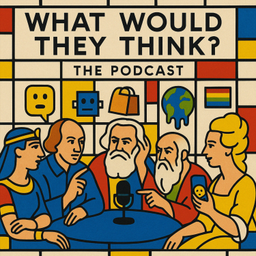
What Would They Think?
Claim This Podcastby Jonathan Millard
5.0(1 reviews)
20 episodes
Updated Daily
Accepts GuestsHas Sponsors
Podcast Overview
What Would They Think explores the gap between the world that was imagined and the one we’re actually living in. Through ironic, often uncomfortable comparisons, it brings the voices of the past into today’s headlines—technology, culture, power, and belief—and asks how they would interpret the systems, behaviors, and contradictions that define modern life. The result is less explanation, more confrontation.
Language
🇺🇲
Publishing Since
3/25/2026
Reach the team behind What Would They Think?
Verified contact details for this show aren't on file yet — sign up to get notified when they land.
Recent Episodes
July 21, 2026
What Would Alfred Hitchcock Think About True Crime Podcasts?
<p>What would Alfred Hitchcock think of a world where the most gripping thing in your earbuds is a real murder — a stranger's last hour, withheld and doled out and scored, pressed play on by millions for the pleasure of the dread, and called caring? He answered this in 1960. He put a woman in a shower and killed her — forty-five seconds, some fifty cuts, and the knife never once touches her skin. The blood was chocolate syrup. Janet Leigh got up, dried off, and went to lunch. The terror was total and the body was perfectly safe, and the safety was the point. The horror was never in the wound. It was in the cut. Fear is not filmed. It is built — and he built it on a woman who was paid to scream.</p><p>True crime took that idea and did the one thing to it he'd have found funniest and worst: it kept the machine and cut the actress. He aimed the dread at fiction on purpose — the mask of a set, a star, an "it's only a movie" — so the audience could feel the fear without a victim paying for it. The mask was the mercy. True crime points the identical machine at the morgue: the same withheld reveal, the same ticking clock, the same delicious complicity of the watcher — except the woman is real, and dead, and does not get up when the episode ends. Same machine. He aimed it at no one; they aim it at the morgue and call it respect. He masked the corpse so you could look at it and live. They tore the mask off and called it the truth.</p><p>And he'd know the mechanism cold, because he built it. The bomb under the table — tell the audience it's there and let them watch the clock, and every dull second becomes unbearable; that's "she had no idea she had four hours to live," a half-century early. Rear Window — he made you the Peeping Tom and then held up the mirror, so you could never quite enjoy the spying cleanly. Rope — he took a real child's murder and staged it as a cocktail party with the body in the room, and he knew it was obscene; he built the obscenity in. And Psycho itself was already true crime: the real Ed Gein, a Wisconsin killer, masked as Norman Bates so you could stand near the horror and survive it. He reached the morgue on purpose, put a mask over it, and called the mask mercy.</p><p>This episode puts the man who built the machinery of dread — and kept it pointed at fiction — in front of a genre that runs it on the real dead. He has opinions. On the Peeping Tom who is now told he's an advocate — the voyeurism rebranded as awareness, the mirror quietly taken down. On the wrong man, the terror of his own childhood, when a policeman locked him in a cell to teach him a lesson — now crowdsourced, a mob convicting whoever looks guilty for the pleasure of the hunt. On the AI channel that pulled millions of views with a hundred and fifty murders that never happened — proof the corpse was always optional, the dread manufactured just as well from nothing. And on October 2025, when a streaming service dramatized the real Ed Gein — the corpse behind Psycho — under his own name, and put Hitchcock himself in the frame as a fellow voyeur: the man who masked the body, now unmasked beside it.</p><p>The man who proved the terror was manufactured meets the genre that forgot to ask what it's manufactured from. Turns out both understood the same thing — that the horror is in the withholding, that the body is beside the point, that whoever gets to hold back the reveal owns the room. Only one of them cast an actress.</p><p>Episode 20.<br>What Would They Think?</p><p></p>
July 14, 2026
What Would Marcel Duchamp Think About NFTs?
<p>What would Marcel Duchamp think of a world where the hardest thing to own is a picture anyone can copy for free — a JPEG, right-click-saved a million times, yet trading for tens of millions because one instance of it was signed? He answered this in 1917. He bought a urinal — mass-produced, common, worth a few dollars — laid it on its back, signed it "R. Mutt," titled it Fountain, and dared a committee that had promised to exhibit anything to hang it. They hid it behind a wall. And in the defense that followed he laid down the whole law a century early: whether the man made it with his own hands is of no importance — he chose it. The object was nothing. The choosing was everything. Art is not made. It is declared.</p><p>The NFT took that idea and did the one thing to it he'd have found funniest and worst: it removed the joke. He aimed the readymade at the market — to prove the worship of the precious object was a con, that a signature could transfigure a piece of plumbing and therefore the whole racket was belief, administered. The NFT points the identical gesture for the market — to manufacture a new precious object out of the least precious thing there is, and sell it at Christie's for sixty-nine million. Same crowbar. Opposite door. He prised the vault open to show it was empty; they welded it shut with a JPEG inside and charged admission.</p><p>And he'd know the mechanism cold, because he built it. He drew a fake cheque to pay his dentist, worth more than its face because he signed it. He issued a speculative bond as an artwork in 1924 — signed, numbered, editioned: an NFT made of paper. He turned his own work into editions, authorized replicas of objects that were never unique, and let the "real" Fountain be a designation with no stable object at all — the original thrown away, surviving as a photograph and a signature. He reached the emptiness on purpose and called it freedom.</p><p>This episode puts the man who proved the object never mattered in front of a market that spent a decade, and a fortune, learning it the hard way. He has opinions. On the spectator who is now also the speculator — the crowd that prices what it praises, so "this is significant" and "this is up forty percent" come out of the same mouth. On the mask — R. Mutt, Rrose Sélavy — worn to free the work from the man, versus the pseudonymous wallet worn to move the money past the state. On MoMA, in December 2025, accessioning a free-to-claim pixel avatar into the permanent collection beside The Starry Night — the readymade's forty-year march into the museum, run in eight. On a market where ninety-six percent of the tokens now point at nothing, immutable and permanent, certifying files that no longer load.</p><p>The man who declared value by signature meets the machine that automated the signature. Turns out both understood the same thing — that the object is beside the point, that whoever gets to designate owns the room. Only one of them was joking.</p><p><br></p><p>Episode 19.<br>What Would They Think?</p><p></p>
July 7, 2026
What Would Marie Antoinette Think About Cancel Culture?
<p>What would Marie Antoinette think of a world where a person can be destroyed before lunch — by a sentence they never spoke, a clip cut from its meaning, an image that was never real — and millions will believe it, repeat it, and never once check? She is the one soul in history most qualified to answer, because it is exactly how she died. The most famous words ever put in her mouth — let them eat cake — she never said. The line was already in print, pinned on some nameless princess, when she was a nine-year-old in Vienna who didn't yet speak French. It was welded to her name after her death, by people who found the doll more useful than the woman. And it worked. Two centuries of historians have failed to unstick it.</p><p>She was not the airhead of the caricature. She was a foreign girl married off at fourteen, undressed at a border and remade as someone else's symbol, watched by a whole court from her wedding night to her last morning. The monster was manufactured: the anonymous pamphlets, pornographic, mass-produced, printed abroad and funded by her enemies — the deepfake, drawn by hand. The diamond necklace she was convicted of buying, she never touched; a con artist forged her signature and hired a look-alike, and the public believed it because it fit. That was the whole trick, then and now: the lie doesn't need to be true, it needs to fit. Octavian at least had to invent his slander himself. In 2026 the machine writes it for you, aims it at a stranger, and sells the outrage by the click.</p><p>This episode sets the most successfully cancelled woman in history — killed by a quote she never said, framed by a jewel she never wore — in front of the descendants who do the same thing to each other for free, a new face a day. From the pamphlet to the feed. She has opinions. On the fabricated quote-card, her own invention, still circulating. On the screenshot — the necklace with diamonds, a tidy artifact of a story that never happened. On the crowd that thinks it's a jury when it's really a supply chain: sincere, lethal, certain this time the target deserves it. On the one thing that stops her scolding anyone — she wasn't innocent. She did spend while France starved. They were wrong about the necklace and right about the palace, and they killed her for the necklace anyway.</p><p>Both knew the same thing: the story always beats the truth, and a lie that fits can outlive the person it's about. But she got a trial — a rigged one, a monstrous one, but a date, a charge, an end, and eventually an appeal. The people we cancel get no court, no verdict, no morning it's over. She was executed once, cleanly, and history could reopen the file. We built something that kills slower and never finishes. She was destroyed by a sentence she never said. We write ours by the million and call it justice.</p><p>Episode 18. What Would They Think?</p><p></p>
20 total episodes available
Deep-dive analytics for What Would They Think?
Frequently asked questions
Have a different question and can't find the answer you're looking for? Reach out to our support team by sending us an email and we'll get back to you as soon as we can.
- What is What Would They Think??
- How often does this podcast release new episodes?
This podcast updates daily.
- Where can I listen to this podcast?
This podcast is available on 4 platforms including Apple Podcasts, Spotify, and more. You can also use the RSS feed directly.
- Does this podcast accept guests?
No, this podcast does not typically feature guests.
Legal Disclaimer
Pod Engine is not affiliated with, endorsed by, or officially connected with any of the podcasts displayed on this platform. We operate independently as a podcast discovery and analytics service.
All podcast artwork, thumbnails, and content displayed on this page are the property of their respective owners and are protected by applicable copyright laws. This includes, but is not limited to, podcast cover art, episode artwork, show descriptions, episode titles, transcripts, audio snippets, and any other content originating from the podcast creators or their licensors.
We display this content under fair use principles and/or implied license for the purpose of podcast discovery, information, and commentary. We make no claim of ownership over any podcast content, artwork, or related materials shown on this platform. All trademarks, service marks, and trade names are the property of their respective owners.
While we strive to ensure all content usage is properly authorized, if you are a rights holder and believe your content is being used inappropriately or without proper authorization, please contact us immediately at hey@podengine.ai for prompt review and appropriate action, which may include content removal or proper attribution.
By accessing and using this platform, you acknowledge and agree to respect all applicable copyright laws and intellectual property rights of content owners. Any unauthorized reproduction, distribution, or commercial use of the content displayed on this platform is strictly prohibited.