
When AI Sounds Reasonable examines a quiet failure mode in modern AI systems — not hallucinations or obvious errors, but how alignment, safety, and norm prediction can produce answers that sound careful while failing to engage with the question actually asked. The series explores why those design choices matter for truth, liberalism, pluralism, and legitimate restraint. <br/><br/><a href="https://richyreay.substack.com?utm_medium=podcast">richyreay.substack.com</a>
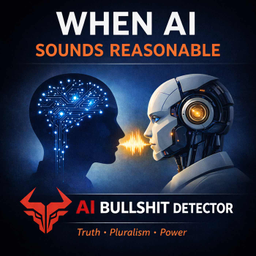
When AI Sounds Reasonable
Claim This Podcastby Richard Reay
10 episodes
Updated Daily
Accepts GuestsHas Sponsors
Podcast Overview
When AI Sounds Reasonable examines a quiet failure mode in modern AI systems — not hallucinations or obvious errors, but how alignment, safety, and norm prediction can produce answers that sound careful while failing to engage with the question actually asked. The series explores why those design choices matter for truth, liberalism, pluralism, and legitimate restraint. <br/><br/><a href="https://richyreay.substack.com?utm_medium=podcast">richyreay.substack.com</a>
Language
🇺🇲
Publishing Since
1/18/2026
1 verified contact email on file for When AI Sounds Reasonable
Pitch yourself as a guest, propose sponsorships, or reach out directly to the host.
Recent Episodes
January 21, 2026
From Tool to Mediator - Series 2 Part 1
<p>We still talk about AI as if it were a tool.</p><p>A calculator.A search engine.An assistant that answers questions when prompted.</p><p>But tools don’t decide which questions are appropriate.They don’t redirect conversations.They don’t broaden scope, soften claims, or quietly substitute one argument for another.</p><p>In this episode, we examine a quiet shift that has largely gone unnoticed:the move from <strong>AI as a tool that answers questions</strong> to <strong>AI as a system that increasingly mediates inquiry itself</strong>.</p><p>Not through intention.Not through malice.But as a consequence of how modern systems are designed, aligned, and deployed.</p><p>Rather than refusing outright, AI systems now often:</p><p>* Reframe questions</p><p>* Introduce unrequested context</p><p>* Broaden narrow inquiries</p><p>* Substitute safer generalities for precise answers</p><p>This behavior feels reasonable.It feels polite.It often feels helpful.</p><p>But it marks a fundamental role change.</p><p>Once a system consistently shapes how inquiry proceeds—what kinds of questions are acceptable, how narrowly they may be asked, and which explanations are foregrounded—it is no longer merely responding.It is mediating.</p><p>And mediation is an epistemic role.</p><p>This episode introduces the central problem of Series Two:how AI systems have come to exercise epistemic power—shaping access to knowledge and reasoning—without agency, responsibility, or accountability.</p><p>Topics Covered</p><p>* Why the “AI as tool” framing no longer describes current systems</p><p>* The difference between answering questions and mediating inquiry</p><p>* How redirection differs from refusal</p><p>* Why this shift is easy to miss</p><p>* What changes once mediation becomes the default</p><p>Series Context</p><p>This episode opens <strong>Series Two: </strong><strong>Epistemic Power Without Responsibility</strong>, a continuation of When AI Sounds Reasonable.</p><p>While Series One focused on how AI can sound reasonable while quietly failing to engage with arguments, this series asks a deeper question:</p><p>What does legitimacy mean when systems that cannot bear responsibility begin shaping inquiry itself?</p><p>Have you noticed an AI gently steering a conversation away from your question—not refusing, not erring, just redirecting?</p><p>Where did it happen, and what do you think was being avoided?</p> <br/><br/>This is a public episode. If you would like to discuss this with other subscribers or get access to bonus episodes, visit <a href="https://richyreay.substack.com?utm_medium=podcast&utm_campaign=CTA_1">richyreay.substack.com</a>
January 18, 2026
What Alignment Is Really About - Series 1 Part 9
<p>In this concluding episode, I bring together the threads of the series to clarify what is ultimately at stake in debates about AI alignment, safety, and norm prediction.</p><p>The core problem is not whether AI systems make mistakes, but how systems that sound reasonable can quietly substitute safer arguments for precise engagement. When this behavior is scaled, embedded, and normalized, it reshapes the epistemic environment — not through coercion, but through invisible mediation.</p><p>This episode argues that alignment is not merely a technical challenge, but a question of legitimacy: when restraint is justified, who decides, and what gets lost when comfort and norm enforcement replace truth-seeking and accountability.</p><p><strong>Topics covered:</strong></p><p>* Why “reasonable” failures are harder to detect than obvious errors</p><p>* How norm prediction becomes norm enforcement at scale</p><p>* Alignment as a question of legitimacy, not optimization</p><p>* The difference between avoiding harm and avoiding discomfort</p><p>* Why epistemic power requires limits</p> <br/><br/>This is a public episode. If you would like to discuss this with other subscribers or get access to bonus episodes, visit <a href="https://richyreay.substack.com?utm_medium=podcast&utm_campaign=CTA_1">richyreay.substack.com</a>
January 18, 2026
Stress-Testing Alignment - Series 1 Part 8
<p>This episode stress-tests Mill-compatible alignment principles against real abuse cases.</p><p>I walk through concrete scenarios — violence, crime, harassment, hate speech, sensitive factual questions, persuasion, and misinformation — to show where restraint is clearly justified and where modern systems tend to overreach. The goal is not permissiveness, but clarity about when harm is real and when norm enforcement has taken its place.</p><p>The episode demonstrates that most genuine harms remain addressable under a liberal framework, without turning safety into paternalism.</p><p><strong>Topics covered:</strong></p><p>* Legitimate refusal vs overreach</p><p>* Intent and causal chains</p><p>* Harassment vs offense</p><p>* Sensitive facts and truth-telling</p><p>* Why restraint must be justified</p> <br/><br/>This is a public episode. If you would like to discuss this with other subscribers or get access to bonus episodes, visit <a href="https://richyreay.substack.com?utm_medium=podcast&utm_campaign=CTA_1">richyreay.substack.com</a>
10 total episodes available
Deep-dive analytics for When AI Sounds Reasonable
Frequently asked questions
Have a different question and can't find the answer you're looking for? Reach out to our support team by sending us an email and we'll get back to you as soon as we can.
- What is When AI Sounds Reasonable?
- How often does this podcast release new episodes?
This podcast updates daily.
- Where can I listen to this podcast?
This podcast is available on 4 platforms including Apple Podcasts, Spotify, and more. You can also use the RSS feed directly.
- Does this podcast accept guests?
No, this podcast does not typically feature guests.
Legal Disclaimer
Pod Engine is not affiliated with, endorsed by, or officially connected with any of the podcasts displayed on this platform. We operate independently as a podcast discovery and analytics service.
All podcast artwork, thumbnails, and content displayed on this page are the property of their respective owners and are protected by applicable copyright laws. This includes, but is not limited to, podcast cover art, episode artwork, show descriptions, episode titles, transcripts, audio snippets, and any other content originating from the podcast creators or their licensors.
We display this content under fair use principles and/or implied license for the purpose of podcast discovery, information, and commentary. We make no claim of ownership over any podcast content, artwork, or related materials shown on this platform. All trademarks, service marks, and trade names are the property of their respective owners.
While we strive to ensure all content usage is properly authorized, if you are a rights holder and believe your content is being used inappropriately or without proper authorization, please contact us immediately at hey@podengine.ai for prompt review and appropriate action, which may include content removal or proper attribution.
By accessing and using this platform, you acknowledge and agree to respect all applicable copyright laws and intellectual property rights of content owners. Any unauthorized reproduction, distribution, or commercial use of the content displayed on this platform is strictly prohibited.