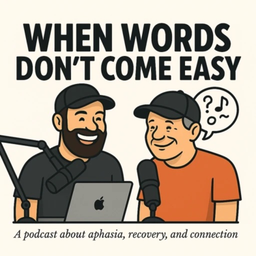
Podcast thumbnail for When Words Don't Come Easy

When Words Don't Come Easy

Claim This Podcast

by Justin and Roger Chlowitz

5.0(3 reviews)
37 episodes
Updated Daily
Accepts GuestsHas SponsorsLocation 🇺🇸

Podcast Overview

When Words Don’t Come Easy is a podcast about connection — even when communication gets hard. I’m Justin, and my dad Roger is recovering from a stroke that left him with aphasia. We talk. We struggle. We laugh. We guess the words. But this show isn’t just about us. It’s also about the people who’ve been there: Other stroke survivors. Families. Speech therapists. Doctors. Advocates. People who know what it’s like when the words won’t come — but the love is still loud. If you’ve ever felt alone in this journey, this podcast is for you. Subscribe and join the conversation.

Language

🇺🇲

Publishing Since

12/13/2025

1 verified contact email on file for When Words Don't Come Easy

Pitch yourself as a guest, propose sponsorships, or reach out directly to the host.

Recent Episodes

Episode thumbnail for Ep. 26 Aphasia At Home W/ Laura Malis

July 26, 2026

Ep. 26 Aphasia At Home W/ Laura Malis

<p>In this episode of <strong>When Words Don&#39;t Come Easy</strong>, we sit down with <strong>Laura Malis</strong>, stroke survivor, aphasia advocate, and founder of <strong>Aphasia at Home</strong>.</p><p><strong>Learn more at </strong><a href="http://www.aphasiaathome.com"><strong>www.aphasiaathome.com</strong></a><strong> and follow Laura on Instagram @aphasiaathome</strong> for free resources that help people with aphasia improve their language, reading, writing, communication, and overall recovery. The website also offers book clubs, conversation groups, technology tools, caregiver resources, and practical exercises you can use at home.</p><p>After her stroke, Laura committed years of hard work to rebuilding her language, reading, and writing skills. That journey inspired her to create <strong>Aphasia at Home</strong>, a resource designed to help people with aphasia, caregivers, families, and speech-language pathologists continue recovery beyond traditional therapy.</p><p>In this episode, we discuss:<br>• Laura&#39;s stroke and aphasia journey<br>• How she regained her language through consistent practice<br>• The importance of reading and writing in recovery<br>• Practical tools for communication at home<br>• Advice for stroke survivors, caregivers, and speech-language pathologists</p><p>If you or someone you love is living with aphasia, this episode is filled with hope, encouragement, and actionable resources to support your recovery journey.</p><p><strong>About the Podcast</strong></p><p>When Words Don&#39;t Come Easy is hosted by Justin and Roger, a father and son sharing real conversations about aphasia, stroke recovery, caregiving, speech therapy, and life after stroke. Our mission is to raise awareness, educate families, and remind everyone that <strong>aphasia is a loss of language, not intellect.</strong></p>

Episode thumbnail for Ep. 25 Your Way to Say: Finding Your Voice After Aphasia W/ Mike Jankowski

July 19, 2026

Ep. 25 Your Way to Say: Finding Your Voice After Aphasia W/ Mike Jankowski

<p><strong>Can you really stop recovering after one year? Stroke survivor Mike Jankowski says absolutely not.</strong></p><p>In this episode of <strong>When Words Don&#39;t Come Easy</strong>, we sit down with stroke survivor Mike Jankowski to discuss his journey through <strong>stroke recovery</strong>, living with <strong>aphasia</strong>, and why one of the most common messages patients hear after a stroke may be one of the most damaging.</p><p>Four years after his stroke, Mike continues to improve, proving that recovery doesn&#39;t follow a calendar. He shares how persistence, therapy, support, and hope have helped him regain skills and confidence long after many people expected his progress to stop.</p><p>Whether you&#39;re a stroke survivor, living with aphasia, caring for a loved one, or a healthcare professional, Mike&#39;s story is a powerful reminder that every recovery journey is unique and that progress is possible at any stage.</p><p>In this episode, we discuss:<br>• Why the &quot;one-year recovery&quot; myth needs to change<br>• Living with aphasia after stroke<br>• The role of neuroplasticity and lifelong brain recovery<br>• Finding hope during the hardest moments<br>• The importance of support from family, friends, and the stroke community<br>• Why stroke survivors are still the same intelligent, capable people they were before their stroke</p><p>At <strong>When Words Don&#39;t Come Easy</strong>, our mission is to raise awareness about aphasia, share real stories from stroke survivors and caregivers, and bring expert insights from speech-language pathologists, researchers, and advocates. Through honest conversations, we hope to educate, inspire, and remind people that communication challenges do not define a person&#39;s intelligence or potential.</p><p>If Mike&#39;s story resonates with you, please subscribe, leave a review, and share this episode. Every share helps raise awareness about aphasia and gives hope to others navigating life after stroke.</p><p><strong>Keywords:</strong> stroke recovery, aphasia, stroke survivor, aphasia awareness, neuroplasticity, brain recovery, speech therapy, stroke rehabilitation, caregiver support, life after stroke.</p><p><br></p>

Episode thumbnail for Ep. 24 A Psychologist's Stroke Recovery | Matthew Liebman

June 28, 2026

Ep. 24 A Psychologist's Stroke Recovery | Matthew Liebman

<p>What happens when a psychologist suddenly becomes the patient?</p><p>In Episode 24 of <strong>When Words Don&#39;t Come Easy</strong>, Justin and Roger sit down with <strong>Matthew Liebman</strong> to discuss his stroke recovery, living with aphasia, and how his professional background gave him a unique perspective on healing.</p><p>Matthew shares what it was like going through a full psychological evaluation after his stroke, the frustration of experiencing cognitive changes firsthand, and how stress can make communication even more difficult. He also opens up about <strong>amusia</strong>, a condition that left him unable to feel rhythm or keep a beat despite having no physical limitations.</p><p>This honest conversation explores the emotional, cognitive, and often invisible challenges of stroke recovery, while offering hope and understanding for survivors, caregivers, and clinicians alike.</p><p><strong>In this episode:</strong></p><ul><li>Life after stroke</li><li>Living with aphasia</li><li>Stress and cognitive overload</li><li>Amusia and losing the sense of rhythm</li><li>Recovery from a psychologist&#39;s perspective</li><li>Finding purpose after stroke</li></ul><p>If you enjoy the episode, please like, subscribe, and share to help raise awareness about aphasia and stroke recovery.</p><p><strong>About the Podcast</strong></p><p><strong>When Words Don&#39;t Come Easy</strong> is hosted by father and son Roger and Justin Chlowitz. After Roger&#39;s stroke left him with aphasia, they created this podcast to educate, inspire, and connect the aphasia community through honest conversations with survivors, caregivers, and experts.</p>

37 total episodes available

Similar Podcasts

Discover related shows you might enjoy

Deep-dive analytics for When Words Don't Come Easy

Frequently asked questions

Have a different question and can't find the answer you're looking for? Reach out to our support team by sending us an email and we'll get back to you as soon as we can.

What is When Words Don't Come Easy?

When Words Don’t Come Easy is a podcast about connection — even when communication gets hard.

I’m Justin, and my dad Roger is recovering from a stroke that left him with aphasia.

We talk. We struggle. We laugh. We guess the words.

But this show isn’t just about us.

It’s also about the people who’ve been there: Other stroke survivors. Families. Speech therapists. Doctors. Advocates. People who know what it’s like when the words won’t come — but the love is still loud.

If you’ve ever felt alone in this journey, this podcast is for you. Subscribe and join the conversation.

How often does this podcast release new episodes?

This podcast updates daily.

Where can I listen to this podcast?

This podcast is available on 4 platforms including Apple Podcasts, Spotify, and more. You can also use the RSS feed directly.

Does this podcast accept guests?

Yes, this podcast regularly features guests.

Legal Disclaimer

Pod Engine is not affiliated with, endorsed by, or officially connected with any of the podcasts displayed on this platform. We operate independently as a podcast discovery and analytics service.

All podcast artwork, thumbnails, and content displayed on this page are the property of their respective owners and are protected by applicable copyright laws. This includes, but is not limited to, podcast cover art, episode artwork, show descriptions, episode titles, transcripts, audio snippets, and any other content originating from the podcast creators or their licensors.

We display this content under fair use principles and/or implied license for the purpose of podcast discovery, information, and commentary. We make no claim of ownership over any podcast content, artwork, or related materials shown on this platform. All trademarks, service marks, and trade names are the property of their respective owners.

While we strive to ensure all content usage is properly authorized, if you are a rights holder and believe your content is being used inappropriately or without proper authorization, please contact us immediately at hey@podengine.ai for prompt review and appropriate action, which may include content removal or proper attribution.

By accessing and using this platform, you acknowledge and agree to respect all applicable copyright laws and intellectual property rights of content owners. Any unauthorized reproduction, distribution, or commercial use of the content displayed on this platform is strictly prohibited.