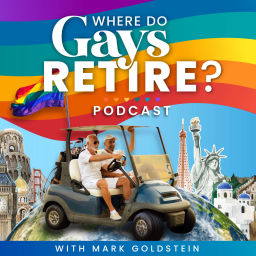
Where Do Gays Retire Podcast
Hosted by Mark Goldstein · Mark Goldstein
5.0from 2 ratings
- 136
- Episodes
- 2
- Ratings
- Bi-weekly
- Cadence
- 2022
- First episode
About Where Do Gays Retire Podcast
Where Do Gays Retire is a podcast where we help you in the LGBTQ+ community find a safe and affordable retirement destination. Join Mark Goldstein as he interviews others who live in gay-friendly places around the globe. Learn about the climate, cost of living, the LGBTQ + community, healthcare, crime and safety, and more.
- Publisher
- Mark Goldstein
- Category
- leisure · society & culture · society & culture
- Language
- en
- Explicit
- No
- First episode
- 3 Aug 2022
- Latest episode
- 7 Oct 2026
Latest episodes
136 episodes in the feed.
7 Oct 2026
Lancaster, PA: No Gay Bars, No Gayborhood, No Problem - With Stephen Hardy
WHERE DO GAYS RETIRE PODCAST Show Notes Lancaster, PA: No Gay Bars, No Gayborhood, No Problem Hosted by Mark Goldstein| Guest: Stephen Hardy |Lancaster, Pennsylvania Runtime: approximately 60 minutes Stephen Hardy and his husband Addison thought Phoenix was the finish line. They had raised two sons there, downsized into a gut-renovated mid-century condo in Midtown, and built a full civic life. Stephen served on the boards of Ballet Arizona and Arizona Opera and chaired the ballet's 2025 gala. Then the desert started to wear on them. Addison missed having a garden. They both missed seasons, museums, and being a short hop from a big city. France was ruled out over the language barrier and the bureaucracy. The Pacific Northwest, where they are both from, had gotten too expensive. New England was on the list, until Stephen's research turned up a name he was not expecting. Lancaster, Pennsylvania. On paper it checked every box. Liberal, walkable, excellent health care, a serious arts and food scene, an hour by train to Philadelphia and three hours to New York, and no Pennsylvania state tax on retirement income. They visited in April 2025 and knew within two hours. They bought a 1920s townhouse in Chestnut Hill and moved in this past April. Here is the part that surprises people. Lancaster has no gayborhood and no gay bar. Stephen says neither is missed. Pride flags fly year round in shop windows and on front porches. He and Addison hold hands walking home from the theater. The city is only about 60,000 people, but it packs them in densely enough that Stephen describes it as the West Village set down on its own in Pennsylvania. Four months in, they had built a full social circle with almost no effort. If you have ever worried that leaving a big city gay scene means giving up community, this conversation is for you. 🎧 In This Episode Why a couple who loved Phoenix's arts scene still decided to leave What it actually feels like to be an out gay couple in a small city surrounded by conservative farm country Why Lancaster has no gay bar, and why Stephen argues it does not need one What a 1920s townhouse in the nicest neighborhood in town really costs How Pennsylvania's retirement income tax break stacks up against its property taxes The one piece of DMV paperwork that catches every out of state mover off guard How they built a real friend group in under four months ⏱️ Chapters 00:00 Introduction. Who Stephen and Addison are, and why Lancaster 03:18 From New York to Connecticut to Phoenix. Two dads, a fashion career, and a second act as an author 05:15 The Mark connection. Neighbors in Phoenix, and two very different exits 06:41 The April 2025 visit. Why the Philly suburbs did not work and Lancaster did in two hours 08:32 A family migration. Stephen's sister, then Addison's sister, followed them 09:04 It is not Amish country. A real small city with four colleges and a multi ethnic population 11:22 Choosing Chestnut Hill. Tree lined streets, fifteen minutes from Penn Square 13:11 Four seasons again. Snow, humidity, and why neither is a dealbreaker 15:23 Rivers, gentle hills, tree ordinances, and yes, sometimes you smell the fields 17:14 LGBTQ+ life. No gayborhood, no gay bar, and no sense of loss 19:31 The Gayest Happy Hour, the Belvedere, and year round Pride flags 19:47 The Gelks. How the Elks Club became a gay bingo night 20:51 Amish Country Queer, and the LGBTQ+ youth who come into the city to be themselves 21:59 City versus county. Navigating a conservative rural surround 23:28 The kilt question 24:03 Cost of living. What a Chestnut Hill townhouse costs, and what the $200,000s still buy 25:10 Property taxes, school taxes, and why they are glad to pay them 26:12 The famous Stephen and Addison renovation, round two 27:10 No Pennsylvania tax on Social Security, pensions, or retirement withdrawals 28:15 Utilities, groceries, dining out, and the state liquor store markup 30:29 Walkability, the Keystone train line, and getting to Philadelphia, New York, and Europe 33:01 Health care. Penn Medicine, an openly gay primary care doctor, and a dentist shortage 36:16 Crime and safety. Walking home at night, and the one real hazard 40:22 Arts and culture downtown. The Fulton, First Fridays, murals, and street pianos 41:52 Southern Market, Central Market, and a downtown with almost no chains 42:29 How they built a social life in four months 45:51 Where they eat 48:31 Logistics. Cash closing, utilities, and Pennsylvania's DMV plus notary two step 50:35 Inheritance tax and why they are updating their wills 51:55 What Stephen misses about Phoenix 53:03 Would he change anything 53:31 Advice for LGBTQ+ folks afraid of leaving a visible gay community behind 56:30 Stephen's books, contact information, and final words of wisdom 📊 Lancaster by the Numbers About 60,000 residents in the city, at roughly 8,100 per square mile, denser than Seattle A fifteen-minute walk from Chestnut Hill to Penn Square, twenty minutes to the train station One hour and five to fifteen minutes to Philadelphia on the Keystone line, twelve trains a day on weekdays and eight on weekends About three hours to New York on the same train $300,000 to $400,000 for a typical Chestnut Hill townhouse, and the $200,000s for a nice three-bedroom elsewhere in the city About $10,000 a year in property taxes across three overlapping tax districts, but $4,000 to $7,000 just blocks away About $275 a month for electric, gas, water, sewer, and garbage combined Zero Pennsylvania state tax on Social Security, pensions, and retirement account withdrawals 1730, the year Lancaster Central Market began, making it the oldest continuously operating public farmers market in the country 1852, the year the Fulton opened, widely considered the oldest continuously operating theater in America 💬 Moments Worth the Listen On why there is no gayborhood: Stephen's answer is not that Lancaster is too small for one. It is that the whole city functions as one. You do not feel a need to self-segregate to feel safe and welcomed. Everyone is simply mixed in, including the older gay couple across the street. On the Elks Club: Stephen remembers his father's Elks lodge as conservative and white. Lancaster's chapter has a contingent of gay members who call themselves the Gelks, and Tuesday night bingo is how Stephen and Addison met half their friend group. On the first two hours in town: Trans flags, Pride flags, and Black Lives Matter signs on the walk. Lilacs and tulips in bloom. Strangers stopping to say you have got to move here. That was it. On what he would change: Nothing. Every day we pretty much get up and pinch ourselves. On the fear of leaving a gay scene behind: You can be yourself anywhere. Gay bars matter enormously in places where people feel unsafe, Stephen says, but Lancaster is not one of those places, and the LGBTQ+ people who live there are there precisely because they feel safe 🎭 Arts and Culture Mentioned Fulton Theatre, an 1852 National Historic Landmark on Prince Street, with a mainstage and a black box, casting out of Philadelphia and New York First Fridays gallery walk along the Prince and Queen Street arts corridor Franklin and Marshall College, Pennsylvania College of Art and Design, Thaddeus Stevens College of Technology, and Millersville University Public pianos placed around town each spring, and the ongoing parking garage mural project Philadelphia Orchestra musicians who live in Lancaster and commute in 🍽️ Food and Drink Mentioned Lancaster Central Market, the 1730 farmers market at Penn Square Southern Market, a converted factory food hall with German, Korean, Caribbean, Mediterranean, and Turkish stalls, largely immigrant owned, with communal seating The Belvedere Inn, an 1870s mansion turned restaurant and bar, with jazz nights, a monthly cabaret, and Stephen's favorite lobster bisque and mussels Bert and the Elephant for Belgian, South County for barbecue, X Marks the Spot for soul food, plus Josephine's, C'est La Vie, and 401 Prime Lemon Street Market, a locally sourced grocery two and a half blocks from their house A downtown of independent coffee roasters, with no Starbucks in the city itself 🏳️🌈 LGBTQ+ Community Mentioned The Gayest Happy Hour, the first Thursday of every month Lancaster's Elks lodge and its Tuesday night bingo The Unitarian Universalist congregation, plus affirming Presbyterian, Baptist, Congregational, Catholic,...
23 Sept 2026
Uruguay for LGBTQ+ Expats: Permanent Residency, Public Healthcare, and Daily Life in Montevideo
🎙️ Uruguay for LGBTQ+ Expats: Permanent Residency, Public Healthcare, and Daily Life in Montevideo Hosted by Mark Goldstein, Where Do Gays Retire Uruguay has some of the strongest LGBTQ+ legal protections in the world, and almost nobody talks about it. Steven Guthrie noticed. When he started looking for somewhere outside the United States to build a life, Spain and Mexico were the obvious candidates. Both were also filling up fast, with rising housing costs and growing friction between newcomers and locals. He wanted somewhere his money would go far and stay that way. A trip through Argentina and Chile, plus a detour into astrocartography, landed him in Montevideo in October 2022. He has been there ever since, now holding permanent residency and managing a growing LGBTQ+ immigrant community of roughly 160 people. In this chat, Steven walks us through what daily life in Montevideo actually costs, how he navigated residency without a lawyer, what the public healthcare system covers, and why individualism will not serve you well in Uruguay. 🌟 What We Cover Why Steven ruled out Spain and Mexico, and what drew him to Uruguay instead Neighborhood by neighborhood: where to land first as a newcomer, and which areas feel most livable long term The climate reality, including a winter that gets colder than the palm trees suggest and a sun strength that surprises people from Florida Walkability, the bus network, and life without a car Carnival, candombe, murgas, and one of the longest celebrations in the world Honest trade-offs: the distance from the US, the absence of direct flights, and what Steven genuinely misses 🌈 LGBTQ+ Life Whether the day-to-day experience matches Uruguay's strong legal reputation, and where the gaps still are Building community from scratch: the WhatsApp group, monthly brunches, the gay men's chorus, and the resource website Steven's group launched Dating culture in Montevideo, and why relationships move faster than most Americans expect Gender affirming care and what is and is not available for trans residents 💰 Costs and Housing What a realistic monthly budget looks like, and what it buys Rent in the city center, utilities, and the imported goods that cost far more than you would expect Why Uruguay is one of the pricier countries in Latin America, and where the money still goes further than in the US 🏥 Healthcare The three systems explained: mutualistas, the public ASSE system, and how pre-existing conditions factor in HIV treatment access, PrEP availability, and the organization that helps new arrivals bridge their medication gap What to sort out before you move if you manage a chronic condition Language and healthcare: why Spanish matters more than finding an English speaking doctor 🛂 Visas and Residency The residency process step by step, and the documents that slow people down Steven's advice on relocation specialists, and why he says you do not need a lawyer The path to citizenship in five years, with no language test required Uruguay's ten-year tax holiday on foreign income 📊 Numbers Steven Shared At the time of recording, Steven described a comfortable monthly budget of roughly $1,500 to $2,000 for a lifestyle similar to what most Americans expect. He pays around $850 a month for a two-bedroom apartment in the city center, with utilities typically running $50 to $75 depending on the season. He mentioned seeing refurbished apartments in the city center listed around $150,000. Private mutualista healthcare, as he understands it, runs roughly $50 to $70 a month, while the public ASSE system he uses has been free for him, including HIV medications, specialist visits, and lab work. He estimated relocation specialists charge somewhere between $1,000 and $2,000 per person. Costs vary by neighborhood, lifestyle, and exchange rate. "I would say be prepared for it not to be a sunshines and rainbows story, because even if you have all your I's dotted and T's crossed, there is going to be an endless amount of mistakes and different mishaps that happen throughout the way, and you have to be able to be prepared to just smile through it." — Steven Guthrie 🔗 Resources Mentioned ASEPO, a Uruguayan organization that connects people with HIV to medical providers, testing, and medication Centro LGBTQ Uruguay, the community resource site Steven's group built for LGBTQ+ immigrants: centrolgbtquy.org Steven's TikTok, where he shares his experience of Uruguayan culture and cuisine: @stevensinfronteras 🎧 Listen Now Find this episode and the full catalog at wheredogaysretire.com, covering destinations across Europe, Latin America, Asia, Africa, and more than forty US cities. 💬 Join the Conversation Thinking about Montevideo and want to talk with people already living it? Steven's group welcomes questions from prospective immigrants at info@centrolgbtquy.org. Are you an LGBTQ+ expat living in a destination you love? We would love to hear your story. The Where Do Gays Retire podcast is always looking for guests from affirming destinations around the world. Reach out to Mark at mark@wheredogaysretire.com. The information shared in this episode reflects the personal experiences of our guest and is for general informational purposes only. Costs, healthcare details, residency requirements, and tax rules described here reflect Steven's own experience at the time of recording and are not universal figures. Immigration policies, healthcare coverage, and tax regulations change frequently. Please consult qualified legal, medical, immigration, and financial professionals, or the appropriate Uruguayan consulate, before making any decisions about living or retiring abroad.
9 Sept 2026
Retiring in Toulouse, France: Gay Life in the Pink City with Cameron Bray
Retiring in Toulouse, France: Gay Life in the Pink City with Cameron Bray In this episode, host Mark Goldstein sits down with Cameron Bray, an Australian-born, naturalized British citizen who has been living permanently in Toulouse, France for over ten years. Cameron arrived with a simple plan: stay three months, learn some French, and move on. That plan never quite worked out. He fell in love with the city, fell in love with a French partner, and never left. Now approaching 60, Cameron is a gay man who has built a full and thriving life in southwest France, founding his own international human resources consultancy and navigating French business life as a foreign entrepreneur. He hopes that by sharing his experience, he can inspire others to take that same leap. Note on currency: as of June 21, 2026, 1 Euro equals approximately $1.15 USD. All figures in this episode are from Cameron's personal experience and reflect conditions at the time of recording. What Is Toulouse Toulouse is France's fourth largest metropolitan area and its fastest growing city, located in the southwest corner of the country near the Spanish border, roughly three hours northwest of Barcelona. Often called La Ville Rose, or the Pink City, the city earned its name from the distinctive long, thin red bricks used in its buildings throughout the region. In certain light, particularly at sunset, the bricks give the entire city a warm pink glow. The Garonne River runs through it. Views of the Pyrenees mountain range are visible from the city center. Cameron describes Toulouse as a "Goldilocks city": not too big, not too small. At roughly 1.2 million people in the metro area, it has enough energy, ambience, and cultural life to feel vibrant, without the overwhelming scale of a major global city. It is also France's biggest university town outside of Paris, which gives it a youthful, buzzing street energy that Cameron says he still pinches himself about after a decade. Why Cameron Chose It Cameron did not plan to stay. He came on the recommendation of friends who had a small apartment there, with a flight to check out the Alliance Francaise language school. He had been made redundant as an HR director in Brighton, had recently come out of a long relationship, and had the financial cushion and the freedom to try something different. What was meant to be a three-month adventure became a permanent life. He describes the move as one driven by gut instinct rather than analysis, noting that over-thinking it might have sent him straight back to the airport. LGBTQ+ Life Toulouse and France more broadly have a deeply laissez-faire attitude toward sexuality. Cameron says he has never experienced discrimination, abuse, or felt unsafe walking the streets of Toulouse or anywhere else in France as a gay man, including in the countryside. France was one of the first countries to decriminalize homosexuality, and same-sex civil partnerships and marriages have been legal for over twenty years, with the same rights as heterosexual partnerships. There is no defined gayborhood in Toulouse, and Cameron says that is very much a reflection of how accepted LGBTQ+ life is there: there is simply no need for one. Gay bars and venues exist, though Cameron notes, as in many cities around the world, the traditional scene has shifted with the rise of apps. Gay men and women live throughout the city and in the surrounding countryside. Cameron has friends, a gay couple, who live in a small rural village an hour and a half away and were welcomed by the mayor at the village festival with flowers and wine, the same as every other new resident. Daily Life and Walkability Toulouse is highly walkable, and Cameron describes his immediate neighborhood as a textbook example of what some urban planners now call the 15-minute city. His bakery is in the building. His butcher, fruit and vegetable shop, wine shop, pharmacy, supermarket, and tram stop are all within a few hundred yards. A fresh market takes place nearby daily. Over the past decade, Toulouse has actively worked to remove cars from the historic city center, converting parking into bike lanes and creating shared pedestrian, cycling, and scooter spaces. The old city is a labyrinth of cobbled streets that was never really designed for cars in the first place. Cameron and his partner walk rather than drive and say they rarely take taxis anywhere within the city. Food and Cafe Culture Food culture in Toulouse is rural-based and deeply regional. The city is known for a few signature dishes: the saucisse de Toulouse, a thick, fatty sausage typically served with pureed potatoes; cassoulet, a hearty white bean stew with dark sausage and breadcrumbs that originated as farmhouse food; and anything involving duck, including confit and, yes, foie gras. Fresh markets are central to daily life, and most meals are cooked from scratch. Processed food is far less prevalent in supermarkets than in the US or Australia. Cameron describes the French relationship with food as one of appreciation rather than consumption. Meals are structured: breakfast, then nothing, then lunch, then nothing, then dinner. Portion sizes are smaller. People eat slowly, talk about what they are eating, and treat wine and food as part of the conversation rather than just fuel. The result, Cameron observes with some bemusement, is that Toulouse is full of people eating rich food in large quantities and yet very few are obese. The cafe culture in Toulouse is genuine. Coffee in the morning under plane trees, wine in the evening at a bar. The city is also France's largest university town outside of Paris, which means the streets stay lively, particularly on Thursday nights, which the locals call le petit weekend. Dinner tends to start around 7:30 to 8:00, preceded by a proper apero of charcuterie, cheese, bread, and wine that can last an hour or more on its own. Language Cameron arrived expecting Toulouse to be less English-friendly than Paris or Bordeaux. He was wrong. Because Airbus, the aviation company, is headquartered in Toulouse, and because American firms like Pratt and Whitney and Rockwell Collins have a major presence there as well, English is widely spoken throughout the city. The European Space Agency is also based there. Signs at the airport and many local businesses operate bilingually. Cameron says that when he first arrived and tried his schoolboy French, shopkeepers would often just switch straight to English. That said, Cameron strongly recommends making a genuine effort with the language. The French appreciate the attempt, even if they complete the sentence for you. He adds that younger French people today are notably more fluent in English than the older generation, and that Toulouse in particular has an internationally-minded feel that makes it more accessible for non-French speakers than many French cities. Costs and Housing Cameron owns a one-bedroom apartment in Toulouse with views of the Garonne River and the Pyrenees, a terrace, a garage, and a cellar. He paid 190,000 euros (approximately $218,500 USD) for it three years ago. His annual electricity bill runs around 400 euros (approximately $460 USD) for two people, in part because of favorable sun exposure in winter. His internet, phone, and basic television package runs approximately 40 euros a month (approximately $46 USD). His mobile phone plan costs around 15 euros a month (approximately $17 USD). Public transport within Toulouse is 2 euros per trip for the subway or bus, and free for seniors. Train travel across the region is one euro on the first Sunday of every month, a government initiative to help people with fewer means stay connected. All museums are free that same Sunday. Cameron describes France's socialist economic model as providing a genuine cushion: during the energy crisis triggered by the war in Ukraine, electricity prices in France rose only 4 percent while UK prices spiked 54 percent, because the French government owns its energy suppliers and capped price increases. French property culture is notably different from the Anglo world. Property here is bought to live in, not to flip. Prices rise slowly. Cameron says the expectation of making a fast profit on real estate simply does not exist in France the way it does in the US or Australia, and he sees that as a feature rather than a bug. Healthcare France operates a universal healthcare system. If you are sick, you will be seen and treated regardless of your ability to pay. Cameron describes five hospital visits for conjunctivitis earlier this year: he walked in, was treated, and walked out each time without a bill. Emergency and life-critical care is covered entirely by the state. Some medications require a small co-pay; others are free. Most residents supplement the public system with a mutuelle, a top-up private insurance that covers things like a private hospital room, dental, physiotherapy, and osteopathy. Cameron pays 60 euros a month (approximately $69 USD) for his mutuelle. He emphasizes this is not like American private health insurance: the mutuelle covers what the state does not, rather than replacing the state system entirely. For new arrivals, getting into the French health system takes patience. Cameron waited nine months to receive his health card. Bureaucracy is a real hurdle, and the administration does not make the process intuitive. However, once you are in the system, it is reliable. A colonoscopy consultation for Cameron's partner, who has a family history of colon cancer, was booked about four months out, which Cameron considers reasonable for a non-urgent specialist appointment. He notes...
Who has been a guest on Where Do Gays Retire Podcast
Names identified in recent episode analyses. Showing up to five guests.
- Loren Ostrow
- Tom Leonard
- Terry Manzberger
Reach and audience
Public platform figures. Ratings count people who left a rating, not total listeners.
- Apple Podcasts (US)
- 5.0 / 5
- 2 ratings
Podcast Authority Score: 48 / 100
A composite of feed quality, social presence, YouTube performance and engagement. Read the methodology.
- Quality
- 64
- Social presence
- 0
- YouTube
- 0
- Engagement
- 81
Contact Where Do Gays Retire Podcast
- Guest appearances
- Does not typically book guests
Based on episode analysis; this does not confirm that the show is currently accepting guests.
Shows with a similar audience





Questions about Where Do Gays Retire Podcast
Who hosts Where Do Gays Retire Podcast?
Mark Goldstein host the show. Published by Mark Goldstein.
How often do new episodes come out?
The show publishes bi-weekly, based on its RSS feed.
Does Where Do Gays Retire Podcast take guests?
The show does not typically feature guests, based on episode analyses.
Host of Where Do Gays Retire Podcast?
Claim your podcast to manage its listing and keep your show details accurate.
Pod Engine is an independent podcast discovery and analytics service and is not affiliated with or endorsed by this podcast. Artwork and show content belong to their owners. Full legal notice.
Explore this show
Podcast research with Pod Engine