
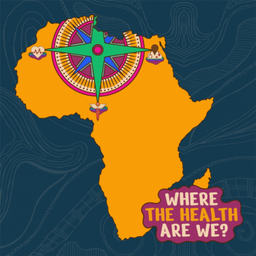
"Where The Health Are We?", hosted and produced by Chinemerem Ihejirika, is a podcast aimed at giving a complete view of the state of healthcare in Africa through insightful interviews with experts who understand the complex and nuanced issues. We hope to not just provide you with a base on which to build your understanding but also inspire thoughtful reflection on the possible solutions to the challenges that plague healthcare systems across the continent. Available on all podcast streaming platforms every other Saturday.
Where the Health Are We?
Claim This Podcastby Kampé Health Studios
5.0(14 reviews)
13 episodes
Updated Daily
Accepts GuestsHas SponsorsLocation 🇳🇬
Podcast Overview
"Where The Health Are We?", hosted and produced by Chinemerem Ihejirika, is a podcast aimed at giving a complete view of the state of healthcare in Africa through insightful interviews with experts who understand the complex and nuanced issues. We hope to not just provide you with a base on which to build your understanding but also inspire thoughtful reflection on the possible solutions to the challenges that plague healthcare systems across the continent. Available on all podcast streaming platforms every other Saturday.
Language
🇺🇲
Publishing Since
1/28/2022
1 verified contact email on file for Where the Health Are We?
Pitch yourself as a guest, propose sponsorships, or reach out directly to the host.
Recent Episodes
October 25, 2022
Reaching Vulnerable Populations in Rural Areas: Liberia's National Community Health Assistant Program
<p>With <a href="https://data.worldbank.org/indicator/SP.RUR.TOTL.ZS?locations=ZG">over 50% of Africans living in rural settings</a> and <a href="https://www.ilo.org/global/about-the-ilo/newsroom/news/WCMS_362525/lang--en/index.htm">83% of the rural population living without basic healthcare coverage</a>, there is a need for African countries to extend healthcare access to vulnerable people in remote areas. Many countries have addressed this issue by implementing community health programs centered around the work of community health workers, sometimes called community health assistants.</p> <p>CHWs are healthcare providers who live in the community they serve and help to bridge the gap between rural populations and the formal healthcare system. Although they receive lower levels of formal education and training than professional healthcare workers such as nurses and doctors, they assume crucial health-promoting roles in the community. They help deliver diagnostic, treatment, or clinical care, encourage the uptake of health services, provide psychosocial support, and assist in disease surveillance.</p> <p>In this episode, we look at Liberia's community health assistant program, a program forged in the wake of the Ebola virus epidemic between 2014 and 2016. The Liberian Government’s first attempt at CHW programming came with the 2008 National Policy and Strategy on Community Health Services. But the policy failed to meet its target due to fragmented implementation, lack of financial incentives for community health workers, and little standardized training and supervision. The new National Community Health Assistant program, launched in 2016, was designed to expand healthcare access to rural areas by integrating community health workers into the national healthcare delivery scheme.</p> <p><u><strong>Guest:</strong></u> <a href="https://www.linkedin.com/in/t-ruston-yarnko-29887213b/">Ruston Yarnko</a>, National Community Health Systems director at Last Mile Health in Liberia.</p> <p><br></p> <p><u><strong>Additional resources</strong></u></p> <ul> <li><a href="https://www.who.int/publications/i/item/what-do-we-know-about-community-health-workers-a-systematic-review-of-existing-reviews">What do we know about community health workers? A systematic review of existing reviews</a></li> <li><a href="https://www.afro.who.int/sites/default/files/2017-07/Community%20Health%20Worker%20Policy%20Brief%20-%20English_0.pdf">Community health worker programmes in the WHO African region Policy Brief</a></li> <li><a href="https://journals.plos.org/globalpublichealth/article?id=10.1371/journal.pgph.0000668">Impact of the Liberian National Community Health Assistant Program on childhood illness care in Grand Bassa County, Liberia</a></li> <li><a href="https://www.exemplars.health/topics/community-health-workers/liberia">Community Health Workers in Liberia (Exemplars in Global Health)</a></li> <li><a href="https://www.bbc.com/future/article/20220406-how-liberias-frontline-health-workers-stop-next-pandemic">How Liberia’s frontline health workers are protecting us all</a><a href="mailto:?subject=Shared%20from%20BBC:How%20Liberia%E2%80%99s%20frontline%20health%20workers%20are%20protecting%20us%20all&body=https%3A%2F%2Fwww.bbc.com%2Ffuture%2Farticle%2F20220406-how-liberias-frontline-health-workers-stop-next-pandemic%3Focid%3Dww.social.link.email" rel="noopener noreferrer" target="_blank"><br> </a></li> </ul>
August 14, 2022
Training Healthcare Workers to Meet Africa's Healthcare Needs
<p>Fundamental to healthcare are the people who deliver it. The science that underlies medicine would be nothing without the skill, compassion, and bravery of those who bring that science to the bedside. Unfortunately, these people who lie at the heart of healthcare systems are in short supply in Africa.</p> <p>Consider the fact that <a href="https://apps.who.int/iris/bitstream/handle/10665/250368/9789241511131-eng.pdf">despite bearing 25% of the world’s disease burden, Africa only has 1.3% of the world’s health personnel. Or the fact that the WHO projected that by 2030, the world would be short 14.5 million healthcare workers, with Africa’s shortfall making up 6.1 million (about 42%) of that number</a>. And as of 2015, there were 1.30 HCWs for every thousand people in Africa, which significantly lags behind the 4.5 HCWs per thousand people needed to reach the Sustainable Development Goals.</p> <p>By many measures, there is a mismatch between the demand for healthcare workers in Africa and their supply. And one reason for this mismatch has been the underinvestment in healthcare personnel training. In this episode, I speak to <a href="//linkedin.com/in/bonaventure-ahaisibwe-41b902b5">Dr. Bonaventure Ahaisibwe</a>, the Managing Director for Impact and Innovation at <a href="https://seedglobalhealth.org/">Seed Global Health</a>, a non-profit dedicated to building human resources for health capacity. We discussed Seed’s approach to building health workforce capacity, the need for information exchange in building capacity, and more.</p> <p>These conversations are essential to keep having because, realistically, there is no healthcare without the people. As such, African countries must empower healthcare workers if they aim to achieve universal health coverage and meet the health needs of their people.</p>
July 31, 2022
Leveraging Existing Resources with Technology to Solve Africa's Emergency Response Problem
<p>Growing up in Nigeria, I was always fearful. Part of that fear was due to this lingering feeling that I was one emergency, mishap, or accident away from losing my life or losing someone I love. I’ll admit that some of it was irrational but a huge part of that fear was justified. I read about stories and observed incidences where people, Nigerians, couldn’t access care in emergencies. Sometimes it was a case of people being unable to get care at the scene of the accidents and the lack of access to ambulances. Or if they got to the hospital by the kindness of bystanders, hospitals didn’t have the capacity to deliver emergency care. Or when the hospital did have that capacity, they refused to deliver care until the patient paid. This dysfunctional sequence of events is what we’d ordinarily call the emergency care system. The World Health Assembly resolution 72.16 defines an emergency care system as “an integrated platform for delivering accessible, quality, time-sensitive health care services for acute illness and injury across the life course”. But as we can see, what exists in Nigeria and in many parts of Africa is not much of a system.</p> <p>As of 2016, Africa was the continent with the highest rate of road traffic deaths with 26.6 deaths per 100,000, compared to 18.2 worldwide. What’s worse is that the death rate from road traffic accidents in SSA is expected to be 72% higher than the global average by 2030. We see similar trends in other causes of death that can be limited by emergency care like ischemic heart disease, stroke, and preterm birth complications.</p> <p>There are several pieces that come together to form an emergency care system and we’ll get to all those pieces in future episodes. But today, we’ll start with the pre-hospital piece, which is how patients are treated on the scene of the accident and transported to health facilities. I speak to <a href="//linkedin.com/in/folakeowodunni">Folake Owodunni</a>, the CEO and co-founder of <a href="https://emergencyresponseafrica.com/">Emergency Response Africa (ERA)</a>.</p>
13 total episodes available
Deep-dive analytics for Where the Health Are We?
Frequently asked questions
Have a different question and can't find the answer you're looking for? Reach out to our support team by sending us an email and we'll get back to you as soon as we can.
- What is Where the Health Are We??
- How often does this podcast release new episodes?
This podcast updates daily.
- Where can I listen to this podcast?
This podcast is available on 4 platforms including Apple Podcasts, Spotify, and more. You can also use the RSS feed directly.
- Does this podcast accept guests?
Yes, this podcast regularly features guests.
Legal Disclaimer
Pod Engine is not affiliated with, endorsed by, or officially connected with any of the podcasts displayed on this platform. We operate independently as a podcast discovery and analytics service.
All podcast artwork, thumbnails, and content displayed on this page are the property of their respective owners and are protected by applicable copyright laws. This includes, but is not limited to, podcast cover art, episode artwork, show descriptions, episode titles, transcripts, audio snippets, and any other content originating from the podcast creators or their licensors.
We display this content under fair use principles and/or implied license for the purpose of podcast discovery, information, and commentary. We make no claim of ownership over any podcast content, artwork, or related materials shown on this platform. All trademarks, service marks, and trade names are the property of their respective owners.
While we strive to ensure all content usage is properly authorized, if you are a rights holder and believe your content is being used inappropriately or without proper authorization, please contact us immediately at hey@podengine.ai for prompt review and appropriate action, which may include content removal or proper attribution.
By accessing and using this platform, you acknowledge and agree to respect all applicable copyright laws and intellectual property rights of content owners. Any unauthorized reproduction, distribution, or commercial use of the content displayed on this platform is strictly prohibited.