
Casual interviews and conversations with researchers at Georgia Southern University to make their research known, understandable and relatable to the public, ultimately, answering the question "Who Cares?" Researchers from Science, Engineering, Education, and the Social Sciences all discuss why what they do matters, how it is studied, and ultimately what the goal of the research is. Done in easy to understand and everyday language, the hosts engage the guests in a conversations to help the public better understand academic research.
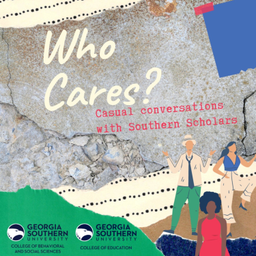
Who Cares? Casual Conversations with Southern Scholars
Claim This Podcastby Georgia Southern University College of Behavioral and Social Sciences
12 episodes
Updated Daily
Accepts GuestsHas SponsorsLocation 🇺🇸
Podcast Overview
Casual interviews and conversations with researchers at Georgia Southern University to make their research known, understandable and relatable to the public, ultimately, answering the question "Who Cares?" Researchers from Science, Engineering, Education, and the Social Sciences all discuss why what they do matters, how it is studied, and ultimately what the goal of the research is. Done in easy to understand and everyday language, the hosts engage the guests in a conversations to help the public better understand academic research.
Language
🇺🇲
Publishing Since
9/10/2020
57 verified contact emails on file for Who Cares? Casual Conversations with Southern Scholars
Pitch yourself as a guest, propose sponsorships, or reach out directly to the host.
Recent Episodes
January 18, 2022
Coastal and Fishing Communities
<p>Jennifer Sweeney Tookes, Ph.D., is an applied cultural anthropologist that studies fishing communities, people who live in coastal regions, and those that work with seafood and seafood processing. In other words, she gathers information about coastal and fishing communities to examine how to assist with problems they are experiencing. It’s a pretty cool job. Sweeney Tookes completed her dissertation work in the Caribbean, working with women in Barbados to understand how health and food practices changed when they migrated to the U.S. Her first research project while at Georgia Southern examined the ways for people to mitigate the overpopulation of the invasive lionfish (interesting-looking fish with venomous spines--ouch). Her research (which includes a lot of conversations with people from all angles of the issue) led Sweeney Tookes to realize that tourists and local people were educated in a way that led them to believe that lionfish are poisonous. Which isn’t true. Sure… it hurts if you pick one up and get stung by one of their spines, but that doesn’t mean you can’t eat a lionfish. In fact, if you cut the spines off, and cook lionfish, they are a very mild tender white fish (mmhhmmm… cooked with butter). With this information, Sweeney Tookes and a team of researchers were able to help find solutions to a human problem which impacted economics, ecosystems, and culture of the Caribbean. Today, Sweeney Tookes is focusing her research on Georgia and South Carolina’s shrimpers and the famous Wild Caught Georgia Shrimp. Although we get a little sidetracked talking about an interesting export of cannonball jellyfish to Asia (it was too interesting to pass up a side conversation about), tune in to hear more about the current concerns for the seafood industry in the Georgia Coast and more on this episode of “Who Cares?”.</p> <p>Sweeney Tookes is an associate professor of sociology and anthropology at Georgia Southern University.</p>
July 19, 2021
How alternative educational opportunities could affect these individuals and what were the necessary components to make a difference.
<p>When Panama-native Beverly Miller, Ph.D., arrived in the United States at age six, she says it was the continued support of teachers and professors that got her through--all the way to her Ph.D. After earning a master’s in education, Miller became a science teacher because, well to be honest, she said there was a drastic need for science teachers (still is, really). Miller found her passion in STEM education for underrepresented students, and her work has focused on that ever since. Existing research tells us that underrepresented groups, especially African Americans, receive some of the poorest education and health care as well as suffer the hardest economically. What Miller wanted to know was how alternative educational opportunities (think summer camps, clubs and STEM events) could affect these individuals and what were the necessary components to make a difference. With experiences teaching alternative STEM education in Chicago, New Mexico, South Africa, Panama and recently here in rural Georgia, what Miller finds is fundamentally the same--students need strong curriculum, field experience and food (yes, food). Students cannot learn when they are hungry. Miller says her camps and alternative learning programs always include food to assist in ensuring that all the basic needs of the students are met so that they can focus on the curriculum, which always includes hands-on experiences. And the best part? With these types of learning opportunities, Miller is able to adapt in the moment to what she sees the students need or want. Bottom line--Miller says parents and guardians should pursue educational opportunities outside of the classroom for their students to ensure they are having moments that are genuine and meaningful to them. These are the moments they will remember. I think we all care about that.</p>
June 14, 2021
Smart tech--the good, the bad and the ugly.
<p>Rami Haddad, Ph.D., associate professor of electrical and computer engineering, asks listeners a question. If the power goes out, can you function? What can you do? If the answer is nothing, then you are completely reliant on technology. While your answer probably differs between work and home, for many of us, just when the internet is down, we find ourselves at a total loss at our place of employment. Haddad points out that just 30 years ago, we were functioning just fine without the internet. How then, can we expect that the next 30 years will not show continued advancement of technology? Haddad conducts research on smart technology, which he explains allows a computer to obtain, process and present useful information. In some of his most recent work, Haddad is training smart technology to examine chest x-rays to recognize and diagnose pneumonia. Left untreated, pneumonia can be life threatening, yet the condition is not uncommon. Advancement that allowed quick and effective diagnosis could save lives. In this episode of “Who Cares?” Haddad and our hosts talk smart tech--the good, the bad and the ugly. While some say advancements in tech are terrifying [think I, Robot; Ex Machina; Wall-E; 2001: A Space Odyssey; Westworld; The Matrix...you get the point], we should remember that there are also advantages to the advancement of technology. We should also remember that if it is terrifying to us, perhaps we should ask our children or grandchildren if it is terrifying to them. More than likely, they are not quite as frightened by technological advances as we oldies are.</p>
12 total episodes available
Deep-dive analytics for Who Cares? Casual Conversations with Southern Scholars
Frequently asked questions
Have a different question and can't find the answer you're looking for? Reach out to our support team by sending us an email and we'll get back to you as soon as we can.
- What is Who Cares? Casual Conversations with Southern Scholars?
- How often does this podcast release new episodes?
This podcast updates daily.
- Where can I listen to this podcast?
This podcast is available on 4 platforms including Apple Podcasts, Spotify, and more. You can also use the RSS feed directly.
- Does this podcast accept guests?
Yes, this podcast regularly features guests.
Legal Disclaimer
Pod Engine is not affiliated with, endorsed by, or officially connected with any of the podcasts displayed on this platform. We operate independently as a podcast discovery and analytics service.
All podcast artwork, thumbnails, and content displayed on this page are the property of their respective owners and are protected by applicable copyright laws. This includes, but is not limited to, podcast cover art, episode artwork, show descriptions, episode titles, transcripts, audio snippets, and any other content originating from the podcast creators or their licensors.
We display this content under fair use principles and/or implied license for the purpose of podcast discovery, information, and commentary. We make no claim of ownership over any podcast content, artwork, or related materials shown on this platform. All trademarks, service marks, and trade names are the property of their respective owners.
While we strive to ensure all content usage is properly authorized, if you are a rights holder and believe your content is being used inappropriately or without proper authorization, please contact us immediately at hey@podengine.ai for prompt review and appropriate action, which may include content removal or proper attribution.
By accessing and using this platform, you acknowledge and agree to respect all applicable copyright laws and intellectual property rights of content owners. Any unauthorized reproduction, distribution, or commercial use of the content displayed on this platform is strictly prohibited.