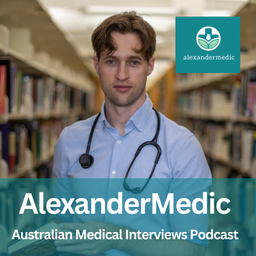
About AlexanderMedic Australian Medical Interviews
Most candidates prepare. The ones who get in prepare differently. Specialty Interviews, IMGs and Pre-Meds
Free episodes on what medical interview panels actually score and what most candidates never find out.
Hosted by Alexander. WAAPA-trained Medical Interview coach. 500+ candidates coached since 2019.
Every episode is built around a mistake that costs candidates real marks and the exact reasoning behind why it fails.
→ Premium worked examples and model answers: https://alexandermedic.supercast.com
→ 1:1 coaching: https://alexandermedic.com
(Preview) Rural Health in Interviews: Equity, Distance and Funding
Rural health is not primarily a rurality issue. It is an equity issue and if you are discussing it as simply a problem of geography, distance, or workforce shortages, you are missing what sits underneath one of Australia’s most important health challenges.
It doesn’t matter whether you’re a JMO applying for specialty training, an IMG preparing for a PESCI or hospital interview, or a medical school applicant facing an MMI station. Rural health can appear at every level and superficial answers rarely score well.
Most candidates don’t struggle because they are unaware that rural communities experience poorer health outcomes. They struggle because they list the problems without explaining the factors driving them, fail to examine how funding mechanisms shape access and outcomes, and propose solutions without considering whether they work in practice.
This preview gives you the first 10 minutes of the full episode.
Why rural health inequity is not simply a problem of rurality
The social, economic, cultural and structural factors affecting rural health outcomes
How geography interacts with access, workforce distribution and continuity of care
Why funding mechanisms matter — and how they can help or hinder rural healthcare delivery
The proposed solutions to Australia’s rural health challenges
What appears to be working and what may not be working so well
Why simply sending more doctors to rural areas is not a complete solution
How to discuss rural health with nuance, balance and clinical insight
How to structure an answer for an MMI, PESCI, hospital or specialty training interview
The terminology that signals a genuine understanding of health equity rather than a rehearsed list of rural disadvantages
If you are walking into a specialty training interview, PESCI assessment, JMO interview or MMI station without being able to discuss rural health at this level, you may be leaving marks on the table on a topic that intersects with equity, access, workforce policy and patient outcomes.
🎧 AlexanderMedic: Australian Medical Interviews — free episodes every week on Spotify and Apple Podcasts.
Want to go deeper?
→ Premium podcast subscription for the full episode https://alexandermedic.supercast.com (https://alexandermedic.supercast.com/)
→ 1:1 coaching, courses and interview resources for specialty training applicants, IMGs and medical school applicants: https://alexandermedic.com (https://alexandermedic.com/)
→ For 24/7 interview coaching, try The Practice Room for free: https://practice.alexandermedic.com (https://practice.alexandermedic.com/)
rural health medical interview · rural health equity Australia · specialty training interview Australia · JMO interview · junior doctor interview · IMG interview Australia · PESCI interview · MMI medical school interview · rural medical workforce · healthcare funding Australia · social determinants of health · rural healthcare access · health inequity Australia · rural workforce distribution · continuity of care · medical interview frameworks · alexandermedic
2 Jun 2026
The CASPER Explained: The Research Behind High and Low Scores (PART 2)
Most people prepare for Casper by memorising phrases. That is exactly why their answers sound average.
Casper does not reward sounding ethical. It rewards showing your reasoning under pressure.
In this episode I work through two publicly available Casper-style scenarios at test pace: the refund scenario and the group contribution scenario.
For each one, I show what a low-scoring answer sounds like, what a stronger answer does differently, and where applicants accidentally lose marks by being too black-and-white.
We also cover the exact exercise I give students to build the skill Casper is really testing: broader perspective-taking, clearer justification, and adapting your answer when the second question changes the scenario.
This is normally a subscriber-only episode, but I've decided to release it on the free feed because I think the exercise alone can significantly improve the way applicants approach Casper preparation.
Part 1 explains the research. Part 2 shows how to apply it.
For additional premium podcast episodes:
https://alexandermedic.supercast.com/ (https://alexandermedic.supercast.com/)
Pre-med, IMG, specialty training interview courses and coaching:
https://alexandermedic.com (https://alexandermedic.com)
Chat GPT Prompt Mentioned:
Generate a Casper SJT practice scenario for me. The scenario should present an everyday ethical dilemma — not clinical or medical — involving at least two people with competing needs or perspectives. It should be 3-4 sentences long. Then provide two follow-up questions. The first question should ask what I would do and why. The second question should change one variable from the original scenario and ask how, if at all, this changes my response.
After I answer, I will paste my response back to you. At that point, analyse my answer and tell me: which perspectives or stakeholders I failed to consider, which solutions or approaches I didn't mention, and where my reasoning was vague or one-sided. Be direct. Don't praise what I got right — focus only on the gap between my answer and a high-scoring response.
2 Jun 2026
The CASPER Explained: The Research Behind High and Low Scores (PART 1)
Most applicants know Casper is testing “communication” and “empathy.” Most still answer it like a generic ethics checklist.
Not because they lack judgment. Because they miss what the test is actually rewarding: context, competing perspectives, clear reasoning, and explaining why , not just what.
In this episode I break down what Casper is, how it is structured, how human raters score it, and what the published research suggests separates low-scoring from high-scoring responses.
We cover why vague answers fail, why generic “calm, non-judgmental, private setting” phrases are not enough, why grammar matters less than people think, and why the second question in each scenario is usually testing whether you can adapt your reasoning when the situation changes.
This applies whether you are a pre-med applicant, IMG, health science applicant, or sitting a pathway where Casper is part of the selection process.
🎧 Part 2 is the practical worked example.
Premium subscribers get it now: https://alexandermedic.supercast.com/ (https://alexandermedic.supercast.com/)
Pre-med, IMG, specialty training interview courses and coaching: https://alexandermedic.com ( https://alexandermedic.com)
Study discussed:https://www.frontiersin.org/journals/medicine/articles/10.3389/fmed.2024.1525156/full (https://www.frontiersin.org/journals/medicine/articles/10.3389/fmed.2024.1525156/full )
Reach and audience
Public platform figures. Ratings count people who left a rating, not total listeners.
Spotify
5.0 / 5
8 ratings
Contact AlexanderMedic Australian Medical Interviews
Guest appearances
Does not typically book guests
Based on episode analysis; this does not confirm that the show is currently accepting guests.
Pod Engine is an independent podcast discovery and analytics service and is not affiliated with or endorsed by this podcast. Artwork and show content belong to their owners. Full legal notice.
Explore this show Podcast research with Pod Engine