
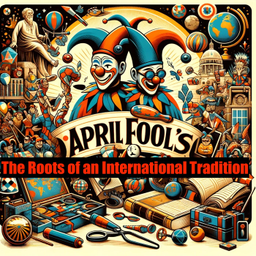
The origins of April Fools' Day remain shrouded in mystery, but the tradition of playing pranks on the first of April has been observed since at least Renaissance Europe, with roots that likely extend even further back in history. Despite numerous theories attempting to trace the holiday's beginnings to ancient Roman festivals like Hilaria or to the reign of Emperor Constantine, conclusive evidence supporting these claims is scarce. One oft-repeated story, itself an example of an April Fools' hoax, suggests that the holiday began in France in 1564 when King Charles IX officially moved the celebration of the New Year to January 1st. According to this tale, those who resisted the change or simply forgot about it continued to celebrate during the week ending on April 1st, thus becoming the target of mockery and foolish gifts or invitations to nonexistent parties. However, this story lacks historical evidence and is more likely an intriguing speculation than a factual account. The earliest unambiguous reference to April Fools' Day can be found in a 1561 Flemish poem by Eduard De Dene. In this work, a nobleman sends his servant on a series of absurd errands on April 1st, establishing a tradition of "fool's errands" that remains popular to this day. This type of prank, which involves sending someone on a fruitless quest for a nonexistent object or person, has endured for centuries as a classic April Fools' Day joke. In England, the first mention of the holiday comes from antiquarian John Aubrey, who referred to it as "Fooles Holy Day" in his 1686 work, "Remaines of Gentilisme and Judaisme." A few decades later, in 1760, Poor Robin's Almanac speculated about the origin of the day, admitting that neither the author nor the people themselves knew why it was celebrated. This early reference highlights the long-standing mystery surrounding the holiday's roots. Across the Atlantic, a 1771 diary entry by Anna Green Winslow in Boston demonstrates that April Fools' Day was well-known in both Canada and New England by the late 18th century. Green's playful entry, in which she reminds her mother of a prank played by her father three years earlier, showcases the holiday's role in fostering lighthearted family humor. As the 19th century progressed, April Fools' Day became increasingly widespread and popular, with frequent references appearing in newspapers and magazines. Pranks evolved into more elaborate forms, often depicted in political cartoons and illustrations of the era. Three common artistic representations emerged: a brick placed under a hat on a sidewalk, tempting passersby to kick the hat; a desirable object tied to a hidden string, yanked away by a concealed prankster when someone attempted to claim it; and a heated coin left for unsuspecting individuals to pick up, resulting in a painful surprise. The holiday also found its way into folksong, as evidenced by the ballad "Campbell the Drover" or "The First Day of April." This tune, collected by Ala
This content was created in partnership and with the help of Artificial Intelligence AI.