
Around the Table is a podcast from Stanley Ulijaszek, Professor of Human Ecology at the University of Oxford and Director of UBVO, and Dr. Tess Bird, an anthropologist of household uncertainty and wellbeing. We interview nutrition, food, and health experts as well as everyday households from around the world, filling in some of the gaps between scientific knowledge and everyday practice.
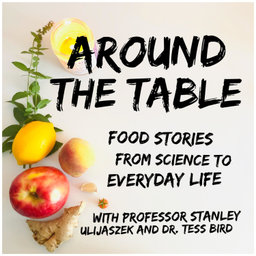
Around the Table: Food Stories from Science to Everyday Life
Claim This Podcastby Dr. Tess Bird and Prof. Stanley Ulijaszek
5.0(3 reviews)
34 episodes
Updated Daily
Accepts GuestsHas SponsorsLocation 🇬🇧
Podcast Overview
Around the Table is a podcast from Stanley Ulijaszek, Professor of Human Ecology at the University of Oxford and Director of UBVO, and Dr. Tess Bird, an anthropologist of household uncertainty and wellbeing. We interview nutrition, food, and health experts as well as everyday households from around the world, filling in some of the gaps between scientific knowledge and everyday practice.
Language
🇺🇲
Publishing Since
5/13/2020
1 verified contact email on file for Around the Table: Food Stories from Science to Everyday Life
Pitch yourself as a guest, propose sponsorships, or reach out directly to the host.
Recent Episodes
January 29, 2021
Food Politics Expert Marion Nestle on Industry Influence on Food Research
<p>In this episode, Stanley interviews Professor Marion Nestle about her two latest books, <a href="https://www.foodpolitics.com/unsavory-truth-how-food-companies-skew-the-science-of-what-we-eat/">Unsavory Truth: How Food Companies Skew the Science of What We Eat</a> (2018) and <a href="https://www.foodpolitics.com/lets-ask-marion-what-you-need-to-know-about-the-politics-of-food-nutrition-and-health/">Let’s Ask Marion: What You Need to Know about the Politics of Food, Nutrition, and Health (with Kerry Trueman)</a> (2020). Prof. Nestle describes the various ways that food industries influence research, pay for their own experts, and avoid regulation, often following the infamous tobacco industry playbook. If you want to learn more, check out Prof. Nestle's regular blog (which we love) at <a href="https://www.foodpolitics.com/">https://www.foodpolitics.com/</a> and find her on Twitter <a href="https://twitter.com/marionnestle">@marionnestle</a>.</p> <p>Marion Nestle is Paulette Goddard Professor, of Nutrition, Food Studies, and Public Health, Emerita, at New York University, which she chaired from 1988-2003 and from which she officially retired in September 2017. She is also Visiting Professor of Nutritional Sciences at Cornell. She earned a Ph.D. in molecular biology and an M.P.H. in public health nutrition from the University of California, Berkeley, and has been awarded honorary degrees from Transylvania University in Kentucky (2012) and from the City University of New York’s Macaulay Honors College (2016).</p>
January 18, 2021
Sociologist Anthony Ryan Hatch on Sugar's Legacy of Racism
<p>In this interview with Tess, sociologist <a href="https://ahatch.faculty.wesleyan.edu/">Prof. Anthony Hatch</a> explains why the problem of sugar is much greater than just being bad for our bodies. As a colonial commodity, sugar carries a legacy of slavery and racism that is still with us today. He describes sugar's relationship to black bodies, metabolic syndrome, and global trade, calling for political action: a boycott of sugar. This podcast is an eye-opening take on sugar from an environmental, ecological, and social perspective. (Listeners take note: we had some sound tech issues with this one, so we hope you can forgive the clicking sound!)</p> <p>Listener's may also be interested in Madeleine Power's discussion of <a href="https://anchor.fm/aroundthetablepod/episodes/Health-Scientist-Dr--Madeleine-Power-discusses-Food-Insecurity-and-Food-Justice-in-the-UK-en0o0l/a-a3v3bhh">food justice in the UK</a>, Esther González-Padilla's description of <a href="https://anchor.fm/aroundthetablepod/episodes/Nutritional-Epidemiologist-Esther-Gonzlez-Padilla-on-Sugar-and-Micronutrient-Dilution-ei56os/a-a2uq317">sugar and micronutrient dilution</a>, and Michael Goran and Emily Ventura's latest book on<a href="https://anchor.fm/aroundthetablepod/episodes/Prof--Michael-Goran-and-Dr--Emily-Ventura-on-Sugarproofing-the-Family-ej00e5/a-a33lnub"> how to help children eat less sugar</a>.</p> <p>Anthony Ryan Hatch, Ph.D., is a sociologist and Associate Professor and Chair of the <a href="https://www.wesleyan.edu/academics/faculty/ahatch/profile.html" rel="noreferrer noopener" target="_blank">Science in Society Program</a> at Wesleyan University where is he is also affiliated faculty in the Department of African American Studies, the College of the Environment, and the Department of Sociology. Dr. Hatch is an expert in health systems, medical technology, and social inequalities. He recently appeared in the PBS documentary <a href="https://www.pbs.org/show/blood-sugar-rising/">Blood Sugar Rising</a> and is the author of <a href="https://www.upress.umn.edu/book-division/books/silent-cells">Silent Cells: The Secret Drugging of Captive America</a> (2019) and <a href="https://www.upress.umn.edu/book-division/books/blood-sugar">Blood Sugar: Racial Pharmacology and Food Justice in Black America</a>. He also mentions his co-authored article, <a href="https://doi.org/10.1080/15528014.2019.1638123">“Sugar Ecologies and their Metabolic and Racial Effects”</a> in the podcast.</p>
December 3, 2020
Health Scientist Dr. Madeleine Power discusses Food Insecurity and Food Justice in the UK
<p><a href="https://wrdtp.ac.uk/dr-madeleine-power/">Dr. Madeleine Power</a> is an expert in UK food aid and food insecurity, in particular its relationship with wider economic and ethnic inequalities. In this interview with Stanley, she discusses her research into food insecurity amongst Pakistani, Muslim, and white British groups in Bradford, UK. Dr. Power describes the variations of food insecurity amongst these groups (it's more complicated than you might think, and different than in the US!) she then talks about the York Food Justice Alliance, which was started as a network to ally local organizations concerned about hunger in York and the Independent Food Aid Network is a national UK network that represents independent food banks around the UK. </p> <p>Dr. Power is Wellcome Fellow in the Department of Health Sciences at the University of York, where she works on poverty and inequalities in access to food. She is Co-Chair of the <a href="https://www.foodaidnetwork.org.uk/" target="_blank">Independent Food Aid Network</a>, a representative body of independent food aid providers, and founder and former Chair of the <a href="https://yorkfoodpoverty.org/" target="_blank">York Food Justice Alliance</a>, a cross-sector partnership addressing food insecurity at the local level. She is a regular commentator on food inequalities and food aid on local and national media. She has published widely on poverty and food, inequalities in food access according to ethnicity and gender, and food aid, including food banks.</p>
34 total episodes available
Deep-dive analytics for Around the Table: Food Stories from Science to Everyday Life
Frequently asked questions
Have a different question and can't find the answer you're looking for? Reach out to our support team by sending us an email and we'll get back to you as soon as we can.
- What is Around the Table: Food Stories from Science to Everyday Life?
- How often does this podcast release new episodes?
This podcast updates daily.
- Where can I listen to this podcast?
This podcast is available on 4 platforms including Apple Podcasts, Spotify, and more. You can also use the RSS feed directly.
- Does this podcast accept guests?
Yes, this podcast regularly features guests.
Legal Disclaimer
Pod Engine is not affiliated with, endorsed by, or officially connected with any of the podcasts displayed on this platform. We operate independently as a podcast discovery and analytics service.
All podcast artwork, thumbnails, and content displayed on this page are the property of their respective owners and are protected by applicable copyright laws. This includes, but is not limited to, podcast cover art, episode artwork, show descriptions, episode titles, transcripts, audio snippets, and any other content originating from the podcast creators or their licensors.
We display this content under fair use principles and/or implied license for the purpose of podcast discovery, information, and commentary. We make no claim of ownership over any podcast content, artwork, or related materials shown on this platform. All trademarks, service marks, and trade names are the property of their respective owners.
While we strive to ensure all content usage is properly authorized, if you are a rights holder and believe your content is being used inappropriately or without proper authorization, please contact us immediately at hey@podengine.ai for prompt review and appropriate action, which may include content removal or proper attribution.
By accessing and using this platform, you acknowledge and agree to respect all applicable copyright laws and intellectual property rights of content owners. Any unauthorized reproduction, distribution, or commercial use of the content displayed on this platform is strictly prohibited.