- 35
- Episodes
- 30
- Ratings
- Monthly
- Cadence
- 2024
- First episode
About At Large
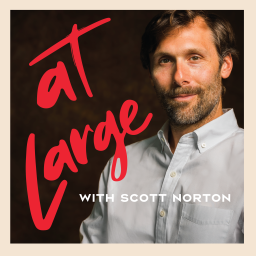
Join Scott Norton, a creative entrepreneur behind Sir Kensington’s condiments, as he converses with world-class creatives who have achieved commercial success and lived to tell the tale. At Large explores the many ways the creatives that have shaped our modern world navigate business and use commerce to scale their craft.
- Publisher
- SickBird Productions
- Category
- business
- Language
- en
- Explicit
- No
- First episode
- 8 Jun 2024
- Latest episode
- 16 Sept 2026
Latest episodes
35 episodes in the feed.
16 Sept 2026
#32: Daniel Humm - Total Work of Heart
At the summit of fine dining, success can feel like a treadmill. Your signature dish becomes an obligation. You work to maintain accolades, not be surprised by them. You are coordinating more than creating. Daniel Humm knows the feeling. After taking Eleven Madison Park to three Michelin stars and the title of best restaurant in the world, he reopened after the pandemic with a radical proposition: an entirely plant-based menu. In a business defined by animal entrées, vegetables would have to carry the room. This was interpreted by many as a political statement, though in this interview I realized it was to twist the knob on his own creative energy through self-imposed constraints. This is the restless mind of a former professional cyclist who takes an athletic approach to artistry. No vegan restaurant had earned three Michelin stars. Humm wanted to be first, which they did handily. This is the tao of Daniel: Set a goal, achieve it, then change the rules on yourself for the thrill of climbing new peaks. Twice through our conversation, Humm quotes Willem de Kooning: “I have to change to stay the same.”He seems to draw more inspiration from artists outside food than from within it: Philip Guston abandoning abstraction, Miles Davis going electric, Monet’s water lilies. He invokes Gesamtkunstwerk (German for "Total Work of Art"), to describe a restaurant where food, room, people, and feeling form one composition. Every dimension has been pushed with love and craft. What surprised me when we first met was his calm. Humm’s standards are exacting, but his presence is almost breezy (that's a good thing, I assure him). We discuss the harder origins of his ambition, how he builds a kitchen where “it’s cool to care,” and how he leads with the standards he sets. We also follow that ambition beyond the dining room: Rethink Food’s work feeding underserved communities, and Riff, a dinner-in-a-box business he’s building with my longtime friend and Sir Kensington’s co-founder, Mark Ramadan. The proposition: $6.99 meals for two that are easy to whip together or an extended creative endeavor, should you so choose. For a chef used to composing an entire evening, the challenge is clear: make an ordinary Tuesday worth gathering around, and nudge home cooks to keep twisting the knob on their own artistry. Full disclosure, I'm a small investor. Along the way, we discuss meditation, the emotional utility of ice cream, and a Japanese rice dish cooked in clay. This is Daniel Humm, At Large. - 03:09 Creative constraints: making a hard job harder 13:11 Changing course at Eleven Madison Park 16:58 The athlete behind the chef 25:22 It's cool to care: culture and leadership 37:12 Looking beyond the kitchen: art and reinvention 41:38 A little more Miles: jazz as a North Star 44:59 Monet and the art of being moved 46:58 Gesamtkunstwerk: the total work of art 49:39 Rethink Food: a bigger table 52:36 Riff: fine-dining thinking for weeknight dinner 1:01:28 Searching for the light: meditation and balance 1:06:24 Off the Cuff: good taste and bad-day ice cream 1:11:30 One Good Recipe: Japanese clay-pot rice Special Thanks to Wiz from Spacecadet and Mark Ramadan for making this episode what it was
15 Jan 2026
#31: W. David Marx - Blank Space Invader
W. David Marx lives in Tokyo, which is perhaps the only place left on earth where one can still observe culture operating according to pre-internet logic—where scarcity creates value, where obscurity breeds desire, where you still have to know a guy to know about the thing. From this vantage point, thirteen time zones away from the algorithmic churn of American pop culture, Marx has written what may be the first comprehensive autopsy of our current century. Blank Space: A Cultural History of the 21st Century arrives with a thesis that feels both obvious and devastating: we are living through a period of unprecedented cultural stagnation. Not the absence of content (God knows we're drowning in content) but the absence of the kind of radical creative invention that used to mark historical time. The innovations that made us say "everything is different now." The art that divided generations. The subcultures that became countercultures that became cultures. Marx's argument is structural, not conspiratorial. No one woke up and decided to lobotomize culture. Rather, a series of incentive structures like smartphone ubiquity, advertising precision, algorithmic optimization, quantified validation, and now generative AI, aligned to reward the immediately popular over the lastingly meaningful. The result is what Marx calls the "omnivore monoculture": a glossy, cross-pollinated, infinitely remixable soup where everything can fuse with everything else because nothing means much anymore. The book traces a brutal arc: from the nerd internet of the early 2000s (when 2 million monthly views made you the biggest blog on earth) to the attention economy of the 2020s (where MrBeast's craft isn't storytelling but thumbnail optimization). From Paris Hilton as cautionary tale to Paris Hilton as misunderstood girlboss. From "selling out" as the ultimate sin to Jimmy Iovine getting a hagiographic HBO documentary for his entrepreneurial genius at making artists more commercial. Marx is often accused of elitism, a charge he neither fully accepts nor entirely denies. His defense is pragmatic: the formulaic pop culture we consume today is always parasitic on innovation from the past. Hip-hop invented on the margins now powers billions of people's daily entertainment. If you don't maintain the conditions for radical invention, the entire system becomes—and here's where he'll lose the optimists—cooked. The stakes, it turns out, aren't just aesthetic. They're about whether we can maintain the capacity for the kind of creative disruption that refreshes culture, that makes us see the world differently, that gives us new ways to understand what it means to be human. Without it, we're left with an ever-more-polished version of what we already have—which is to say, we're living in the blank space. Ladies and gentlemen, I present W. David Marx, at large. Topics: 00:35 Introducing W. David Marx and His Book 'Blank Space' 02:28 Writing the Cultural History of the 21st Century 06:38 The Influence of Financial and Technology Platforms on Culture 12:48 "Poptimism" and the Shift in Cultural Values 17:56 The Rise of "Omnivore Monoculture" 28:05 The Impact of the Internet on Cultural Production 39:00 The Evolution of Food Culture in the Internet Era 42:02 The Rise of Restaurant Reservations as Status Symbols 44:21 MMA and UFC as a Cultural Artifact 48:37 "The Zynternet" and the Counter-Counterculture 01:00:38 The Artistic Mindset in the 21st Century 01:07:08 At Large and Off the Cuff + Collard Greens Recipe References: Blank Space - A Cultural History of the 21st Century (https://www.amazon.com/Blank-Space-Cultural-History-Twenty-First/dp/0593833996) David's Instagram (https://www.instagram.com/wdavidmarx/?hl=en) David Halberstine - The 50s (https://www.amazon.com/Fifties-David-Halberstam/dp/0449909336) Ametora (https://www.amazon.com/Ametora-Japan-Saved-American-Style/dp/0465059732) Status and Culture (https://www.amazon.com/Status-Culture-Creates-Identity-Constant/dp/0593296702) The Defiant Ones (https://en.wikipedia.org/wiki/The_Defiant_Ones_(TV_series)) Geese (https://en.wikipedia.org/wiki/Geese_(band)) Lil Nas X - Old Town Road (https://www.youtube.com/watch?v=r7qovpFAGrQ) DJ Danger Mouse - The Grey Album (https://soundcloud.com/blainepwilson/sets/danger-mouse-the-grey-album) The Weeknd - House of Balloons (https://open.spotify.com/album/2YHC9dhR9vMTdCeY0T1FOs) How to Succeed in Mr Beast Production (https://cdn.prod.website-files.com/6623b7720b009050313e701c/66ede69453b7bbadcd2f05a8_How-To-Succeed-At-MrBeast-Production%20(2).pdf) Bed Intruder Video (https://www.youtube.com/watch?v=hMtZfW2z9dw) The Rehearsal (https://en.wikipedia.org/wiki/The_Rehearsal_(TV_series)) The Chair Company (https://en.wikipedia.org/wiki/The_Chair_Company) Adam Smith's Invisible Hand (https://en.wikipedia.org/wiki/Invisible_hand) Honor Levy - My First Book (https://www.amazon.com/My-First-Book-Honor-Levy/dp/0593656539) -- @swhnorton (https://instagram.com/swhnorton) http://atlargeshow.com (http://atlargeshow.com)
23 Dec 2025
#30: Raed Khawaja - Breath & Work
On a sun-bleached afternoon in Venice, California, where the ghost of the counterculture still haunts every exposed-brick studio and cosmic juice bar, Raed Khawaja sits beneath an iconic skylight that once illuminated the work of James Turrell and Robert Irwin. The light here is different. Anyone who's spent time in Los Angeles knows this instinctively: it's the reason artists have migrated west for generations, chasing something ineffable in the quality of atmospheric illumination itself.Khawaja, the CEO and co-founder of Open, has built something curious in this space. Not quite a studio, not quite a sanctuary, not quite a brand, though it is emphatically all three. Open offers breathwork, meditation, and movement practices in a market so thoroughly saturated with wellness grifters, Instagram yogis, and overpriced adaptogens that even using the word "wellness" has become an act of self-incrimination. Khawaja knows this. "I hate that word," he admits without hesitation.Yet here we are, in perhaps the most self-consciously well square mile in America, where green juice costs $16 and everyone you meet is either microdosing, macrodosing, or preparing a 30-day reset that will definitely, finally, be the one that sticks. The contradictions are almost too obvious to catalogue: the abundance masquerading as asceticism, the consumption marketed as consciousness, the $200 leggings required for the privilege of learning to simply breathe. We can do better, and thankfully, Raed knows this.Khawaja's background—PepsiCo, Bank of America, the machinery of billion-dollar brands—suggests someone who understands exactly what he's doing. He describes himself as "the anti-guru," more interested in curation than revelation, in stripping away the mystical theater to reveal what actually works. Open's synthesis of breathwork, sound, and movement into something immediate and accessible represents, if not an invention, then a thoughtful construction of building blocks.The timing feels urgent. Gen Z is 50% religiously unaffiliated, up from 8% in the early nineties. Mental health diagnoses have reached crisis levels. And now, artificial intelligence threatens to render our last claim to uniqueness (our cognitive superiority) utterly obsolete. "We're entering a purpose and meaning crisis," Khawaja observes, and he's not wrong. When machines can think, what's left for us?This is the existential backdrop against which Open operates: a secular space for seeking in an increasingly untethered age, located in a neighborhood that has always attracted seekers, housed in a building that once belonged to artists obsessed with perception itself. The symbolism borders on too perfect, which is perhaps the point.What follows is a conversation we recorded in his space with a live audience, about altered states and applied philosophy, about what it means to build something genuine in a landscape of post-consumerist materialism, and about whether we're all just one good breath away from figuring this whole thing out—or at least getting through the day without doom-scrolling ourselves into oblivion. Topics:01:31 Taste of a Guided Breath Work Session03:40 The Philosophy Behind Open07:31 Raed's Journey and Creation of Open14:42 The Role of Religion and Spirituality Today19:47 Community and Connectivity in Modern Wellness29:05 AI and the Future of Humanity33:48 The Purpose of Education in the Age of AI34:27 Techno-Optimism and the Future36:42 The Human Experience and Altered States39:17 The Role of Drugs in Society41:22 Balancing and Integration47:31 At Large and Off The Cuff: Quickfire57:35 Conclusion and Farewell Links: Open (https://www.instagram.com/op_e___n/?hl=en) Raed's Instagram (https://www.instagram.com/raed____k/?hl=en) Holotropic Breathwork (https://health.clevelandclinic.org/should-you-try-holotropic-breathwork-heres-what-it-does) Hamilton Morris (https://www.youtube.com/playlist?list=PLDbSvEZka6GGo4gH2zxpvvkBGzoo9DAWU) Arete (https://en.wikipedia.org/wiki/Arete) Kikagaku Moyo (https://open.spotify.com/artist/0hrb5WRiNlj8vh3WnCgXFq) ---📸@swhnorton (https://www.instagram.com/swhnorton)🐦@swhnorton (https://x.com/swhnorton?lang=en)🖥️http://atlargeshow.com (http://atlargeshow.com)
Who has been a guest on At Large
Names identified in recent episode analyses. Showing up to five guests.
- Jerry Greenberg
- Missy Robbins
- Clare Vivier
Reach and audience
Public platform figures. Ratings count people who left a rating, not total listeners.
- Spotify
- 5.0 / 5
- 30 ratings
Podcast Authority Score: 30 / 100
A composite of feed quality, social presence, YouTube performance and engagement. Read the methodology.
- Quality
- 60
- Social presence
- 0
- YouTube
- 0
- Engagement
- 0
Contact At Large
- Guest appearances
- Books guests
Based on episode analysis; this does not confirm that the show is currently accepting guests.
Host of At Large?
Claim your podcast to manage its listing and keep your show details accurate.
Pod Engine is an independent podcast discovery and analytics service and is not affiliated with or endorsed by this podcast. Artwork and show content belong to their owners. Full legal notice.
Explore this show
Podcast research with Pod Engine