
A show exploring how today’s tech leaders secure innovation through automation and trust. Hosted by Wil Ramos, each episode shares real stories and lessons in DevSecOps, AI security, and building resilient modern organizations.
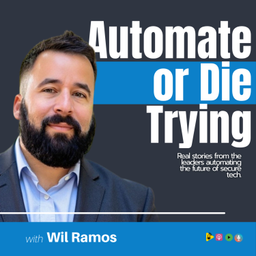
Automate or Die Trying
Claim This Podcastby Wil Ramos
5.0(1 reviews)
25 episodes
Updated Daily
Accepts GuestsHas Sponsors
Podcast Overview
A show exploring how today’s tech leaders secure innovation through automation and trust. Hosted by Wil Ramos, each episode shares real stories and lessons in DevSecOps, AI security, and building resilient modern organizations.
Language
🇺🇲
Publishing Since
12/4/2025
Reach the team behind Automate or Die Trying
Verified contact details for this show aren't on file yet — sign up to get notified when they land.
Recent Episodes
June 1, 2026
“How Keith Belanger Builds AI-Ready Data Platforms Without Sacrificing Governance or Trust”
<p><strong>Episode Summary</strong></p><p>Everyone wants faster automation and better AI outcomes, but few organizations stop to examine the data foundations underneath them. In this episode of Automate or Die Trying, host Will talks with Keith Belanger about why acceleration alone is not a strategy—and why AI will amplify both the strengths and weaknesses already present in your data ecosystem.</p><p>Drawing on three decades of experience in data architecture, including leading a 300+ terabyte migration to Snowflake in a highly regulated insurance environment, Keith explains why many enterprise data failures are not dramatic breaches but quiet, cumulative problems that build over time. He shares lessons from large-scale modernization efforts, the importance of data modeling and architectural discipline, and why organizations often create technical debt by prioritizing speed over design.</p><p>The conversation explores how AI agents interact with enterprise data, why governance and testing must become continuous practices, and how organizations can detect schema drift, data quality issues, and hidden risks before they impact business decisions. Keith also discusses the growing role of DataOps, the importance of embedding architectural intent into AI-assisted development, and why human oversight remains essential even as automation becomes more powerful.</p><p>If you're responsible for data engineering, AI initiatives, security, governance, or enterprise architecture, this episode offers practical insights into building data platforms that can scale safely while remaining trustworthy and AI-ready.</p><p><strong>Key Topics Discussed</strong></p><ul><li>Why “acceleration is neutral” in data and AI</li><li>Lessons from a 300+ TB Snowflake migration</li><li>The hidden cost of cumulative data failures</li><li>Data contracts, schema drift, and governance</li><li>AI-ready data and enterprise trust</li><li>Continuous testing and observability</li><li>DataOps automation and CI/CD for data platforms</li><li>Human oversight in AI-assisted engineering</li><li>Balancing speed, security, and architectural discipline</li><li>Building resilient foundations for enterprise AI</li></ul><br/><p><strong>Guest Information</strong></p><ul><li>Keith Belanger – Field CTO,<a href="https://www.dataops.live?utm_source=chatgpt.com" rel="noopener noreferrer" target="_blank"> </a><u><a href="https://www.dataops.live?utm_source=chatgpt.com" rel="noopener noreferrer" target="_blank">DataOps.live</a></u></li><li>LinkedIn:<a href="https://www.linkedin.com/in/krbelanger?utm_source=chatgpt.com" rel="noopener noreferrer" target="_blank"> </a><u><a href="https://www.linkedin.com/in/krbelanger?utm_source=chatgpt.com" rel="noopener noreferrer" target="_blank">Keith Belanger LinkedIn Profile</a></u></li></ul><br/><p><strong>Listen Now & Subscribe:</strong></p><p><strong><a href="https://podcasts.apple.com/us/podcast/automate-or-die-trying/id1858617259" rel="noopener noreferrer" target="_blank">Apple Podcasts</a></strong>, <strong><a href="https://open.spotify.com/show/7JJN8GliYhaECVEduFcvmW?si=99700a8227cb47eb" rel="noopener noreferrer" target="_blank">Spotify</a></strong>, <strong><a href="https://music.amazon.com/podcasts/e7e24a5f-61e0-4c7f-8af1-be7b87cbdc02/automate-or-die-trying" rel="noopener noreferrer" target="_blank">Amazon Music</a></strong>, or find us wherever you get your podcasts.</p><p><strong>Powered by <a href="https://cybersecurityprivacy.com/" rel="noopener noreferrer" target="_blank">cybersecurityprivacy.com</a></strong></p><p><strong>Automate or Die Trying empowers leaders to adopt AI securely, move faster with confidence, and transform the future of work.</strong></p>
May 29, 2026
“How Christopher Moravec Is Building Autonomous AI Agents for Government, GIS, and the Physical World”
<p><strong>Episode Summary:</strong></p><p>In this episode of <strong>Automate or Die Trying</strong>, host <strong>Wil Ramos</strong> sits down with <strong>Christopher Moravec</strong>, CTO and founder of Dymatic, to explore what it actually looks like to deploy AI agents into real-world government, GIS, and public sector workflows.</p><p>Christopher shares how Dymatic helps cities and agencies modernize permitting, infrastructure management, zoning feedback, and operational processes using AI-powered mapping and automation systems. From analyzing traffic plans to processing thousands of public comments, he explains how location-aware AI is transforming how governments operate at scale.</p><p>The conversation also dives into Christopher’s personal AI ecosystem, including his autonomous AI agent named “Jaws” — an assistant running from a Mac Mini in his workshop that manages tasks, reviews emails, writes newsletters, controls environmental systems, and is now learning to operate inside a physical robot body it helped code itself.</p><p>Christopher breaks down the practical realities of deploying AI into production environments, including why most organizations are giving agents too much access, how prompt injection attacks actually work, and why layered security and restricted permissions matter more than flashy demos. He also explains how AI guardrails fail in practice, how poison-pill data attacks could shape future disinformation campaigns, and why AI systems need multiple layers of validation, auditing, and monitoring.</p><p>They also explore the future of operating systems, autonomous workflows, physical AI agents, and how AI may eventually replace traditional applications with dynamic, generated interfaces tailored to each user in real time.</p><p>For leaders experimenting with agentic AI, Christopher emphasizes the importance of starting small, focusing on measurable workflow improvements, and limiting AI access to only the systems and permissions truly required.</p><p><strong>Key Takeaways:</strong></p><ul><li>AI agents should start with narrowly scoped tasks before expanding autonomy</li><li>Most AI security failures come from giving agents unnecessary permissions</li><li>Prompt injection attacks remain one of the biggest risks in production AI systems</li><li>Layered validation and monitoring are essential for safe AI deployment</li><li>AI systems consuming public data can become vulnerable to disinformation poisoning</li><li>Autonomous agents require immutable logging and continuous auditing</li><li>The future operating system may revolve around AI-generated interfaces instead of apps</li><li>AI-assisted automation can dramatically reduce repetitive operational workloads</li><li>Physical AI agents and embodied systems are becoming increasingly practical</li><li>The best AI deployments solve boring operational problems that save real time</li></ul><br/><p><strong>Connect with Christopher Moravec:</strong></p><ul><li>LinkedIn:<a href="https://www.linkedin.com/in/christophermoravec" rel="noopener noreferrer" target="_blank"> https://www.linkedin.com/in/christophermoravec</a></li></ul><br/><p><strong>Websites:</strong></p><ul><li><a href="https://moravec.net/" rel="noopener noreferrer" target="_blank">https://moravec.net</a></li><li><a href="https://moraveclabs.com/" rel="noopener noreferrer" target="_blank">https://moraveclabs.com</a></li></ul><br/><p><strong>Listen Now & Subscribe:</strong></p><p><a href="https://podcasts.apple.com/us/podcast/automate-or-die-trying/id1858617259" rel="noopener noreferrer" target="_blank"><strong>Apple Podcasts</strong></a>, <a href="https://open.spotify.com/show/7JJN8GliYhaECVEduFcvmW?si=99700a8227cb47eb" rel="noopener noreferrer" target="_blank"><strong>Spotify</strong></a>, <a href="https://music.amazon.com/podcasts/e7e24a5f-61e0-4c7f-8af1-be7b87cbdc02/automate-or-die-trying" rel="noopener noreferrer" target="_blank"><strong>Amazon Music</strong></a>, or find us wherever you get your podcasts.</p><p><strong>Powered by </strong><a href="https://cybersecurityprivacy.com/" rel="noopener noreferrer" target="_blank"><strong>cybersecurityprivacy.com</strong></a></p><p><strong>Automate or Die Trying empowers leaders to adopt AI securely, move faster with confidence, and transform the future of work.</strong></p>
May 28, 2026
“How Lawrence Pingree Is Redefining AI Security, Agentic Defense, and Runtime Trust”
<p><strong>Episode Summary:</strong></p><p>In this episode of <strong>Automate or Die Trying</strong>, host <strong>Wil Ramos </strong>sits down with <strong>Lawrence Pingree,</strong> Head of Security and AI Research at SACR (Software Analyst Cyber Research), to explore how AI agents are fundamentally reshaping cybersecurity, governance, and enterprise defense strategies.</p><p>Lawrence shares insights from a career spent defining major cybersecurity categories including EDR, content disarm and reconstruction, cloud incident response automation, and generative AI runtime defense. Drawing from his experience at Gartner, SonicWall, and SACR, he explains how industry terminology becomes standard practice and why language itself plays a critical role in advancing cybersecurity innovation.</p><p>The conversation dives deep into the rise of agentic AI and why traditional security architectures are struggling to keep pace with machine-speed automation. Lawrence introduces concepts like identity dark matter, Unified Agentic Defense Platforms (UADP), and Just-in-Time Trust, describing how non-human identities and autonomous AI agents are creating entirely new operational and governance challenges for modern enterprises.</p><p>They also unpack how runtime security is evolving beyond traditional EDR models, why organizations must rethink prevention versus detection, and how AI systems introduce additive risks on top of existing human vulnerabilities. Lawrence explains why future security strategies will require real-time behavioral scoring, federated trust systems, and continuous runtime inspection across AI workflows and agent communications.</p><p>For leaders navigating the next wave of AI adoption, Lawrence emphasizes the importance of practical security design, runtime visibility, identity management, and building defenses that can adapt as fast as the technology itself evolves.</p><p>Key Takeaways:</p><ul><li>AI agents are introducing new forms of identity risk and “identity dark matter”</li><li>Traditional zero trust models are struggling to keep pace with agentic AI systems</li><li>Runtime security and real-time prevention are becoming critical for AI defense</li><li>Unified Agentic Defense Platforms (UADP) aim to standardize AI runtime protection</li><li>AI vulnerabilities are additive to existing human and infrastructure security risks</li><li>Non-human identities now vastly outnumber human identities in enterprise environments</li><li>Behavioral scoring and federated trust models may become essential for AI governance</li><li>Security automation has always existed, but AI dramatically increases its scale and speed</li><li>Prompt injection, credential leakage, and agent misalignment are emerging enterprise risks</li><li>Future security strategies must prioritize runtime visibility and adaptive prevention</li></ul><br/><p><strong>Connect with Lawrence Pingree:</strong></p><ul><li>LinkedIn:<a href="https://www.linkedin.com/in/lawrencepingree" rel="noopener noreferrer" target="_blank"> https://www.linkedin.com/in/lawrencepingree</a></li></ul><br/><p><strong>Websites:</strong></p><ul><li><a href="https://lawrencepingree.com" rel="noopener noreferrer" target="_blank">https://lawrencepingree.com</a></li><li><a href="https://geek-guy.com" rel="noopener noreferrer" target="_blank">https://geek-guy.com</a></li><li><a href="https://iuniverse.com" rel="noopener noreferrer" target="_blank">https://iuniverse.com</a></li></ul><br/><p><strong>Listen Now & Subscribe:</strong></p><p><a href="https://podcasts.apple.com/us/podcast/automate-or-die-trying/id1858617259" rel="noopener noreferrer" target="_blank"><strong>Apple Podcasts</strong></a>, <a href="https://open.spotify.com/show/7JJN8GliYhaECVEduFcvmW?si=99700a8227cb47eb" rel="noopener noreferrer" target="_blank"><strong>Spotify</strong></a>, <a href="https://music.amazon.com/podcasts/e7e24a5f-61e0-4c7f-8af1-be7b87cbdc02/automate-or-die-trying" rel="noopener noreferrer" target="_blank"><strong>Amazon Music</strong></a>, or find us wherever you get your podcasts.</p><p><strong>Powered by </strong><a href="https://cybersecurityprivacy.com/" rel="noopener noreferrer" target="_blank"><strong>cybersecurityprivacy.com</strong></a></p><p><strong>Automate or Die Trying empowers leaders to adopt AI securely, move faster with confidence, and transform the future of work.</strong></p>
25 total episodes available
Deep-dive analytics for Automate or Die Trying
Frequently asked questions
Have a different question and can't find the answer you're looking for? Reach out to our support team by sending us an email and we'll get back to you as soon as we can.
- What is Automate or Die Trying?
- How often does this podcast release new episodes?
This podcast updates daily.
- Where can I listen to this podcast?
This podcast is available on 4 platforms including Apple Podcasts, Spotify, and more. You can also use the RSS feed directly.
- Does this podcast accept guests?
Yes, this podcast regularly features guests.
Legal Disclaimer
Pod Engine is not affiliated with, endorsed by, or officially connected with any of the podcasts displayed on this platform. We operate independently as a podcast discovery and analytics service.
All podcast artwork, thumbnails, and content displayed on this page are the property of their respective owners and are protected by applicable copyright laws. This includes, but is not limited to, podcast cover art, episode artwork, show descriptions, episode titles, transcripts, audio snippets, and any other content originating from the podcast creators or their licensors.
We display this content under fair use principles and/or implied license for the purpose of podcast discovery, information, and commentary. We make no claim of ownership over any podcast content, artwork, or related materials shown on this platform. All trademarks, service marks, and trade names are the property of their respective owners.
While we strive to ensure all content usage is properly authorized, if you are a rights holder and believe your content is being used inappropriately or without proper authorization, please contact us immediately at hey@podengine.ai for prompt review and appropriate action, which may include content removal or proper attribution.
By accessing and using this platform, you acknowledge and agree to respect all applicable copyright laws and intellectual property rights of content owners. Any unauthorized reproduction, distribution, or commercial use of the content displayed on this platform is strictly prohibited.