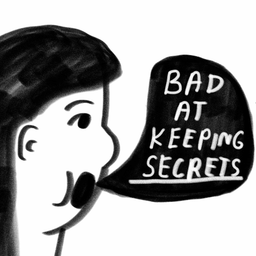
Podcast thumbnail for BAD AT KEEPING SECRETS

BAD AT KEEPING SECRETS

Claim This Podcast

by looking at secrets to understand why we are the way we are.

63 episodes
Updated Daily
Accepts GuestsHas SponsorsLocation 🇺🇸
20

Podcast Authority

Beta
PoorBased on show quality, social media presence, reviews, charts, and more
Pod Engine
Quality6
Social0
YouTube82
Engagement0

Podcast Overview

Each week, we invite thought leaders and experts in the fields of art, design and self-help, to talk about their areas of expertise, share a secret and share what is exciting for them. <br/><br/><a href="https://peopleiveloved.substack.com?utm_medium=podcast">peopleiveloved.substack.com</a>

Language

🇺🇲

Publishing Since

1/8/2023

Unlock The Full Podcast Authority Score Report

See how your podcast performs across key metrics

20

Podcast Authority

Beta
PoorBased on show quality, social media presence, reviews, charts, and more
Pod Engine
Quality6
Social0
YouTube82
Engagement0
5
Excellent Areas
3
Good Performance
11
Growth Opportunities
excellent
Episode Length
54 minutes
Performing excellently!
good
Show Notes Quality
3.0/5

Recommendations available

Unlock the full report to see detailed tips

needs improvement
Publishing Consistency
Every 19 days

Recommendations available

Unlock the full report to see detailed tips

+16 More Metrics

Unlock comprehensive insights including:

  • • YouTube presence analysis
  • • Social media reach metrics
  • • RSS compliance scoring
  • • Podcast 2.0 features
  • • Technical standards
What's Included in Your Full Report

Detailed Analytics

  • Complete breakdown of all 19 authority metrics
  • Personalized recommendations for each metric
  • Industry benchmarks and comparisons
  • Technical RSS feed analysis and compliance scoring

Growth Strategies

  • Step-by-step action plans for improvement
  • Quick wins to boost your score immediately
  • Pro tips from successful podcasters
Get your free podcast insights report

See how your show performs across every key metric

Instant delivery
No spam
Attract Better Guests

High authority scores make your podcast more attractive to industry leaders and influencers who want to appear on credible shows.

Secure Sponsorships

Sponsors look for podcasts with proven authority and engagement. Your score demonstrates your podcast's value to potential partners.

Grow Your Audience

Understanding your strengths and weaknesses helps you make data-driven decisions to expand your listener base effectively.

1 verified contact email on file for BAD AT KEEPING SECRETS

Pitch yourself as a guest, propose sponsorships, or reach out directly to the host.

Recent Episodes

Episode thumbnail for Tell them. First. Without waiting.

March 30, 2026

Tell them. First. Without waiting.

<p><strong>The Mistake I Keep Making (And Maybe You Do Too)</strong></p><p>I used to think my biggest problem was saying too much.</p><p>I’m Carissa. I’m bad at keeping secrets — literally, it’s the name of my podcast — and for a long time I low-key believed that my tendency to overshare was something I needed to fix. Like if I could just learn to hold back a little more, I’d seem more polished. More put-together. More professional.</p><p>Case in point: when my mother-in-law first met me, she told my husband Josh that she was surprised he liked me because I talked too much. Too much. And honestly? She wasn’t wrong. I’ve spent a lot of my life believing that my openness was the problem.</p><p>Then I sat down with <a target="_blank" href="https://www.lesliekjohn.com/">Leslie John,</a> a Harvard professor who has spent years researching self-disclosure, and she completely flipped the script on me.</p><p>Turns out, the thing most of us should actually be worried about isn’t sharing too much. It’s sharing too little.</p><p>Leslie calls it TLI — Too Little Information — and it’s everywhere. It’s the “I’m fine” when you’re not. It’s swallowing the hard conversation because you don’t want to make things weird. It’s never saying “I love you” first because what if they don’t say it back. It’s editing yourself so carefully, for so long, that the people closest to you don’t actually know you.</p><p>And here’s what hit me hardest: Leslie told me that undersharing is actually one of the biggest problems in long-term relationships. Ding ding ding. I’m not going to lie — I needed to hear that one right now. Like, personally. Like she was talking directly to me.</p><p>I think about how many times I’ve censored myself in relationships, in friendships, even in my own marriage — convinced I was being smart or safe — when really I was just quietly building walls and calling it boundaries.</p><p>We kick off the conversation with a question I think so many of us have wrestled with: is it a good idea to tell someone you love them first? The answer might surprise you — but you’re going to have to listen to find out.</p><p><a target="_blank" href="https://www.lesliekjohn.com/">Leslie’s book, </a><a target="_blank" href="https://www.lesliekjohn.com/">Revealing: The Underrated Power of Oversharing</a><a target="_blank" href="https://www.lesliekjohn.com/">,</a> isn’t a permission slip to trauma dump on your coworkers. It’s something way more nuanced and honestly more important than that. It’s about learning to read the room, understanding when to be transparent versus vulnerable, and recognizing that being truly known by the people around you isn’t a liability — it’s the whole point. If you want the full run down on the how and the why of knowing when to share, grab her book. It’s the kind of read that makes you want to call someone you love immediately after.</p><p>So whether you’re an oversharer who just wants to feel good about it, or someone who holds everything close and is tired of feeling invisible — this episode is for you.</p><p>And when you’re done listening? Tell someone you love them. First. Without waiting. Without knowing if they’ll say it back. Because Leslie’s research shows that most of the time, they will. And even when it’s scary, even when your voice shakes a little — that moment of being truly seen is worth every second of vulnerability it took to get there.</p><p>I spent a long time thinking my openness was too much. Turns out, it was never enough.</p><p>Don’t make the same mistake. Listen, subscribe, and go tell someone how you feel.</p><p>We’ll be here when you get back.</p><p>Love, Carissa</p><p>P<a target="_blank" href="https://www.lesliekjohn.com/quiz">S Who doesn’t like a good quiz? Check out Leslie’s to find out more of what kind of oversharer you are. </a></p><p>PPS If you liked this and want to support us, subscribe :) Or get something for someone you love from People I’ve Loved. Like a <a target="_blank" href="https://www.peopleiveloved.com/collections/objects/products/you-are-loved-mug">mug for your mom</a> (this was the OG mug we made for my mom for mother’s day 2020…)</p><p>PPPS Bad At Keeping Secrets is a podcast by Carissa Potter (me). The music was produced by <a target="_blank" href="https://www.officiallyquigley.com/">Officially Quigley,</a> and the sound editing was done by <a target="_blank" href="https://markmcdonald.us/">Mark McDonald. </a>Mark helps people start podcasts, and I highly recommend him if you have been thinking about starting one. You can sign up for a free meeting with him <a target="_blank" href="https://www.birkdalemedia.com/">here</a>.</p><p><p>BAD AT KEEPING SECRETS is a reader-supported publication. We are so happy you are here!</p></p><p></p> <br/><br/>Get full access to BAD AT KEEPING SECRETS at <a href="https://peopleiveloved.substack.com/subscribe?utm_medium=podcast&#38;utm_campaign=CTA_4">peopleiveloved.substack.com/subscribe</a>

Episode thumbnail for I tried to fix my husband. A neuroscientist stopped me.

March 16, 2026

I tried to fix my husband. A neuroscientist stopped me.

<p><strong>Persuasion</strong> (n.): The act of causing someone to do or believe something through reasoning or argument. From the Latin persuadere — to advise thoroughly. Note that nowhere in the definition does it say anything about the other person actually wanting to be advised.</p><p>I have spent years trying to get Josh to exercise.</p><p>Not in a controlling way. Or — okay, maybe in a slightly controlling way, but for good reasons. Ten out of ten doctors agree that moving your body is good for you. This is not a controversial position. This is not me projecting. This is just science, and I would like the person I love to be alive and ambulatory for as long as possible, partly because I love him and partly because I have done the math and I cannot physically take care of him if something goes wrong. I have told him this. Directly. Lovingly. With data.</p><p>His response is not words. It is a look.</p><p>The look says: you think you know better than me. You think I’m not doing enough. You are trying to control my time. He doesn’t have to say any of it. It lands anyway, fully formed, right in the center of my chest. And just like that, the conversation is over — not because we fought, but because the look closed the door before I could get through it.</p><p>I asked his sister once. She is excellent at movement, the kind of person who actually looks forward to it, and I thought maybe she had a key I didn’t. Her advice: just take things off his plate so he has more space. I appreciated this. I also wanted to laugh. I have a plate. My plate is full. My plate has things on it that fell off other people’s plates. I cannot take things off Josh’s plate with the plate situation I am currently managing.</p><p>So for years, nothing changed. And I kept trying the same things — the gentle ask, the walk-to-get-coffee reframe, the calm laying out of medical evidence — and getting the same look. And somewhere in the back of my mind I started to wonder if the problem was not Josh’s relationship to exercise but my relationship to giving advice.</p><p>Enter Emily Falk.</p><p>Falk is a neuroscientist at the <a target="_blank" href="https://www.asc.upenn.edu/research/centers/communication-neuroscience-lab">University of Pennsylvania</a> and the author of W<a target="_blank" href="https://bookshop.org/p/books/what-we-value-the-neuroscience-of-choice-and-change-emily-falk/5696ac08cbcd0591?utm_source=google&#38;utm_medium=cpc&#38;utm_campaign=dsa_nonbrand&#38;utm_content={adgroupname}&#38;utm_term=aud-1721779758455:dsa-19959388920&#38;gad_source=1&#38;gad_campaignid=12440232635&#38;gbraid=0AAAAACfld42inGNtOxRMTCZdQ1uxx3dVJ&#38;gclid=CjwKCAjw1N7NBhAoEiwAcPchp9T4hgOvtOaxqilFcC6snq7JyjE8tlIwzf8BJ948jwq5VGG-gf2STxoC8O4QAvD_BwE">hat We Value</a>, and she studies how the brain actually processes information, change, and persuasion. What she found rearranged something in me. The first thing: the part of the brain that activates when we receive unsolicited advice is the same part associated with social threat. Being told what to do doesn’t just feel annoying. It registers, neurologically, as danger. Josh’s look is not stubbornness or defensiveness or a personal rejection of my very reasonable cardiovascular concerns. It is, in the most literal sense, his brain protecting him.</p><p>Which means every time I made my careful, loving, evidence-based case for movement, I was accidentally pulling the pin on a grenade.</p><p>But here is the part that really got me. Because it would be easy to read this and conclude that Josh is the problem — that his threat response is the obstacle, that if he could just receive information without his nervous system treating it like an attack, everything would be fine. Except Falk also has things to say about the person doing the advising. About why we give advice in the first place. About the uncomfortable truth that what looks like concern is sometimes also about us — our anxiety, our need for control, our own fear dressed up as helpfulness. I am trying to control Josh. </p><p>I thought about the mornings I pick up my phone before I’ve said a word to anyone. Before coffee, before I’ve decided what kind of day I want to have, I am already checking — how is the post doing, did anyone reach out, does anyone still care, am I still here. There was a time when this ritual paid off. Good news, a new collab, someone saying something that made me feel like the work mattered. Now it’s a letdown ninety-five percent of the time. I put the phone down feeling depressed and worthless and like no one loves me.</p><p>When that is simply not true.</p><p>I know this. I know it the way I know that Josh should exercise, the way I know that checking the metrics at 7am is not going to make me feel better. I know it clearly, rationally, with my whole brain. And I do it anyway. Every morning. I watch myself do it almost from outside my own body, and I cannot stop.</p><p>This is Falk’s second insight, the one that I couldn’t argue my way around: knowing something is good for you is almost entirely useless in the moment you are deciding whether to do it. The brain does not make decisions the way we think it does — through calm, rational weighing of evidence. It makes them fast, socially, emotionally, in response to what feels immediately rewarding and what the people around us seem to value. The milkshake wins not because you don’t know better. It wins because knowing better is the wrong tool for the job.</p><p>So what is the right tool?</p><p>This is where I want to hand you the book. Because what Falk found — about how change actually happens, about what makes advice land instead of detonate, about why Josh is finally, slowly, taking a few walks a week and how that happened without a single additional conversation about cardiovascular health — is something I could not have predicted, and couldn’t have argued myself into believing.</p><p><p>Share this with someone you love.</p></p><p>It has everything to do with who is in the room when you make a decision. And almost nothing to do with knowing what’s good for you.</p><p>I’m not going to tell you what to do with that. You know I won’t. (Or am I kinda doing it right now??)</p><p>But I will say: something shifted. Not dramatically. Not in a way that makes a clean story. Just — the look comes less often now. And some mornings, I put the phone down before I check.</p><p>XO, Carissa</p><p>PS Bad At Keeping Secrets is a podcast by Carissa Potter (me). The audio was produced by <a target="_blank" href="https://www.officiallyquigley.com/">Officially Quigley,</a> and the sound editing was done by <a target="_blank" href="https://markmcdonald.us/">Mark McDonald. </a>Mark helps people start podcasts, and I highly recommend him if you have been thinking about starting one. You can sign up for a free meeting with him <a target="_blank" href="https://www.birkdalemedia.com/">here</a>.</p><p>PPS One more plug for Emily. <a target="_blank" href="https://www.google.com/search?q=emily+falk+book+lab+norton&#38;sa=X&#38;sca_esv=9a3fab58edaf9218&#38;rlz=1C5CHFA_enUS913US913&#38;biw=1426&#38;bih=1211&#38;udm=28&#38;sxsrf=ANbL-n4voVlP1BKJtTg77I_nWK-Ek5r0bA%3A1773683872073&#38;shopmd=1&#38;ei=oES4afKVBOLE0PEPgNSh6Qk&#38;ved=0ahUKEwjy5Y2p_6STAxViIjQIHQBqKJ0Q4dUDCCE&#38;uact=5&#38;oq=emily+falk+book+lab+norton&#38;gs_lp=Ehlnd3Mtd2l6LW1vZGVsZXNzLXNob3BwaW5nIhplbWlseSBmYWxrIGJvb2sgbGFiIG5vcnRvbkjwGlCeA1j3GHABeAGQAQCYAeEBoAHvCKoBBTcuMy4xuAEDyAEA-AEBmAIDoALkAcICChAAGLADGNYEGEfCAgYQABgWGB7CAgQQIRgKmAMAiAYBkAYIkgcDMi4xoAefBbIHAzEuMbgH3gHCBwM5LTPIB5L5AoAIAA&#38;sclient=gws-wiz-modeless-shopping#sv=CAYS1gESABosMmFoVUtFd2pVanVteF82U1RBeFd4RGpRSUhmYW5BamdRZ2kxNkJBZ0dFQmcicwoSNDcyMzMyODM0NTAxODY4OTU1EgAaFDE3NjYxNjg2MTk1MTY0MTQ3ODc4IhQxNzY2MTY4NjE5NTE2NDE0Nzg3OCoAMgA6AEoCaGdSAGIAagCKAQCgAQOwAQDCAQDKAQDaAQDiAQDwAQD6AQCSAgDaAgAwAEItMmFoVUtFd2pVanVteF82U1RBeFd4RGpRSUhmYW5BamdRcm9nR2VnUUlCaEFPIP35v9kKMAJKCBACGAEgASgB">Her book is here.</a></p><p>PPPS If you are in the Bay Area, THIS SATURDAY, Ashley Neese and Danny Paul Grody are hosting an event at the Berkeley Art Museum. <a target="_blank" href="https://bampfa.org/event/still-together">Click here for more info.</a></p><p></p> <br/><br/>Get full access to BAD AT KEEPING SECRETS at <a href="https://peopleiveloved.substack.com/subscribe?utm_medium=podcast&#38;utm_campaign=CTA_4">peopleiveloved.substack.com/subscribe</a>

Episode thumbnail for "I DON’T MAKE CONTENT FOR YOU."

March 9, 2026

"I DON’T MAKE CONTENT FOR YOU."

<p>‘I don’t make content for you.’</p><p>I was reading something Gabby wrote recently and it stopped me in my tracks. We both feel it — the world is a lot right now. We see it the same way, we respect each other deeply, and yet we find ourselves responding to it all very differently. That contrast has been sitting with me.</p><p>How are you responding to this moment?</p><p>So I reached out to her. Not for answers exactly, but because I wanted to hear how she’s making sense of this moment — and what she thinks we should do with it.</p><p>That’s what blogger, designer, best-selling author Gabrielle Blair said to MAGA supporters who love her design tips but ignore her politics. And it sparked a whole conversation about who we’re willing to include and who we’re not.</p><p>Today: activism, complicity, privilege, and the line between being inclusive and making space for harm. We talk about Confederate town names, being called racist for anti-racist work, and why there are no excuses left for supporting fascism.</p><p>This one goes deep. Here we go. </p><p>Gabby is amazing, follow her here:</p><p>Sending love, rage, hope, care, kindness and whatever you need today. Permission to make. You got this. We got this. We don’t have another option.</p><p></p><p>XO, Carissa</p><p><p>BAD AT KEEPING SECRETS is so glad you are here. We want to be in this with you. </p></p><p></p> <br/><br/>Get full access to BAD AT KEEPING SECRETS at <a href="https://peopleiveloved.substack.com/subscribe?utm_medium=podcast&#38;utm_campaign=CTA_4">peopleiveloved.substack.com/subscribe</a>

63 total episodes available with 3 transcripts

Recent guests on BAD AT KEEPING SECRETS

Guests from recent episodes — sign up to see every guest that has ever appeared on this show.

Paul Leonardi

Guest

Katherine May

Guest

Domenica Ruta

Guest

Jessica Baum

Guest

Natasha Gregson Wagner

Guest

Ruthie Ackerman

Guest

Vicki Tan

Guest

Carla Fernandez

Guest

Jennifer Pastiloff

Guest

Curtis Sittenfeld

Guest

Deep-dive analytics for BAD AT KEEPING SECRETS

Frequently asked questions

Have a different question and can't find the answer you're looking for? Reach out to our support team by sending us an email and we'll get back to you as soon as we can.

What is BAD AT KEEPING SECRETS?

Each week, we invite thought leaders and experts in the fields of art, design and self-help, to talk about their areas of expertise, share a secret and share what is exciting for them. <br/><br/><a href="https://peopleiveloved.substack.com?utm_medium=podcast">peopleiveloved.substack.com</a>

How often does this podcast release new episodes?

This podcast updates daily.

Where can I listen to this podcast?

This podcast is available on 4 platforms including Apple Podcasts, Spotify, and more. You can also use the RSS feed directly.

Does this podcast accept guests?

Information about guest appearances is not available.

Legal Disclaimer

Pod Engine is not affiliated with, endorsed by, or officially connected with any of the podcasts displayed on this platform. We operate independently as a podcast discovery and analytics service.

All podcast artwork, thumbnails, and content displayed on this page are the property of their respective owners and are protected by applicable copyright laws. This includes, but is not limited to, podcast cover art, episode artwork, show descriptions, episode titles, transcripts, audio snippets, and any other content originating from the podcast creators or their licensors.

We display this content under fair use principles and/or implied license for the purpose of podcast discovery, information, and commentary. We make no claim of ownership over any podcast content, artwork, or related materials shown on this platform. All trademarks, service marks, and trade names are the property of their respective owners.

While we strive to ensure all content usage is properly authorized, if you are a rights holder and believe your content is being used inappropriately or without proper authorization, please contact us immediately at hey@podengine.ai for prompt review and appropriate action, which may include content removal or proper attribution.

By accessing and using this platform, you acknowledge and agree to respect all applicable copyright laws and intellectual property rights of content owners. Any unauthorized reproduction, distribution, or commercial use of the content displayed on this platform is strictly prohibited.