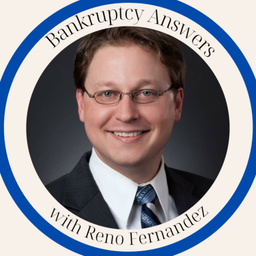
Podcast thumbnail for Bankruptcy Answers with Reno Fernandez

Bankruptcy Answers with Reno Fernandez

Claim This Podcast

by Reno Fernandez

5.0(1 reviews)
37 episodes
Updated Daily
Accepts GuestsHas SponsorsLocation 🇺🇸

Podcast Overview

Bankruptcy appellate attorney Reno Fernandez answers questions about the Bankruptcy Code, discusses recent developments, interviews bankruptcy luminaries, and more. This podcast is geared mostly for attorneys desiring an introduction to bankruptcy topics, although consumers should enjoy it as well. This podcast is for educational purposes only. You may not rely on this podcast for legal advice. Always consult a lawyer. In some jurisdictions, this podcast constitutes an advertisement. © Copyright 2023 by the Complex Appellate Litigation Group, LLP. All rights reserved.

Language

🇺🇲

Publishing Since

2/7/2023

2 verified contact emails on file for Bankruptcy Answers with Reno Fernandez

Pitch yourself as a guest, propose sponsorships, or reach out directly to the host.

Recent Episodes

Episode thumbnail for Third Party Payoff Under Factoring Agreement Not Avoidable Despite Ponzi Scheme Connection

July 4, 2023

Third Party Payoff Under Factoring Agreement Not Avoidable Despite Ponzi Scheme Connection

<p><a href="http://media.ca7.uscourts.gov/cgi-bin/OpinionsWeb/processWebInputExternal.pl?Submit=Display&Path=Y2023/D06-22/C:22-2436:J:St__Eve:aut:T:fnOp:N:3064473:S:0" target="_blank" rel="noopener noreferer">Mann v. LSQ Funding Group, L.C., No. 22-2436 (7th Cir. June 22, 2023)</a></p> <p><br></p> <p>TRANSCRIPT</p> <p><br></p> <p>Hello to all the lawyers, fiduciaries, students, and bankruptcy fans out there. Today we are talking about Mann v. LSQ Funding Group.</p> <p><br></p> <p>On June 22, 2023, the U.S. Court of Appeals for the Seventh Circuit affirmed summary judgment in favor of LSQ Funding Group, L.C., a creditor in the Engstrom, Inc. bankruptcy case. Summary judgment was entered against Douglas Mann, chapter 7 trustee for the bankruptcy estate. The case revolved around an alleged preferential and fraudulent transfer from a third party, namely Millennium Funding, to LSQ, which the court determined did not involve &quot;an interest of the debtor in property.&quot;</p> <p><br></p> <p>Engstrom had entered into an invoice-factoring agreement with LSQ. The trustee alleged that the CEO of Engstrom was running a Ponzi scheme based on fraudulent invoices. LSQ terminated its agreement with Engstrom upon discovering the scheme. This left Engstrom in debt to LSQ for a sum of $10.3 million. To rectify this, Millennium paid LSQ this sum directly, and LSQ then released its rights in Engstrom&#39;s invoices to Millennium. Engstrom declared bankruptcy within three months of the transaction.</p> <p><br></p> <p>The trustee filed a complaint against LSQ, seeking to avoid the payment made by Millennium as a preferential or fraudulent transfer. The bankruptcy court, however, granted summary judgment in LSQ&#39;s favor. This decision was upheld by the district court.</p> <p><br></p> <p>On further appeal, the Seventh Circuit focused on the language of the bankruptcy code, in particular, the phrase &quot;an interest of the debtor in property.&quot; The court applied a two-pronged test considering whether the debtor had control over the funds transferred and whether the transfer reduced the property of the estate. The Seventh Circuit found that, while a jury could conclude that Engstrom selected LSQ to receive the payment from Millennium, there was little evidence suggesting that Engstrom had control over the disposition of the funds or the accounts.</p> <p><br></p> <p>Moreover, all parties agreed that neither the $10.3 million nor the accounts transferred from LSQ to Millennium were part of Engstrom&#39;s estate, and the funds never passed through any of Engstrom&#39;s accounts. Also, the trustee admitted that the transaction did not negatively affect other creditors. The trustee could not establish that reversing the payment would make the funds part of Engstrom&#39;s estate. Therefore, the Seventh Circuit concluded that the transfer did not involve &quot;an interest of the debtor in property,&quot; and thus it was not avoidable under the bankruptcy code.</p> <p><br></p> <p>Of course, I will put a link to the opinion in the show notes. I am Reno Fernandez, and I represent bankruptcy trustees, receivers, assignees, and other fiduciaries. Thank you.</p> <p><br></p>

Episode thumbnail for Fifth Circuit Rules Bankruptcy Court Lacked Jurisdiction to Approve Post-Confirmation Settlement That Conflicted With Plan

June 28, 2023

Fifth Circuit Rules Bankruptcy Court Lacked Jurisdiction to Approve Post-Confirmation Settlement That Conflicted With Plan

<p><a href="https://www.ca5.uscourts.gov/opinions/pub/21/21-20456-CV0.pdf" target="_blank" rel="noopener noreferer">Sarnosky v. Chesapeake Energy Corp. (In re Chesapeake Energy Corp.), No. 21-20323 (5th Cir. June 8, 2023)</a></p> <p><br></p> <p>TRANSCRIPT</p> <p><br></p> <p>Hello lawyers, fiduciaries, students, and bankruptcy fans. Today we are talking about Sarnosky v. Chesapeake Energy Corporation.</p> <p><br></p> <p>On June 8, 2023, the U.S. Court of Appeals for the Fifth Circuit vacated a judgment approving a settlement agreement, entered into after confirmation of a chapter 11 plan of reorganization, that conflicted with the plan and was not supported by any proofs of claim. In a dispute involving Pennsylvania oil and gas lessors, as well as the state&#39;s attorney general, the debtors were accused of underpaying royalties prior to their bankruptcy filing. After entering bankruptcy, some lessors filed proofs of claim, whereas others did not. Those who filed proofs of claim were slated to receive approximately 0.01% of their claims under the confirmed chapter 11 plan, while the claims that were not filed were discharged. </p> <p><br></p> <p>It was assumed that the oil and gas leases would persist unaffected by the bankruptcy. According to the settlements, the lessors could secure well over 20% of their claims, albeit at the cost of substantial alterations to the lease terms.</p> <p><br></p> <p>The debtors attempted to gain bankruptcy court approval for two class-action settlements regarding pre-petition claims, which did not have any proofs of claim filed. These efforts were met with opposition from creditors in similar situations who had filed proofs of claim. </p> <p><br></p> <p>Despite this, the bankruptcy court ruled that it had “core” jurisdiction over the settlements, determined that the settlements were in the best interests of the debtors&#39; estates, and approved the settlements. While the District Court affirmed these decisions, it clarified that the bankruptcy court had &quot;related to&quot; jurisdiction as opposed to &quot;core&quot; jurisdiction.</p> <p><br></p> <p>However, the Fifth Circuit vacated and remanded the decisions with instructions to dismiss. The Fifth Circuit determined that the bankruptcy court lacked jurisdiction to approve post-confirmation settlements of discharged claims. It was particularly problematic that these settlements conflicted with the confirmed chapter 11 plan and disclosure statement, especially given the fact that no proofs of claim had been filed for these claims.</p> <p><br></p> <p>As always, I will put a link to the opinion in the show notes. I am Reno Fernandez, and I represent bankruptcy trustee, receivers, assignees, and other fiduciaries. Thank you.</p>

Episode thumbnail for Bankruptcy Judge Converts Motion for Rule 2004 Exam Into Motion for Post-Judgment Discovery

June 26, 2023

Bankruptcy Judge Converts Motion for Rule 2004 Exam Into Motion for Post-Judgment Discovery

<p><a href="https://www.miwb.uscourts.gov/sites/miwb/files/opinions/22-80070%20%28Richardson%20v.%20Younce%29%20MDO%20re%202004%20Examination.pdf" target="_blank" rel="noopener noreferer">Richardson v. Younce (In re Nail), No. 22-01379 (Bankr. W.D.Mich. June 8, 2023)</a></p> <p><br></p> <p>TRANSCRIPT</p> <p><br></p> <p>Good morning attorneys, fiduciaries, students, and bankruptcy fans. Today we are talking about Richardson v. Younce.</p> <p><br></p> <p>On June 8, 2023, the U.S. Bankruptcy Court for the Western District of Michigan issued a memorandum decision and order dealing with a motion by the chapter 7 trustee, who had prevailed in litigation, for authority to conduct an examination of the judgment debtor pursuant to Rule 2004 of the Federal Rules of Bankruptcy Procedure. To begin with, the court explained that Rule 2004 does not apply for two reasons. First, Rule 2004 does not apply in pending litigation, where Rule 30 of the Federal Rules of Civil Procedure applies (through Rule 7030 of the Federal Rules of Bankruptcy Procedure).</p> <p><br></p> <p>Second, Rule 2004 does not apply to discovery in aid of judgment. Instead, Rule 69 of the Federal Rules of Civil Procedure (through Rule 7069 of the Federal Rules of Bankruptcy Procedure) applies. Although Rule 69 allows a judgment creditor to employ state-court procedure as well as any procedure “provided in these rules…” this naturally refers to the Federal Rules of Civil Procedure, not the Federal Rules of Bankruptcy Procedure.</p> <p><br></p> <p>However, in a show of extraordinary practicality, the court did not deny the motion. Instead, the court converted it to a motion under Rule 69 and granted the motion.</p> <p><br></p> <p>In dicta, the court offered some advice. The court noted that enforcement of judgments under federal law is “confusing, even difficult, for the federal courts and litigants.” Accordingly, the court suggested that the Trustee consider domesticating the judgment under the Uniform Enforcement of Foreign Judgments Act and utilize state court to enforce the judgment.</p> <p><br></p> <p>As usual, I will put a link to the opinion in the show notes. I am Reno Fernandez, and I represent trustees, receivers, assignees, and other fiduciaries. Thank you.</p>

37 total episodes available

Deep-dive analytics for Bankruptcy Answers with Reno Fernandez

Frequently asked questions

Have a different question and can't find the answer you're looking for? Reach out to our support team by sending us an email and we'll get back to you as soon as we can.

What is Bankruptcy Answers with Reno Fernandez?

Bankruptcy appellate attorney Reno Fernandez answers questions about the Bankruptcy Code, discusses recent developments, interviews bankruptcy luminaries, and more. This podcast is geared mostly for attorneys desiring an introduction to bankruptcy topics, although consumers should enjoy it as well.

This podcast is for educational purposes only. You may not rely on this podcast for legal advice. Always consult a lawyer. In some jurisdictions, this podcast constitutes an advertisement.

© Copyright 2023 by the Complex Appellate Litigation Group, LLP. All rights reserved.

How often does this podcast release new episodes?

This podcast updates daily.

Where can I listen to this podcast?

This podcast is available on 4 platforms including Apple Podcasts, Spotify, and more. You can also use the RSS feed directly.

Does this podcast accept guests?

Yes, this podcast regularly features guests.

Legal Disclaimer

Pod Engine is not affiliated with, endorsed by, or officially connected with any of the podcasts displayed on this platform. We operate independently as a podcast discovery and analytics service.

All podcast artwork, thumbnails, and content displayed on this page are the property of their respective owners and are protected by applicable copyright laws. This includes, but is not limited to, podcast cover art, episode artwork, show descriptions, episode titles, transcripts, audio snippets, and any other content originating from the podcast creators or their licensors.

We display this content under fair use principles and/or implied license for the purpose of podcast discovery, information, and commentary. We make no claim of ownership over any podcast content, artwork, or related materials shown on this platform. All trademarks, service marks, and trade names are the property of their respective owners.

While we strive to ensure all content usage is properly authorized, if you are a rights holder and believe your content is being used inappropriately or without proper authorization, please contact us immediately at hey@podengine.ai for prompt review and appropriate action, which may include content removal or proper attribution.

By accessing and using this platform, you acknowledge and agree to respect all applicable copyright laws and intellectual property rights of content owners. Any unauthorized reproduction, distribution, or commercial use of the content displayed on this platform is strictly prohibited.