March 19, 2024
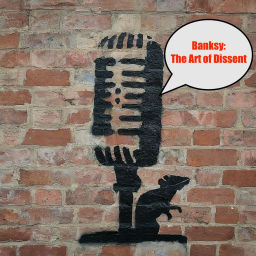
Banksy- The Art of Dissent
Banksy, the elusive and enigmatic street artist, has captivated the world with his thought-provoking, satirical, and often controversial artworks. Born in Bristol, England, in the 1970s, Banksy's true identity remains unknown, adding to the mystique surrounding the artist. Despite his anonymity, Banksy has become one of the most recognizable and influential figures in contemporary art, with his works fetching millions of dollars at auctions and his name synonymous with the street art movement. <br />Chapter 1: The Early Years and Rise to Fame Little is known about Banksy's early life, as the artist has gone to great lengths to maintain his anonymity. It is believed that he was born in Bristol in the 1970s and became involved in the city's underground street art scene in the early 1990s. During this time, Bristol was a hotbed of graffiti culture, with artists like 3D (Robert Del Naja) and Nick Walker paving the way for a new generation of street artists. <br />Banksy's early works were heavily influenced by the French graffiti artist Blek le Rat, who is often credited with pioneering the use of stencils in street art. Banksy began using stencils to create his own unique style, which often featured humorous, satirical, and political themes. His works started appearing on the streets of Bristol and London, gaining attention from locals and the media alike. <br />One of Banksy's earliest known works is a series of stenciled rats that appeared in Bristol in the late 1990s. These rats, which often sported slogans like "Because I'm Worthless" and "Our Time Will Come," were a commentary on the often overlooked and marginalized members of society. This theme of social and political commentary would become a hallmark of Banksy's work throughout his career. <br />As Banksy's popularity grew, so did the scale and ambition of his projects. In the early 2000s, he began creating larger, more elaborate works that often involved a degree of performance or installation. One of his most famous early stunts was the "Turf War" exhibition in 2003, where he painted live animals like sheep and cows with graffiti slogans and displayed them in a makeshift gallery in London's East End. <br />Chapter 2: Breaking Boundaries and Going Global As Banksy's fame spread beyond the UK, he began to travel the world, leaving his mark on cities from New York to Gaza. His works often appeared in unexpected places, such as on the West Bank barrier separating Israel and Palestine, or in the disaster-stricken areas of New Orleans after Hurricane Katrina. <br />One of Banksy's most ambitious projects to date was the "Dismaland" theme park, which opened in the seaside town of Weston-super-Mare in 2015. Billed as a "family theme park unsuitable for children," Dismaland was a darkly humorous and subversive take on the traditional amusement park, featuring works by Banksy and other artists that critiqued consumerism, authoritarianism, and the entertainment industry. <br />Banksy's global reach and influence have also made him a target for thieves and vandals. In 2007, a group of thieves posing as city workers attempted to steal a Banksy mural from a wall in London's Tottenham neighborhood. The mural, which depicted a young girl hugging a bomb, was later recovered by police and sold at auction for over £200,000. <br />Despite these challenges, Banksy has continued to create new works and push the boundaries of what is possible in street art. In 2018, he made headlines around the world with his "self-destructing" painting, "Girl with Balloon," which shredded itself moments after being sold at auction for over £1 million. The stunt was later revealed to be a critique of the art market and the commodification of street art. <br />Chapter 3: Social and Political Commentary One of the defining features of Banksy's work is its biting social and political commentary. Through his art, Banksy has tackled a wide range of issues, from war and poverty to consumerism and the environment. <br />One of his most famous works is the "Rage, Flower Thrower" stencil, which depicts a masked protester throwing a bouquet of flowers instead of a Molotov cocktail. The image has become an iconic symbol of peaceful protest and resistance, and has been reproduced on countless t-shirts, posters, and other merchandise. <br />Another notable work is the "Slave Labour" mural, which appeared on the wall of a Poundland store in London's Wood Green neighborhood in 2012. The mural, which depicts a young boy hunched over a sewing machine making Union Jack bunting, was a commentary on the use of sweatshop labor in the production of souvenirs for the Queen's Diamond Jubilee and the London Olympics. <br />Banksy has also used his art to critique the British government and its policies. In 2017, he created a large mural in the English port town of Dover, depicting a worker chipping away at one of the stars on the European Union flag. The mural was widely interpreted as a commentary on Brexit and the UK's impending departure from the EU. <br />More recently, Banksy has turned his attention to the COVID-19 pandemic and its impact on society. In July 2020, he created a series of stencils on the London Underground that featured rats wearing face masks and using hand sanitizer. The works were accompanied by a video that showed Banksy, disguised as a cleaner, spraypainting the stencils on the train carriage walls. <br />Chapter 4: Philanthropy and Activism In addition to his art, Banksy is also known for his philanthropic and activist work. Over the years, he has donated his artworks and the proceeds from their sales to a variety of charitable causes, from homelessness and poverty to animal rights and refugee aid. <br />One of his most significant charitable contributions came in 2018, when he donated £205,000 from the sale of his "Civilian Drone Strike" installation to a group of Palestinian activists. The installation, which featured a remote-controlled car and a series of "street signs" that referenced US military drone strikes in the Middle East, was sold at a charity auction to raise money for a Palestinian hospital. <br />Banksy has also used his art to raise awareness about the plight of refugees and migrants. In 2015, he created a series of murals in the Calais Jungle, a refugee camp in northern France that housed thousands of migrants and asylum seekers. The murals, which featured images of Steve Jobs (whose biological father was a Syrian migrant) and a riff on Theodore Gericault's famous painting "The Raft of the Medusa," were a powerful commentary on the human cost of the refugee crisis. <br />More recently, Banksy has turned his attention to the Black Lives Matter movement and the ongoing struggle for racial justice. In June 2020, he created a new artwork in response to the killing of George Floyd by Minneapolis police. The painting, which was accompanied by a statement on Banksy's Instagram account, depicted a vigil candle setting fire to an American flag, with the words "People of Color" spray-painted beneath it. <br />Chapter 5: The Art Market and Authentication As Banksy's popularity has grown, so too has the demand for his work in the art market. Despite his anti-establishment ethos and critique of the commodification of art, Banksy's works have fetched millions of dollars at auction, with some pieces selling for over £10 million. <br />The high prices and demand for Banksy's work have also led to a thriving market for forgeries and unauthorized reproductions. In response, Banksy has established an authentication body called Pest Control, which verifies the authenticity of his works and issues certificates of authenticity to buyers. <br />However, even Pest Control has been the subject of controversy and legal disputes. In 2019, a collector who had purchased a Banksy sculpture called "The Drinker" for £40,000 sued Pest Control for refusing to authenticate the work, claiming that the organization was engaging in "anti-competitive practices." The case was eventually settled out of court, with the details of the settlement remaining confidential. <br />The authentication process for Banksy's works has also been complicated by the artist's use of an online marketplace called "Gross Domestic Product." Launched in 2019, the store allowed customers to purchase Banksy-branded merchandise like t-shirts, mugs, and replicas of his artworks. However, in order to purchase an item, customers had to answer a series of questions designed to weed out art dealers and speculators. The store was seen as a tongue-in-cheek critique of the art market and the commodification of Banksy's brand. <br />Chapter 6: Mural and Speculation In March 2021, a new Banksy mural appeared on the side of a house in Bristol, England, sparking speculation and excitement among fans and art enthusiasts. The mural, which depicts a young girl firing a slingshot of red flowers, was discovered on the morning of March 4th by the homeowner, who had no idea that the artwork had been created on his property. <br />The mural, which has been dubbed "Aachoo!!" by Banksy, is believed to be a reference to the ongoing COVID-19 pandemic and the importance of maintaining social distancing and good hygiene practices. The girl in the mural is shown sneezing, with the force of the sneeze causing her to drop the flowers from her slingshot. <br />Since its discovery, the mural has become a local attraction, with crowds of people gathering to take photos and admire the artwork. The homeowner, who has chosen to remain anonymous, has said that he plans to cover the mural with a protective plastic sheet to prevent it from being damaged or vandalized. <br />The appearance of the new mural has also sparked speculation about Banksy's identity and his connection to Bristol. Some have suggested that the artwork is a nod to Banksy's roots in the city, where he first began his career as a graffiti artist in the 1990s. Others have pointed to the timing of the m