- 21
- Episodes
- 2025
- First episode
About Barfly Cinema
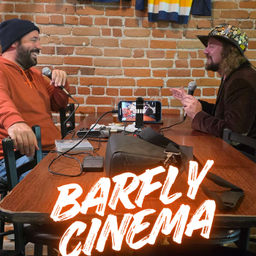
Tom and Gage discuss cinema at Beerworks in downtown Medford, OR. New episodes every Monday.
- Publisher
- Thomas Backman
- Category
- tv & film · tv & film
- Language
- en
- Explicit
- No
- First episode
- 29 Oct 2025
- Latest episode
- 3 Feb 2026
Latest episodes
21 episodes in the feed.
3 Feb 2026
Frequency (2000) Review
Tom and Gage discuss Frequency from 2000. Frequency (2000) is a sci-fi drama wrapped around a very human father–son bond, and baseball is the emotional through line that stitches the timelines together. The story centers on John Sullivan, a New York detective in 1999, and his father Frank, a firefighter living in 1969. Through a freak aurora, they communicate via an old ham radio—and John realizes he can change the past. One of the first and most personal changes comes through baseball: John warns Frank about a future World Series game, proving the connection is real and convincing Frank to trust what he’s hearing from his son. Baseball functions as more than a cool proof-of-time-travel trick. It’s their shared language, a symbol of normalcy and love across decades. Frank is a passionate baseball fan, and John’s childhood memories of watching games with his dad represent a relationship cut short when Frank died young. By using baseball knowledge to save Frank from a fatal fire, John isn’t just altering history—he’s reclaiming the moments he lost: tossing a ball, arguing over games, being a kid with his dad. As the timeline shifts and new dangers emerge, baseball remains the emotional anchor. Even when memories fracture and reality rewrites itself, the father–son bond forged over baseball persists. In the end, the movie suggests that while time can bend and chaos can ripple outward, shared rituals—like baseball—carry love across generations, grounding the sci-fi premise in something deeply familiar and heartfelt. ⚾️
28 Jan 2026
Buffalo 66 (1998) Review
Tom and Gage discuss Vincent Gallo's Buffalo 66 from 1998. Buffalo ’66 (1998) — Summary Buffalo ’66 is a bleak, off-kilter indie film that mixes deadpan humor, romantic fantasy, and emotional trauma. The story follows Billy Brown (played by Vincent Gallo), who’s just been released from prison after five years. Too ashamed to admit the truth to his emotionally abusive parents, Billy kidnaps Layla (Christina Ricci), a shy tap dancer, and forces her to pose as his wife for a visit home. What begins as coercive and unsettling gradually softens into something more complicated and intimate. The film drifts between: Billy’s crippling resentment toward his parents His obsession with the Buffalo Bills’ Super Bowl loss, which he blames for ruining his life Fantasies of violence and revenge Unexpected moments of tenderness between Billy and Layla Stylistically, it’s stark and stylized: long silences, washed-out colors, abrupt emotional shifts. The tone walks a tightrope between cruelty and vulnerability. By the end, the film becomes less about crime or revenge and more about whether deeply damaged people can choose connection over self-destruction. It’s controversial, uncomfortable, and very personal—basically a cinematic emotional wound. Vincent Gallo — Career Overview Vincent Gallo is one of those artists where the work and the personality are inseparable, for better or worse. Early Career Started in the 1980s New York art scene, involved in music, painting, and experimental film Acted in films like Arizona Dream (1993) and The Funeral (1996), gaining attention for his intensity and unpredictability Breakthrough: Buffalo ’66 Gallo wrote, directed, starred in, composed the music for, and partially shot the film It became a cult hit and was praised for its originality, performances (especially Christina Ricci), and raw emotional honesty Cemented Gallo as a major indie auteur—but also as a difficult, polarizing figure Later Film Work Directed The Brown Bunny (2003), infamous for: An explicit sex scene Being brutally panned at Cannes, then partially redeemed after re-editing Acted in films like: Trouble Every Day (2001) Essential Killing (2010), which won him Best Actor at the Venice Film Festival Music and Art Released several lo-fi, melancholic albums blending post-punk, blues, and experimental sounds Continues to paint and exhibit visual art His music and art share the same themes as his films: alienation, nostalgia, masculinity, and romantic despair Controversy and Reputation Known for provocative, offensive, or inflammatory statements Frequently clashes with critics, audiences, and collaborators Seen by some as a misunderstood auteur; by others as self-indulgent and misogynistic His public persona has often overshadowed his actual work Big Picture Vincent Gallo is best understood as: A deeply personal artist who puts his own damage onscreen Someone whose work can feel honest, cruel, romantic, and repellent all at once A figure who thrives on discomfort—both emotional and cultural If you like Buffalo ’66, you’re usually responding to its lonely, wounded sincerity, not necessarily to Gallo himself. If you want, I can also: Compare Buffalo ’66 to The Brown Bunny Talk about why the film became such a cult classic Or unpack the Billy/Layla relationship in more detail
26 Jan 2026
The Duellists (1977) Review
The Duellists (1977) Review Tom and Gage discuss Ridley Scott's The Duellists from 1977. The Duellists (1977), Ridley Scott’s debut feature, is a restrained, elegant historical drama adapted from Joseph Conrad’s short story The Duel. Set during the Napoleonic Wars, it explores obsession, honor, and the corrosive pull of pride through a decades-long personal feud. Plot Summary The film follows two French army officers, Armand d’Hubert (Keith Carradine) and Gabriel Feraud (Harvey Keitel), whose lives become entangled by a seemingly trivial insult. D’Hubert is tasked with delivering a reprimand to Feraud, a hot-tempered and fiercely proud officer. Feraud interprets this as a personal slight and challenges d’Hubert to a duel. What begins as a minor dispute spirals into a lifelong obsession. Over the course of nearly 20 years—across shifting fronts of the Napoleonic Wars, changes in rank, political upheaval, and personal fortunes—the two men repeatedly seek each other out to duel: with swords, pistols, and under varying conditions. Each duel is inconclusive, never resolving the feud. While Feraud clings fanatically to the idea that his honor has been stained and must be redeemed through combat, d’Hubert increasingly views the conflict as irrational and destructive, even as he feels bound by the rigid codes of military honor. The feud costs both men dearly, but especially Feraud, whose inability to move on ultimately leaves him isolated and diminished. The film culminates in a final confrontation after Napoleon’s fall, where d’Hubert gains the upper hand and—rather than killing Feraud—forces him to confront the emptiness of his obsession. Major Themes 1. Obsession and Futility At its core, The Duellists is about how obsession can hollow out a life. Feraud defines himself almost entirely through the duel; without it, he has no identity. The original cause of the conflict becomes irrelevant—what matters is the continuation of the feud itself. The film quietly argues that obsession thrives not on meaning, but on repetition. 2. Honor as a Trap Honor is presented not as a noble ideal but as a socially enforced prison. Both men are constrained by an unwritten code that demands they keep fighting, even when it no longer makes sense. D’Hubert, the more reflective of the two, recognizes the absurdity but lacks the freedom to escape it—until the very end. 3. Reason vs. Passion The duelists embody opposing temperaments: D’Hubert represents reason, restraint, and adaptability. Feraud represents passion, pride, and rigidity. Their conflict mirrors Enlightenment rationality clashing with raw emotion. Importantly, the film does not portray reason as heroic in a conventional sense—d’Hubert survives not because he is braver, but because he evolves. 4. The Absurdity of Violence Set against the backdrop of massive historical violence—the Napoleonic Wars—the personal feud seems small, almost ridiculous. Yet it is deadly serious to the men involved. Scott underscores the irony that while empires rise and fall, these two men are locked in a private, meaningless war of their own. 5. Time, Change, and Stagnation Time moves forward inexorably in the film: regimes change, careers rise and fall, and d’Hubert matures emotionally and socially. Feraud, by contrast, remains frozen—still fighting the same battle for the same wounded pride. The film suggests that survival, both personal and political, depends on the ability to adapt. 6. Masculinity and Identity The duels are not just about honor; they are about how men define themselves. Feraud equates masculinity with dominance and violence. D’Hubert gradually learns that self-worth can exist outside constant confrontation. The final mercy he shows Feraud is a rejection of the narrow, destructive version of masculinity they were both taught. In Short The Duellists is less a swashbuckling adventure than a quiet, philosophical meditation on pride and persistence. With painterly visuals and a deliberately measured pace, it treats violence not as spectacle but as ritual—one that becomes emptier and sadder each time it is repeated. It’s a film about how letting go can be harder, and braver, than fighting.
Contact Barfly Cinema
- Guest appearances
- Books guests
Based on episode analysis; this does not confirm that the show is currently accepting guests.
Host of Barfly Cinema?
Claim your podcast to manage its listing and keep your show details accurate.
Pod Engine is an independent podcast discovery and analytics service and is not affiliated with or endorsed by this podcast. Artwork and show content belong to their owners. Full legal notice.
Explore this show
Podcast research with Pod Engine