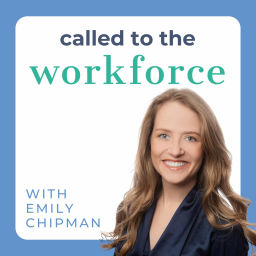
Called to the Workforce
We talk about how women of faith can develop professional and leadership skills.
4.8from 33 ratings
- 16
- Episodes
- 33
- Ratings
- Daily
- Cadence
- 2024
- First episode
About Called to the Workforce
Welcome to Called to the Workforce podcast, where we talk about how women of faith can develop professional and leadership skills for their careers, volunteer or church service, and lives. Hosted by Emily Chipman, internationally recognized master certified Marshall Goldsmith Stakeholder Centered Coach, and a lifelong LDS Christian who has learned the value of mentors and open conversations to teach women how to build strong careers and strong faith practices that complement each other. Each episode features an in-depth conversation with an LDS Christian woman sharing hard-earned professional and leader development lessons from her work and faith and valuable insights into the roadmap for doing this today. Subscribe to the show on YouTube or your favorite podcast app to catch all of Season 1! calledtotheworkforce.substack.com (https://calledtotheworkforce.substack.com?utm_medium=podcast)
- Publisher
- We talk about how women of faith can develop professional and leadership skills.
- Category
- business · religion & spirituality
- Language
- en
- Explicit
- No
- First episode
- 16 Apr 2024
- Latest episode
- 23 Mar 2026
Latest episodes
16 episodes in the feed.
23 Mar 2026
S2 E4: You got the role. Why don't you feel like it?
New title. Bigger office. Harder decisions. And internally? Am I actually this person? As an executive coach, I see this moment all the time. It doesn’t matter whether it’s a first-time manager, someone stepping into the C-suite, or a woman considering whether she even wants the bigger role. Identity doesn’t automatically catch up to opportunity. In this episode, I sat down with Dr. Suzy Larson to talk about what she calls Professional Identity Formation — the process of learning to think, act, and eventually feel like the role you’ve stepped into. And it often starts with a wobble. For her, it was a simple doctor’s office form. Occupation: __________ She paused. For years she wrote “pharmacist.” Now she was in academia. Was she still one? That tiny hesitation? That’s the moment. Four Key Takeaways: 1. Identity lags behind growth.You don’t wake up confident just because someone handed you a title. You grow into it. Thinking, acting, and feeling like the role takes repetition and time. 2. Reflection turns chaos into clarity.Suzy shared a simple tool: What? So what? Now what?When something shakes you — a promotion, a failure, a pivot — pause. Meaning doesn’t form without reflection. 3. Who you are at home and who you are at work are not separate.I loved her DNA helix analogy. Your personal and professional identities twist together. You don’t leave yourself at the door — you refine yourself as you go. 4. Change the soundtrack.This one hit. Suzy is actively working to speak to herself the way she speaks to her daughters — with generosity instead of criticism. Identity isn’t just built by competence. It’s reinforced by the story you rehearse every day. There’s a line she shared at the end that I haven’t stopped thinking about: It’s okay to be both a masterpiece and a work in progress at the same time. That might be the most accurate description of leadership I’ve ever heard. You are already valuable. And you are still becoming. Both are true. In this episode, we cover: [00:02:15] What professional identity formation actually means[00:04:00] The identity wobble moment[00:06:30] Reflection as a development tool[00:08:15] The “What? So what? Now what?” model[00:14:15] Supporting someone in a transition[00:19:45] The DNA helix: personal + professional identity intertwined[00:23:45] Identity-based habits and Atomic Habits[00:28:30] Women, confidence, and shrinking[00:31:30] Anchoring identity in faith[00:39:15] “Masterpiece and work in progress” This is a public episode. If you would like to discuss this with other subscribers or get access to bonus episodes, visit calledtotheworkforce.substack.com (https://calledtotheworkforce.substack.com?utm_medium=podcast&utm_campaign=CTA_1)
16 Mar 2026
S2 E3 Women Are Great at Building Relationships. We Just Hesitate to Use Them.
In this episode, I sat down with Kriss Pond to talk about something that I believe quietly shapes careers more than talent alone: Professional relationships. Not just building them.Leveraging them. Kriss has worked in social work, oncology, youth programming, and university housing. Early in her career, she experienced two very different leaders — one who focused almost exclusively on outcomes… and one who understood that outcomes are built on people. Nine employees left under the first leader. Under the second?People stayed. And they showed up. That contrast shaped how Kriss leads — and how she thinks about relationship capital. Four Key Takeaways: 1. Results don’t happen without relationships.One of the most powerful stories Kriss shared was about a CEO who knew everyone’s name — doctors, custodial staff, cafeteria workers. Not because he had time. Because he knew it mattered. The message was simple: if people don’t feel valued, they eventually leave — physically or emotionally. 2. Relationship capital is built in the “nanoseconds.”A head poked into an office. Ten seconds in a hallway. A thoughtful follow-up email. Those tiny interactions are deposits. And when you need something later — that’s when you feel the return. 3. Leveraging isn’t selfish — it’s strategic.Kriss didn’t wait for networking magic. When she stepped back into a previous role, she made a 90-day plan and asked herself: Who do I need to be successful? She asked questions. Took people to lunch. Even kept Almond M&Ms in her desk for the IT specialist who kept her department running. That’s not manipulation. That’s understanding how work actually gets done. 4. Invest in the outcome more than your idea.This one hit me. Speak up. Offer the idea. Contribute fully. And if the group chooses another direction? Get on board and help make it successful. That’s maturity. That’s influence. That’s leadership. One thing I appreciated in this conversation was the reminder that office politics doesn’t have to be dirty. It can simply mean:Do you know how things move?Do you know who helps them move?And have you invested enough that when you ask for help, people are glad to give it? In this episode, we cover: [00:03:30] A first job that revealed the cost of neglecting relationships[00:05:45] A CEO who knew every name — and why that mattered[00:09:30] Building relationships in the margins of busy days[00:14:30] Why women hesitate to leverage their networks[00:19:00] The Almond M&M story — and what happened after she left[00:25:30] The Arbinger pyramid: personal way of being → relationships → teaching → correction[00:36:00] Presenting ideas without over-attaching[00:45:15] Handling disappointment when your idea isn’t chosen[00:47:45] “You add value wherever you go.” This is a public episode. If you would like to discuss this with other subscribers or get access to bonus episodes, visit calledtotheworkforce.substack.com (https://calledtotheworkforce.substack.com?utm_medium=podcast&utm_campaign=CTA_1)
9 Mar 2026
S2 E2 Finding Your Leadership Voice
In this episode, I sat down with Dr. Janalee Emmer to talk about something that sounds simple… but is anything but: Authenticity at work. Not performative confidence.Not copying someone else’s leadership style.But cultivating your voice — and learning when and how to use it. Janalee’s career didn’t unfold in a straight line. She explored. She kept multiple tracks open. She built depth in her field while also gaining varied experience. And eventually, she stepped into the role of Director of the BYU Museum of Art — a role that required her to lead in her own way, not her predecessor’s. That distinction matters more than we think. Four Key Takeaways: 1. Depth gives you flexibility.Janalee didn’t stay broad and vague. She chose a field — art history — and then built experience within it. Specificity made her credible. Variety made her adaptable. That combination is what made future leadership possible. 2. Authentic doesn’t mean unfiltered.You don’t interact with a university president the same way you interact with your three-year-old niece — and that doesn’t make you fake. It makes you wise. Authenticity isn’t sameness. It’s alignment with your values across different settings. 3. Practice your voice before the stakes are high.Janalee talked about learning to speak up respectfully in lower-stakes settings so she could lead effectively in higher-stakes ones. Tone matters. Mission alignment matters. And listening deeply — even when you disagree — builds long-term trust. 4. Faith requires daily recommitment.From leaving a tenure-track “dream job” to navigating seasons that didn’t look the way she expected, Janalee shared a powerful reminder: faith is fragile if we don’t choose it daily. Sometimes the most faithful thing we can ask is, What is the one needful thing right now? One moment that stayed with me was her reframing of the Mary and Martha story. We often praise Mary and quietly criticize Martha.But what if we are both? What if leadership requires stillness and action?Focus and forward movement? That balance — at work and at home — is part of finding your voice. In this episode, we cover: [00:02:00] Finding direction without narrowing too soon[00:08:30] Leadership authenticity vs. imitation[00:19:15] Speaking up in high-stakes environments[00:25:00] Navigating disappointment professionally[00:31:15] Faith, unexpected paths, and daily recommitment[00:40:45] Mary & Martha reframed for working women[00:44:03] “You are doing better than you think.” This is a public episode. If you would like to discuss this with other subscribers or get access to bonus episodes, visit calledtotheworkforce.substack.com (https://calledtotheworkforce.substack.com?utm_medium=podcast&utm_campaign=CTA_1)
2 Mar 2026
S2 E1 Why Most Women Leadership Development Programs Don’t Work (And What Actually Does)
In this season opener, I’m doing something a little different. No guest. Just a conversation about something that matters more than we often admit: How do you choose a leadership program that actually changes you? Last year, I attended a training with Dr. Susan Madsen on women’s leadership development. I walked in thinking about what I could improve as a practitioner. I walked out thinking about how many capable women invest time and money into programs that create awareness… but not transformation. Somewhere between 70–75% of leadership development programs don’t show measurable performance improvement. That should make us pause. So in this episode, I break down the three research-backed elements that truly move the needle for women — and what to look for before you say yes to anything. Four Key Takeaways: 1. Leadership identity matters more than skill-building. You can teach communication frameworks all day long. But if a woman does not internally see herself as a leader, the skill won’t stick. Identity has layers: * You internalize it. * Others recognize it. * The broader system endorses it. If a program never makes space for imposter syndrome, ambition, perfectionism, or confidence — it’s probably too shallow. 2. Calling fuels courage. One of the most fascinating findings in the research is this: When women feel a sense of calling connected to leadership, they step up. When they don’t, they hesitate — even if they’re qualified. Calling increases job satisfaction, resilience, engagement, and meaning. Leadership isn’t always about wanting the spotlight. Sometimes it’s about recognizing the impact you’re capable of making. 3. Unconscious bias must be handled carefully. This topic matters — deeply. But if it’s taught poorly, it can leave women frustrated and angry in ways that don’t serve them in their specific workplace culture. If a program claims to cover bias, ask who is teaching it — and what their expertise is. This isn’t a checkbox conversation. 4. One-day inspiration does not create transformation. Real development takes time. The research suggests multi-day programs, spaced over months, with peer cohorts and real assignments. Awareness is easy. Becoming takes repetition, reflection, and community. One moment that stayed with me was the simple shift from doing → being → becoming. We can practice behaviors.We can act like leaders. But until it becomes who we are — until we internalize it — it won’t sustain under pressure. Leadership isn’t an event you attend. It’s an identity you grow into. In this episode, we cover: [00:01:15] Why most programs don’t show performance improvement[00:02:15] Leadership identity: internalization, recognition, endorsement[00:05:15] Perfectionism, ambition, and imposter syndrome[00:06:45] Calling and purpose as a driver for stepping up[00:08:15] Research-backed benefits of feeling called[00:09:30] Why unconscious bias training requires real expertise[00:12:55] One-day events vs. sustained development[00:13:45] Cohorts, peer groups, and challenging assignments[00:16:45] A simple mentoring challenge for this season If there’s one small assignment before the next episode drops: Ask someone to mentor you. You might be surprised how willing people are to support you — if you’re willing to ask. Season two is about identity, influence, purpose, and growth. And we’re just getting started. This is a public episode. If you would like to discuss this with other subscribers or get access to bonus episodes, visit calledtotheworkforce.substack.com (https://calledtotheworkforce.substack.com?utm_medium=podcast&utm_campaign=CTA_1)
25 Jun 2024
S1 Bonus Episode: Lauren Williams: Navigating Layoffs and Job Loss | Supporting Those Who Lost Their Community
Lauren Williams returns to the podcast for a special episode this week. When we launched the podcast, we decided to do a special live recording that touches on a topic affecting many of us or people we care about: layoffs and job loss. For full show notes and transcripts visit https://calledtotheworkforce.substack.com (https://calledtotheworkforce.substack.com) During our podcast, guests share their professional experiences and faith experiences. Views expressed reflect their own beliefs and do not reflect their employers past, present, or future. The Church of Jesus Christ of Latter-day Saints does not sponsor this podcast. This is a public episode. If you would like to discuss this with other subscribers or get access to bonus episodes, visit calledtotheworkforce.substack.com (https://calledtotheworkforce.substack.com?utm_medium=podcast&utm_campaign=CTA_1)
18 Jun 2024
Stacey Unck: Building and Leveraging Relationships for Success
How do you build and leverage relationships to help you professionally? Stacey Unck, … In our conversation, we discuss: What do you when the job you want isn’t coming easily? In competitive environments, how do you decide to show up? Why it’s important to pay attention to your own patterns of behavior. How to build and leverage relationships with colleagues, managers, and peers to help you professionally. Faith & Leadership | Why is it important to have a clear vision and understanding of God's plan for your life? The value of knowing you’ve got people supporting you. For full show notes and transcripts visit https://calledtotheworkforce.substack.com (https://calledtotheworkforce.substack.com) During our podcast, guests share their professional experiences and faith experiences. Views expressed reflect their own beliefs and do not reflect their employers past, present, or future. The Church of Jesus Christ of Latter-day Saints does not sponsor this podcast. This is a public episode. If you would like to discuss this with other subscribers or get access to bonus episodes, visit calledtotheworkforce.substack.com (https://calledtotheworkforce.substack.com?utm_medium=podcast&utm_campaign=CTA_1)
11 Jun 2024
EP 9: Abby Chipman: Managing Conflict and High Emotions is a Leadership and Human Experience
Abby Chipman has a bachelor’s degree in statistics and an MBA focused on finance. She worked for the US Census Bureau as a Statistician Analyst for three years, and during her MBA, she interned at a microfinance bank in Kenya. She then worked for Fidelity Investments as a financial representative and then as a relationship manager, working with high-net-worth clients. During her time at Fidelity, Abby also obtained her Certified Financial Planner license. For full show notes and transcripts visit https://calledtotheworkforce.substack.com (https://calledtotheworkforce.substack.com) During our podcast, guests share their professional experiences and faith experiences. Views expressed reflect their own beliefs and do not reflect their employers past, present, or future. The Church of Jesus Christ of Latter-day Saints does not sponsor this podcast. This is a public episode. If you would like to discuss this with other subscribers or get access to bonus episodes, visit calledtotheworkforce.substack.com (https://calledtotheworkforce.substack.com?utm_medium=podcast&utm_campaign=CTA_1)
4 Jun 2024
EP 8: Emily Chipman: Creating a 10 Year Career Plan and Managing Your Career
This week, host Emily Chipman steps out of the host role and into the hot seat. As the first woman invited to teach other coaches the internationally top ranked executive coaching certification, Emily operates a strategic partnership firm, collaborating with HR teams in multiple industries to elevate the healthy development and increase the influence of their top talent leaders and teams. For full show notes and transcripts visit https://calledtotheworkforce.substack.com (https://calledtotheworkforce.substack.com) During our podcast, guests share their professional experiences and faith experiences. Views expressed reflect their own beliefs and do not reflect their employers past, present, or future. The Church of Jesus Christ of Latter-day Saints does not sponsor this podcast. This is a public episode. If you would like to discuss this with other subscribers or get access to bonus episodes, visit calledtotheworkforce.substack.com (https://calledtotheworkforce.substack.com?utm_medium=podcast&utm_campaign=CTA_1)
28 May 2024
EP 7: Carly Porter: Navigating the Unexpected Life | Building Professional Relationships | Neurodiversity in the Workplace
For about 15 years, Carly Porter has worked in HR at well-known companies such as Honeywell and Citibank. During that time, she gained broad experience in general HR before specializing in leadership and learning development. While at Citibank, she piloted a bespoke career development platform customized for female middle management. She recently joined CAPCO as Associate Director Head of Learning and Development of North America. For full show notes and transcripts visit https://calledtotheworkforce.substack.com (https://calledtotheworkforce.substack.com) During our podcast, guests share their professional experiences and faith experiences. Views expressed reflect their own beliefs and do not reflect their employers past, present, or future. The Church of Jesus Christ of Latter-day Saints does not sponsor this podcast. This is a public episode. If you would like to discuss this with other subscribers or get access to bonus episodes, visit calledtotheworkforce.substack.com (https://calledtotheworkforce.substack.com?utm_medium=podcast&utm_campaign=CTA_1)
21 May 2024
Ep 6: Margo: Managing Expectations and Multiple Jobs
Margo Poole graduated with a bachelor's degree in physical education. She earned her master's degree in physical therapy and has been practicing for over 20 years. Margo was a member of the American Physical Therapy Association for 11 years and became an APTA-credentialed Clinical Instructor in 2013. She earned a Corrective Exercise Specialist certification in 2017 and a dry needling certification in 2023. For full show notes and transcripts visit https://calledtotheworkforce.substack.com (https://calledtotheworkforce.substack.com) During our podcast, guests share their professional experiences and faith experiences. Views expressed reflect their own beliefs and do not reflect their employers past, present, or future. The Church of Jesus Christ of Latter-day Saints does not sponsor this podcast. This is a public episode. If you would like to discuss this with other subscribers or get access to bonus episodes, visit calledtotheworkforce.substack.com (https://calledtotheworkforce.substack.com?utm_medium=podcast&utm_campaign=CTA_1)
14 May 2024
Ep 5: Misty Bastian: What to do if You've Made a Big Mistake | Career Flexibility | Finding a Strong Leadership Voice in a Volunteer Role
Misty Bastian received an undergraduate degree in Communications and a graduate degree in education focusing on the arts. She has volunteered as an ESL instructor, worked as the director of communications at Jamberry, and worked for several years as a Senior Consultant for Strategic Communications and Project Management at companies including Booz Allen Hamilton and Acuity. In her current role as Director of Global Philanthropy at Doterra, she oversees the day-to-day operations of the doTerra Healing Hounds Foundation. For full show notes and transcripts visit https://calledtotheworkforce.substack.com (https://calledtotheworkforce.substack.com) During our podcast, guests share their professional experiences and faith experiences. Views expressed reflect their own beliefs and do not reflect their employers past, present, or future. The Church of Jesus Christ of Latter-day Saints does not sponsor this podcast. This is a public episode. If you would like to discuss this with other subscribers or get access to bonus episodes, visit calledtotheworkforce.substack.com (https://calledtotheworkforce.substack.com?utm_medium=podcast&utm_campaign=CTA_1)
7 May 2024
EP 4: Jessica Johnson: Developing Our Own and Others' Talents
Jessica Johnson is the managing director of leadership development for one of the top HR and leadership consulting firms in the world (RBL). She has coached women in leadership roles in the United States and many other countries, including Canada, Saudi Arabia, Abu Dhabi, and Mauritius. Jessica has also worked as a live television sports producer and managed the internal operations of a thousand offshore employees for a management consulting firm. For full show notes and transcripts visit https://calledtotheworkforce.substack.com (https://calledtotheworkforce.substack.com) During our podcast, guests share their professional experiences and faith experiences. Views expressed reflect their own beliefs and do not reflect their employers past, present, or future. The Church of Jesus Christ of Latter-day Saints does not sponsor this podcast. This is a public episode. If you would like to discuss this with other subscribers or get access to bonus episodes, visit calledtotheworkforce.substack.com (https://calledtotheworkforce.substack.com?utm_medium=podcast&utm_campaign=CTA_1)
30 Apr 2024
Ep 2: Becca Pike: Building Influence Within Your Company Through Kindness
Becca Pike is currently the Associate Director of Outreach and Recruitment at Brigham Young University. Prior to this role, she worked at Deseret Digital Media doing instructional Design. Becca also worked at Wavetronics, where she facilitated courses like The 7 Habits, The Speed of Trust, The Outward Mindset, and Situational Leadership II. Becca currently serves as a “Stake Relief Society President” which means that her church volunteer role is supporting the leadership of local congregations’ womens groups. For full show notes and transcripts visit https://calledtotheworkforce.substack.com (https://calledtotheworkforce.substack.com) During our podcast, guests share their professional experiences and faith experiences. Views expressed reflect their own beliefs and do not reflect their employers past, present, or future. The Church of Jesus Christ of Latter-day Saints does not sponsor this podcast. This is a public episode. If you would like to discuss this with other subscribers or get access to bonus episodes, visit calledtotheworkforce.substack.com (https://calledtotheworkforce.substack.com?utm_medium=podcast&utm_campaign=CTA_1)
30 Apr 2024
Ep 1: Deb Weiss: Business Acumen and Becoming a High Value Employee & Leader
Right off the bat, Deb Weiss surprised me with her chosen topic. Deb is one hundred percent passionate about the topic that everyone I’ve talked to the podcast about has happily avoided. Business acumen may seem like the least “sexy” or “dishy” topic, but it’s changed her level of confidence, her ability to succeed professionally, and her level of success. Deb beautifully explains that if you want to be understood and feel more confident at work… learn to speak the language of your company and how things get done. This is a critical tool to help you stand out professionally as a high-value employee and leader. For full show notes and transcripts visit https://calledtotheworkforce.substack.com During our podcast, guests share their professional experiences and faith experiences. Views expressed reflect their own beliefs and do not reflect their employers past, present, or future. The Church of Jesus Christ of Latter-day Saints does not sponsor this podcast. This is a public episode. If you would like to discuss this with other subscribers or get access to bonus episodes, visit calledtotheworkforce.substack.com (https://calledtotheworkforce.substack.com?utm_medium=podcast&utm_campaign=CTA_1)
30 Apr 2024
Ep 3: Lauren Williams: Working with a Global and Diverse Workforce
Lauren Williams has a bachelor’s degree in Marketing and International Business. She later received a Master’s degree in Information Systems from the University of Utah. She completed a certificate in leadership excellence through an American Express employee partnership with Harvard. Professionally, she has worked for the National Geographic Society, American Express focusing on consumer marketing and operations. In 2018 she switched careers and went into Product Management. She’s worked for Lendio and most currently at Regions Bank. For full show notes and transcripts visit https://calledtotheworkforce.substack.com (https://calledtotheworkforce.substack.com) During our podcast, guests share their professional experiences and faith experiences. Views expressed reflect their own beliefs and do not reflect their employers past, present, or future. The Church of Jesus Christ of Latter-day Saints does not sponsor this podcast. This is a public episode. If you would like to discuss this with other subscribers or get access to bonus episodes, visit calledtotheworkforce.substack.com (https://calledtotheworkforce.substack.com?utm_medium=podcast&utm_campaign=CTA_1)
16 Apr 2024
Welcome to Called to the Workforce
Welcome to Called to the Workforce podcast, where we talk about how women of faith can develop professional and leadership skills for their careers, volunteer or church service, and lives. Hosted by Emily Chipman, internationally recognized master certified Marshall Goldsmith Stakeholder Centered Coach, and a lifelong LDS Christian who has learned the value of mentors and open conversations to teach women how to build strong careers and strong faith practices that complement each other. Each episode features an in-depth conversation with an LDS Christian woman sharing hard-earned professional and leader development lessons from her work and faith and valuable insights into the roadmap for doing this today. Subscribe to the show on YouTube or your favorite podcast app to catch all of Season 1! Episode updates, shownotes and more, can be found on our Substack newsletter at https://calledtotheworkforce.substack.com (https://calledtotheworkforce.substack.com) This is a public episode. If you would like to discuss this with other subscribers or get access to bonus episodes, visit calledtotheworkforce.substack.com (https://calledtotheworkforce.substack.com?utm_medium=podcast&utm_campaign=CTA_1)
Reach and audience
Public platform figures. Ratings count people who left a rating, not total listeners.
- Apple Podcasts (US)
- 4.8 / 5
- 25 ratings
- Spotify
- 5.0 / 5
- 8 ratings
Contact Called to the Workforce
- Guest appearances
- Does not typically book guests
Based on episode analysis; this does not confirm that the show is currently accepting guests.
Host of Called to the Workforce?
Claim your podcast to manage its listing and keep your show details accurate.
Pod Engine is an independent podcast discovery and analytics service and is not affiliated with or endorsed by this podcast. Artwork and show content belong to their owners. Full legal notice.
Explore this show
Podcast research with Pod Engine