- 19
- Episodes
- Weekly
- Cadence
- 2025
- First episode
- 119K
- YouTube views
About Capital Conversations
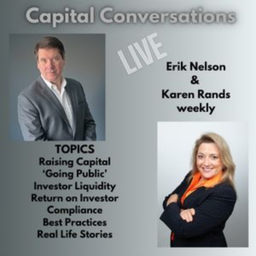
Welcome to "Capital Conversations," the podcast where we demystify the art of fundraising for privately held and publicly traded companies. Join us as we explore strategies for raising capital, preparing for initial public offerings (IPOs), and equipping investors with the tools to evaluate growth potential. Each episode features industry experts and entrepreneurs sharing insights and real-world experiences, empowering you to navigate the funding landscape with confidence. Whether you're a business owner seeking capital or an investor, tune in for actionable advice and inspiring stories.
- Publisher
- Erik Nelson & Karen Rands
- Category
- business
- Language
- en
- Explicit
- No
- First episode
- 31 Mar 2025
- Latest episode
- 10 Aug 2026
Latest episodes
19 episodes in the feed.
10 Aug 2026
A Look at Preparing BitMine Immersion Technologies
Most companies don't wake up one morning and ring the opening bell at the New York Stock Exchange. Getting there takes years of preparation, disciplined execution, strong corporate governance, and countless strategic decisions that most investors never see. In this episode of Capital Conversations, Karen Rands sits down with Erik Nelson to discuss the remarkable journey of BitMine Immersion Technologies—from a dormant public shell to an NYSE-listed company. As BitMine's President, Erik offers an inside look at the company's evolution, the work required to prepare for an uplisting, and the strategic decisions that positioned the company for significant growth. Rather than focusing on cryptocurrency itself, the conversation explores the fundamentals of building shareholder value. Erik explains why maintaining clean financials, strong governance, adequate capitalization, and disciplined management created opportunities when market conditions changed. The hosts also discuss the importance of avoiding shortcuts, learning from competitors, choosing the right advisors, and always being prepared to raise capital—even when you don't immediately need it. Whether you're leading a private company, managing a public company, or investing in one, this episode provides valuable insight into the long-term work that creates opportunities when the right moment arrives.
3 Aug 2026
Introduction to Reg A+ and Crowdfunding
For decades, investing in promising private companies was largely reserved for venture capital firms, angel investors, and the ultra-wealthy. Today, that's changing. In this solo episode of Capital Conversations, Karen Rands explains how Regulation A+ has opened private investing to everyday investors while giving growth-stage companies a powerful alternative to traditional venture capital. She explores why Reg A+ has become one of the most significant developments to come out of the JOBS Act and how it creates opportunities for both entrepreneurs seeking capital and investors looking for earlier-stage growth opportunities. Using her "Four W's" framework—Who, What, Where, and Why—Karen breaks down how Reg A+ works, what makes it different from traditional crowdfunding, why transparency matters, and how investors can evaluate opportunities responsibly. She also discusses where companies fit into the capital-raising lifecycle, why many businesses use Reg A+ as a bridge to the public markets, and how thoughtful investors can build a more diversified portfolio by including private investments alongside traditional asset classes. Whether you're an entrepreneur considering a capital raise or an investor looking to better understand private market opportunities, this episode offers a practical introduction to one of today's fastest-growing fundraising strategies.
27 Jul 2026
Why Companies Get Delisted
Most investors spend their time looking for the next winning stock. Very few spend time learning how companies disappear from major exchanges. Yet every year, hundreds of publicly traded companies lose their exchange listings—not because they suddenly went bankrupt overnight, but because they failed to meet ongoing listing requirements. For investors, understanding why this happens can mean the difference between protecting your investment and watching it lose liquidity almost overnight. In this episode of Capital Conversations, Karen Rands and Erik Nelson take a deep dive into the delisting process, explaining how stock exchanges monitor public companies, what happens when businesses fall below continued listing standards, and why declining share prices are often just the symptom of much larger business problems. Erik also explains why communication with shareholders is one of the most overlooked responsibilities of public company management and how many companies unknowingly create their own delisting risk by neglecting investor relations. The conversation goes beyond theory by discussing real-world examples, recent rule changes, reverse stock splits, SEC reporting requirements, auditor issues, and the dramatic impact delisting can have on liquidity, company valuation, and future fundraising opportunities. Whether you're an investor evaluating public companies or an executive responsible for one, this episode provides a practical roadmap for recognizing warning signs before they become costly problems.
20 Jul 2026
Market Uncertainty, AI, Stablecoins & Today's IPO Market
The IPO market never exists in a vacuum. Interest rates, inflation, government spending, new technologies, and investor confidence all shape when companies decide to go public—and whether investors are willing to buy. In this episode of Capital Conversations, Erik Nelson and Karen Rands step away from theory and examine several current events affecting today's capital markets. They discuss how economic uncertainty influences IPO timing, why strong companies can still succeed in volatile markets, and what recent public offerings like Circle and CoreWeave reveal about investor appetite for emerging technologies. The conversation also explores stablecoins, artificial intelligence, and why today's most exciting industries still depend on timeless business fundamentals. While new technologies continue to reshape investing, Erik emphasizes that successful public companies are still built on sound management, disciplined execution, and the ability to create long-term shareholder value. Karen adds perspective on how investors can separate headlines from substance by focusing on business models instead of hype. Whether you're preparing your company for the public markets or simply trying to understand how today's economic environment affects investing, this episode provides practical insight into navigating an evolving marketplace.
14 Jul 2026
Identifying Red Flags Before You Invest
Episode Summary In this episode of Capital Conversations, Karen Rands presents her eight-point framework for identifying investment red flags before capital is committed. She discusses how investors evaluate executive summaries, financial projections, business plans, market positioning, competition, management teams, traction, valuation, and investment structure. Karen also explains why founders must understand their target market, communicate a compelling value proposition, and demonstrate a realistic strategy for growth before approaching investors. The episode concludes with Karen's "green light, yellow light, red light" evaluation process—a practical method for determining whether a company is truly ready to raise capital.
7 Jul 2026
Introduction to Due Diligence
Episode Summary In this episode of Capital Conversations, Erik Nelson introduces the core principles of due diligence and explains how professional investors evaluate investment opportunities before committing capital. Using FINRA Regulatory Notice 10-22 as a guide, Erik discusses management evaluations, background investigations, financial statement analysis, market research, competitive analysis, and common warning signs that investors should never ignore. He also explains why due diligence is designed to reduce risk, improve decision-making, and protect investor capital throughout the investment process.
29 Jun 2026
The Anatomy of a Pitch
Crafting an Investor Presentation That Gets Attention Hosts: Karen Rands & Erik Nelson Raising capital starts long before an investor writes a check. It starts with a story. Not a story about your product. Not a story about your technology. And not a story about how hard you've worked to get where you are today. It starts with a story that answers one simple question every investor is asking: "How am I going to make money?" In this episode of Capital Conversations, Karen Rands and Erik Nelson break down the anatomy of a successful investor presentation and explain why so many startups fail to raise capital—not because they're bad companies, but because they tell the wrong story. Investors aren't buying your product. They're investing in your company, your management team, your business model, and your ability to execute. Karen shares lessons learned from decades of reviewing startup pitches, coaching founders, and working directly with angel investors. The discussion covers everything from market opportunity and business models to management teams, financial forecasts, traction, and investor psychology. Along the way, they explain why presentations should be designed to earn the next meeting—not close the deal—and how founders can avoid the common mistakes that cause investors to lose interest within the first few minutes. Whether you're preparing for an angel group presentation, a venture capital meeting, a crowdfunding campaign, or a public offering, this episode provides a practical framework for building presentations that communicate value, inspire confidence, and open doors. Show Notes: https://sterlinginvestments.com/podcast-the-anatomy-of-a-pitch/
22 Jun 2026
Introduction to Angel Investing with Karen Rands
Angel Investing Fundamentals: Inside Secrets to Angel Investing Hosts: Karen Rands & Erik Nelson Angel investing remains one of the most misunderstood forms of investing—even though it has helped build many of the world's most successful companies. In this episode of Capital Conversations, Karen Rands takes listeners behind the scenes of her bestselling book, Inside Secrets to Angel Investing, sharing the lessons she learned from years of working directly with angel investors, entrepreneurs, startup founders, and investment groups. What began as educational material for members of her angel network eventually evolved into a comprehensive guide designed to help investors make smarter decisions and avoid the costly mistakes that often come from learning solely through experience. Karen explains why angel investing is not simply about finding exciting companies. Successful investors develop objective criteria, understand how businesses grow, evaluate management teams, assess market opportunities, and maintain the discipline to separate emotion from investment decisions. Throughout the conversation, she and Erik discuss the common mistakes investors make, the importance of strong financial models, and why many promising companies fail despite having innovative products. The episode also explores how angel investing compares to traditional investments such as stocks and real estate, why access to private investment opportunities has expanded dramatically since the JOBS Act, and how crowdfunding is creating new pathways for individuals to participate in early-stage investing and wealth creation. Most people spend their lives investing in companies after they've already become successful. Angel investors participate much earlier—when ideas are still being built, markets are still forming, and entrepreneurs are still proving what's possible. This episode provides a practical introduction to the mindset, strategies, and evaluation process behind successful angel investing. Episode Summary In this episode of Capital Conversations, Karen Rands shares the story behind her book Inside Secrets to Angel Investing and explains the key principles every angel investor should understand before investing in startups. Karen and Erik discuss how investors evaluate opportunities, why management teams often matter more than products, common mistakes made by both entrepreneurs and investors, how financial models reveal business viability, and why diversification remains essential in angel investing. The conversation also explores crowdfunding, wealth creation, portfolio construction, and the role angel investors play in helping innovative companies grow. In This Episode, You'll Learn Why Karen wrote Inside Secrets to Angel Investing How angel investors evaluate startup opportunities The difference between emotional and objective investing Why management teams often matter more than products How to assess market size and market opportunity Why financial models matter when evaluating companies Common mistakes angel investors make How entrepreneurs underestimate capital requirements The importance of diversification in angel investing How angel investing compares to stocks and real estate Why the JOBS Act changed private investing What makes a startup attractive to investors How crowdfunding is expanding access to private investments Why coachability matters in startup leadership
16 Jun 2026
Current Events and Market Updates
After nine episodes covering everything from IPOs and Reg A+ offerings to angel investing and due diligence, it's time to connect the dots. In this milestone tenth episode of Capital Conversations, Karen Rands and Erik Nelson step back to look at the bigger picture: how companies actually move through the capital-raising ecosystem as they grow. From founder capital and friends-and-family funding to angel investors, venture capital, public markets, and ultimately acquisitions or IPOs, they explain how each stage fits together and why understanding the journey matters for both entrepreneurs and investors. The discussion also includes Erik's recent experiences at the Planet MicroCap Conference in Las Vegas and the Bank Holding Company Association conference, providing a firsthand look at how investors evaluate opportunities in today's market. They explore the differences between microcap investors, hedge funds, family offices, private equity firms, and traditional buyout funds while highlighting where growth companies can find capital at different stages of development. Most entrepreneurs focus on raising their next dollar. The most successful entrepreneurs understand the entire capital journey. Whether you're building a startup, preparing for growth, considering a Reg A+ offering, attracting angel investors, or planning an eventual exit, this episode provides a roadmap for understanding how capital flows through the business lifecycle and how investors help drive innovation, job creation, and long-term wealth creation.
9 Jun 2026
Angel Investing & Sig Mosley
In this episode of Capital Conversations, Karen Rands and Erik Nelson kick off their angel investing series with a look at one of the most influential investors in the Southeast: Sig Mosley. Often called the "Godfather of Angel Investing" in Atlanta, Sig has spent decades helping entrepreneurs turn ideas into companies, companies into exits, and exits into generational wealth. The conversation explores what angel investing actually is, why it has historically been misunderstood, and how it became one of the primary engines behind innovation in the United States. Karen shares her own introduction to angel investing, her experience running an angel network, and the lessons she learned from some of the country's most successful early-stage investors. They also discuss how access to capital shapes entrepreneurial success, why angel investors play such a critical role before venture capital enters the picture, and how changes in securities laws have opened investing opportunities to a much broader audience than ever before. Along the way, they examine the remarkable impact Sig Mosley has had on entrepreneurs, investors, and the startup ecosystem throughout the Southeast. Most people know the names Amazon, Apple, Google, Microsoft, and Facebook. Far fewer know the names of the investors who believed in those companies when they were little more than ideas. This episode explores why those early investors matter, how wealth is created long before a company goes public, and why angel investing remains one of the most powerful — and least understood — forces in business.
1 Jun 2026
Interview with Michael Littman
In this episode of Capital Conversations, Karen Rands and Erik Nelson are joined by veteran securities attorney Michael Littman for a practical discussion about the legal realities behind Regulation A+ offerings and public company capital raises. With nearly five decades of securities law experience and more than 100 companies guided into the public markets, Michael brings a perspective few professionals can match. The conversation explores what companies need to do before they ever file a Reg A+, why financial preparation is often the biggest obstacle to success, and how small mistakes in marketing, disclosures, or investor communications can create serious regulatory problems. They also discuss how public companies can use Reg A+ to raise additional capital, why general solicitation is such a powerful tool, and how companies can leverage crowdfunding without relying solely on venture capital or traditional investment banks. One of the biggest themes throughout the episode is preparation. Strong financial records, experienced advisors, proper disclosures, and realistic expectations matter far more than most founders realize. Companies that approach capital raising strategically often create multiple future options. Companies that don't frequently discover their problems only after regulators, auditors, or investors begin asking questions. Most founders focus on how to raise money. Far fewer focus on how to become investable. This episode explains why that distinction matters—and how companies can avoid many of the mistakes that derail capital raises before they ever get started.
25 May 2026
Introduction to Regulation a and Current Events
In this episode of Capital Conversations, Karen Rands and Erik Nelson move beyond theory and into real-world examples of companies that used Regulation A+ and crowdfunding to raise capital, go public, and create liquidity for investors—with very different outcomes afterward. They break down the explosive rise of Newsmax following its Reg A+ offering, why investor enthusiasm matters, and how audience loyalty can dramatically impact public market performance. They also examine companies like Boxable, ShiftPixy, Myomo, and Chicken Soup for the Soul Entertainment to show how crowdfunding can create opportunity even when the long-term business outcome becomes more complicated. The conversation digs into something most people misunderstand about private investing: investors can still succeed even if the company later struggles. Timing, liquidity events, valuation, and market demand all matter—and those factors often determine outcomes more than headlines do. They also explore how companies continue raising money after going public, how secondary markets create liquidity for early investors, and why understanding dilution, equity lines, and long-term capital strategy is critical for both founders and shareholders. Most people only hear about crowdfunding when a company succeeds spectacularly—or collapses publicly. What they miss is everything in the middle: the mechanics, the investor psychology, the capital strategy, and the way these deals actually evolve over time. This episode gives a clearer look at how Reg A+ offerings behave in the real world—beyond the hype, beyond the fear, and beyond the headlines. Episode SummaryIn this episode of Capital Conversations, Karen Rands and Erik Nelson analyze several real-world Regulation A+ and crowdfunding case studies, including Newsmax, Boxable, ShiftPixy, Myomo, and Chicken Soup for the Soul Entertainment. They discuss how these companies raised capital, how investors achieved liquidity, what happened after the offerings, and the risks and opportunities associated with alternative public financing paths. The episode also explores secondary markets, equity credit lines, dilution pressure, valuation disagreements, and why strong investor appeal is critical in crowdfunding success. You'll Learn: Why Newsmax became a breakout Reg A+ success story How investor demand impacts stock performance What equity credit lines and ATM offerings are Why dilution matters after an IPO How Boxable used crowdfunding and secondary markets Why valuation disagreements delay IPOs How secondary exchanges like Hive create liquidity Why ShiftPixy ultimately failed despite early success How Myomo used crowdfunding to support medical innovation Why investors can still profit even if companies later struggle What founders should understand before pursuing Reg A+ fundingEpisode Summary
18 May 2026
Introduction to Regulation A Offerings
In this episode of Capital Conversations, Karen Rands and Erik Nelson take a deep dive into Regulation A+ offerings and why they’ve become one of the most important capital raising tools for companies caught in the middle—too large for angel funding, too small for private equity, or simply outside the narrow lane venture capital firms typically pursue. They break down how Reg A+ works, why it matters, and how it changed the landscape of private investing by opening equity opportunities to everyday investors instead of limiting participation to accredited millionaires and institutional money. The conversation also gets into what most companies underestimate when they consider a Reg A+: the preparation, the marketing, the shareholder communication, and the strategy required to make an offering successful. Raising capital this way is not “build it and they will come.” Companies have to create visibility, investor trust, and momentum long before the raise closes. They also explore how Reg A+ compares to Reg D, Reg CF, traditional IPOs, and reverse mergers—and why this pathway may become increasingly important as venture funding tightens and more companies look for alternative ways to scale. Most founders assume their only options are banks, VCs, or giving up control to private equity. That gap leaves a massive number of good companies stuck in place—not because the opportunity isn’t there, but because they don’t know another path exists. This episode explains how Reg A+ works in the real world—so founders and investors can better understand the opportunity, the risks, and the long-term potential of this evolving capital market strategy. In this episode of Capital Conversations, Karen Rands and Erik Nelson break down Regulation A+ offerings and how they give companies an alternative path to raising growth capital outside traditional venture capital and bank financing. They explain the evolution of Reg A+, how it emerged from the JOBS Act, and why it represents what Karen calls the “democratization of the capital markets.” The discussion covers Tier 1 vs Tier 2 offerings, accredited vs unaccredited investors, testing the waters, marketing strategy, shareholder communications, and how Reg A+ can help companies bridge the gap between private and public markets. The episode also explores real-world examples, including Newsmax and BrewDog, and explains why visibility, investor trust, and strategic communication are critical to a successful offering. What Regulation A+ offerings are The difference between Tier 1 and Tier 2 Reg A offerings How Reg A+ differs from Reg D and Reg CF Why Reg A+ is useful for “middle market” companies How general solicitation changed private investing Why marketing is critical to a successful Reg A+ raise What “testing the waters” means How Reg A+ can help companies prepare for uplisting Why shareholder communication matters How ordinary investors can participate in private offerings Episode SummaryIn This Episode, You’ll Learn
11 May 2026
IPO Preparedness
Episode Summary In this episode of Capital Conversations, Karen Rands and Erik Nelson take a deeper dive into IPO preparedness—what companies actually need in place before approaching investment bankers or entering the public markets. They break down the legal, financial, and operational components required to be taken seriously in the IPO process, including corporate structure, proper stock issuance, audited financials, governance, and internal systems. The conversation also explores how companies are evaluated by investment bankers, why preparation impacts valuation and access to capital, and how entrepreneurs can avoid costly mistakes that delay or prevent a successful public offering. In the Episode You'll Learn What “IPO preparedness” really means and why it matters How to structure your company for public market readiness The difference between authorized vs issued shares Why improper stock issuance can block an IPO The role of securities attorneys (and why general attorneys aren’t enough) What PCAOB audits are and why they’re required How financial records and reporting impact capital access Why investment bankers pass on unprepared companies The importance of governance, boards, and internal controls How to position your company for valuation and investor confidence Timestamps 00:22 — Welcome + episode recap and positioning 02:43 — Recap of prior episodes and show structure 05:04 — Erik’s background and capital markets overview 07:33 — IPOs vs acquisitions as exit strategies 10:40 — What is IPO preparedness? 11:58 — Why preparation matters to investment bankers 14:05 — How companies get in front of bankers (conferences, referrals) 15:03 — Corporate structure: C-Corp vs LLC 17:29 — Why public markets prefer corporations 20:31 — Authorized vs issued shares explained 21:54 — Why share structure impacts valuation 23:21 — Prior stock issuances and compliance risks 24:50 — Securities laws and exemptions (Reg D, 4(a)(2)) 26:43 — Common mistakes in fundraising compliance 29:53 — Fixing past filing mistakes (Form D, etc.) 30:32 — Why securities attorneys are essential 31:31 — Not all securities attorneys are equal 32:51 — Industry conferences and networking (Planet MicroCap) 34:42 — Financial preparedness and audit requirements 36:09 — PCAOB audits vs standard audits 38:44 — Cost and timing impact of poor bookkeeping 41:13 — Business plans vs prospectuses 42:53 — Role of investment bankers in evaluating companies 43:39 — Market comps and valuation comparisons 45:35 — Unicorn valuations and market reality 48:12 — Venture capital dynamics and buybacks 50:03 — Forecasting vs forward-looking restrictions 51:15 — Financial models and investor scrutiny 51:41 — Corporate governance and board structure 52:56 — Exchange requirements (NASDAQ vs NYSE) 54:35 — Operational readiness and internal controls 56:39 — CEO role and investor relations 57:22 — Financial metrics and sustainability 58:47 — Crafting a strong investor narrative 59:10 — What makes a compelling company story 1:02:01 — Public speaking and leadership visibility 1:02:45 — Closing remarks and next episode preview
4 May 2026
A Conversation with Richard Kreger of Moody Capital
Episode Summary In this episode of Capital Conversations, Karen Rands and Erik Nelson are joined by Richard Krieger, CEO of Moody Capital Solutions, for a deep, tactical conversation on capital raising strategies that most companies overlook. Richard breaks down how rights offerings work, why they’re often misunderstood, and how they can be used to raise capital while strengthening—not harming—existing shareholder relationships. The discussion challenges common assumptions about dilution, discounts, and traditional financing methods like overnight deals and ATMs. They also explore how market structure, investor behavior, and technology have evolved—and why companies that fail to plan ahead for capital needs often limit their own options. In the Episode You'll Learn: Why rights offerings are one of the most underutilized capital raising strategies The biggest mistakes companies make when raising capital Why discounts don’t always mean more dilution How rights offerings align with long-term shareholder value The hidden risks of ATM (at-the-market) offerings Why short sellers avoid companies doing rights offerings The role of transfer agents in executing capital strategies How digital securities and blockchain are evolving the market Why timing your capital raise is critical to success Timestamps: 00:24 — Welcome + introduction to Richard Krieger 01:50 — Podcast disclaimer 02:40 — Market recap: Dow Jones decline and support levels 05:04 — Chart analysis: why markets “fill gaps” 05:47 — Richard Krieger background and Moody Capital acquisition 08:06 — Lessons from the 2008 financial crisis 09:51 — Introduction to rights offerings 10:57 — Treating shareholders like customers 14:51 — How rights offerings reach all shareholders 18:28 — Why most companies don’t use rights offerings 20:30 — What companies get wrong about capital raises 21:48 — Key insight: discount vs dilution 23:21 — Case studies: Amco Pittsburgh, Cytosorbents, FlexShopper 24:44 — Who actually participates in rights offerings 25:23 — Risks and timing considerations 26:02 — Role of investment banks vs management 27:00 — Shift from roadshows to digital capital raising 28:22 — Investor behavior and transparency 29:02 — Problems with ATM offerings 31:14 — Why ATMs create uncertainty 33:19 — Short selling risks during rights offerings 35:39 — Short squeeze dynamics explained 36:21 — Overstock digital securities case study 39:37 — Blockchain securities and settlement challenges 42:47 — Evolution of digital trading infrastructure 45:32 — Rights offerings for OTC companies 46:25 — Reg A+ and raising up to $75M 48:47 — DTC and distribution advantages 50:08 — Why adoption of rights offerings may increase 50:26 — What’s next for Moody Capital 51:52 — Public vs private capital challenges 52:36 — Growth of corporate venture arms 53:07 — How to contact Moody Capital 54:04 — Final takeaway: shareholders are customers 55:16 — Choosing the right transfer agent 56:15 — Cross-border strategies and listings 57:24 — Mountain Share Transfer contact info 58:23 — Upcoming conferences 58:35 — Closing remarks
27 Apr 2026
IPOs and Public Listings
Episode Summary In this episode of Capital Conversations, Karen Rands and Erik Nelson shift into their first “Hot Topics” discussion, breaking down recent market activity and what it means for investors and companies. They analyze the recent pullback in the Dow Jones Industrial Average, explore how market corrections impact IPO activity and valuations, and highlight opportunities that arise during volatility. The conversation also dives into private market strategies, including crowdfunding success stories, venture capital dynamics, and why some companies are delaying IPOs. They wrap with a forward-looking discussion on regulatory changes, the evolving OTC markets, and the potential impact of the proposed Texas Stock Exchange. What the recent Dow Jones pullback means and how corrections are defined Why market downturns create opportunities for long-term investors The difference between public market volatility and private market investing How crowdfunding can lead to major liquidity events Why venture-backed companies are delaying IPOs and buying back shares What “unicorn” valuations really mean (and why they can be misleading) How OTC market changes and new regulations may impact capital formation What the Texas Stock Exchange could mean for competition and regulation 00:24 — Welcome + Hot Topics overview 01:00 — Disclaimer and purpose of the discussion 03:01 — Dow Jones overview and recent market pullback 05:02 — Market corrections vs bear markets explained 06:57 — Why downturns create buying opportunities 07:27 — Public vs private market investing differences 11:59 — Crowdfunding success story and liquidity outcomes 14:16 — IPO pricing, liquidity, and investor returns 17:12 — Share structure and capital strategy 20:40 — Why investors need to understand cap tables 23:14 — Venture capital behavior and liquidity strategies 24:40 — Why companies buy back shares before IPOs 27:21 — The truth about “unicorn” valuations 31:01 — Venture capital timelines and exit pressure 34:15 — OTC markets explained 37:26 — New OTC rules and “Expert Market” 40:20 — OTC ID and disclosure requirements 42:48 — Texas Stock Exchange discussion 46:46 — Regulation and SEC vs state dynamics 49:07 — FINRA’s role and market oversight 53:49 — Future of regulation and market competition 57:03 — Upcoming guest preview 57:53 — Where to follow Erik 58:55 — Closing remarks In This Episode, You’ll LearnTimestamps
20 Apr 2026
Initial Public Offerings Overview
Episode Summary In this episode of Capital Conversations, Karen Rands and Erik Nelson break down one of the most important milestones in business growth: going public. They walk through what an Initial Public Offering (IPO) actually is, why companies pursue it, and how today’s market differs from decades past. The conversation expands into alternative paths to the public markets, including direct listings, reverse mergers, and SPAC transactions. They also explore secondary markets, liquidity options for early investors, and how capital raising strategies have evolved. The episode wraps with a discussion on cross-border listings and how companies choose between exchanges like NASDAQ and the NYSE. What an IPO is and why companies go public How today’s IPO market differs from the past The role of investment banks in raising capital and pricing offerings What “lock-up periods” mean for insiders and investors How secondary markets provide liquidity before an IPO What direct listings are and when they make sense The pros and cons of reverse mergers How SPACs work—and why they can be risky What cross-border listings and ADRs are How companies choose between NASDAQ and NYSE 00:22 — Welcome + episode overview (IPO focus) 02:07 — Why IPOs matter for wealth creation and liquidity 02:52 — “It’s not 1985 anymore”: how IPO markets have changed 04:31 — Why companies go public today 05:50 — How IPO capital raising actually works 07:38 — Lock-up periods explained 08:23 — Secondary markets and pre-IPO liquidity 10:01 — IPO vs secondary offerings 11:48 — Reg A+ and private-to-public transitions 12:48 — Broker-dealers and alternative trading systems (ATS) 14:13 — Investment banks and IPO opportunities today 16:33 — What is a direct listing? 18:00 — Spotify example and when direct listings make sense 19:47 — What is a reverse merger? 20:58 — Why reverse mergers often struggle 23:46 — Common mistakes in reverse mergers 28:44 — What is a SPAC? 30:28 — SPAC risks and investor redemptions 32:49 — Real-world SPAC outcomes and pitfalls 36:40 — What are cross-border listings? 38:30 — ADRs vs ordinary shares explained 41:44 — NASDAQ vs NYSE: how companies choose 44:22 — Listing requirements and regulatory differences 46:33 — Exchange competition and perks 48:09 — Wrap-up + next episode preview
13 Apr 2026
Introduction to Capital Conversations
Hosts: Karen Rands & Erik Nelson Episode Summary In the inaugural episode of Capital Conversations,hosts Karen Rands and Erik Nelson introduce the purpose of the show:demystifying fundraising and capital markets for privately held and publiclytraded companies. They share their professional history, explain why capitalmarkets are more interconnected than most people realize, and outline whatlisteners can expect each month—core topics, timely industry discussions, andexpert guests. In This Episode, You’ll Learn Why fundraising strategy matterslong before IPO conversations begin The difference between primarymarkets (raising capital) and secondary markets (liquidity and price discovery) Why the right advisors can make orbreak capital-raising success How capital structure impactslong-term outcomes What future episodes will cover,including IPO preparation, reverse mergers, SPACs, and market regulation Timestamps 00:22 — Welcome to the first episode 00:49 — Karen and Erik’s history and why this show exists 02:02 — Helping “middling companies” reach the next lifecycle 03:38 — Why capital markets are connected 04:11 — Entrepreneurs and investors don’t know what they don’t know 06:07 — Purpose of the show and format 10:06 — Erik’s background and market experience 13:51 — Uplisting, SPACs, and real-world outcomes 15:44 — Karen’s background and angel investing journey 22:47 — Primary vs. secondary markets 24:50 — Liquidity and price discovery explained 30:06 — Investment bankers and broker-dealers 32:30 — Institutional vs. individual investors 35:03 — Transfer agents and their role 37:03 — Legal advisors and common mistakes 43:25 — Accountants, PCAOB audits, and compliance issues 44:24 — Upcoming topics and deep dives 45:05 — Next episode preview: IPO markets 46:21 — Monthly format and audience engagement 50:30 — Where to reach Erik 50:51 — Closing remarks
31 Mar 2025
Capital Conversations with Erik & Karen - Launch Episode
Welcome to "Capital Conversations," the LinkedIn LIVE podcast where we demystify the art of fundraising for privately held and publicly traded companies. Join us each week as Karen Rands and Erik Nelson explore strategies for raising capital, preparing for initial public offerings (IPOs), and equipping investors with the tools to valuate growth potential. Erik & Karen's my professional alliance and friendship is decades long. They will be talking about the mistakes that business owners make in raising capital, going public, and staying public, wondering why it seems the same mistakes are made again and again. Part of it is because the rules are always changing, the other part is that they just don't know what they don't know. We decided to change that with are weekly podcast. I hope you will join us. Each episode is scheduled for an hour to allow time for Q&A from our listening audience, but the main programming is targeted at half hour. Each episode will offer insights from our own real-world experiences, and then expand as we bring on guest speakers and panelists. Our goal is give you actionable take-aways and worthwhile 'aha' moments to put to work now, or add to your planning for raising capital or getting to an exit. Whether you're a business owner seeking capital, an established public company, or thinly traded company struggling to stay public, or an investor wondering how your investment in that private company can get to an exit - tune in for lively conversation between to friends that are 'old hats' in the space of finance, corporate compliance, and investing.
Reach and audience
Public platform figures. Ratings count people who left a rating, not total listeners.
- YouTube views
- 119,168
- Score snapshot 15 Sept 2025
Podcast Authority Score: 31 / 100
A composite of feed quality, social presence, YouTube performance and engagement. Read the methodology.
- Quality
- 27
- Social presence
- 0
- YouTube
- 86
- Engagement
- 0
Host of Capital Conversations?
Claim your podcast to manage its listing and keep your show details accurate.
Pod Engine is an independent podcast discovery and analytics service and is not affiliated with or endorsed by this podcast. Artwork and show content belong to their owners. Full legal notice.
Explore this show
Podcast research with Pod Engine