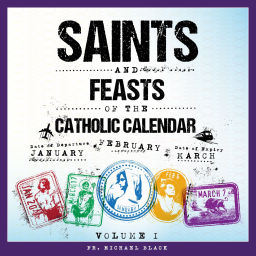
"Catholic Saints & Feasts" offers a dramatic reflection on each saint and feast day of the General Calendar of the Catholic Church. The reflections are taken from the four volume book series: "Saints & Feasts of the Catholic Calendar," written by Fr. Michael Black.<br /><br />These reflections profile the theological bone breakers, the verbal flame throwers, the ocean crossers, the heart-melters, and the sweet-chanting virgin-martyrs who populate the liturgical calendar of the Catholic Church.

Catholic Saints & Feasts
Claim This Podcastby Fr. Michael Black
Podcast Overview
"Catholic Saints & Feasts" offers a dramatic reflection on each saint and feast day of the General Calendar of the Catholic Church. The reflections are taken from the four volume book series: "Saints & Feasts of the Catholic Calendar," written by Fr. Michael Black.<br /><br />These reflections profile the theological bone breakers, the verbal flame throwers, the ocean crossers, the heart-melters, and the sweet-chanting virgin-martyrs who populate the liturgical calendar of the Catholic Church.
Language
🇺🇲
Publishing Since
1/5/2022
1 verified contact email on file for Catholic Saints & Feasts
Pitch yourself as a guest, propose sponsorships, or reach out directly to the host.
Recent Episodes

November 20, 2025
November 20: St. Bernward of Hildesheim, Bishop
November 20: Saint Bernward of Hildesheim, Bishop<br />c.960–1022 <br />Optional Memorial; Not on Universal Calendar; Liturgical Color: White <br />Patron saint of goldsmiths & architects <br /><br />A well-educated and pious bishop sponsors the practical arts <br /><br />Some doors in the city of Rome draw people in like huge vertical magnets, pulling groups of pilgrims slowly towards them across broad atriums. The dots of laser pointers dance over the doors of the Basilica of St. John Lateran as guides point and explain how these towering doors once swung open onto the Roman Curia, where senators in white togas stood debating matters of empire. The colossal, sober, bronze doors of the 2nd century Pantheon still hang from its jambs. And the large, intricate, wood paneled doors of Santa Sabina date from the 430s! The eyes of today’s saint, Bernward of Hildesheim, gazed up in wonder at these very same sets of doors when he visited Rome in the year 1001. And while he gazed, he also resolved to carry back just a bit of this Roman elegance, this Roman nobility, this Roman weight, to the cold land, to the far land, he had come from. <br /><br />St. Bernward of Hildesheim lived at the half-way point between us and Jesus Christ. His life spanned mankind’s crossing from the first to the second millennium. Bernward had an impeccable pedigree, with the branches of his noble family tree extending throughout lower Saxony, in today’s northern Germany. His family lineage, fine education, and personal piety opened doors of power and influence to him throughout his life. He was chosen as the tutor to the most important man of his time and place, Otto III, who became the Holy Roman Emperor. And he was appointed bishop of Hildesheim at a young age in 993 and remained in that position, and in that town, until he breathed his last thirty years later. <br /><br />Bernward lived long before the founding of the great universities of Europe, in an age when monasteries and cathedrals were Europe’s preeminent centers of learning. A cathedral school, in particular, was the equivalent of an elite prep school today. It was as important to a diocese as the cathedral itself. Bernward attended the cathedral school of Hildesheim as a youth long before becoming bishop of the same diocese. <br /><br />The academic theology done in Europe’s universities starting in the 1200s created a more disciplined and professional guild of theologians but moved theology to a neutral location. In Bernward’s more feudal age, men learned theology in the beating heart of the church, in the red-hot centers of prayer and apostolic activity where the faithful habitually gathered – in cathedrals and monasteries. Bishops, thinkers, and authors baptized babies, said funeral masses, anointed the sick, sang vespers, and led processions while also studying and writing. Their audience was the faithful. Their forum was the pulpit. University-based theology was severed from the great centers of spirituality so familiar to the first millennium. It was more scientific, yes, but also more dry. St. Bernward was a man of the first millennium. His public was not other academics but his happy people. His theology was both intellectual and practical, with church ideas and church life braided tightly together, as they should be. <br /><br />Bernward mastered the seven liberal arts common to his age and showed a keen interest in practical craftmanship. He was an energetic bishop who commissioned the building of castles, an abbey, and numerous decorative items for his churches. Inspired by his extended roman visit, he ordered a huge set of bronze doors for his cathedral, known as the Bernward doors. These commanding pieces of functional art, with their simple but expressive figures in deep relief, can still be admired today. They were not made of perishable material. They were made to last and have lasted for half the life of the church. <br /><br />St. Bernward’s kind disappeared with his...

May 29, 2024
May 31: Visitation of the Blessed Virgin Mary
May 31: Visitation of the Blessed Virgin Mary <br />Feast; Liturgical Color: White <br /><br />Two young mothers and their treasures meet <br /><br />Only in the Catholic Church would a Feast Day first celebrated in the thirteenth century be considered “new.” But that is when the Visitation first appeared in some liturgical calendars. Our oldest liturgical feasts date from the apostolic period. That is, they were likely celebrated by the Apostles themselves in the years immediately following the earthly life of Christ. The original historical events of Holy Thursday, Good Friday, and Easter Sunday transformed into liturgical events so rapidly and so naturally that the earliest Christian writings are of a liturgical nature. Other Feast Days, such as Christmas, Mary the Mother of God, and the Birth of John the Baptist had to wait their turn. They are ancient but cede pride of place to the foundational events of Holy Week, just as America’s Presidents’ Day must cede to the more essential Independence Day. Without a country, there would no presidents, and without a death and resurrection, there would be no Christianity or Christian calendar in the first place. <br /><br />The Visitation falls, liturgically, when it happened historically. Mary conceived Jesus Christ in late March. Saint John the Baptist was born in late June. And it was between these two bookends that pregnant Mary visited her pregnant cousin Elizabeth. Perhaps it was in late May. We may be surprised in heaven to discover that many of our biblically based feast days are commemorated on the exact historical dates they occurred. Would God deceive us otherwise? After all, no good father would tell the family to celebrate his son’s birthday on a date other than when he was born. <br /><br />It is the Gospel of Saint Luke that recounts for us so many details of Mary’s life that otherwise remain untold. Saint John writes at the end of his Gospel that Jesus did and said many other things which are not written down. Perhaps the same could be said of Mary. Many words were spoken, gestures made, and events transpired, yet so much remains a mystery. Yet if we knew all there was to know about God and the things of God, then heaven would be a bore and not be heaven at all. <br /><br />The Visitation is the first time that Mary publicly exercises her role as Mediator of the Son of God. God chose not only to become a man but to become such in the same way that all men do, through gestation and birth, with His virginal conception the sole miracle. Catholicism is a religion that believes in secondary causality. God directly intervenes in creation only rarely, instead inviting His creatures to perfect His raw creation by using their God-given talents. God did not cure the cancer. The skilled surgeon removed the tumor. He used the gifts God gave him. It was not a direct intervention. It was not a miracle. It was the doctor’s mind and hands being put to their highest use. Mary generously mediated the Incarnation, placing her body at God’s disposition. She, the Mother of the Church, carries the entire Church in her womb. She, the Ark of the Covenant, houses a treasure more precious than Moses’ stone tablets of old. And she, the Morning Star, shines in the blackness before the blazing sun rises in the east, dawning a new day. <br /><br />Christ’s presence in Mary’s womb radiates outward with x-ray power and reverberates in the words of faith which arise from Elizabeth and her child, John. Jesus’ cousin leaps for joy inside his mother. And Elizabeth reacts by speaking those graceful words, which countless voices will go on to pray, in countless languages, many billions of times in the centuries since and in the ages to come: “Blessed are you among women, and Blessed is the fruit of thy womb.” The Visitation is one of the sources of the Hail Mary. <br /><br />Elizabeth is a prophet. We are her hearers. For a prophecy to be a prophecy, it has to become true. Elizabeth’s words were true and are true. Mary is indeed blessed among women, and her fruit has indeed changed the world. Mary’s humility instinctively deflects. She praises the source of all goodness, God, rather than the goodness of her own generosity. All things, save evil, can be traced back to God. Mary is at the head of the trail in clearing the tangled path overgrown since the sin of Eve. With mankind close behind, Mary leads us back to discover anew the source of all truth, goodness, and beauty.<br /><br />Mary and Elizabeth, your generosity in cooperating with God’s will initiated the events of the New Testament. May we be equally generous in cooperating with God’s plans for our lives, knowing the beginning but not the end, lighting a fire that warms the lives of unknown others.
May 13, 2024
test audio
274 total episodes available
Similar Podcasts
Discover related shows you might enjoy

The Saints
The Merry Beggars

Catholic Saints
Augustine Institute

Bishop Barron’s Sunday Sermons - Catholic Preaching and Homilies
Bishop Robert Barron

Saints Alive Podcast
Saints Alive

The Thomistic Institute

Pints With Aquinas
Matt Fradd

The Word on Fire Show - Catholic Faith and Culture
Bishop Robert Barron

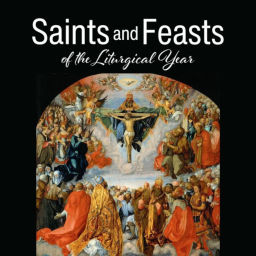
Saints & Feasts of the Liturgical Year
My Catholic Life!

The Rosary with Bishop Robert Barron
Bishop Robert Barron

Catholic Sprouts: Daily Podcast for Catholic Kids
Nancy Bandzuch

Sunday Homilies with Fr. Mike Schmitz
Ascension

A Rosary Companion
The Communion of Saints

The Liturgy of the Hours: Sing the Hours
Paul Rose

St. Josemaria Institute Podcast
St. Josemaria Institute

The Rosary in a Year (with Fr. Mark-Mary Ames)
Ascension
Deep-dive analytics for Catholic Saints & Feasts
Frequently asked questions
Have a different question and can't find the answer you're looking for? Reach out to our support team by sending us an email and we'll get back to you as soon as we can.
- What is Catholic Saints & Feasts?
- How often does this podcast release new episodes?
This podcast updates daily.
- Where can I listen to this podcast?
This podcast is available on 10 platforms including Apple Podcasts, Spotify, and more. You can also use the RSS feed directly.
- Does this podcast accept guests?
Yes, this podcast regularly features guests.
Legal Disclaimer
Pod Engine is not affiliated with, endorsed by, or officially connected with any of the podcasts displayed on this platform. We operate independently as a podcast discovery and analytics service.
All podcast artwork, thumbnails, and content displayed on this page are the property of their respective owners and are protected by applicable copyright laws. This includes, but is not limited to, podcast cover art, episode artwork, show descriptions, episode titles, transcripts, audio snippets, and any other content originating from the podcast creators or their licensors.
We display this content under fair use principles and/or implied license for the purpose of podcast discovery, information, and commentary. We make no claim of ownership over any podcast content, artwork, or related materials shown on this platform. All trademarks, service marks, and trade names are the property of their respective owners.
While we strive to ensure all content usage is properly authorized, if you are a rights holder and believe your content is being used inappropriately or without proper authorization, please contact us immediately at hey@podengine.ai for prompt review and appropriate action, which may include content removal or proper attribution.
By accessing and using this platform, you acknowledge and agree to respect all applicable copyright laws and intellectual property rights of content owners. Any unauthorized reproduction, distribution, or commercial use of the content displayed on this platform is strictly prohibited.