
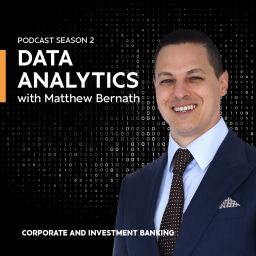
Data Analytics with Matthew Bernath
Claim This Podcastby Rand Merchant Bank
Podcast Overview
<p>Find out how decision makers are using data analytics to turn insights into action.</p> <p>RMB’s Head of Data Analytics, Matthew Bernath, talks to business leaders across sectors to explore how data analytics is being used to take the guess work out of decision making.</p>
Language
🇺🇲
Publishing Since
12/17/2020
1 verified contact email on file for Data Analytics with Matthew Bernath
Pitch yourself as a guest, propose sponsorships, or reach out directly to the host.
Recent Episodes
January 27, 2022
S2 / E5 The science behind precision retailing - Rand Merchant Bank (rmb.co.za)
<p>On this episode of the podcast series, we are joined by Chris Steyn, Shoprite Technology’s Head of Data Analytics. Serving over 24 million customers in nearly 3 000 stores, with in excess of 25 000 points of sale and 100 000 articles moving through these points, data presents very exciting opportunities for the Shoprite Group and the chance to execute their strategy of becoming <em>smarter</em>. From a data analytics perspective, Chris believes a focus on customer-centricity and the enablement of precision retailing is essential. Customers need to have a rewarding experience when they interact — is the product available, is the quality of the highest standard, is the pricing correct and the in-store experience enjoyable? With precision retailing, it’s all about infusing more science into the decision-making process such as inventory control, wastage and shrinkage, quality control on fresh produce etc. With so many moving parts, there are many opportunities to mine different data assets that currently exist within the organisation.</p> <p>In order for data to be collected and made useable, many years have been spent on standardising the data pipelines to ensure they are complete, timeous and of a high quality. This led to a data bulk architecture with different channels, exposing more data assets to more of the organisation. ShopriteX is a new digital innovation unit that aims to marry data science, technology and talent with customer-focus at its core; consolidating all the business entities with an emphasis on commerce, rewards, and personalisation.</p> <p>The focus for retail is the evolution of customers from single to multi-channel and how this activity is tracked and monitored. Location analysis, the introduction of augmented reality in different forms, and the concept of customer offer engines are very important. The old systems targeted the masses, whereas now it’s all about tailoring to the individual customer needs and desires. Shoprite continues to invest more in outside intelligence, and favours an ecosystem where exploration, ideation, research and experimentation is encouraged. They have a saying – productionise your curiosity; create a workforce that is challenging every single norm that exists within the current landscape. For organisations going forward, Chris feels it’s all about investment in human talent and potential and creating an environment where people can be informed, educated and inspired.</p><p>See <a href="https://omnystudio.com/listener">omnystudio.com/listener</a> for privacy information.</p>
January 27, 2022
S2 / E6 How fintechs use data for innovation - Rand Merchant Bank (rmb.co.za)
<p>On today’s episode of the podcast series, we’re joined by RMB’s Head of Telecommunication, Media & Technology Advisory, Arun Varughese. There is so much happening in the payments landscape, and not many people are aware of the plumbing that exists behind contactless payments. It may happen in mere seconds, but is actually a very complex web of electronic communication both locally and internationally.</p> <p>Cash is still dominant in Africa and South Africa; 60% of payments are made using physical cash, so the market for card payments and alternative fintechs is massive. The proliferation of smartphones using digital wallet services such as Apple Pay, has enabled consumers to pay for things in a much more convenient manner. Around the world there are payment options such as WeChat, Alipay, PayPal and ever-growing cryptocurrency solutions. With all this innovation and change occurring, there is a trend of moving towards financial inclusion for most of the planet, and the move away from cash is really going to be driving it.</p> <p>Data is now very much at the fore; within banks there’s a lot of analysis of consumer behaviour, such as where you swiped your card, what you purchased, how often you shop etc. When you tie that up with things such as location data, even from an economic and aggregate perspective, you can see with real-time data which direction the economy is moving.</p> <p>A new development on South African shores is ‘Buy Now Pay Later’ – a method of payment that’s a direct replacement for credit cards, where everyone benefits – the fintech, the consumer, and the merchant. This system allows one to borrow money on an interest-free basis over a period of time, where you can opt to pay it back in equal installments over a 4-8 week period. It’s a very real threat to traditional banking where interest is made on credit cards and fees. It’s a closed-loop system – the data is extremely valuable; fintechs can build up a much clearer picture of their customers, allowing them to target better products and services.</p> <p>From an advisory perspective, Arun’s role is to consult players in the value chain on a variety of choices, particularly around capital and how to expand their businesses. As a bank, RMB hopes to grow with their clients in this increasingly active space.</p><p>See <a href="https://omnystudio.com/listener">omnystudio.com/listener</a> for privacy information.</p>
January 27, 2022
S2 / E4 Alternative data: beyond the balance sheet - Rand Merchant Bank (rmb.co.za)
<p>Patrice Rassou, Ashburton Investments’ CIO joins us on this episode of the podcast series. The investment industry is very familiar with the processing and extraction of data in order to make investment decisions. A few decades back this was largely a manual process; now data is available in a digital format with quite a lot of history, allowing for spreadsheets to be built rapidly. There are also alternative sources of data available to triangulate forecasts with what industry experts are saying, thereby improving the quality of these forecasts and also the quality of valuations.</p> <p>There’s a lot of raw data available, but the real issue is how easy or difficult it is to arrange and process that data in order to be able to extract signals, and how useful these are from a predictive viewpoint. To explore these signals in financial markets, Patrice believes you need to see whether there are relationships that you can observe, and are these persistent and significant enough to make money out of. The volume of data, which is into the billions, really shows that there is a vast field to mine of both structured and unstructured data which requires a lot of computing power to handle the frequency and velocity. The key focus in financial markets now is getting the signals out of this noise. The differentiating factor is making sense of the relationships, and ensuring the data will have a lasting impact that can be explored long-term.</p> <p>What is alternative data? Instead of using traditional financial information, there has been a whole industry that has sprung up with a swathe of available data. Some examples are satellite imagery that gives data on mobility, traffic outside of shopping malls, ships piling up outside of ports, trucks coming in and out of factories and so forth. There are also social media indicators allowing you to pick up whether your average person is feeling more bullish or more bearish; what their type of buying habits are, what interests them in terms of financial markets chatter, etc. Alternative data used to be quite costly to collect and difficult to integrate, where increasingly there are providers who supply these alternative sources of data, sometimes to the highest bidder to avoid overcrowding.</p> <p>The world of financial analysis has really evolved from being one driven by humans, to having machines and very sophisticated quantity processes able to handle and analyse huge amounts of data and deliver returns; one Patrice feels is a race between man and machine.</p><p>See <a href="https://omnystudio.com/listener">omnystudio.com/listener</a> for privacy information.</p>
18 total episodes available
Deep-dive analytics for Data Analytics with Matthew Bernath
Frequently asked questions
Have a different question and can't find the answer you're looking for? Reach out to our support team by sending us an email and we'll get back to you as soon as we can.
- What is Data Analytics with Matthew Bernath?
<p>Find out how decision makers are using data analytics to turn insights into action.</p> <p>RMB’s Head of Data Analytics, Matthew Bernath, talks to business leaders across sectors to explore how data analytics is being used to take the guess work out of decision making.</p> - How often does this podcast release new episodes?
This podcast updates inactive.
- Where can I listen to this podcast?
This podcast is available on 2 platforms including Apple Podcasts, Spotify, and more. You can also use the RSS feed directly.
- Does this podcast accept guests?
Information about guest appearances is not available.
Legal Disclaimer
Pod Engine is not affiliated with, endorsed by, or officially connected with any of the podcasts displayed on this platform. We operate independently as a podcast discovery and analytics service.
All podcast artwork, thumbnails, and content displayed on this page are the property of their respective owners and are protected by applicable copyright laws. This includes, but is not limited to, podcast cover art, episode artwork, show descriptions, episode titles, transcripts, audio snippets, and any other content originating from the podcast creators or their licensors.
We display this content under fair use principles and/or implied license for the purpose of podcast discovery, information, and commentary. We make no claim of ownership over any podcast content, artwork, or related materials shown on this platform. All trademarks, service marks, and trade names are the property of their respective owners.
While we strive to ensure all content usage is properly authorized, if you are a rights holder and believe your content is being used inappropriately or without proper authorization, please contact us immediately at hey@podengine.ai for prompt review and appropriate action, which may include content removal or proper attribution.
By accessing and using this platform, you acknowledge and agree to respect all applicable copyright laws and intellectual property rights of content owners. Any unauthorized reproduction, distribution, or commercial use of the content displayed on this platform is strictly prohibited.