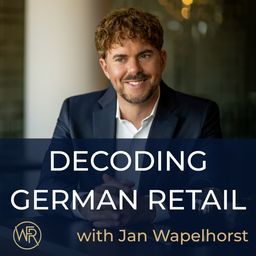
How global brands win in European trade.Starting with Germany's toughest market.What does it really take to get your product listed in German grocery retail? And what can the German market teach you about winning across Europe?The German grocery market is worth over 250 billion euros, controlled by five retail groups, and governed by unwritten rules that most international brands never learn — until it's too late.Decoding German Retail is hosted by Jan Wapelhorst, former buying director at EDEKA, REWE, and Lidl. After 16 years on the other side of the table, he now helps international food manufacturers navigate the complexities of German retail — from Category Management and listing negotiations to pricing architecture and trade spend.Each episode decodes one specific mechanism of the German market. No theory, no fluff — just the insider perspective that buyers never share openly.Whether you're planning your market entry, preparing for a buyer meeting, or trying to understand why your product keeps getting rejected — this podcast gives you the answers you won't find anywhere else.New episodes bi-weekly.Website: wfr-advisory.comContact: info@wfr-advisory.comLinkedIn: Jan WapelhorstAuthor: Jan WapelhorstLanguage: English
The countdown is over. The invitations went out three weeks ago. The first calendar slots are booked. The autumn phase of the German annual negotiation season is live. And most international suppliers still believe the negotiation is a meeting. A room with a spreadsheet, a buyer, and a coffee cup. It is not.
The annual negotiation is a sequence of parallel processes that runs inside a German retail headquarters for about eight weeks straight, and only about twenty percent of it happens in the room the supplier is sitting in. This episode maps the other eighty percent through five signals that shape every autumn meeting before the door opens.
Signals covered: the budget that just landed on your buyer's desk and how the two-to-three-percent margin target rewrites the room; the category review committee in the room next door and how listing decisions get made without you; the regional layer that centralized-market playbooks completely miss; the silent delisting tracker and the three internal signals that reveal whether your brand is on it; and the autumn framework letter being drafted right now, which most suppliers dismiss as generic and which is in fact the published map of the coming negotiation.
Closes with a single takeaway. The German autumn negotiation is not decided in the meeting, it is confirmed there. Preparation has to address the five parallel processes running around the room, or it misses the actual decision moment.
8 Sept 2026
SESSION 05: DIE DREI SÄTZE
Companion Brief zur Reihe: insights.wfr-advisory.com (http://insights.wfr-advisory.com)
Vernetze dich mit Jan Wapelhorst auf LinkedIn für regelmäßige Einblicke in den deutschen Handel.
Website: wfr-advisory.com (http://wfr-advisory.com)
E-Mail: info@wfr-advisory.com (mailto:info@wfr-advisory.com)
25 Aug 2026
SESSION 04: RUNDGANG DURCH EINE HANDELSZENTRALE
Companion Brief zur Reihe: insights.wfr-advisory.com (http://insights.wfr-advisory.com)
Vernetze dich mit Jan Wapelhorst auf LinkedIn für regelmäßige Einblicke in den deutschen Handel.
Website: wfr-advisory.com (http://wfr-advisory.com)
E-Mail: info@wfr-advisory.com (mailto:info@wfr-advisory.com)
Contact Decoding German Retail
Guest appearances
Does not typically book guests
Based on episode analysis; this does not confirm that the show is currently accepting guests.
Pod Engine is an independent podcast discovery and analytics service and is not affiliated with or endorsed by this podcast. Artwork and show content belong to their owners. Full legal notice.
Explore this show Podcast research with Pod Engine