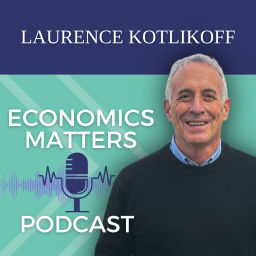
Economics Matters is a podcast hosted by Professor Laurence Kotlikoff, one of the most influential economists in the world, a Global Economics Advisor, NY Times Best Selling Author, President of Economic Security Planning, Inc., and Director of the Fiscal Analysis Center. In each episode, Professor Kotlikoff talks to experts about the power of economics in our modern day society. From personal finance and fiscal policy, to social security and income inequality, Economics Matters delves into much of the economic challenges of modern society.

Economics Matters with Laurence Kotlikoff
Claim This Podcastby Economics Matters
Podcast Authority
Beta
Podcast Overview
Economics Matters is a podcast hosted by Professor Laurence Kotlikoff, one of the most influential economists in the world, a Global Economics Advisor, NY Times Best Selling Author, President of Economic Security Planning, Inc., and Director of the Fiscal Analysis Center. In each episode, Professor Kotlikoff talks to experts about the power of economics in our modern day society. From personal finance and fiscal policy, to social security and income inequality, Economics Matters delves into much of the economic challenges of modern society.
Language
🇺🇲
Publishing Since
9/9/2023
Unlock The Full Podcast Authority Score Report
See how your podcast performs across key metrics
Podcast Authority
Beta
Recommendations available
Unlock the full report to see detailed tips
Unlock comprehensive insights including:
- • YouTube presence analysis
- • Social media reach metrics
- • RSS compliance scoring
- • Podcast 2.0 features
- • Technical standards
Detailed Analytics
- Complete breakdown of all 19 authority metrics
- Personalized recommendations for each metric
- Industry benchmarks and comparisons
- Technical RSS feed analysis and compliance scoring
Growth Strategies
- Step-by-step action plans for improvement
- Quick wins to boost your score immediately
- Pro tips from successful podcasters
See how your show performs across every key metric
High authority scores make your podcast more attractive to industry leaders and influencers who want to appear on credible shows.
Sponsors look for podcasts with proven authority and engagement. Your score demonstrates your podcast's value to potential partners.
Understanding your strengths and weaknesses helps you make data-driven decisions to expand your listener base effectively.
1 verified contact email on file for Economics Matters with Laurence Kotlikoff
Pitch yourself as a guest, propose sponsorships, or reach out directly to the host.
Recent Episodes

June 25, 2026
The Man Who Turned Down $1.3 Million to Stay in School — And Changed Medicine Forever
<p><strong>What does it actually take to solve a scientific puzzle that stumped researchers for fifty years — and why are the same AI tools that cracked it still getting basic financial math catastrophically wrong?</strong></p><p>In 2024, Demis Hassabis won the Nobel Prize in Chemistry for something that sounds almost too ambitious to be real: teaching artificial intelligence to predict the three-dimensional shape of any protein, a problem that had resisted traditional science for half a century. The breakthrough, called AlphaFold, has already mapped over 200 million proteins, a feat with profound implications for how we understand and treat disease.</p><p>In this episode, Larry Kotlikoff sits down with <strong>Sebastian Mallaby</strong>, the New York Times bestselling author and veteran journalist behind The Infinity Machine, his deeply reported new biography of Hassabis and the rise of DeepMind. Mallaby walks through the improbable arc of Hassabis's career - from chess prodigy to video game programmer to the architect of some of the most consequential AI breakthroughs of the last decade. Then turns to a sharper, more urgent question: what can AI actually be trusted to get right, and where does it quietly, confidently fail?</p><p><br></p><p><strong>What You'll Learn:</strong></p><ul><li><strong>[00:32:01] The $1.3 million check Demis Hassabis turned down</strong> — and why he chose to study computer science instead of cashing in on his teenage video game fortune</li><li><strong>[00:33:00] Why AI was considered a dead field as recently as 2012</strong> — and how Hassabis convinced Peter Thiel to fund a company built on a technology that, at the time, couldn't do much of anything</li><li><strong>[00:34:05] What "agentic AI" actually means</strong> — and how DeepMind's early systems learned to master Atari games through pure trial and error, years before "agentic" became a buzzword</li><li><strong>[00:35:08] Reinforcement learning vs. deep learning, explained simply</strong> — the difference between an AI that learns from reading and one that learns from doing</li><li><strong>[00:43:56] How neural networks actually work</strong> — a plain-language breakdown of "weights," layers, and how a system tweaks itself toward a correct answer through millions of small adjustments</li><li><strong>[00:41:00] Why AI is fundamentally inductive, not deductive</strong> — and why that distinction explains both its remarkable strengths and its most dangerous blind spots</li><li><strong>[01:04:57] How AlphaFold's protein-folding breakthrough connects directly to disease research</strong> — including new frontiers in understanding conditions like Parkinson's</li><li><strong>[01:05:59] Inside Isomorphic Labs</strong> — Hassabis's newest venture, aimed at using AI to dramatically accelerate (not replace) the drug discovery pipeline</li><li><strong>[01:16:00] Why AI tools are getting deterministic financial questions wrong</strong> — Larry's own real-world tests show major AI models disagreeing wildly on life insurance needs, optimal savings, and Roth conversion strategy, even though these problems have one mathematically correct answer</li><li><strong>[01:12:43] What this means for the future of work</strong> — a candid exchange on AI adoption timelines, productivity's "jagged edge," and whether human labor markets have time to adjust</li></ul><p><strong>Sebastian Mallaby</strong> is an award-winning journalist and author of six books, including the New York Times bestseller The Infinity Machine: How an AI Pioneer Reshaped the Future, as well as The Power Law: Venture Capital and the Making of the New Future and More Money Than God. A former correspondent for The Economist and longtime member of the Washington Post editorial board. He co-hosts the podcast The Spillover with Rebecca Patterson of the Council on Foreign Relations.<br></p><ul><br></ul>

June 25, 2026
The Regime We Were Supposed to Topple Just Got Stronger
<p><strong>What if everything you've been told about the new Iran deal — and what "winning" the war even meant — is built on a comparison that doesn't hold up, and a strategic outcome that's the opposite of what most commentators are claiming?</strong></p><p>A 14-point memorandum is about to be signed in Switzerland, and the headlines are already calling it weaker than the 2015 Obama-era nuclear deal that Trump once tore apart. But according to <strong>Adam Garfinkle </strong>-<strong> </strong>veteran foreign policy analyst, former editor of The American Interest, and author of the forthcoming book The Age of Spectacle - that comparison is fundamentally misleading. The real story is stranger, more consequential, and far more relevant to your daily life than a nuclear negotiation: it's about what happens to a society that has stopped reading, stopped distinguishing fantasy from fact, and is now heading into midterm elections where the rules themselves may not hold.</p><p>In this episode, Alex Kotlikoff sits down with Garfinkle to unpack the actual strategic outcome of the Iran conflict, why the regime may have emerged stronger rather than weaker, and how a deeper cultural shift (one Garfinkle has spent a career studying) is reshaping American democracy itself.</p><ul><li><strong>[00:02:22] Why comparing this new Iran deal to the 2015 JCPOA is misleading</strong> — the contexts are not remotely the same, and treating them as equivalent distorts the real picture</li><li><strong>[00:06:39] How the Iranian nuclear program was actually crippled</strong> — not in the recent skirmishes, but in the "12-day war" of June 2025</li><li><strong>[00:09:13] The unintended consequence of targeting Iran's senior leadership</strong> — how the strikes may have produced a more nationalistic, more competent, and more entrenched regime rather than a weaker one</li><li><strong>[00:10:39] The psychological effect on ordinary Iranians</strong> — why surviving a massive US-Israeli attack has pushed many toward resignation rather than rebellion, delaying any hope of internal regime change</li><li><strong>[00:13:01] The "balance of interests vs. balance of power" principle</strong> — why raw military superiority doesn't determine outcomes, and how this echoes a lesson from Vietnam</li><li><strong>[00:29:00] Introducing "The Age of Spectacle"</strong> — Garfinkle's framework for understanding how digital technology is replacing shared reality with personalized fantasy</li><li><strong>[00:34:01] The "first post-literate American war"</strong> — how declining literacy has fundamentally changed the way Americans understand conflict, politics, and the world around them</li><li><strong>[00:40:28] The literacy statistic that explains a lot more than you'd think</strong> — an estimated 50-60% of American adults read at a sixth-grade level or below</li><li><strong>[01:04:00] What could happen to the 2026 midterms</strong> — the scenarios Garfinkle considers most plausible, including legal challenges to majority-minority districts and pressure campaigns at the local level</li><li><strong>[01:05:05] A possible fix already proven at the state level</strong> — how California depoliticized redistricting, and why Garfinkle supports a constitutional amendment banning gerrymandering nationwide</li></ul><p><strong>Adam Garfinkle</strong> is a veteran international affairs analyst and writer, formerly the founding editor of The American Interest and a longtime contributor to U.S. foreign policy discourse. He publishes regularly on Substack at <strong>The Raspberry Patch</strong>, where he has written extensively on the Iran conflict since its outset. His forthcoming book, The Age of Spectacle, examines how communications technology has reshaped American political consciousness from the Korean War to the present day.</p><ul><li><a href="https://adamgarfinkle.substack.com/" target="_blank">The Raspberry Patch</a> — Adam Garfinkle's Substack, including his ongoing series of essays on the Iran war</li><li><strong>The Age of Spectacle</strong> — Garfinkle's forthcoming book on media, technology, and the erosion of shared reality (publication details pending)</li><li><strong>"</strong><a href="https://think.kera.org/2024/11/06/some-top-college-students-cant-get-through-a-novel/" target="_blank">Why Elite College Students Can't Read Whole Books</a><strong>"</strong> — referenced Atlantic article by Rose Horowitch on declining literacy among university students</li></ul><p>What You'll Learn in This EpisodeFeatured GuestResources Mentioned</p>

June 9, 2026
The $83 Billion Scam Hidden Inside Medicare (And the Economist Who Proved It)
<p>What if the system designed to protect your health in retirement was actually engineered (from the inside) to profit from keeping you confused, underserved, and locked out of the care you've already paid for?</p><p><br>You've spent decades paying into Medicare. You've done everything right. And yet, as you approach the years when healthcare matters most, the system greeting you on the other side is riddled with hidden traps, gaming, and a funding crisis that Washington refuses to look at directly.<br>In this episode, Professor Kotlikoff talks with his Boston University colleague Dr. Randy Ellis, one of the world's foremost health economists and the architect of the very risk-adjustment formula that determines how much the government pays your Medicare Advantage plan. He literally built it. And he's saying it's being exploited in ways that are costing taxpayers $83 billion a year, with your care hanging in the balance.<br><strong>Time Stamped Learnings:</strong></p><ul><li>[8:27] Why Medicare Advantage plans are paid billions more than they should be, and how insurance companies game the diagnostic coding system to pocket the difference</li><li>[9:00] The "cherry-picking" crisis nobody in Washington wants to admit: how private health plans are specifically designed to attract healthy enrollees and quietly push sick ones back into traditional Medicare</li><li>[10:24] Why the formula running your Medicare payments is 30 years old (built in the 1990s, implemented in 2002, and barely updated since) while insurance companies have decades of new data and technology to exploit every loophole</li><li>[23:00] What Europe is doing right, and why countries like the Netherlands, Germany, and Belgium are delivering better health outcomes at nearly half the cost per GDP</li><li>[41:14] The age-65 cliff that's trapping older Americans in jobs they don't want, just to hold onto insurance before Medicare kicks in, and a smarter way to phase that transition</li><li>[39:16]The Ellis Plan: a bold, practical reimagining of how America could restructure its entire healthcare system (without starting a political war)</li><li>[48:38] Why your kids and grandkids are the ones who will ultimately pay for every year we delay fixing this, and what the math actually looks like</li><li>[54:46] The risk adjustment fix that could make insurance companies actually want to enroll sick people AND save Medicare billions in the process</li></ul><p><br><strong>Featured Guest</strong><br>Dr. Randy Ellis is a Professor of Economics at Boston University, Past President of the American Society of Health Economists, and author of more than 150 academic papers and reports. With over 11,000 Google Scholar citations, he is best known for developing the HCC Risk Adjustment Formula — the model used to calculate Medicare Advantage (Part C), Medicare Part D, and Obamacare marketplace payments. His current research, developed alongside collaborator Dr. Arlene Ash, proposes a modernized risk adjustment framework that could save the Medicare program $83 billion annually.<br><strong>What You Walk Away With</strong><br>America spends over 18% of its GDP on healthcare, and is on a trajectory toward 20%. Sweden spends 11% and ranks 4th in the world for health outcomes. We rank 21st. This is policy failure compounded by decades of inaction, gaming, and a political culture too proud to look abroad for better answers. If you're approaching Medicare age, actively enrolled, or simply trying to understand why your premiums keep rising faster than inflation — this conversation is essential listening.</p>
137 total episodes available
Recent guests on Economics Matters with Laurence Kotlikoff
Guests from recent episodes — sign up to see every guest that has ever appeared on this show.
Andrew Fesiak
Guest
Alex Kotlikoff
Guest
Wade Pfau
Guest
Kevin Esler
Guest
Glenn Loury
Guest
Martin Wolf
Guest
John Rutledge
Guest
Anders Åslund
Guest
Paulo Nogueira Batista
Guest
Jean Chatzky
Guest
Alan Gassman
Guest
Jay Abolofia
Guest
Similar Podcasts
Discover related shows you might enjoy

The Long View
Morningstar, Christine Benz - Director of Personal Finance and Retirement Planning, Ben Johnson - Head of Client Solutions, Amy Arnott - Portfolio Strategist

Macro Musings with David Beckworth
Mercatus Center at George Mason University

Bogleheads On Investing Podcast
bogleheads

Investing Insights
Morningstar, Ivanna Hampton, Sarah Hansen

EconTalk
Russ Roberts

Conversations with Tyler
Mercatus Center at George Mason University

Retire With Style
Wade Pfau & Alex Murguia

WashingtonWise
Charles Schwab

Masters in Business
Bloomberg

Odd Lots
Bloomberg

Moody's Talks - Inside Economics
Moody's Analytics

The Rational Reminder Podcast
Benjamin Felix, Cameron Passmore, and Dan Bortolotti

Money Stuff: The Podcast
Bloomberg

The Meb Faber Show
The Idea Farm

The Prof G Pod with Scott Galloway
Vox Media Podcast Network
Deep-dive analytics for Economics Matters with Laurence Kotlikoff
Frequently asked questions
Have a different question and can't find the answer you're looking for? Reach out to our support team by sending us an email and we'll get back to you as soon as we can.
- What is Economics Matters with Laurence Kotlikoff?
- How often does this podcast release new episodes?
This podcast updates bi-weekly.
- Where can I listen to this podcast?
This podcast is available on 9 platforms including Apple Podcasts, Spotify, and more. You can also use the RSS feed directly.
- Does this podcast accept guests?
Yes, this podcast regularly features guests.
Legal Disclaimer
Pod Engine is not affiliated with, endorsed by, or officially connected with any of the podcasts displayed on this platform. We operate independently as a podcast discovery and analytics service.
All podcast artwork, thumbnails, and content displayed on this page are the property of their respective owners and are protected by applicable copyright laws. This includes, but is not limited to, podcast cover art, episode artwork, show descriptions, episode titles, transcripts, audio snippets, and any other content originating from the podcast creators or their licensors.
We display this content under fair use principles and/or implied license for the purpose of podcast discovery, information, and commentary. We make no claim of ownership over any podcast content, artwork, or related materials shown on this platform. All trademarks, service marks, and trade names are the property of their respective owners.
While we strive to ensure all content usage is properly authorized, if you are a rights holder and believe your content is being used inappropriately or without proper authorization, please contact us immediately at hey@podengine.ai for prompt review and appropriate action, which may include content removal or proper attribution.
By accessing and using this platform, you acknowledge and agree to respect all applicable copyright laws and intellectual property rights of content owners. Any unauthorized reproduction, distribution, or commercial use of the content displayed on this platform is strictly prohibited.