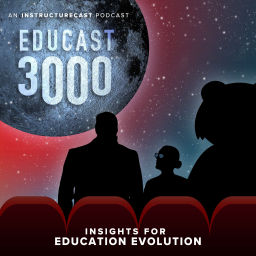
Ah, education…a world filled with mysterious marvels. From K12 to Higher Ed, educational change and innovation are everywhere. And with that comes a few lessons, too.
Each episode, EduCast3000 hosts, Melissa Loble and Ryan Lufkin, will break down the fourth wall and reflect on what’s happening in education – the good, the bad, and, in some cases, the just plain chaotic. This is the most transformative time in the history of education, so if you’re passionate about the educational system and want some timely and honest commentary on what’s happening in the industry, this is your show.
Subscribe wherever you listen to your podcasts and join the conversation! If you have a question, comment, or topic to add, drop us a line using your favorite social media platform.
Prompt-asic Park: How 22 College Campuses Scaled GenAI Without Losing Control
Hosts Melissa Loble and Ryan Lufkin are joined by Dr. Leslie Kennedy, Assistant Vice Chancellor for Academic Technology Services at the California State University Office of the Chancellor, where she co-leads the academic side of the CSU's system-wide generative AI initiative. Kennedy's team gave every CSU campus access to an enterprise AI environment, built the CSU AI Commons, and surveyed the system about how people are actually using AI. She talks with Melissa and Ryan about what the survey found, what it missed, and why she feels bad for her students with AI stress.
In this episode:
Kennedy's path from linguistics to ed tech, by way of five years at WebCT
Why portfolios stuck and micro-credentialing hasn't yet
The equity problem that led the CSU to buy AI for everyone
What the system-wide survey showed about student and faculty use
The question the survey didn't capture: am I allowed to use this in this class?
What faculty say they need, starting with assessment help
Why administrators have a harder time admitting they're lost
Kennedy on leaning in while the headlines call for tapping the brakes
For further reading:
CSU AI Commons: https://genai.calstate.edu/ (https://genai.calstate.edu/)
Faculty AI Showcases: https://genai.calstate.edu/communities/faculty/csu-artificial-intelligence-educational-innovations-challenge-award-showcases?combine=literacy&combine_1=&field_campus_target_id=All (https://genai.calstate.edu/communities/faculty/csu-artificial-intelligence-educational-innovations-challenge-award-showcases?combine=literacy&combine_1=&field_campus_target_id=All)
CSU Systemwide AI Advisory Committee: https://genai.calstate.edu/about/systemwide-generative-ai-advisory-committee (https://genai.calstate.edu/about/systemwide-generative-ai-advisory-committee)
CSU AI Workforce Acceleration Board: https://genai.calstate.edu/about/workforce-acceleration-board (https://genai.calstate.edu/about/workforce-acceleration-board)
22 Sept 2026
The Skills-Based Redemption: Upgrading Badges into Real HR Currency
Sean Murphy, director of workforce and post-secondary pathways at the Bipartisan Policy Center, joins hosts Ryan Lufkin and Tracy Weeks for a conversation about why the handoff between education and employment still breaks down, and what it would take to fix it. Sean has worked the same problem from four seats: a local workforce board, staff jobs for a US senator and a governor, corporate philanthropy at Walmart, and now federal policy. Together they get into the four parts of a talent system that actually functions, why data built for compliance fails the people it's meant to serve, what digital credentials still leave out, and what institutions can start on now instead of waiting on legislation.
In this episode:
Why silos are normal and bridges, not demolition, are the goal.
The four moving parts of a working system: demand, recognition, gaps, and matching.
How data built for compliance fails the workers and employers it's supposed to serve.
Why most digital badges carry only a school name, a program name, and a date.
Sean's own transcript: three remarkable quarters, recorded as 15 credits each.
What skills-based hiring got wrong, and why a degree stays legally defensible.
Skills as a language of learning, employment, and service, not a degree replacement.
The people the system forgets: everyone between school and unemployment.
One thing a registrar or CTE program can start on this semester.
For further reading:
https://bipartisanpolicy.org/hub/ai-and-workforce-navigator/ (https://bipartisanpolicy.org/hub/ai-and-workforce-navigator/)
https://bipartisanpolicy.org/report/a-nation-at-risk-to-a-nation-at-work-the-case-for-a-national-talent-strategy/ (https://bipartisanpolicy.org/report/a-nation-at-risk-to-a-nation-at-work-the-case-for-a-national-talent-strategy/)
8 Sept 2026
REPLAY: Psychometrics Reloaded
Most teachers will never meet a psychometrician, but every standardized test their students sit for went through one. Russell Ligon and Alexandra Lee do that work,, and in this replay hosts Ryan Lufkin and Melissa Loble ask them how they landed in a field almost nobody plans on, how assessment practice has shifted over their careers, and why the technical work behind a test decides whether it's fair to the student taking it.
In this episode:
Failure gets treated as the thing assessment exists to prevent, and the group argues it teaches more than a clean score ever does.
Accountability has moved from centralized to decentralized models, and with that came the expectation that a test be built against the standards of the state that adopted it rather than shipped intact from somewhere else.
Psychometricians are the reason a test can be called equitable, and Russell and Alexandra walk through the parts of the job that never show up on a score report, including how each of them found their way into it.
Assessment of learning, for learning, and as learning are three separate jobs, and a balanced system runs all three instead of asking one test to carry the whole picture.
Every assessment spends time that instruction could have used, and the group is direct about that trade instead of treating more student data as free.
Validity holds the whole structure up, because a test without it still measures something, just not what anyone needed to know, and a teacher who doesn't trust the instrument won't act on what it tells them.
What comes next in assessment turns less on new technology than on whether the culture around testing lets a test show real growth, and the conversation closes on where AI fits into that.
Who has been a guest on Educast 3000
Names identified in recent episode analyses. Showing up to five guests.
Matt Winters
Dr Thomas Cavanagh
Dr Jocelyn Widmer
Glenda Morgan
Dr Tracy Weeks
Reach and audience
Public platform figures. Ratings count people who left a rating, not total listeners.
Apple Podcasts (US)
5.0 / 5
1 ratings
Spotify
5.0 / 5
1 ratings
Podcast Authority Score: 38 / 100
A composite of feed quality, social presence, YouTube performance and engagement. Read the methodology.
Quality
75
Social presence
0
YouTube
0
Engagement
0
Contact Educast 3000
Guest appearances
Books guests
Based on episode analysis; this does not confirm that the show is currently accepting guests.
Questions about Educast 3000
Who hosts Educast 3000?
Ryan Lufkin and Melissa Loble host the show. Published by InstructureCast.
How often do new episodes come out?
The show publishes daily, based on its RSS feed.
Does Educast 3000 take guests?
Yes. Guests have been identified in episode analyses.
Host of Educast 3000?
Claim your podcast to manage its listing and keep your show details accurate.
Pod Engine is an independent podcast discovery and analytics service and is not affiliated with or endorsed by this podcast. Artwork and show content belong to their owners. Full legal notice.
Explore this show Podcast research with Pod Engine