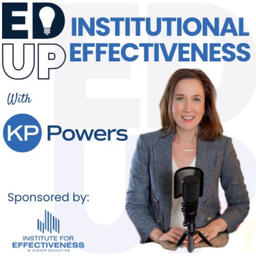
EdUp Institutional Effectiveness is a podcast for higher education leaders who want to understand what’s shaping institutional performance before it shows up in the numbers.
Hosted by Kristina 'KP' Powers, PhD, the show uses the Powers Index of College & University Performance™ to explore early signals of strength and strain across data, finance, governance, culture, and partnerships. Through conversations with practitioners, scholars, and select vendors, the podcast offers clear thinking, shared language, and practical insight to support better decisions and more effective leadership.
Lead With Candor: Cherron Hoppes, The Community Solution
Grounded in the Powers Index™ of College and University Performance (https://kppowers.com/powersindex/), this podcast explores what shapes institutional performance before it shows up in the numbers. Supported by the Institute for Effectiveness in Higher Education® (https://instituteforeffectiveness.org/) and hosted by Kristina 'KP' Powers, PhD (https://kppowers.com).
I sat down with The Community Solution Education System (https://www.tcsedsystem.edu/) Chief Academic Officer Dr. Cherron Hoppes (https://www.linkedin.com/in/cherronhoppes/), whose work spans six colleges and universities with programs ranging from osteopathic medicine and law to clinical psychology and early childhood education. Leaders will hear how student evidence, disciplined scale and candor at the executive level help an institution decide what to pursue and what to decline.
This series is designed for leaders, practitioners, and institutional partners committed to building learning systems that translate expertise into opportunity.
KEY INSIGHTS
After 14 years of enrollment decline at Golden Gate University, a student satisfaction survey showed that working adults could not predict the term in which their next course would run; a master schedule, outreach to recent stop-outs and a commitment to deliver courses on plan helped grow enrollment 40% within 4 years.
The same survey supported a decision to decline: students were dissatisfied with childcare yet rated it unimportant, which gave Cherron the evidence to decline trustees' proposals for a childcare center and keep capacity on the changes students valued most.
A new student information system across six institutions offers a clean slate for consistent business processes, which frees energy for the work that distinguishes each institution; data inform those choices, and the experts at the table decide.
Executives who present every initiative as a success lose the ability to call on colleagues, boards and resources, while leaders who name three areas that need work, along with a plan for each, build the trust that makes support possible.
Powers Index™ Signal(s) in Focus
Signal 4: Executive Leadership: the capacity of presidents and cabinets to anchor decisions in mission, state openly where the institution needs to improve and surround themselves with people whose expertise exceeds their own.
Signal 7: Regulatory: the ability to respond to shifting federal requirements that add reporting costs even as pressure to lower prices grows, starting every response from the best interest of students, including graduate students who need a clear path to finish without unmanageable debt.
Signal 12: Stewardship: the responsibility to direct limited people, dollars and attention toward the changes students identify as most important, including the evidence-based decision to decline an addition that would consume capacity without serving them.
Key Resources
KP on IE newsletter (on Substack) (https://kppowers.substack.com/)
Kristina 'KP' Powers, PhD — EdUp Institutional Effectiveness podcast host (https://kppowers.com)
Institute for Effectiveness in Higher Education® (https://instituteforeffectiveness.org/)
Powers Index of College & University Performance™ (https://kppowers.com/powersindex/)
13 Sept 2026
Program Data Into Decisions: Mark Koveleski, Gray DI
Grounded in the Powers Index™ of College and University Performance (https://kppowers.com/powersindex/), this podcast explores what shapes institutional performance before it shows up in the numbers. Supported by the Institute for Effectiveness in Higher Education® (https://instituteforeffectiveness.org/) and hosted by Kristina 'KP' Powers, PhD (https://kppowers.com).
I sat down with Gray Decision Intelligence (https://www.graydi.us) Vice President of New & Emerging Markets Mark Koveleski (https://www.linkedin.com/in/mark-koveleski-27396317), who spent nearly 18 years at the National Student Clearinghouse before helping colleges and universities put labor-market and outcomes data to work. Mark calls himself a sledgehammer rather than a chisel, and our conversation lands on what that asks of leaders: getting new information into the open and moving it toward a decision rather than leaving it in the drawer.
This series is designed for leaders, practitioners, and institutional partners committed to building learning systems that translate expertise into opportunity.
KEY INSIGHTS
Transparency and executive leadership move together, and the institutions set up for what is coming are the ones that bring new data into the open and act on it.
Introducing labor-market and program-outcome data can feel threatening to faculty; effective leaders disarm the defensiveness by making it about intellectual curiosity rather than a verdict on anyone's program.
Data used continuously across academic affairs, workforce, career services and marketing does far more than a portfolio review pulled off the shelf once a year.
Workforce Pell is coming, and the institutions leaning in now to connect programs to outcomes will be better positioned than the ones waiting to see whether it holds.
Powers Index™ Signal(s) in Focus
Signal 2: Transparency: whether leaders bring new financial and outcomes data into the open where more people can question and use it, instead of keeping it inside one office.
Signal 4: Executive Leadership: whether leaders respond to what the data shows and move it toward a decision rather than leaving it in the drawer.
Signal 10: Partners: whether a partner company like Gray helps a college get the right data to the people who must act on it.
Key Resources
KP on IE newsletter (on Substack) (https://kppowers.substack.com/)
Kristina 'KP' Powers, PhD — EdUp Institutional Effectiveness podcast host (https://kppowers.com)
Institute for Effectiveness in Higher Education® (https://instituteforeffectiveness.org/)
Powers Index of College & University Performance™ (https://kppowers.com/powersindex/)
23 Aug 2026
Two Kinds of Capacity: Yesenia Espinal, Espinal Advisory
Grounded in the Powers Index™ of College and University Performance (https://kppowers.com/powersindex/), this podcast explores what shapes institutional performance before it shows up in the numbers. Supported by the Institute for Effectiveness in Higher Education® (https://instituteforeffectiveness.org/) and hosted by Kristina 'KP' Powers, PhD (https://kppowers.com).
I sat down with Espinal Advisory & Analytics (https://www.espinaladvisoryanalytics.com/) Principal Consultant Yesenia Espinal (https://www.linkedin.com/in/yeseniaespinal/), who spent years leading institutional research and data analytics at Howard University before opening her own firm. She makes the case that capacity is two things and not one, staffing and structure, and that consolidating a sprawl of redundant reports can free the people an institution already has. If you have ever been told the only fix is more staff, this conversation offers a second answer.
This series is designed for leaders, practitioners, and institutional partners committed to building learning systems that translate expertise into opportunity.
KEY INSIGHTS
Capacity works two ways, staffing and structure. Consolidating redundant reports into a smaller, well-filtered set gives the same team room to do the work.
Institutions cannot automate their way around weak data foundations. AI exposes the gaps in data quality, governance, and reporting definitions rather than closing them.
Documentation and reconciliation are the unglamorous work that decides whether leaders can trust the numbers they are handed.
Institutional effectiveness leaders belong at the table before a system implementation begins, not after go-live, because they know which reports the institution cannot function without.
Powers Index™ Signal(s) in Focus
Signal 5: Operational Quality: the reliability of day-to-day execution and reporting operations that let an institution run without a few people working nights and weekends to hold it together.
Signal 3: Employee Expertise: the fluency and confidence of the people using institutional data, and the structure that turns existing staff into usable capacity.
Key Resources
KP on IE newsletter (on Substack) (https://kppowers.substack.com/)
Kristina 'KP' Powers, PhD — EdUp Institutional Effectiveness podcast host (https://kppowers.com)
Institute for Effectiveness in Higher Education® (https://instituteforeffectiveness.org/)
Powers Index of College & University Performance™ (https://kppowers.com/powersindex/)
Reach and audience
Public platform figures. Ratings count people who left a rating, not total listeners.
Apple Podcasts (US)
5.0 / 5
1 ratings
Contact EdUp Institutional Effectiveness
Guest appearances
Books guests
Based on episode analysis; this does not confirm that the show is currently accepting guests.
Host of EdUp Institutional Effectiveness?
Claim your podcast to manage its listing and keep your show details accurate.
Pod Engine is an independent podcast discovery and analytics service and is not affiliated with or endorsed by this podcast. Artwork and show content belong to their owners. Full legal notice.
Explore this show Podcast research with Pod Engine