
Ever wonder why you can't start that email, your kid melts down over homework, or some conversations feel impossible? It's Executive Functioning, the 9 brain skills running your life behind the scenes. Host Jamila Godfrey strips away clinical jargon to explore how we focus, plan, regulate, and connect. Real stories, practical strategies, honest conversations about what strengthens and challenges us. For anyone neurodivergent or neurotypical, parent or professional navigating the beautiful mess of being human. Build better brains, better connections, 1 conversation at a time as a real village.
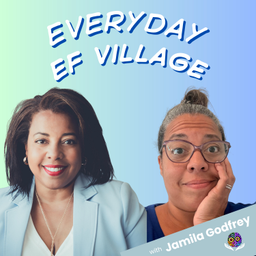
Everyday EF Village
Claim This Podcastby Jamila
7 episodes
Updated Daily
Accepts GuestsHas SponsorsLocation 🇨🇦
Podcast Overview
Ever wonder why you can't start that email, your kid melts down over homework, or some conversations feel impossible? It's Executive Functioning, the 9 brain skills running your life behind the scenes. Host Jamila Godfrey strips away clinical jargon to explore how we focus, plan, regulate, and connect. Real stories, practical strategies, honest conversations about what strengthens and challenges us. For anyone neurodivergent or neurotypical, parent or professional navigating the beautiful mess of being human. Build better brains, better connections, 1 conversation at a time as a real village.
Language
🇺🇲
Publishing Since
10/9/2025
Reach the team behind Everyday EF Village
Verified contact details for this show aren't on file yet — sign up to get notified when they land.
Recent Episodes
April 20, 2026
Cognitive Flexibility: The Art of Curiosity
<p>The skill I love most is the one that's always been hardest for me. And I think that's exactly why it matters. Of all nine executive functioning skills, <strong>cognitive flexibility</strong> is the one that gets more rigid the older we get, if we don't actively nurture it. </p><p>It's also the skill that sits at the root of almost everything: how we handle conflict, how we see other people's perspectives, how we show up under pressure when our brains want to default to the familiar. </p><p>In this episode, I'm getting personal. I'm talking about growing up being shuttled between homes after my parents split and how that didn't make me resilient the way people might assume. It made me stubborn. </p><p>I'm talking about not discovering my neurodivergence until much later in life, about being a first-generation daughter of an immigrant family, about the layers of lived experience that shaped how flexible, or inflexible my thinking was for a long time. </p><p>I introduce the <strong>Target Rings framework</strong>: your innerwork, your network, and your meaningful moments and how every person in every ring has quietly been building or eroding your cognitive flexibility your entire life. </p><p>I share a moment from a recent <strong>Capacity Under Pressure </strong>workshop that stopped me in my tracks: a white, middle-aged man from Alberta raised his hand and said, "I feel like you're speaking directly to my brain." And what that moment cracked open about the <strong>75% that connects all of us regardless of what our 25% looks like. </strong></p><p>I also share something harder. A family member who used a word I said at 10 years old as a weapon in a conversation decades later. My reaction. My depletion. And what I had to sit with afterward, because cognitive flexibility without honesty is just performance. </p><p>Here's what I know: the executive functioning skills are the 75% that every single one of us shares. Your brain has them. So does mine. So does the person across the table from you who sees the world completely differently. </p><p>And cognitive flexibility is the skill that makes it possible to find each other there, not by erasing the 25% of lived nuance that makes us who we are, but by getting curious about it instead of defensive. </p><p>This episode is for anyone who has ever gotten reactive and known it even as it was happening. Anyone who has felt unseen, misunderstood, or dismissed and then, in a harder moment, realized they were doing the same thing to someone else. The work is daily. It's messy. It's worth it. </p><p><u><strong>Topics covered:</strong></u></p><ul><li>What cognitive flexibility actually looks like from the inside out</li><li>The Target Rings framework: innerwork, network, and meaningful moments</li><li>Why rigidity is tied to our experiences and how to interrupt the pattern</li><li>The 75/25 framework: our shared brain skills vs. our lived nuance</li><li>Curiosity as the antidote to reactivity</li><li>Why kids are the best model for flexible thinking</li><li>The running analogy: how cognitive fitness gets built one rep at a time </li></ul><p>Jamila is the founder of Village of Play, a brain fitness and executive functioning organization based in Cochrane, Alberta. She works with children, adults, and corporate teams to strengthen executive functioning skills, build neuroscience-based learning habits, and develop communication frameworks that hold up under real pressure. Learn more at <a href="https://www.villageofplay.com/" target="_blank" rel="noopener noreferer"><strong>villageofplay.com</strong></a></p><p> #ExecutiveFunctioning #CognitiveFlexibility #BrainFitness #CapacityUnderPressure #Neuroscience #Leadership #MindsetWork</p>
February 6, 2026
Mentally Safe Coaching, Cognitive Flexibility and Building Resilience Through Sport
<p><strong>Summary</strong></p><p>In this episode, Jamila Godfrey and Certified Mental Performance Consultant and Member of the Canadian Sport Psychology Association Erin Brennan explore the importance of creating emotionally safe coaching environments that foster human connection and accountability. They discuss the skills learned through sports, the value of early exposure to different sports, and the significance of navigating failure to build resilience. The conversation emphasizes the need for a process-over-outcome mindset, the impact of communication, and the role of cognitive flexibility in youth development. They also touch on the importance of self-awareness and values in guiding decision-making and goal setting. In this enlightening conversation, Jamila and Erin explore the intersection of mental health and youth sports, emphasizing the importance of psychological safety, emotional regulation, and open communication. They discuss how cognitive flexibility can be nurtured through play, the critical role of adults in modeling emotional regulation, and the need for supportive environments for neurodivergent children. The dialogue also highlights the empowerment of girls in sports and the necessity of focusing on the process rather than just outcomes to foster resilience in youth.</p><p><strong>Takeaways</strong></p><ul><li>Emotionally safe coaching environments foster human connection.</li><li>Accountability is crucial for both athletes and coaches.</li><li>Multi-sport participation enhances adaptability and resilience.</li><li>Sports teach time management and teamwork skills.</li><li>Early exposure to various sports helps children find their passion.</li><li>Sitting in discomfort is essential for personal growth.</li><li>Focusing on the process rather than the outcome builds resilience.</li><li>Impact over intention encourages thoughtful communication.</li><li>Cognitive flexibility is a key skill developed through sports.</li><li>Values-driven behavior guides decision-making and goal setting. Kids often show initial apprehension but can quickly become engaged.</li><li>Fun should be a central focus in youth activities.</li><li>Cognitive flexibility is essential for growth and learning.</li><li>Creating psychologically safe environments enhances performance.</li><li>Emotionally regulated adults can positively influence children.</li><li>Open communication is crucial for youth mental health.</li><li>Advocacy for neurodivergent kids is essential in education.</li><li>Empowering girls in sports leads to greater equity.</li><li>Supporting youth in sports requires community involvement.</li><li>Focusing on the process over outcomes fosters resilience.</li></ul><p>For youth and adult practical, brain fitness skill-building workshops and programs, learn more at <a href="https://www.villageofplay.com/" target="_blank" rel="noopener noreferer">https://www.villageofplay.com/</a></p><p>To learn more about mental performance training for youth athletes, you can connect with Erin at mindovermatterperformance@gmail.com</p><p><br></p><p><strong>Warning:</strong> May include slight explicit language.</p><p>If you or someone you know is considering suicide or self-harm, or is anxious, depressed, upset or needs to talk, there are people who can help with confidential support across Canada:</p><p><strong>Call or text 988</strong> for immediate suicide crisis support, available 24 hours a day, 7 days a week, in English and French.</p><p><strong>Kids Help Phone</strong> offers free, confidential support for children, teens, and young adults. Call <strong>1-800-668-6868</strong> or text <strong>CONNECT to 686868</strong>.</p><p><strong>Talk Suicide Canada</strong> provides national support and resources. Call <strong>1-833-456-4566</strong> or text <strong>45645</strong> during evening hours.</p><p>If you or someone else is in immediate danger, call <strong>911</strong> or go to the nearest emergency department.</p><p><br></p><p></p><p></p>
November 30, 2025
Renewing Your Mind, Regulating Your Life, and Finding Your Village
<p>In this conversation, I reflect and explore the intersection of faith, emotional regulation, and community. Faith has been a foundational aspect of my life, akin to how others may rely on nature or philosophy or anything else that anchors you in life, and I ponder on how concepts of emotional regulation and executive functioning are deeply rooted in scripture, highlighting that practices like patience and peace are not inherent traits but skills developed over time. The importance of community in personal growth and emotional stability is critical in my life, and believe that isolation hinders our ability to thrive. Ultimately, the call is for all of us to use a holistic approach that integrates faith and neuroscience, encouraging all listeners to find your anchors and rebuild your communities.</p><p>Takeaways</p><ul><li>Faith is a foundational aspect of life.</li><li>Emotional regulation is a practice, not a trait.</li><li>Community is essential for personal growth.</li><li>Scripture and neuroscience complement each other.</li><li>Patience and peace are skills developed over time.</li><li>Isolation hinders emotional stability.</li><li>We need each other to thrive.</li><li>Spiritual and emotional lives are interconnected.</li><li>Connection is more important than conversion.</li><li>Small daily movements lead to significant change.</li></ul>
7 total episodes available
Deep-dive analytics for Everyday EF Village
Frequently asked questions
Have a different question and can't find the answer you're looking for? Reach out to our support team by sending us an email and we'll get back to you as soon as we can.
- What is Everyday EF Village?
- How often does this podcast release new episodes?
This podcast updates daily.
- Where can I listen to this podcast?
This podcast is available on 4 platforms including Apple Podcasts, Spotify, and more. You can also use the RSS feed directly.
- Does this podcast accept guests?
Yes, this podcast regularly features guests.
Legal Disclaimer
Pod Engine is not affiliated with, endorsed by, or officially connected with any of the podcasts displayed on this platform. We operate independently as a podcast discovery and analytics service.
All podcast artwork, thumbnails, and content displayed on this page are the property of their respective owners and are protected by applicable copyright laws. This includes, but is not limited to, podcast cover art, episode artwork, show descriptions, episode titles, transcripts, audio snippets, and any other content originating from the podcast creators or their licensors.
We display this content under fair use principles and/or implied license for the purpose of podcast discovery, information, and commentary. We make no claim of ownership over any podcast content, artwork, or related materials shown on this platform. All trademarks, service marks, and trade names are the property of their respective owners.
While we strive to ensure all content usage is properly authorized, if you are a rights holder and believe your content is being used inappropriately or without proper authorization, please contact us immediately at hey@podengine.ai for prompt review and appropriate action, which may include content removal or proper attribution.
By accessing and using this platform, you acknowledge and agree to respect all applicable copyright laws and intellectual property rights of content owners. Any unauthorized reproduction, distribution, or commercial use of the content displayed on this platform is strictly prohibited.