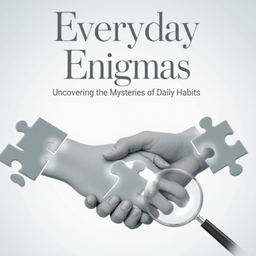
Explore the fascinating stories and science behind the habits we take for granted. From why we shake hands to the origins of saying 'bless you' after a sneeze, each episode uncovers the mysteries of our daily routines.

Everyday Enigmas
Claim This Podcastby Beata Malczak
Podcast Authority
Beta
Podcast Overview
Explore the fascinating stories and science behind the habits we take for granted. From why we shake hands to the origins of saying 'bless you' after a sneeze, each episode uncovers the mysteries of our daily routines.
Language
🇺🇲
Publishing Since
3/6/2025
Unlock The Full Podcast Authority Score Report
See how your podcast performs across key metrics
Podcast Authority
Beta
Recommendations available
Unlock the full report to see detailed tips
Recommendations available
Unlock the full report to see detailed tips
Unlock comprehensive insights including:
- • YouTube presence analysis
- • Social media reach metrics
- • RSS compliance scoring
- • Podcast 2.0 features
- • Technical standards
Detailed Analytics
- Complete breakdown of all 19 authority metrics
- Personalized recommendations for each metric
- Industry benchmarks and comparisons
- Technical RSS feed analysis and compliance scoring
Growth Strategies
- Step-by-step action plans for improvement
- Quick wins to boost your score immediately
- Pro tips from successful podcasters
See how your show performs across every key metric
High authority scores make your podcast more attractive to industry leaders and influencers who want to appear on credible shows.
Sponsors look for podcasts with proven authority and engagement. Your score demonstrates your podcast's value to potential partners.
Understanding your strengths and weaknesses helps you make data-driven decisions to expand your listener base effectively.
Reach the team behind Everyday Enigmas
Verified contact details for this show aren't on file yet — sign up to get notified when they land.
Recent Episodes

June 30, 2026
Why Do We Need Closure?
This episode explores why unfinished experiences stay in our minds long after they happen. The human brain naturally seeks complete stories with clear beginnings, middles, and endings. When relationships, conversations, or important events end without explanation, they create "open loops" that the brain continues trying to resolve—a phenomenon related to the Zeigarnik Effect. The episode explains how uncertainty is often more emotionally exhausting than painful truth because the brain constantly searches for missing answers and meaning. This is especially evident in unresolved relationships, unanswered messages, and unfinished conversations, where imagination fills the gaps with endless possibilities. It also explores how humans build their identities through personal narratives, making incomplete endings feel like unfinished chapters in the story of their lives. While people often believe closure must come from others, true psychological closure frequently comes from accepting that some answers may never arrive. Ultimately, closure is not about forgetting the past or having every question answered. It is about allowing an experience to find its place in our life story, so it becomes a completed chapter rather than an unfinished sentence that continues to shape the future.

June 22, 2026
Why Do We Smile at Strangers?
This episode explores why humans often smile at people they do not know. A smile functions as a micro-trust signal, helping reduce uncertainty during brief encounters with strangers. It communicates peaceful intentions, friendliness, and acknowledgment without requiring words. Humans evolved to quickly evaluate whether unfamiliar people are safe or potentially threatening. Smiles became an effective social tool because they are simple, universal, and easy to recognize. They help create a sense of safety and make interactions in shared spaces feel more comfortable. The episode also explains how smiles are contagious, influencing both the person giving the smile and the person receiving it. Even brief exchanges can strengthen feelings of connection and social belonging. Ultimately, smiling at strangers is more than a polite habit. It is an ancient social signal that helps build trust, ease tension, and remind people that they are part of a shared human community.

June 17, 2026
Why Do We Feel Embarrassed Alone?
This episode explores why people can feel embarrassed even when they are completely alone. Embarrassment evolved as a social emotion that helps humans maintain relationships and avoid behaviors that might harm their standing within a group. Because social acceptance was historically important for survival, the brain treats socially awkward moments as valuable lessons. Emotionally significant experiences are stored more strongly in memory, which is why embarrassing moments can resurface years later and still trigger the same uncomfortable feelings. The brain partially recreates the original emotional response, even though the event is long over. The episode also examines the spotlight effect, the tendency to overestimate how much other people notice and remember our mistakes. In reality, most people are focused on their own lives and rarely remember our embarrassing moments as clearly as we do. Ultimately, these memories persist because the brain is trying to learn and protect us. However, the fact that we cringe at old mistakes often means we have grown since then. The embarrassment is not evidence of failure—it can be evidence of personal development and self-awareness.
60 total episodes available
Deep-dive analytics for Everyday Enigmas
Frequently asked questions
Have a different question and can't find the answer you're looking for? Reach out to our support team by sending us an email and we'll get back to you as soon as we can.
- What is Everyday Enigmas?
- How often does this podcast release new episodes?
This podcast updates daily.
- Where can I listen to this podcast?
This podcast is available on 4 platforms including Apple Podcasts, Spotify, and more. You can also use the RSS feed directly.
- Does this podcast accept guests?
No, this podcast does not typically feature guests.
Legal Disclaimer
Pod Engine is not affiliated with, endorsed by, or officially connected with any of the podcasts displayed on this platform. We operate independently as a podcast discovery and analytics service.
All podcast artwork, thumbnails, and content displayed on this page are the property of their respective owners and are protected by applicable copyright laws. This includes, but is not limited to, podcast cover art, episode artwork, show descriptions, episode titles, transcripts, audio snippets, and any other content originating from the podcast creators or their licensors.
We display this content under fair use principles and/or implied license for the purpose of podcast discovery, information, and commentary. We make no claim of ownership over any podcast content, artwork, or related materials shown on this platform. All trademarks, service marks, and trade names are the property of their respective owners.
While we strive to ensure all content usage is properly authorized, if you are a rights holder and believe your content is being used inappropriately or without proper authorization, please contact us immediately at hey@podengine.ai for prompt review and appropriate action, which may include content removal or proper attribution.
By accessing and using this platform, you acknowledge and agree to respect all applicable copyright laws and intellectual property rights of content owners. Any unauthorized reproduction, distribution, or commercial use of the content displayed on this platform is strictly prohibited.