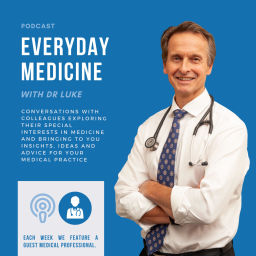
Podcast thumbnail for Everyday Medicine with Dr Luke

Everyday Medicine with Dr Luke

Claim This Podcast

by Dr Luke Crantock

5.0(10 reviews)
208 episodes
Updated Weekly
Accepts GuestsHas SponsorsLocation 🇦🇺
53

Podcast Authority

Beta
FairBased on show quality, social media presence, reviews, charts, and more
Pod Engine
Quality74
Social0
YouTube0
Engagement81

Podcast Overview

Conversations with colleagues exploring their special interests in medicine and bringing to you Insights, ideas and advice for your medical practice.

Language

🇺🇲

Publishing Since

8/28/2020

Unlock The Full Podcast Authority Score Report

See how your podcast performs across key metrics

53

Podcast Authority

Beta
FairBased on show quality, social media presence, reviews, charts, and more
Pod Engine
Quality74
Social0
YouTube0
Engagement81
6
Excellent Areas
3
Good Performance
10
Growth Opportunities
excellent
Episode Length
40 minutes
Performing excellently!
good
Publishing Consistency
Every 9 days

Recommendations available

Unlock the full report to see detailed tips

poor
Episode Thumbnails

Recommendations available

Unlock the full report to see detailed tips

+16 More Metrics

Unlock comprehensive insights including:

  • • YouTube presence analysis
  • • Social media reach metrics
  • • RSS compliance scoring
  • • Podcast 2.0 features
  • • Technical standards
What's Included in Your Full Report

Detailed Analytics

  • Complete breakdown of all 19 authority metrics
  • Personalized recommendations for each metric
  • Industry benchmarks and comparisons
  • Technical RSS feed analysis and compliance scoring

Growth Strategies

  • Step-by-step action plans for improvement
  • Quick wins to boost your score immediately
  • Pro tips from successful podcasters
Get your free podcast insights report

See how your show performs across every key metric

Instant delivery
No spam
Attract Better Guests

High authority scores make your podcast more attractive to industry leaders and influencers who want to appear on credible shows.

Secure Sponsorships

Sponsors look for podcasts with proven authority and engagement. Your score demonstrates your podcast's value to potential partners.

Grow Your Audience

Understanding your strengths and weaknesses helps you make data-driven decisions to expand your listener base effectively.

3 verified contact emails on file for Everyday Medicine with Dr Luke

Pitch yourself as a guest, propose sponsorships, or reach out directly to the host.

Recent Episodes

Episode thumbnail for Episode 190 - Pharmacological Treatments for Obesity with Dr Matthew Peverelle

June 22, 2026

Episode 190 - Pharmacological Treatments for Obesity with Dr Matthew Peverelle

<p>Australians who are either overweight or obese are increasingly turning to pharmacological approaches coupled with dietary measures to achieve their weight loss goals before considering bariatric surgery.</p><p>These therapies are typically considered for adults whose BMI’s are equal or above 30 kg/m2 or above 27 kg/m2 with associated comorbidities and include the following:</p><p>Incretin based therapies including dual incretin agonists (most effective)</p><p>Appetite suppressants-central acting drugs</p><p>Dopaminergic/opioid pathway modulation therapies</p><p>Nutrient absorption inhibition therapies</p><p>The most effective pharmacologic treatments available in clinical use are synthetic incretins. Natural incretins are gut derived hormones released after eating that enhance pancreatic insulin secretion in a glucose dependent manner.</p><p>Examples in clinical use include: Exenatide (Byetta), Semaglutide (Ozempic-approved for type 2 diabetes, Wegovy-approved for weight loss), Liraglutide (Saxenda with daily dosing). Another well-known GLP-1 is Dulaglutide (Trulicity).</p><p>When applied for weight loss Semaglutide and Liraglutide lead to 10-15% body weight reduction. Benefits beyond diabetes and weight loss include a 30% reduction in the risk of heart attacks and strokes. These drugs also show promise in treating conditions such as fatty liver disease, obstructive sleep apnoea, and kidney disease.</p><p>Side effects include nausea, vomiting, diarrhoea, gallstones and pancreatitis (0.2-0.3 % in most studies). They are contraindicated in patients with medullary thyroid cancer.</p><p>Another incretin in clinical practice is Gastric Inhibitory Polypeptide (GIP) also known as Glucose Dependent Insulinotropic Polypeptide.</p><p>The synthetic GIP receptor agonist in clinical use today is called Tirzepatide. When combined with GLP-1 receptor agonists, the combination greatly increases weight loss and improves glucose control. This combination is known as "twincretin" therapy and in clinical use for obesity is marketed as Mounjaro. Clinical trials demonstrate it producing 20-22% weight loss for patients.</p><p>Discontinuation rates for patients using incretin therapies for weight loss is quoted between 50-75 % in one year with factors including expense and side effects influencing this statistic. Recent data also points to significant weight regain over a two-year period after medication withdrawal.</p><p>The centrally acting appetite suppressants include Phentermine which is a sympathomimetic noradrenergic agent used short term over weeks-months and increases noradrenaline and dopamine in the hypothalamus to reduce appetite. These therapies can expect an 8-12 % weight loss.</p><p>Naltrexone combined with Bupropion acts on the POMC neurons reducing appetite and food cravings. Nausea, seizure activity and hypertension are side effects for a quoted 5-9 % weight loss.</p><p>Orlistat is a gastrointestinal fat absorption inhibitor inhibiting pancreatic lipase and decreasing fat absorption by about 30 %. Steatorrhea and loss of fat-soluble vitamins are side effects for only 3-5 % weight loss.</p><p>To discuss the application of these therapies in more depth we are joined by gastroenterologist Dr Matthew Peverelle. Matthew completed his advanced training in gastroenterology at Monash Health and Austin Health including the Victorian Liver Transplant Unit. He then continued his studies abroad completing a hepatology fellowship at the prestigious Kings College Hospital in London, subsequently he has developed a strong interest in both hepatology, luminal gastroenterology and Endo bariatrics.</p><p>Thank you for joining us as he brings his expertise to the next two podcast episodes.</p><p><strong>References</strong>: </p><ul><li><a href="https://www.gihealth.com.au/dr-matthew-peverelle⁠ " target="_blank" rel="ugc noopener noreferrer">Matthew Peverelle</a> </li><li>Australian Family Physician, Pharmacotherapy for obesity, Lee &amp; Dixon Vol 46,7, July 2017 </li><li><a href="https://www.niddk.nih.gov/" target="_blank" rel="ugc noopener noreferrer">Niddk.nih.gov </a></li><li><a href="https://www.obesityevidencehub.org.au/" target="_blank" rel="ugc noopener noreferrer">Obesity Evidence Hub,</a> 31/07/2025 </li><li><a href="https://obesitymedicine.org/" target="_blank" rel="ugc noopener noreferrer">Obesitymedicine.org </a></li><li><a href="https://pmc.ncbi.nlm.nih.gov/" target="_blank" rel="ugc noopener noreferrer">Pmc.ncbi.nlm.nih.gov </a></li></ul>

Episode thumbnail for Episode 189 - Medical Cybercrime with Dave Vosnakes and Stephanie Way

May 25, 2026

Episode 189 - Medical Cybercrime with Dave Vosnakes and Stephanie Way

<p>Medical cybercrime refers to criminal activities involving cyber-attacks on healthcare systems, devices and data. These attacks can range from ransomware and data breaches to the exploitation of vulnerabilities in medical devices, posing serious threats to patient safety, data privacy and the stability of healthcare operations.</p><p>According to the Office of the Australian Information Commissioner in 2023, the healthcare industry tops the list for cyber-attacks. Healthcare became the most reported non-government sector for cybercrime incidents in FY2023–24 with more attacks than financial services, education and other critical infrastructure industries, highlighting its vulnerability, further ransomware attacks targeting the Australian health sector are growing.</p><p>Highlighting this point 41% of healthcare organisations in Australia experienced a cyber-attack in 2023. This marks a significant rise in the targeting of this critical sector with a 71% year on year increase in global cyber-attacks targeting healthcare organisations.</p><p>32% of healthcare cyber incidents involved compromised accounts or credentials, others included malware infections (17%) and compromised network infrastructure (12%).</p><p>Patients are also concerned, in one survey 82% of Australians indicated they were worried about unauthorised access to personal health records and consider health information security when choosing healthcare providers. 33% said they were “very to extremely worried” about the security of their health information.</p><p>In December 2022, Medibank, the Australian health insurance giant, was the victim of a major data breach, affecting the personal details of 9.7 million customers. The attack was believed to be linked to a well-known ransomware group based in Russia, the REvil ransomware gang.</p><p>Eastern Health an operator of 4 Melbourne hospitals subsequently fell victim to a cyberattack causing certain elective surgeries to be postponed at the time. Another notable incident targeted Melbourne Heart Group.</p><p>Reinforcing these concerns tech giant Microsoft has also stated that the healthcare sector (and aligned industries) is one of the top targets for cyber criminals.</p><p><strong>Types of Medical Cybercrime include: </strong></p><p><strong>Ransomware Attacks</strong>: These attacks encrypt a healthcare organisation&#39;s data, demanding a ransom for its release, potentially disrupting critical services and delaying patient care. </p><p><strong>Data Breaches:</strong> Cybercriminals may steal sensitive patient information, including medical records, financial data, and personal details, for various malicious purposes. </p><p><strong>Medical Device Exploitation</strong>: Vulnerabilities in connected medical devices, such as pacemakers or insulin pumps, can be exploited to compromise patient safety or disrupt treatment. <strong>Supply Chain Attacks: </strong>Cybercriminals may target the healthcare organisation&#39;s supply chain, compromising vendors or partners to gain access to the primary target. </p><p><strong>Phishing Attacks</strong>: These attacks involve tricking individuals into revealing sensitive information or installing malware, often through deceptive emails or websites. </p><p><strong>Social Engineering: </strong>Attackers use psychological manipulation to gain access to systems or information.</p><p>Impact of medical cybercrime on patient safety, data privacy, financial losses, operational disruptions and erosion of trust cannot be overstated.</p><p>To explore and discuss this topic in more detail we are joined on this podcast by both Dave Vosnakes and Stephanie Way from The Australian Government National Office of Cybersecurity who provide an expert overview of the growing problem. Please welcome them to the podcast.</p><p><strong>References:</strong></p><ul><li><a href="https://www.homeaffairs.gov.au/about-us/our-portfolios/cyber-security/cyber-coordinator/national-office-cyber-security-nocs⁠" target="_blank" rel="noopener noreferer"><br></a></li><li><a href="https://www.oaic.gov.au/" target="_blank" rel="noopener noreferer">Office of the Australian Information Commissioner</a></li><li><a href="https://www.actnowstaysecure.gov.au/" target="_blank" rel="noopener noreferer">Act Now. Stay Secure</a></li><li><a href="https://pmc.ncbi.nlm.nih.gov/articles/PMC8059789/" target="_blank" rel="noopener noreferer">Australian Signals Directorate</a><br></li></ul>

Episode thumbnail for Episode 188 - Perimenopause, Menopause and MHT with Dr Sugandha Kumar (Part 2)

April 27, 2026

Episode 188 - Perimenopause, Menopause and MHT with Dr Sugandha Kumar (Part 2)

<p>It is now increasingly recognised that women’s health care needs at menopause have been both under-recognised and under-treated by medical practitioners, and that menopause management has not been emphasised adequately in graduate and post-graduate education. Considering that half the world’s population spend about a third of their lives after menopause, this unmet need must be recognised and addressed. I was curious to explore this subject in greater detail and welcome the opportunity to review some basic science and definitions.</p><p>Menopause, also known as the climacteric, is the time when menstrual periods permanently stop, marking the end of the reproductive stage for females. It is often defined as having occurred when a woman has not had any menstrual bleeding for a year.</p><p>Perimenopause is the natural stage in a woman’s life occurring before the final menstrual period, or menopause, when a woman&#39;s body transitions away from its reproductive years. Based on these criteria, perimenopause starts when there are persistent differences in cycle length of seven or more days between consecutive cycles and continues until 12 months after the last menstrual period. During this time, the ovaries gradually become less functional, leading to changes in menstrual cycles and potential infertility.</p><p>Perimenopause is a time when risk factors for chronic disease need to be considered, including acceleration of bone loss, increase in cardiovascular risk arising from adverse changes in lipids and altered glucose metabolism. Cancer screening programs, including bowel, breast, and cervical cancer should also be discussed with patients at this time.</p><p>Medical treatment of perimenopause and menopause is aimed at ameliorating symptoms and to prevent bone loss and is centred on the use of menopausal hormone therapy (MHT) with replacement of oestrogens either alone, in the case of previous hysterectomy, or combined with progesterone when the uterus is present.</p><p>Many of the concerns about MHT raised by older studies are no longer considered barriers to its use in healthy women. The risks arise around discussions of breast cancer, uterine cancer and cardiovascular disease including thromboembolic events and strokes.</p><p>For cardiovascular disease the evidence pertaining to MHT risk relates to timing and the use of oral rather than transdermal oestrogen. If oral or transdermal oestrogen therapy is initiated within 10 years or earlier since menopause or less than age 60 years, there may be a slightly reduced coronary heart disease risk.</p><p>With this background I would like to introduce Dr Sugandha Kumar. Dr Kumar is an Obstetrician and Gynaecologist committed to providing comprehensive women’s health care in the south-eastern suburbs of Melbourne.</p><p>Sugandha did her early specialist training at a prestigious medical institute in India (PGIMER, Chandigarh) and completed her advance training in Obstetrics and Gynaecology in Australia (Monash and Eastern Health). She holds specialist appointments at Box Hill Hospital and has a strong focus on improving outcomes for her patients by offering up-to-date and evidence-based treatment options. She provides obstetric and gynaecological and is expert in advanced laparoscopic surgery including laparoscopic hysterectomy and endometriosis surgery as well as having specialist interest in menopausal hormone therapy. Please welcome Sugandha to the podcast which we will present in two parts.</p><p><strong>References:</strong></p><p>Dr Sugandha Kumar : Create Fertility:<a href="http://www.createfertility.com.au"> <u>⁠www.createfertility.com.au⁠</u></a></p><p><a href="https://www.thelancet.com/series/menopause"><u>⁠https://www.thelancet.com/series/menopause⁠</u></a></p><p>Swan Study: JAMA 2015;175:531–39</p><p><br></p>

208 total episodes available

Recent guests on Everyday Medicine with Dr Luke

Guests from recent episodes — sign up to see every guest that has ever appeared on this show.

Dr David Canty

Guest

Dr Maria Brosnan

Guest

Anders Sorman-Nilsson

Guest

Dr Ming Yii

Guest

Dr Kiryu Yap

Guest

Sister Jodie Manssen

Guest

Deep-dive analytics for Everyday Medicine with Dr Luke

Frequently asked questions

Have a different question and can't find the answer you're looking for? Reach out to our support team by sending us an email and we'll get back to you as soon as we can.

What is Everyday Medicine with Dr Luke?

Conversations with colleagues exploring their special interests in medicine and bringing to you Insights, ideas and advice for your medical practice.

How often does this podcast release new episodes?

This podcast updates weekly.

Where can I listen to this podcast?

This podcast is available on 8 platforms including Apple Podcasts, Spotify, and more. You can also use the RSS feed directly.

Does this podcast accept guests?

Yes, this podcast regularly features guests.

Legal Disclaimer

Pod Engine is not affiliated with, endorsed by, or officially connected with any of the podcasts displayed on this platform. We operate independently as a podcast discovery and analytics service.

All podcast artwork, thumbnails, and content displayed on this page are the property of their respective owners and are protected by applicable copyright laws. This includes, but is not limited to, podcast cover art, episode artwork, show descriptions, episode titles, transcripts, audio snippets, and any other content originating from the podcast creators or their licensors.

We display this content under fair use principles and/or implied license for the purpose of podcast discovery, information, and commentary. We make no claim of ownership over any podcast content, artwork, or related materials shown on this platform. All trademarks, service marks, and trade names are the property of their respective owners.

While we strive to ensure all content usage is properly authorized, if you are a rights holder and believe your content is being used inappropriately or without proper authorization, please contact us immediately at hey@podengine.ai for prompt review and appropriate action, which may include content removal or proper attribution.

By accessing and using this platform, you acknowledge and agree to respect all applicable copyright laws and intellectual property rights of content owners. Any unauthorized reproduction, distribution, or commercial use of the content displayed on this platform is strictly prohibited.