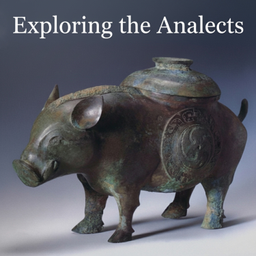
Exploring the Analects takes you passage by passage through the collected teachings of Confucius. Host Elliott Bernstein brings each quote to life with fresh translations, historical context, and insights for Chinese learners—all while showing how 2,500-year-old ideas still speak to how we live, communicate, and connect today. Whether you're a philosophy buff, a student of Mandarin, or just curious about one of history's most influential texts, this podcast makes the Analects accessible, engaging, and surprisingly relevant.

Exploring the Analects
Claim This Podcastby Elliott Bernstein
Podcast Overview
Exploring the Analects takes you passage by passage through the collected teachings of Confucius. Host Elliott Bernstein brings each quote to life with fresh translations, historical context, and insights for Chinese learners—all while showing how 2,500-year-old ideas still speak to how we live, communicate, and connect today. Whether you're a philosophy buff, a student of Mandarin, or just curious about one of history's most influential texts, this podcast makes the Analects accessible, engaging, and surprisingly relevant.
Language
🇺🇲
Publishing Since
12/21/2025
1 verified contact email on file for Exploring the Analects
Pitch yourself as a guest, propose sponsorships, or reach out directly to the host.
Recent Episodes

June 10, 2026
Bronze-Age Clickbait
<p>Clickbait is everywhere — political chaos, freak accidents, Florida Man. And Confucius, who had his own version of this problem 2,500 years ago, had a clear answer: stop feeding it entirely.</p><p>Passage 7.21 records the four topics Confucius refused to engage with: strange occurrences, feats of strength, rebellion, and spirits. Each one is a spectacle that grabs attention and pulls people away from the actual work of living well. We look at what each category means, why Confucius thought these topics were dangerous rather than just boring, and how the logic connects back to last episode's 慎 (heedfulness).</p><p>Along the way: the strange history of the Spring and Autumn Annals and the scholars who tied themselves in knots trying to explain why the Confucius who refused to discuss chaos supposedly authored a chronicle full of it — including the concept of 微言大義 (small words with big meaning), a 1st-century BCE commentary tradition, and 朱熹's 12th-century theory of the Mandate of Heaven as natural disaster forecast.</p><p>Follow along with the episode guide at analects.net.</p>

June 8, 2026
No Undo Button for Life (7.13)
<p>You've had an undo button on your email for years. Return policies, apologies, second chances — so much of modern life is fixable that it trains us to be casual. But you can't un-rupture an artery, and you can't un-start a war.</p><p>In passage 7.13, Confucius lists the three areas of life where he dropped the casual attitude entirely: ritual cleansing, warfare, and illness. The virtue behind all three is 慎 (shèn) — not just caution, but the refusal to be indecisive when the stakes are permanent. </p><p>We trace 慎 across six passages, discover what happens when heedfulness lacks the framework of ritual (spoiler: timidity), and learn why Confucius refused medicine from a nobleman but would have taken it from a doctor.</p><p>Along the way: statins and arterial plaque, CPR training as a metaphor for ritual, Mencius on when war becomes liberation, and a first-century BCE commentary from Confucius's own 11th-generation descendant.</p><p>Follow along with the episode guide at analects.net.</p>

May 20, 2026
Don’t Call a Tail a Leg (6.25)
<p>A seven-character riddle about a ritual wine vessel becomes a lesson in why names matter. In passage 6.25, Confucius picks up a 觚 (gū) — a tall, angular bronze cup designed to make you drink slowly — and finds it's lost the very shape that gave it meaning. His complaint isn't really about pottery.</p><p>Along the way: Abraham Lincoln's joke about a dog's tail, the cosmological symbolism hidden in a wine cup's dimensions, why China's first emperor 秦始皇 Qin Shi Huang burning the classics was the end of a slippery slope that started with sloppy naming, and the delicious irony of 司馬遷 Sima Qian using the same vessel metaphor to mean the exact opposite of what Confucius intended.</p><p>Follow along with the episode guide at analects.net.</p>
21 total episodes available
Deep-dive analytics for Exploring the Analects
Frequently asked questions
Have a different question and can't find the answer you're looking for? Reach out to our support team by sending us an email and we'll get back to you as soon as we can.
- What is Exploring the Analects?
- How often does this podcast release new episodes?
This podcast updates daily.
- Where can I listen to this podcast?
This podcast is available on 4 platforms including Apple Podcasts, Spotify, and more. You can also use the RSS feed directly.
- Does this podcast accept guests?
Information about guest appearances is not available.
Legal Disclaimer
Pod Engine is not affiliated with, endorsed by, or officially connected with any of the podcasts displayed on this platform. We operate independently as a podcast discovery and analytics service.
All podcast artwork, thumbnails, and content displayed on this page are the property of their respective owners and are protected by applicable copyright laws. This includes, but is not limited to, podcast cover art, episode artwork, show descriptions, episode titles, transcripts, audio snippets, and any other content originating from the podcast creators or their licensors.
We display this content under fair use principles and/or implied license for the purpose of podcast discovery, information, and commentary. We make no claim of ownership over any podcast content, artwork, or related materials shown on this platform. All trademarks, service marks, and trade names are the property of their respective owners.
While we strive to ensure all content usage is properly authorized, if you are a rights holder and believe your content is being used inappropriately or without proper authorization, please contact us immediately at hey@podengine.ai for prompt review and appropriate action, which may include content removal or proper attribution.
By accessing and using this platform, you acknowledge and agree to respect all applicable copyright laws and intellectual property rights of content owners. Any unauthorized reproduction, distribution, or commercial use of the content displayed on this platform is strictly prohibited.
