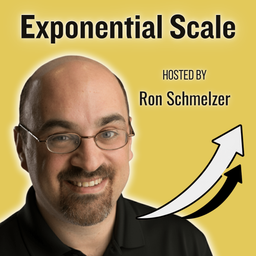
Small Team Big Scale with Ron Schmelzer
Helping Teams With Big Ambitions Scale without Scaling Headcount.
The Small Team Big Scale Scale podcast explores how the smallest teams are scaling big. Hosted by Ron Schmelzer, Forbes writer, 3x exited founder, AI thought leader, and founder of Scalebrate, each episode explores the playbooks, systems, and mindset behind today’s fastest-scaling Microteams who are looking to Megascale.
You’ll hear from visionary “Scalebrity” founders, thought leaders, and AI-powered builders who are proving that you don’t need a megateam to make a mega impact. Learn how they automate, systemize, and scale smarter, not bigger.
If you’re a small team with big ambitions, this is your unfair advantage to grow with clarity, leverage, and celebration.
Because the future isn’t big teams: it’s small teams that scale exponentially.
Scaling AI in a Trillion Dollar Organization: Interview with Kristin Milchanowski, Chief AI & Quantum Officer, BMO Financial Group
What happens when a small team inside a $1.5 trillion bank has to turn cutting-edge AI and quantum research into governed, production-grade outcomes? Kristin Milchanowski, Chief AI & Quantum Officer and Founding Director of the BMO Institute for Applied AI & Quantum, joins the show to explain how her lean team drives operating leverage at scale... without adding headcount.
Kristin shares how BMO measures every AI initiative against business value before a single dollar is budgeted, why trust inverts with generative AI (your system's best month can become your most dangerous), and how scheduling doubt is now a leadership discipline she's brought to the U.S. Army. From a peer forum of 18 Chief AI Officers to the principle that governance is the steering wheel — not the brake — this episode is a playbook for anyone running a focused team inside a massive org.
What you'll learn:
How BMO converts AI research into trusted business value with a small team inside a $1.5T organization
Why trust inverts with generative AI — and why your system's best month can become your most dangerous
The principle that governance is the steering wheel, not the brake, and how embedded governance actually accelerates adoption
Why Kristin schedules doubt as a discipline, and how challenging agreement is now a leadership essential
How BMO's peer forum of 18 Chief AI Officers is creating shared responsible AI principles across the banking sector
Links:
Kristin Milchanowski on LinkedIn (https://www.linkedin.com/in/kristinmilchanowski/)
BMO Financial Group (https://bmo.com)
Small Team Big Scale Podcast (https://smallteambigscale.com/podcast)
Subscribe to Small Team Big Scale: scalebrate.com/podcast (https://smallteambigscale.com/podcast)
3 Sept 2026
$1M to $50M+ Bootstrapped — Interview with Guillaume Moubeche, Lempire
Guillaume Moubeche started Lemlist with $1,000 and 30 VC rejections. Five years later, his company Lempire hit $57M ARR with 40% EBITDA margins and zero outside funding. He closed the first 100 customers himself in year one through self-prospecting, built a community that became his growth loop, and sold secondary shares in 2021.
In this episode, Guillaume breaks down how "eating your own dog food" became a compounding growth engine, why revenue is a lagging indicator, and how he transitioned from CEO to chairman while building an employee equity model designed to create millionaires. He also shares why valuation numbers mislead and what he's investing in through Clifton Family Office.
What you'll learn:
How self-prospecting landed the first 100 customers with zero sales team
Why growth loops beat paid acquisition — and how Lemlist's community became the engine
Revenue is a lagging indicator: why what you do now shows up six months later
The trust triangle: credibility, reliability, and emotional connection in founder-led growth
From CEO to chairman: how Guillaume structured employee equity to create millionaires
Links:
Guillaume Moubeche on LinkedIn (https://www.linkedin.com/in/guillaume-moubeche-a026541b2/)
Lempire (https://lempire.com)
Lemlist (https://lemlist.com)
Small Team Big Scale Podcast (https://smallteambigscale.com/podcast)
Subscribe to Small Team Big Scale: scalebrate.com/podcast (https://smallteambigscale.com/podcast)
Supported by Zapier (https://zapier.com)
27 Aug 2026
Decisions That Scale — Interview with Hoda Helmi, Corteva Agriscience
Hoda Helmi started as a team of one inside Corteva Agriscience — a $17.4B agricultural company with 21,500 employees across 110 countries — and built an AI and decision-science practice that now shapes how the enterprise makes its most consequential decisions. She didn't start with a data platform or an AI lab. She started with one decision and built outward.
She introduces the "digital decision twin" — a living model of enterprise decisions, constraints, and possible futures — and explains why starting with the decision (not the data) is the fastest path to measurable value. Along the way, she shares the Name, Fame, Same, Aim, Game framework for introducing yourself and your work, the franchise model for scaling small teams inside large organizations, and why asking the right questions beats knowing all the answers.
What you'll learn:
Why decisions — not data or tools — are the true leverage point for scaling teams
How to build a digital decision twin that models enterprise decisions and constraints
The Name, Fame, Same, Aim, Game framework for introducing yourself and your work
Why starting with one consequential decision beats building a massive platform
How to balance operating model structure with team flexibility and innovation
Links:
Hoda Helmi on LinkedIn (https://www.linkedin.com/in/hodahelmi/)
Corteva Agriscience (https://www.corteva.com)
Small Team Big Scale Podcast (https://smallteambigscale.com/podcast)
Subscribe to Small Team Big Scale: scalebrate.com/podcast (https://smallteambigscale.com/podcast)
Reach and audience
Public platform figures. Ratings count people who left a rating, not total listeners.
Apple Podcasts (US)
5.0 / 5
2 ratings
Host of Exponential Scale?
Claim your podcast to manage its listing and keep your show details accurate.
Pod Engine is an independent podcast discovery and analytics service and is not affiliated with or endorsed by this podcast. Artwork and show content belong to their owners. Full legal notice.
Explore this show Podcast research with Pod Engine