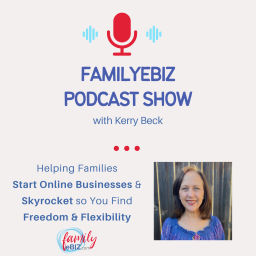
FamilyEbiz Podcast
Hosted by Kerry Beck · Kerry Beck
5.0from 1 ratings
- 136
- Episodes
- 1
- Ratings
- Daily
- Cadence
- 2023
- First episode
- 3K
- YouTube views
About FamilyEbiz Podcast
FamilyEbiz podcast helps families start their online business & skyrocket it . . . so they can find the freedom & flexibility they are dreaming of.
- Publisher
- Kerry Beck
- Category
- business
- Language
- en
- Explicit
- No
- First episode
- 8 Nov 2023
- Latest episode
- 5 Oct 2026
Latest episodes
136 episodes in the feed.
5 Oct 2026
135: Selling Is Service: End the Fear of Selling
What if hiding your offer is actually hurting the very people you want to help? Selling is service — and if your product solves a real problem, staying quiet is keeping your audience stuck. In this episode, we break down the mindset shift that changes everything about how you show up and sell. Here are 5 things you will walk away with: ✅Why hiding your offer is fear, not humility ✅The difference between pushy marketing and REAL service ✅Why free content informs but paid offers transform ✅The 1-sentence addition you can make to any post or email right now ✅How to start believing in your offer enough to actually share it Ready to stop playing small and start serving at the level your audience deserves? Sign up for the free training on Oct 13: What Your Business is Missing? 5 Fixes to Unlock Real Growth (https://familyebiz.com/5fixes). It’s exactly what is holding your business back Resources for You Free Training — "What's Missing? Five Fixes That Unlock Real Growth" (https://familyebiz.com/5fixes) : Oct 13 Live Class (1:00 PM) Show Notes: Hiding Your Offer Is Not Humility — It's Fear What if not sharing your product with your audience is actually hurting the very people you want to help? You've created something valuable, you believe it works, but you hesitate to talk about it because you're going to ask for money, and you're scared. The online world says don't be salesy. But I'm going to say something different. Hiding your offer is not humility. It's fear. You Don't Have a Product Problem — You Have a Belief Problem Here's the reality. You're creating content but not making consistent sales. You're showing up but avoiding the offer. You're learning from 10 different places but nothing feels complete. And you've got this thing going on in your head — who am I to sell this? Who am I to ask for money? What if no one buys? Some of you have been working on your content for months or even years without seeing results. You believe in your product. But you keep hesitating to sell it, over and over again. I know what that's like, because I used to not really want to put things out for sale. I just as soon give everything for free and let people enjoy it. But that doesn't work. In the last few years I've really worked on my mindset around that imposter syndrome. And I see other people — people know about their products. Why? Because they share them. They let their audience know they have something for sale. You don't have a product problem. You have a belief problem about selling. Selling Is Not Taking — It's Serving Let's talk about changing our mindset. Selling is not taking. It is serving. If your product truly solves a problem, then when you do not offer it, it keeps your people stuck. Does that make sense? If your product solves their problem and you don't ever tell them about it, they just stay stuck — or they go find someone else to buy that product from. Pushy marketing is pressure and manipulation. That is not what I'm talking about. Serving is initiation, invitation, and a solution. You are inviting them in to solve their problem. Competent entrepreneurs don't pitch — they lead. Mel Robbins and the 5-Second Rule There was a person named Mel Robbins. She struggled financially, she nearly lost everything. She created something just for herself called the 5-Second Rule — it was to help her get through a really hard season. Financial trouble, marriage stress, career problems, panic attacks just getting out of bed. Initially she shared it for free, but then she realized people needed deeper help. That's when she turned it into a book, into courses, and into speaking. She turned a personal tool into a framework that has helped millions — because she didn't keep it to herself. If she had just kept it to herself, everyone else would have stayed stuck or tried to figure it out on their own. You need to share your products if they solve a problem. Free Content Informs. Paid Offers Transform. People don't just need information. They need transformation — and that's what your paid offer provides. If you're multitasking, come back to me for this one. Free content informs. Paid offers transform. If you stay in free content mode, your audience stays stuck. They're not going to see transformation. Free advice without a system is why you're not making sales. James Wedmore started as a YouTuber giving free advice on video tips. He spent years teaching YouTube and video marketing, but he realized his people needed a different type of structure to actually succeed. So he shifted his mindset, saw the gap, and began building paid programs to solve their problems. His business exploded. His audience didn't need more free tips. They needed a proven path, a strategy, and a new mindset — and that is what he taught in his paid courses. What to Do This Week I want you to think about this question — and you probably already know the answer. What problem does your product solve? Write that down. Then ask yourself — what happens if your audience doesn't solve that problem? Let's say you've got a great way to help people lose weight. If they don't solve that problem, it's not just that they don't have a solution. Their health goes down, nothing is working right, maybe their finances are even affected because they're spending money on the wrong things. When they don't solve their problem, other areas of their life hurt too. So here's what I want you to do. Add one sentence to your next post, or a PS in your next email. Something like — if you want help with this, here's how I can help you go further. That's not pushy. That is serving. That is leadership. Daymond John from Shark Tank started FUBU — For Us By Us — with a very small amount of money from his mom. He promoted it relentlessly himself. He was not afraid to get that brand out there. Now he's a gazillionaire who helps other people start businesses. He believed in his brand enough to promote it himself. Do you believe in your brand enough? You're not failing. You're just holding back your solution. And in doing that, you're not serving the people you want to help. If you want a simple way to know what to say, when to say it, and how to guide people to your offer — come to my free class on Oct 13. It's called What's Missing in Your Business: Five Fixes to Unlock Real Growth. You can sign up here (https://familyebiz.com/5fixes) Yes, it's a free class. And yes, I will have something paid — because if you want more transformation, you'll be willing to pay for that transformation. If you feel stuck with your sales, if you're not sure how to serve your people, come to this class. We're going to talk about things that can take your business to the next level.
28 Sept 2026
134: Stuck? Taking Action Breeds Clarity Every Single Time
If you've been waiting until you feel ready, confident, or clear enough to move forward in your business, this episode is going to reframe everything. Taking action breeds clarity — and that one shift is the difference between staying stuck and building something that actually earns. Here are 5 things you'll discover in this episode: ✅Why confidence isn't something you wait for — it's something you build by doing ✅The version 1.0 mindset that gets your product earning money and improving at the same time ✅Why perfectionism is just procrastination wearing a disguise ✅Why low prices can actually hurt your sales and signal low value ✅The gap between you and profitable creators is really made of (it's not talent or luck) Ready to stop waiting and start moving toward a business that actually pays you? Grab your VIP spot for the Simple Reboot to Make Money Fireside Chat by clicking the link below! Resources for You Simple Reboot: Start Making Money Online — Free VIP Fireside Chat (https://familyebiz.com/fireside-vip) with live Q&A and business feedback Show Notes: The Myth of the Fearless Founder In 1996, a middle school teacher named Julie Clark was sitting in her basement holding a borrowed video camera. She had zero business experience, no budget, and no team. She wanted to make an educational video for her newborn daughter — introducing music, language, poetry, and colors. But she was paralyzed by doubt. I'm not qualified. Why should I do this? I had no right to compete with these big studios. Here's the turning point. She didn't wait for confidence to magically appear. She edited the video herself. She drove to a local toy store and asked them to put a few copies on the shelf. Scrappy work. A scrappy business starting in a basement. And that project eventually became Baby Einstein — which generated $20 million before Disney acquired it. Julie didn't cross the finish line because she started with unshakable confidence. She built confidence because she started. She built confidence because she took action. Taking Action Breeds Clarity Most top earners were terrified when they got started. They were dealing with imposter syndrome. They were overwhelmed by the technical setups, the branding, the legalities when they launched their first product. You don't need clarity before you act. Clarity is a byproduct of taking action. Marie Forleo has often said — clarity comes from action, not thought. We think clarity comes from thinking through everything and coming up with a bulletproof master plan. But clarity in your business comes from taking the next step, and then the next. Taking action breeds clarity. Taking action breeds clarity. Confidence isn't a personality trait. It is an earned quality that builds over time. The more you work on this, the more confident you're going to become. How to Think About Failure A lot of people think — if I take action and fail, I'll just quit. Low initial sales. Negative feedback. Tech glitches. I've experienced all of those. I remember a summit registration going wrong on launch day a month and a half out. That is not failure. That is a lesson you learn and then you move forward. Successful entrepreneurs view those same hiccups as neutral data points. They use them to iterate and improve. Thomas Edison said — I didn't fail 10,000 times. I found 10,000 ways to not make a light bulb. That's the attitude you want. In the last year I've put things out that didn't make money. I moved on or I redid them and found a better way to get that product to market. You want to focus on the process, not just the outcome. Those who succeed focus on building quality audience relationships and consistent output. They learn the lessons from what didn't work and they tweak it the next time. Imperfect Action Is Still Action Perfectionism isn't a high standard. Spending three months tweaking a logo is not going to make you money. Drafting something for three months and never publishing it is not going to make you money. Good is good enough. As my mentor Dan Kennedy used to say — procrastination is just a disguise. You tell yourself you're still tweaking it, but you're really just procrastinating. If you could see some of the products I put out in 2009, 2010, and 2011 — oh my gosh, they were horrible. I would be so embarrassed now. They were flawed. But they were on the market. They made money. They gathered real feedback. A perfect draft on your hard drive isn't making money and it isn't giving you any feedback about how to grow your business. Ship early. Sell quickly. Gather feedback. Then iterate and keep growing. I have continued to tweak my Raising Leaders, Not Followers course over the years — selling the same course over and over and making it better each time. Your Pricing Mindset Is Costing You Some of you are working hard and taking action, but you think the most you can charge is $5, $10, maybe $25. You tell yourself — my audience doesn't spend that much. Especially in the homeschool market. Homeschoolers don't spend money. Well, they spend $200 on a course I sell. There are math and writing curricula priced at $200 and $300. People are spending money. The problem is a mindset problem — and it comes through in how you talk about and share your products. Low prices actually attract high-maintenance clients. And when you price something so low, buyers think it must not be high quality. People judge value based on price. When you charge $5, they assume your solution is trivial. They may use it. They may not. Your audience is not broke. They spend money daily on things they prioritize. If they aren't paying you, they're paying someone else. It's a value positioning issue, not a wallet issue. Stop pricing based on your own bank account or your own buying habits. You are not your customer. Your price should be based on the value and transformation your solution provides. I have moms tell me that Raising Leaders, Not Followers completely changed the way they homeschool. That kind of transformation is worth real money. The Gap Is Smaller Than You Think The gap between you and profitable entrepreneurs isn't talent, luck, or innate confidence. It's the willingness to act before you're fully ready. To take the next step anyway. And to charge what your work is actually worth. Taking action breeds clarity. Every single time. If you're ready to bridge that gap and launch a profitable business with a clear roadmap, join our VIP waitlist (https://familyebiz.com/fireside-vip) for something coming in October. You'll get exclusive early access, special pricing, and step-by-step guidance to take imperfect action that yields real revenue. You'll also be invited to the Simple Reboot to Start Making Money Online — a free fireside chat workshop where you can bring your questions, your product, whatever you're working on. We'll have Q&A at the end and I'm not selling anything — I just want to help you move forward. The link is in the show notes.
21 Sept 2026
133: The 3-Step Framework To Convert Email Leads To Sales
Sending one email and hoping for results usually leads to zero orders. Your product isn't bad, but your messaging stays invisible when life gets busy for your readers. A clear promotional cycle helps you share your offer consistently so casual followers become eager buyers. Discover how a simple three-step marketing framework helps you convert email leads to sales without complicated funnels. Learn how to articulate the exact problem keeping your audience stuck and guide them directly toward your solution. Stop guessing with random posts and build an intentional routine that generates real revenue. ✅Why one-and-done emails fail to convert email leads to sales ✅2 quick site checks that instantly fix your messaging ✅3-step system that turns cold leads into ready buyers ✅The simple secret behind building deep reader engagement ✅Why a confused mind will never buy your product Click the link below to turn your audience into steady buyers today! Resources for You VIP Waitlist (https://familyebiz.com/fireside-vip) — Simple Reboot: Start Making Money Online (live Q4 workshop with live feedback) Show Notes: Why You're Getting Crickets — And It's Not Your Product Have you ever sent out an email, sat back with a cup of coffee, and secretly hoped — please let today be the day I make a sale — only to check your dashboard five hours later and see zero orders? I have personally. So what do you do? Do you assume your product is bad or your audience is broken? So you pivot. You pick a new idea. You start a new project. You do something completely different next week. Here's what's really going on. The problem is not your product. It's not your niche or your price point. The real problem is you're running a business on random acts of content instead of a simple promotional plan. The One-and-Done Email Problem Most creators spend weeks building a digital product or course, send one email, post one social graphic, get crickets, and make an assumption — my audience just won't buy this. They just won't spend the money. That is random promotion. One email does not sell. It usually takes seven touches for someone to take action on your offer. If you didn't make any sales, it doesn't mean your offer is bad. It means your messaging was invisible. Your audience is busy juggling kids and life and work. A single post easily gets lost, even if it was something they would have happily paid for. And that's not a product problem — it's a visibility and consistency problem. What Brandon Stanton Did Differently Brandon Stanton started Humans of New York in 2010 after losing his finance job. His original plan was to photograph 10,000 New Yorkers and put them on a map. But he realized pretty quickly that wasn't going to do anything. He needed to build relationships, engagement, and connection. It wasn't until he started a daily rhythm — interviewing his subjects and sharing their deep, real stories — that he started to see the power of building a business. He used that platform to build a global community and eventually became a multiple New York Times bestselling author. Consistency and a clear narrative rhythm transformed his scattered idea into a sustainable movement. One random effort does not build momentum. A structured, intentional routine is what moves people from casual observers to dedicated followers and buyers. Some people are on my list for two or three years before they buy my Raising Leaders, Not Followers course. Others buy immediately. You've got to build relationship and keep showing up — and hit people wherever they are. From Random Promotion to a Simple Promotional Cycle This does not have to be a complex 50-step corporate launch campaign. It's simply a window of time — maybe a week — where all your messaging points toward one pain point and one clear solution. When you jump from topic to topic each week, you're switching audiences and switching solutions. Your audience gets confused. And a confused mind does not buy. Let me repeat that — a confused mind does not buy. Here's what you need to do this week. Go look at your website, your most recent blog post, podcast, or email broadcast. Ask yourself these two questions. Did I give my readers one clear next step to take? And did I give this piece of content a job? Every single email, blog post, and podcast needs a job — a call to action. If you didn't give it one, you left your audience hanging with no idea what to do next. Three Steps to Convert Email Leads to Sales Step one — identify the problem. Help your audience realize what is keeping them stuck. Not what you're guessing is keeping them stuck — what they've actually told you. You need to know their real pain points in their own words. Step two — reframe the solution. Show them why all their DIY efforts haven't worked, and then show them why your approach is different. Step three — present the clear path forward. Give them one specific next step. Not five options. One. That's the cycle. And the key is to keep coming back to it — not just once, but consistently. I learned from my mentor Amy Porterfield that the most successful online business owners aren't building something new every time. They're refining the same offer over and over, making it convert better each time. About four or five years ago I quit selling every homeschool course I had and focused on Raising Leaders, Not Followers — and my Life Skills Leadership Summit goes alongside it. Everything points to one thing. Email Is Still the Most Effective Tool Social media algorithms change constantly. Your email list doesn't. When you build a relationship with your email list through consistent, targeted messaging over multiple touch points, you are building the most reliable path to consistent sales. Instead of random posts, random podcast episodes, and random emails that lead to random results — build a system. Identify a real problem. Reframe the solution. Give them the clear next step. Repeat it. That is how you convert email leads to sales instead of getting crickets. I'm hosting a free VIP fireside chat (https://familyebiz.com/fireside-vip) — the Simple Reboot to Start Making Money Online — on Friday, October 10th. I'm going to walk through the exact four-step system that every profitable online business needs so you can stop spinning your wheels and start making consistent money. Come with your questions. We'll look at your specific business and find the gap between your pain point and your solution. The link is in the show notes or the description.
Reach and audience
Public platform figures. Ratings count people who left a rating, not total listeners.
- YouTube views
- 3,388
- Score snapshot 15 Sept 2025
- Spotify
- 5.0 / 5
- 1 ratings
Podcast Authority Score: 62 / 100
A composite of feed quality, social presence, YouTube performance and engagement. Read the methodology.
- Quality
- 95
- Social presence
- 0
- YouTube
- 74
- Engagement
- 0
Contact FamilyEbiz Podcast
- Guest appearances
- Books guests
Based on episode analysis; this does not confirm that the show is currently accepting guests.
Questions about FamilyEbiz Podcast
Who hosts FamilyEbiz Podcast?
Kerry Beck host the show. Published by Kerry Beck.
How often do new episodes come out?
The show publishes daily, based on its RSS feed.
Does FamilyEbiz Podcast take guests?
Yes. Guests have been identified in episode analyses.
Host of FamilyEbiz Podcast?
Claim your podcast to manage its listing and keep your show details accurate.
Pod Engine is an independent podcast discovery and analytics service and is not affiliated with or endorsed by this podcast. Artwork and show content belong to their owners. Full legal notice.
Explore this show
Podcast research with Pod Engine