- 12
- Episodes
- Monthly
- Cadence
- 2026
- First episode
About Fed Up, But Figuring It Out
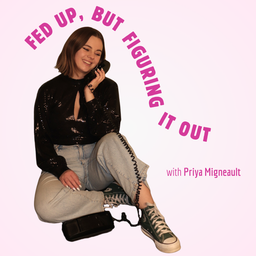
Fed Up, But Figuring It Out is a research-driven podcast about power, politics, identity, media, and the stories we tell ourselves about the world. Hosted by Priya, a Canadian university student, each episode blends academic insight, critical analysis, and honest reflection, one researched rant at a time. If you’ve ever opened the news and thought WTF and want to understand why things feel off, you’re in the right place. This show is for people who refuse the comforting but hollow narrative that everything is okay, because ignoring what hurts is the easiest way to lose our empathy and our humanity. Here, we stay curious, ask better questions, explore the narratives around mainstream issues, and learn how to care more intentionally in a world that often rewards indifference. Topics span feminism, digital culture, masculinity, queer love, fascism, and social justice, always with nuance, research, and heart.
- Publisher
- Priya Migneault
- Category
- news
- Language
- en
- Explicit
- Yes
- First episode
- 2 Feb 2026
- Latest episode
- 13 Jul 2026
Latest episodes
12 episodes in the feed.
13 Jul 2026
How to Balance being Aware and being Hopeful: The One Thing Every Activist (Person) Needs to Hear
How do you stay informed without becoming overwhelmed? How do you keep fighting for change without burning yourself out? In the season one finale of Fed Up, But Figuring It Out, we explore one of the biggest challenges facing politically engaged people today: balancing anger with hope. From political polarization and social injustice to climate anxiety and activist burnout, caring deeply about the world can feel emotionally exhausting. This episode examines why awareness often comes with frustration, why hope isn't naïve - it's necessary, and how joy can become a form of resistance. Drawing on insights from activists, writers, and social movements, we discuss practical ways to stay engaged while protecting your mental health and remembering that meaningful change is always a collective effort. If you've ever wondered how to keep caring without burning out, this episode is for you. Sources: Doyle, G., Wambach, A., & Doyle, A. (2025). We can do hard things: Answers to life’s 20 questions. The Dial Press.
29 Jun 2026
The Red Pill Pipeline: How Young Men Are Radicalized Online
How did self-improvement content turn into resentment toward women? In this episode of Fed Up, But Figuring It Out, we unpack the red pill pipeline: what it is, who it targets, why it works, and why it matters. From fitness influencers and dating advice to online echo chambers and political radicalization, the pipeline doesn't begin with hatred; it begins with vulnerability. Many young men searching for confidence, belonging, and answers find themselves pulled toward content that offers certainty, simple explanations, and someone to blame. We'll explore the rise of the manosphere, the connection between masculinity and identity, the role algorithms play in shaping beliefs, and why the growing gender divide in politics and dating should concern all of us. This episode isn't about blaming men. It's about understanding how insecurity is monetized and how polarization spreads. Sources: Fink, S. (2025). Singles tell us how the political gender gap is impacting their dating lives: ‘I would not date anybody who votes conservative.’ Toronto Star. https://www.thestar.com/life/singles-tell-us-how-the-political-gender-gap-is-impacting-their-dating-lives-i-would/article_1e6d09ec-4e16-4f57-8e04-4c537d93a6d8.html Foster , J. (2025, November). Surviving the red pill: Escaping the alt-right pipeline. The Daily Free Press. https://dailyfreepress.com/11/09/22/215951/surviving-the-red-pill-escaping-the-alt-right-pipeline/ Genetically Modified Skeptic. (2025a, April). The Alt-Right Pipeline Almost Got Me. Here’s Why It Failed. YouTube. https://www.youtube.com/watch?v=ID8Xq3chNi4 The Guardian. (2025b, October). The red pill pipeline is “a cult” - here’s how I escaped. YouTube. https://www.youtube.com/watch?v=JvQOqM01Lic Hale, R. (2025, April). Here’s what red pill, misogyny and other manosphere terms mean. USA Today. https://www.usatoday.com/story/life/health-wellness/2025/04/17/red-pill-meaning-manosphere-misogyny-and-other-terms-explained/83098716007/ Luck, F. (2025, May). ‘Uneducated and Unhappy’: How I fell down the alt-right pipeline and how Hitler’s artwork helped me escape. LBC. https://www.lbc.co.uk/article/alt-right-pipeline-redpilled-andrew-tate-elon-musk-5Hjd4rP_2/ Movieclips. (2013). Uptown Girls (7/11) Movie CLIP - It’s a Harsh World (2003) HD. YouTube. https://www.youtube.com/watch?v=a5WAyc-EaNc Shanspeare. (2024). I Infiltrated the Manosphere. YouTube. https://www.youtube.com/watch?v=znIjiaEPbYU Urena, J. (2025, November). The kids are not alright! gen Z boys and the Red Pill Pipeline. Fordham Political Review. https://fordhampoliticalreview.org/the-kids-are-not-alright-gen-z-boys-and-the-red-pill-pipeline/
8 Jun 2026
Populism: Who Actually Speaks for "The People"?
Populism is one of the most talked-about ideas in modern politics, but what does it actually mean? In this episode of Fed Up, But Figuring It Out, we unpack the rise of populism, why politicians across the political spectrum claim to represent "the people," and how the term has evolved from a political movement into a powerful branding tool. We explore the relationship between populism and meritocracy, the tension between expertise and representation, and why so many self-proclaimed populist leaders come from the very elite institutions they claim to oppose. We examine what separates authentic representation from political performance. Most importantly, we ask a deeper question: Who gets included when politicians talk about "the people", and who gets left out? If you've ever wondered why every politician claims they're fighting for ordinary people, this episode is for you. Sources: BBC Ideas. (2019, February). Populism explained | A-Z of ISMs Episode 16 - BBC Ideas. YouTube. https://www.youtube.com/watch?v=l5U61HGQ-OQ Cole, T. A. (2025, November 13). To reform meritocracy, put character at the center. MIT Sloan Management Review. https://sloanreview.mit.edu/article/to-reform-meritocracy-put-character-at-the-center/ Cultural populism. ECPS. (n.d.). https://www.populismstudies.org/Vocabulary/cultural-populism/ Friedman, S., Ellersgaard, C., Reeves, A., & Larsen, A. G. (2023). The meaning of merit: Talent versus hard work legitimacy. Social Forces, 102(3), 861–879. https://doi.org/10.1093/sf/soad131 Kandpal, E. (2025, September). A Populism That’s Really of the People? Poverty, Protest, and Regime Collapse in South Asia. Center for Global Development. https://www.cgdev.org/blog/populism-thats-really-people-poverty-protest-and-regime-collapse-south-asia Laycock, D. (2019). Populism in Canada. The Canadian Encyclopedia. https://www.thecanadianencyclopedia.ca/en/article/populism Molloy, D. (2018, March 6). What is populism, and what does the term actually mean?. BBC News. https://www.bbc.com/news/world-43301423 Sandel, M. J. (2021, January). The myth of meritocracy. Harvard Gazette. https://news.harvard.edu/gazette/story/2021/01/the-myth-of-meritocracy-according-to-michael-sandel/ York University. (2025, April 1). What is populism?. Observatory of Populism in Canada. https://www.yorku.ca/research/robarts/observatory-populism/what-is-populism/
25 May 2026
Empathy: The Real Target of the War on "Woke"?
What if empathy isn’t weakness, but one of the bravest and most radical skills we can develop? In this episode of Fed Up, But Figuring It Out, we explore why empathy has become so controversial in modern culture and politics. From the rise of anti-“woke” rhetoric to burnout, vulnerability, leadership, capitalism, and social division, this episode explores how empathy challenges systems built on fear, hierarchy, and disconnection. Drawing on insights from Brené Brown and real-world political and cultural examples, this conversation breaks down the difference between empathy and sympathy, why vulnerability terrifies people, and how empathy can become a form of rebellion in a polarized world. If you’ve ever wondered why compassion is mocked, why empathy feels exhausting, or why caring about other people has become political, this episode is for you. Sources: The Canadian Press. (2025, April 23). Pierre Poilievre says he’ll end “woke ideology” - he isn’t saying what that means. CTV News. https://www.ctvnews.ca/federal-election-2025/article/pierre-poilievre-says-hell-end-woke-ideology-he-isnt-saying-what-that-means/ Meechan , F., McCann , L., & Cooper , C. (2022). The importance of empathy and compassion in organizations: Why there is so little, and why we need more. Exploring the Connections between Critical and Contemporary Social Theory and the Sociology of Culture, 145–163. https://doi.org/10.4337/9781839103261.00017 The RSA. (2013, December 10). Brené Brown on Empathy. YouTube. https://www.youtube.com/watch?v=1Evwgu369Jw TED. (2011, January). The Power of Vulnerability | Brené Brown | TED. YouTube. https://www.youtube.com/watch?v=iCvmsMzlF7o Tsang M. (2013). The importance of empathy--as I have studied and experienced it. Hawai'i journal of medicine & public health: a journal of Asia Pacific Medicine & Public Health, 72(9 Suppl 4), 79–80.
11 May 2026
The Double Standard of Fantasy, Romance, and “Women’s Fiction”
Why are fantasy stories written by women treated like guilty pleasures while male-centered fantasy is praised as genius world-building? In this episode of Fed Up, But Figuring It Out, we dive into the double standards surrounding romance, fantasy, and “women’s literature.” From Harry Potter and Percy Jackson to Throne of Glass, this episode explores how the stories we grow up with shape empathy, emotional literacy, and whose perspectives are considered “universal.” We unpack why women’s fantasy is so often dismissed as “porn,” while violent or sexually explicit male fantasy rarely faces the same criticism. This conversation also examines the neuroscience and cultural impact of porn versus romance novels, the role of emotional intimacy in women’s storytelling, the patriarchy present in reading culture, and why reading female perspectives matters for everyone, not just women. Drawing on feminist thought, reading statistics, BookTok culture, and personal reflections as an avid fantasy reader, this episode asks a bigger question: what does it say about our society when stories centered on women’s emotions, safety, and desire are mocked instead of respected? Sources: Carroll, J. (2023, April 18). Porn Gap: Difference in men and women pornography patterns. Wheatley Institute. https://wheatley.byu.edu/family/porn-gap-difference-in-men-and-women-pornography-patterns Iyengar, S. (2025, January). The Men-Women Split in Reading is Real—and Persists Amid Historical Rate Declines. National Endowment for the Arts. https://www.arts.gov/stories/blog/2025/men-women-split-reading-real-and-persists-amid-historical-rate-declines Snitow, A. B. (1994). Mass Market Romance: Pornography for Women Is Different. In Living With Contradictions (1st ed.). Chapter, Routledge. Tylka, T. L. (2015). No harm in looking, right? Men’s pornography consumption, body image, and well-being. Psychology of Men & Masculinity, 16(1), 97–107. https://doi.org/10.1037/a0035774
27 Apr 2026
Why Queer Love Hits Harder: What That Says About Us, Storytelling, and Romance
Why do queer love stories on screen feel more emotional, more authentic, and sometimes even more powerful, regardless of your identity? In this episode of Fed Up, But Figuring It Out, we unpack the cultural, political, and emotional weight behind queer romance in media. From decades of tragic storytelling to the recent rise of soft, joyful representation, queer love has been shaped by resistance, vulnerability, and choice in ways that challenge traditional narratives of romance. We explore how heteronormative scripts have flattened straight relationships on screen, why audiences, queer or not, are drawn to stories that feel intentional, and how representation impacts not just visibility, but emotional depth. This isn’t about saying queer love is “better”, it’s about understanding why it often feels more real. This episode dives into media, culture, identity, and storytelling to ask a bigger question: what does the portrayal of love on screen say about power, norms, and who gets to be seen? Sources: Castellano, R. (2025, September 15). Why authenticity is the secret to stronger relationships. Psychology Today. https://www.psychologytoday.com/us/blog/the-humanistic-explorer/202509/why-authenticity-is-the-secret-to-stronger-relationships Maimann , K. (2025, December 21). Why are women so into the man-on-man romance in heated rivalry?. CBC news. https://www.cbc.ca/news/entertainment/heated-rivalry-fandom-women-9.7020182 Queer Love and the rewriting of romantic norms. Daniel Dashnaw. (2025, March 21). https://danieldashnawcouplestherapy.com/blog/queer-love-and-the-rewriting-of-romantic-norms
13 Apr 2026
Feminists Hate Men & Other Lies
Feminism isn’t anti-men, it’s anti-inequality. This episode unpacks the myths, the backlash, and the real meaning behind the movement. If you’ve ever questioned feminism, felt defensive in these conversations, or just want a clearer, more honest understanding of gender equality, this episode is for you. Sources: Elsesser, K. (2023). Feminists don’t hate men, according to New Research. Forbes. https://www.forbes.com/sites/kimelsesser/2023/11/27/feminists-dont-hate-men-according-to-new-research/ Feminism is for everybody. (2019). The Lancet, 393(10171). Haysley, K. (2025). a classic Julia Sugarbaker moment, portrayed by icon, #Dixie Carter. #designingwomen #1980stv. Instagram. https://www.instagram.com/p/DPpk8aokWIN/ Hedges, T. (2024). Reclaiming misandry from misogynistic rhetoric. Feminist Review, 136(1), 84–99. https://doi.org/10.1177/01417789231223202 Hopkins-Doyle, A., Petterson, A. L., Leach, S., Zibell, H., Chobthamkit, P., Binti Abdul Rahim, S., Blake, J., Bosco, C., Cherrie-Rees, K., Beadle, A., Cock, V., Greer, H., Jankowska, A., Macdonald, K., Scott English, A., Wai Lan YEUNG, V., Asano, R., Beattie, P., Bernardo, A. B., … Sutton, R. M. (2023). The misandry myth: An inaccurate stereotype about feminists’ attitudes toward men. Psychology of Women Quarterly, 48(1), 8–37. https://doi.org/10.1177/03616843231202708 New study debunks myth that feminists hate men. University of Surrey. (2023). https://www.surrey.ac.uk/news/new-study-debunks-myth-feminists-hate-men Prince, V. (2025). “Why don’t you trust men?” Instagram. https://www.instagram.com/p/DOxTHkqDt5g/
30 Mar 2026
The Myth of Neutrality
What does it really mean to be “neutral” in today’s world, and is it even possible? In this episode, we unpack what it really means to call yourself “apolitical” in a world where politics shapes everything. From activism burnout and information overload to performative allyship and social media pressure, we explore why so many people feel stuck between caring too much and not engaging at all. This conversation challenges the idea that staying out of politics is ever truly neutral, and asks a harder question: when does not choosing a side become a privilege in itself? If you’re interested in politics and culture, social justice conversations, critical thinking, media literacy, and what activism looks like in the digital age, this episode is for you. Sources: The apathy of being apolitical: Why remaining neutral during times of conflict is not an option. The Phoenix News. (2023). https://www.thephoenixnews.ca/posts/the-apathy-of-being-apolitical-why-remaining-neutral-during-times-of-conflict-is-not-an-option Dorsey, E. (2025, August 27). Being apolitical is unacceptable in today’s political climate. Collegiate Times. https://www.collegiatetimes.com/opinion/being-apolitical-is-unacceptable-in-today-s-political-climate/article_9f725a71-eafb-490c-926b-5a96134b9948.html “First they came....” poem by Martin Niemoller – poem, meaning, summary, and poem analysis. Unread Poets Society. (2022, December 21). https://unreadpoetssociety.com/2022/12/11/first-they-came-poem-by-martin-niemoller-poem-meaning-summary-and-poem-analysis/ Gassam Asare, J. (2023, December 6). Do celebrities like Beyonce have a responsibility to speak about injustice?. Forbes. https://www.forbes.com/sites/janicegassam/2023/12/06/do-celebrities-like-beyonce-have-a-responsibility-to-speak-about-injustice/ Krishna. (2025). The illusion of being apolitical. The Good Men Project. https://goodmenproject.com/featured-content/the-illusion-of-being-apolitical/
16 Mar 2026
Toxic Masculinity & Loneliness: How 'Manhood' affects Men's Mental Health
Is toxic masculinity fueling the male loneliness epidemic? In this episode of Fed Up, But Figuring It Out, host Priya Migneault unpacks the complex relationship between toxic masculinity, men’s mental health, and rising loneliness among men. While masculinity itself isn’t inherently harmful, rigid expectations around dominance, emotional suppression, and hyper-independence can leave many men isolated and struggling to connect. Priya explores how traditional gender norms, like “man up” culture, fear of vulnerability, and the pressure to appear strong, discourage emotional openness and prevent men from forming deep friendships or seeking help. The result? Higher rates of loneliness, depression, substance use, and suicide among men. If you care about gender equality, mental health, masculinity, and modern culture, this conversation is for you. Sources: Connor-Savarda, B.-N. (2023, March 30). Loneliness: One of the consequences of toxic masculinity. Emotion Intelligence Magazine. https://www.ei-magazine.com/post/loneliness-one-of-the-consequences-of-toxic-masculinity Engaging men in gender equality: End violence against women in Canada. Canadian Women’s Foundation. (2018, January 10). https://canadianwomen.org/blog/comes-toxic-masculinity-lose/ How Toxic Masculinity Harms Men and Boys. Survivors.org. (2025, January 21). https://survivors.org/how-toxic-masculinity-harms-men/ Jones, F., Verity, L., Panayiotou, M., & Qualter, P. (2023). A review of evidence on the link between masculinity, loneliness, and suicide as observed in social media discussions. Current Research in Behavioral Sciences, 5. https://doi.org/10.1016/j.crbeha.2023.100129 Reeves, R. (2022, October 17). Toxic masculinity is a harmful myth. Society is in denial about the problems of boys and men. Big Think. https://bigthink.com/the-present/toxic-masculinity-myth/ Salter, M. (2019, February 27). The Problem With a Fight Against Toxic Masculinity. The Atlantic. https://www.theatlantic.com/health/archive/2019/02/toxic-masculinity-history/583411/ Suicide in Canada: Key statistics (infographic). Government of Canada. (2023). https://www.canada.ca/en/public-health/services/publications/healthy-living/suicide-canada-key-statistics-infographic.html Wade, D. (2023, March 31). Defining — and Addressing — Toxic Masculinity. Healthline. https://www.healthline.com/health/toxic-masculinity
2 Mar 2026
The Echo Chamber Effect: Algorithms, Confirmation Bias, and the Collapse of Shared Reality
Are we actually disagreeing—or are we living in completely different realities? In this episode of Fed Up, But Figuring It Out, Priya breaks down how echo chambers, filter bubbles, and algorithm-driven content are reshaping truth, fueling political polarization, and making empathy harder than ever. From social media algorithms and confirmation bias to online radicalization and the January 6 insurrection, this episode explores how personalized media ecosystems distort reality—and why none of us are immune. If you’ve ever felt like the world is spiraling, wondered why conversations feel impossible, or questioned what’s real online anymore, this episode is for you. Join the conversation on Instagram: @fedup.pod Sources: BBC. (n.d.). What are echo chambers?. BBC Bitesize. https://www.bbc.co.uk/bitesize/articles/zbwkbqt Levy, G., & Razin, R. (2019). Echo Chambers and their effects on economic and political outcomes. Annual Review of Economics, 11, 303–328. https://doi.org/10.1146/annurev-economics-080218-030343 Meacham, M. (2013). The Neuroscience of Engagement. ATD. https://www.td.org/content/atd-blog/the-neuroscience-of-engagement TED. (2011). Beware online “filter bubbles” | Eli Pariser. YouTube. Retrieved 2026, from https://www.youtube.com/watch?v=B8ofWFx525s&t=20s.
16 Feb 2026
What Even Is Fascism?
Fascism doesn’t come back wearing the same uniform. It returns disguised as patriotism, “traditional values,” law and order, and promises of safety. In this episode of Fed Up, But Figuring It Out, Priya Migneault breaks down what fascism actually is, how it works, and why it keeps resurfacing in moments of fear, economic instability, and political distrust. Drawing on political theory, historical case studies, and contemporary examples, this episode unpacks the core traits of fascism: authoritarianism, ultranationalism, propaganda, anti-intellectualism, rigid hierarchies, manufactured victimhood, and the erosion of democratic norms from the inside out. From Mussolini’s Italy and Hitler’s Germany to modern strongmen politics, book bans, culture wars, state violence, and economic scapegoating, the patterns are clear — even when the slogans change. This isn’t an abstract history lesson. It’s an exploration of how fascism thrives today through misinformation, fear-based rhetoric, attacks on education, moral panics about gender and sexuality, and the false promise of certainty in uncertain times. The episode also examines why people are drawn to fascist movements, how authoritarianism predicts political behavior more than income or education, and why neutrality and indifference are not harmless positions. Ultimately, this episode asks a necessary question: Will we recognize fascism when it shows up looking familiar? And what responsibility do we have to pay attention, speak up, and protect empathy before it’s too late? If you’ve ever felt like something is deeply off — politically, socially, culturally — this episode gives you the language, history, and tools to name it. Sources: Drew, C. (2023, March 23). 12 examples of fascism in history. Helpful Professor. https://helpfulprofessor.com/examples-of-fascism/ Fousek, P. (2021, January 7). Fascism, and how to fight it. Hampton Institute. https://www.hamptonthink.org/read/fascism-and-how-to-fight-it Macwilliams, M. (2016, January 17). The One Weird Trait that Predicts Whether You’re a Trump Supporter. Politico Magazine. https://www.politico.com/magazine/story/2016/01/donald-trump-2016-authoritarian-213533/ Mahoney, K. (2009). Hate Speech, Equality, and the State of Canadian Law. Wake Forest Law Review, 44(2), 321–351. McLean, E. (2023, April 7). Fascism’s History Offers Lessons About Today’s Attacks on Education. Scientific American. https://www.scientificamerican.com/article/fascisms-history-offers-lessons-about-todays-attacks-on-education/ Soucy, R. (2025). Fascism. Encyclopedia Britannica. https://www.britannica.com/topic/fascism Stanley, J. (2018). How Fascism Works: The Politics of Us and Them. Random House. Stanley, J. (2023, February 14). Banning Ideas and Authors is Not a “Culture War” – It’s Fascism. The Guardian. https://www.theguardian.com/us-news/2023/feb/13/african-american-studies-republican-ban-florida
2 Feb 2026
Welcome to the Show ❤️🔥
Welcome to Fed Up, But Figuring It Out, a podcast for anyone officially done pretending everything is fine. Host Priya Migneault unpacks systems of power, politics, and identity, one researched rant at a time. From climate to capitalism, gender to internet echo chambers, we trace the connections shaping our world and figure out how to navigate the mess with curiosity, compassion, and a little fire. 🔥
Contact Fed Up, But Figuring It Out
- Guest appearances
- Does not typically book guests
Based on episode analysis; this does not confirm that the show is currently accepting guests.
Host of Fed Up, But Figuring It Out?
Claim your podcast to manage its listing and keep your show details accurate.
Pod Engine is an independent podcast discovery and analytics service and is not affiliated with or endorsed by this podcast. Artwork and show content belong to their owners. Full legal notice.
Explore this show
Podcast research with Pod Engine